Science
How China Raced Ahead of the U.S. on Nuclear Power


China is quickly becoming the global leader in nuclear power, with nearly as many reactors under construction as the rest of the world combined. While its dominance of solar panels and electric vehicles is well known, China is also building nuclear plants at an extraordinary pace. By 2030, China’s nuclear capacity is set to surpass that of the United States, the first country to split atoms to make electricity.
Many of China’s reactors are derived from American and French designs, yet China has overcome the construction delays and cost overruns that have bogged down Western efforts to expand nuclear power.
At the same time, China is pushing the envelope, making breakthroughs in next-generation nuclear technologies that have eluded the West. The country is also investing heavily in fusion, a potentially limitless source of clean power if anyone can figure out how to tame it.
Beijing’s ultimate objective is to become a supplier of nuclear power to the world, joining the rare few nations — including the United States, Russia, France and South Korea — that can design and export some of the most sophisticated machines ever invented.
“The Chinese are moving very, very fast,” said Mark Hibbs, a senior fellow at the Carnegie Endowment for Peace who has written a book on China’s nuclear program. “They are very keen to show the world that their program is unstoppable.”
As the United States and China compete for global supremacy, energy has become a geopolitical battleground. The United States, particularly under President Trump, has positioned itself as the leading supplier of fossil fuels like oil, gas and coal. China, by contrast, dominates the manufacturing of solar panels, wind turbines and batteries, seeing renewable power as the multi-trillion-dollar market of the future.
Nuclear power is enjoying a resurgence of global interest, especially as concerns about climate change mount. That’s because nuclear reactors don’t spew planet-warming emissions, unlike coal and gas plants, and can produce electricity around the clock, unlike wind and solar power.
The Trump administration wants to quadruple U.S. nuclear power capacity by 2050, even as it ignores global warming, and it hopes to develop a new generation of reactor technology to power data centers at home and sell to energy-hungry countries overseas. Officials fear that if China dominates the nuclear export market, it could expand its global influence, since building nuclear plants abroad creates deep, decades-long relationships between countries.
Yet in the race for atomic energy, China has one clear advantage: It has figured out how to produce reactors relatively quickly and cheaply. The country now assembles reactors in just five to six years, twice as fast as Western nations.
While U.S. nuclear construction costs skyrocketed after the 1960s, they fell by half in China during the 2000s and have since stabilized, according to data published recently in Nature. (The only two U.S. reactors built this century, at the Vogtle nuclear plant in Waynesboro, Ga., took 11 years and cost $35 billion.)
Construction costs of nuclear reactors
“When we first got this data and saw that declining trend in China, it surprised me,” said Shangwei Liu, a research fellow at the Harvard Kennedy School of Government who led the paper.
The big questions, Mr. Liu said, are how China got so good at nuclear power — and whether the United States can catch up.
How China mastered nuclear power
A modern nuclear power plant is one of the most complex construction projects on Earth.
The reactor vessel, where atoms are split, is made of specialized steel up to 10 inches thick that must withstand bombardment by radiation for decades. That vessel, in turn, is housed in a massive containment dome, often three stories high and about as wide as the U.S. Capitol dome, made of steel-reinforced concrete to prevent dangerous leaks. Thousands of miles of piping and wiring must meet exacting safety standards.
Financing these multibillion-dollar projects is staggeringly difficult. Even minor problems, like needing regulator approval to modify a component midway through, can lead to long delays and can cause borrowing costs to skyrocket.
Over time, China has conquered this process.
It starts with heavy government support. Three state-owned nuclear developers receive cheap government-backed loans to build new reactors, which is valuable since financing can be one-third of costs. The Chinese government also requires electric grid operators to buy some of the power from nuclear plants at favorable rates.
Just as importantly, China’s nuclear companies build only a handful of reactor types and they do it over and over again.
That allows developers to perfect the construction process and is “essential for scaling efficiently,” said Joy Jiang, an energy innovation analyst at the Breakthrough Institute, a pro-nuclear research organization. “It means you can streamline licensing and simplify your supply chain.”
The fact that the Chinese government has a national mandate to expand nuclear power means that companies can confidently invest in domestic factories and a dedicated engineering work force. In a sprawling complex near Shanghai, giant reactor pressure vessels are being continuously forged, ready to be shipped to new projects without delay. Teams of specialized welders move seamlessly from one construction site to the next.
It’s been different in the West.
In the 1970s and 1980s, U.S. nuclear construction slowed to a trickle as interest rates rose and regulators frequently tightened safety rules, causing delays. Worries about the disposal of nuclear waste and fears after the 1979 partial meltdown of a reactor at Three Mile Island, in Pennsylvania, didn’t help. At the same time, private developers kept experimenting with new reactor designs that required different components and introduced fresh complications. U.S. nuclear power died from a lack of predictability.
The contrast became glaring in the late 2000s, when U.S. utilities tried to revive nuclear power with a new reactor model called the AP1000, with improved safety features. Developers struggled with the novel technology, leading to repeated delays and soaring costs. By the time the two reactors in Georgia were finished last year, most utilities were hesitant to try again.
As it happened, China built AP1000s at the same time. It, too, faced severe challenges, such as difficulties in obtaining coolant pumps and unpredictable cost spikes. But instead of giving up, Chinese officials studied what went wrong and concluded they needed to tweak the design and develop domestic supply chains.
“What the Chinese did was really smart,” said James Krellenstein, the chief executive of Alva Energy, a nuclear consultancy. “They said, we’re going to pause for a few years and incorporate every lesson learned.”
China is now building nine more copies of that reactor, known as the CAP1000, all on pace to be completed within five years at a drastically lower cost, an Energy Department report found.
At the Haiyang nuclear power plant, China keeps building
Nuclear proponents in the United States sometimes argue that overly strict safety regulations drive up costs.
China’s safety requirements are similar. But in China the approval process is more predictable, and opponents have fewer ways to challenge a project. Most reactors in China break ground weeks after receiving final approval from the safety regulator, according to research by Ms. Jiang. In the United States, by contrast, projects often need additional permits from state governments that can take months or years.
“China is practiced at building really big things, everything from dams to highways to high speed rail, and those project management skills are transferable,” said David Fishman, a power sector consultant at Lantau Group, a consulting firm.
As China, the world’s biggest emitter of greenhouse gases, seeks to curb pollution, it is counting on nuclear power to play an important role.
Solar and wind power are growing fast and account for most of China’s clean electricity, but the country also burns enormous amounts of coal to supply power when the sun isn’t shining and the wind isn’t blowing. More nuclear power could help backstop renewables and displace coal.
China’s nuclear expansion still faces hurdles. One of China’s plants suffered a smaller radioactive leak in 2021, and a bigger accident could trigger a public backlash. The country is still figuring out where to bury its nuclear waste, and some cities have seen impassioned protests over plans for waste reprocessing plants. Beijing has also blocked new reactors in much of China’s interior over concerns about their water use. If that moratorium persists, it could limit the industry’s growth.
For now, though, the country is barreling ahead, with plans to build hundreds of reactors by midcentury.
Can the U.S. catch up?
In the United States, nuclear power is one of the rare types of energy that has support from Republican and Democratic politicians alike, especially as demand for electricity rises. Even environmentalists like Al Gore who once fretted about catastrophic accidents and radioactive waste are warming to the technology.
Yet the U.S. is pursuing a starkly different path to nuclear expansion, one that leans more heavily on private innovation than government backing.
Dozens of start-ups are working on a new generation of smaller reactors meant to be cheaper than the hulking plants of old. Tech companies like Google, Amazon and OpenAI are pouring billions into nuclear start-ups like Kairos Power, X-Energy and Oklo to help power their data centers for artificial intelligence. Early projects are underway in Wyoming, Texas and Tennessee, though few, if any, new reactors are expected before the 2030s.
The Trump administration wants to accelerate this work by reducing regulations at the Nuclear Regulatory Commission, which certifies the safety of reactors before they are built. The agency’s critics say it has become too hidebound to handle advanced reactors that are less prone to meltdowns.
Energy Secretary Chris Wright said that the administration is betting that the private capital flowing into nuclear projects will spark American ingenuity and catapult the U.S. ahead of China. “Entrepreneurial capitalist competition is where the U.S. thrives, and I think it’s an advantage over China,” he said in an interview.
Yet some worry that the United States is betting too heavily on technological breakthroughs instead of focusing on the financing, skills and infrastructure needed to build plants, as China has. The U.S., for instance, has lost almost all of its heavy forging capacity to make large reactor components. A new generation of advanced reactors could also take years to perfect, leaving America behind.
“You look at the number of designs, particularly in the U.S., you think, Oh, God, help us,” said Philip Andrews-Speed, a senior research fellow at the Oxford Institute for Energy Studies. “I would think narrowing down is the sensible thing to do.”
While the Trump administration has moved to speed up nuclear permitting and increase domestic supplies of nuclear fuel, some important government tools for advancing new reactors, such as the Energy Department’s loan office, have been hampered by staffing cuts. Efforts to slash safety regulations could be contentious. There is also a risk that interest by tech giants could fizzle if the A.I. boom slows.
“There’s no reason the United States couldn’t expand nuclear power,” said Stephen Ezell, vice president for global innovation policy at the Information Technology and Innovation Foundation. “But are we just going to see a few small reactors power a few data centers, or are we going to see a serious whole government approach to bring back nuclear power as an essential source of electricity?”
A race to power the world
China’s fast-paced nuclear program is a prelude to a larger goal: dominating the global market. Chinese companies have already built six reactors in Pakistan and plan to export many more.
At the same time, China is working to surpass the United States in technological innovation. China has built what it calls the world’s first “fourth generation” reactor, a gas-cooled model that can provide heat and steam for heavy industry in addition to electricity. The Chinese are also pursuing technologies that use less uranium, such as thorium reactors, or recycle spent nuclear fuel. It’s a recognition that China doesn’t have enough domestic uranium for a massive build-out of traditional reactors.
Even if U.S. companies and labs remain at the forefront of innovation, one recent report warned that China was 10 to 15 years ahead of the United States in its ability to deploy next-generation reactors widely.
It’s a familiar story: The United States invented solar panels and batteries, only to watch as China scaled those technologies and now controls global markets.
“Maybe we can convince some of our allies not to buy Chinese reactors, but there are going to be plenty of other countries out there with growing energy demands,” said Paul Saunders, president of the Center for National Interest, a conservative-leaning think tank. “And if America isn’t ready, we won’t be able to compete.”



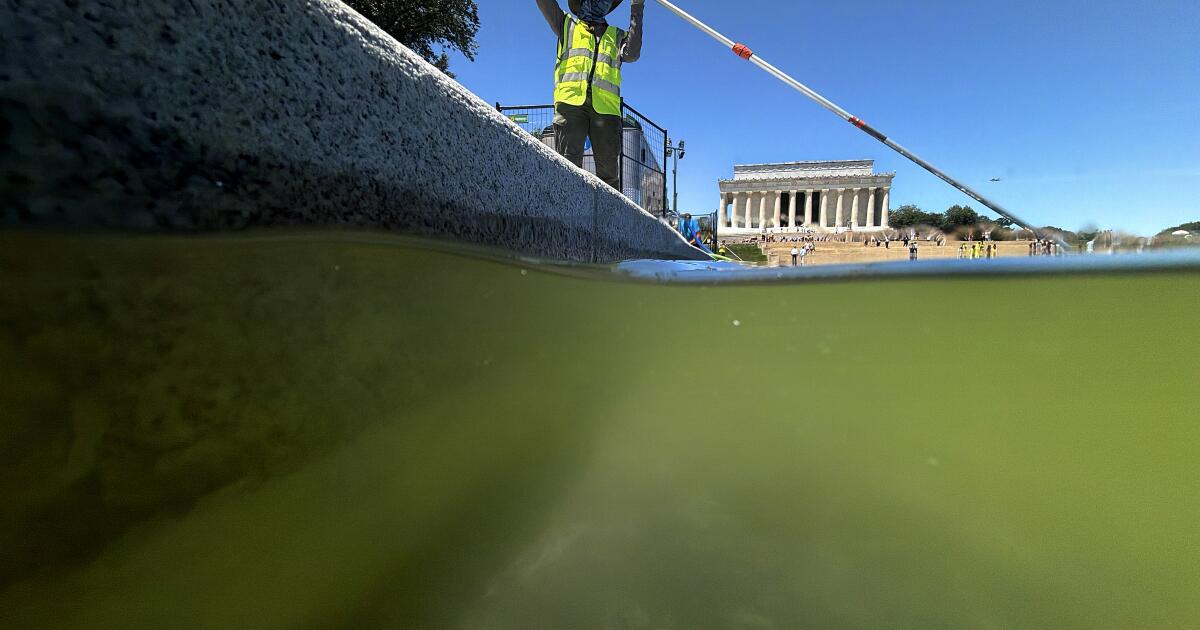
Just days after the Trump administration completed millions of dollars in renovations on the Lincoln Memorial Reflecting Pool to make it American flag-blue, residents and online users noted it had turned a phosphorescent green.
Here’s why:
The calm, still waters of the Reflecting Pool make it an ideal nursery for algae growth. Algae need nitrogen and phosphorus to grow, and the Reflecting Pool is primarily fed by the Potomac River, which gets heavy doses of those nutrients from nearby urban and agricultural lands.
The Potomac also absorbed one of the largest sewage spills in U.S. history earlier this year when a pipe burst five miles upstream of Washington, although that event probably happened too long ago to contribute to the algal bloom today.
Untreated sewage is high in nitrogen and phosphorus. When nutrient levels are high, feasting algae can quickly reproduce.
The Department of the Interior said when the algae first appeared that it was “residual,” from the supply lines to the pool.
Experts also speculate that the darker blue color may be helping the Reflecting Pool absorb more heat. The higher temperatures promote algae growth by allowing their metabolisms to shift into overdrive.
Summer temperatures in D.C. aren’t helping. This week, temperatures are as high as 95 degrees in the city, prompting a heat alert.
The combination probably explains the excessive growth, turning the water surface an opaque green and preventing onlookers from seeing the new blue hue of the concrete basin.
Algae are important and beneficial organisms when the ecosystem is in balance. They’re the base of the aquatic food chain, fed on by herbivores of all shapes and sizes, including shrimp and juvenile fish, which in turn feed organisms higher up the food chain. The single-celled organisms use the power of the sun to produce energy through photosynthesis, similar to houseplants on your balcony.
In an effort combat the algae in the Reflecting Pool, employees of the National Park Service were seen pouring in gallons of hydrogen peroxide, a chemical commonly used in pool maintenance.
The Department of the Interior also is employing a “high-tech nanobubble ozone technology” to destroy the cells of the algae.
Ozone — yes, the same irritant that is in smog — is a gas composed of three oxygen molecules, and the small size of the bubbles allow the most gas transfer into the water, where it can damage algal cells, similar to how it irritates our lungs.
This only treats the symptoms, however. Generally, ozone nanobubbling is effective as a temporary solution for algae blooms. Longer-term fixes would have to address what makes the Reflecting Pool so ideal for algae, such as its depth, darker color and inflow of nitrogen and phosphorus.
In California, ozone nanobubbles also have been used in a project to improve water quality in the Tijuana River. The 120-mile river that runs near the border in northern Mexico and Southern California was the site of a pilot study in 2025. The U.S. section of the International Boundary and Water Commission reported that the nanobubbling reduced “odors and bacteria,” but the project concluded prematurely after a flood swept some of the instrumentation into the river.

A plant extract that’s gaining popularity as a pain cure-all and has been associated with multiple California deaths in its concentrated, synthetic form has been approved for research as a treatment for opioid addiction by the federal government.
Kratom is derived from the leaves of Mitragyna speciosa, a tree native to Southeast Asia, and is commonly made into a powder or pill.
Researchers say people in the U.S. are using kratom to alleviate anxiety, treat chronic pain or as a remedy for the symptoms associated with quitting opioids, due to its ability to bind with opioid receptors in the body. But recently, public health officials have raised alarms about a component of the leaf called 7-hydroxymitragynine, also known as 7-OH, an alkaloid that has the potential for abuse and addiction in high doses.
Last year, the Los Angeles County Public Health Department linked the deaths of six county residents to the use of 7-OH mixed with other substances. The toxicology screens for some of the deceased revealed both kratom and 7-OH, leading to a countywide crackdown of products with either compound because they’re unregulated.
Although there is no scientific consensus on whether kratom has therapeutic value, the Food and Drug Administration has recommended that its potent 7-OH form be classified as a controlled substance. Consumers who use 7-OH as a pain reliever expecting an experience similar to consuming kratom are at risk, said Dr. Mason Turner, president-elect of the California Society of Addiction Medicine.
“I have a couple of patients that I work with who use 7-OH for chronic pain management, not realizing the potential of the medication, and then developed an opioid use disorder,” Turner said. “I think in that case it was very clear they were seeking it for the chronic pain, not to get high, not to have some kind of experience, but really to reduce their pain.”
About two decades ago, Turner said, the healthcare industry started acknowledging the limits and risks of prescribing opioids for chronic pain. Some doctors pulled back on prescriptions, recognizing the potential for abuse.
That led some patients to find alternative solutions, he said.
“Maybe they don’t get a good benefit, or maybe the benefit from some of the other treatments is not as robust as what they got from opioids,” Turner said. “So they seek out some of these illicit products … or they look for kratom or 7-OH to be able to mitigate the pain.”
Turner said he supports further research into kratom and regulation because “it could be worth exploring as a treatment for chronic pain.”
On June 1, the National Institutes of Health announced that researchers from the University of Florida would begin the first phase of clinical trials on kratom to evaluate it as a potential treatment for opioid addiction. The research would be done with the FDA’s approval, according to officials.
“This … is a major step toward expanding treatment options for the millions of Americans struggling with opioid use disorder, which has contributed to historically high overdose mortality rates,” said Dr. Nora Volkow, director of NIH’s National Institute on Drug Abuse, in a statement.
Interest in kratom surged in the last couple of years as users have reported consuming the compound in the form of a pill, powder or tea to treat various ailments. A John Hopkins survey conducted in 2020 reported that 91% of respondents used kratom to treat chronic pain, 67% to treat anxiety, 64% for depression and 41% to treat opioid dependence.
A more recent study by the University of Michigan and Texas State University found that more than 5 million people in the U.S., including more than 100,000 children ages 12 to 17, have used kratom, the compound experts say is growing in popularity with young adults.
In the study, which analyzed data from the National Survey on Drug Use and Health collected between 2021 and 2024, researchers say that despite numerous state-level bans on kratom across the nation, its use is at an all-time high and is increasing.
People between the ages of 21 and 34 said they used kratom at least once and 1% said they used it in the last year. The share of children ages 12 and older who said they had used kratom increased from 1.6% in 2021 to 1.9% in 2024.
The FDA has stated that neither kratom nor 7-OH are approved as drug products, dietary supplements or food additives, but that hasn’t stopped storefronts and companies from selling them as such.
Up until November you could find kratom and 7-OH products in smoke shops and specialty stores in California, but that has stopped.
“Until kratom and its pharmacologically active key ingredients mitragynine and 7-OH are approved for use, they will remain classified as adulterants in drugs, dietary supplements and foods,” the California Department of Public Health told The Times via email.
Kratom “Feel Free Classic” liquid products are displayed at a smoke shop in Los Angeles in 2024 before they were banned.
(Michael Blackshire / Los Angeles Times)
In May, the California Department of Public Health and Atty. Gen. Rob Bonta filed a complaint against Ashlynn Marketing Group Inc., accusing the company of repeatedly flouting the state’s regulations on kratom products.
The filing, submitted in the San Diego County Superior Court, seeks a judge’s order to condemn and destroy the embargoed kratom products, halt ongoing unlawful manufacturing and impose civil penalties.
The California Department of Public Health “is pursuing legal action because Ashlynn’s continued manufacture and sale of these products pose a clear and preventable public‑health risk and violates state and federal law,” said Dr. Erica Pan, the department’s director and state public health officer. “7-OH and kratom-derived products have been associated with addiction, serious health harms, overdose and death.”
The state is alleging its inspectors visited Ashlynn Marketing Group’s facility in Santee in May 2025 and found kratom powders, capsules, liquids and chewable tablets being manufactured and held for sale.
During the visit, inspectors issued an embargo to prohibit the sale and distribution of all kratom-related materials on-site, according to the complaint.
Public health inspectors conducted follow-up visits at the facility in October and April, “collecting evidence at both inspections that indicated embargoed kratom products had been moved, tampered with and repackaged,” according to public health officials.
“In addition, investigators observed evidence of continued manufacturing and distribution of kratom materials,” officials said. “The firm’s owner continues to manufacture kratom products and ships orders weekly.”
To date, the California Department of Public Health has seized more than $5 million worth of kratom and 7-OH products, a spokesperson for the department told The Times.
California and Los Angeles County are considering whether to tighten regulations or ban the compounds altogether.

NEW YORK — Scientists have unearthed communities of marine life — including jellyfish, tubeworms and brittle stars — thriving on a whale graveyard that is millions of years old.
These graveyards form when whale carcasses fall to the sea floor, becoming a sustaining snack for nearby critters. This one, located up to 23,000 feet below the surface of the southeastern Indian Ocean, spans the largest area and is so far the deepest and oldest found.
A whale’s sheer size and the unique chemistry of its bones are the keys to forming these unique underwater neighborhoods, said Xikun Song, a biologist with the Chinese Academy of Sciences’ Institute of Deep-sea Science and Engineering.
“At the same time, the very nature of the deep ocean makes these sites exceptionally difficult for scientists to locate,” Song, who was involved with the latest find, wrote in an email.
Researchers explored the remains during multiple deep-sea submersible trips in 2023, collecting samples and mapping the extent of the necropolis. They found five carcass sites and fossils, including skulls belonging to beaked and baleen whales. The oldest bones date back 5.3 million years.
Feeding and living on the carcasses were myriad creatures, large and small, including sea cucumbers, squat lobsters and saltwater clams. Many of them are likely species that have never been documented, according to findings published Wednesday in the journal Nature.
“The potential number of specimens is just astounding,” said paleontologist Stephen Godfrey with the Calvert Marine Museum in Maryland, who wasn’t involved in the research.
Many factors likely conspired to preserve the bones for millions of years, according to the study authors. They’re dense enough to outlast attacks from bone-eating worms, and located deep enough in the ocean to avoid getting buried by dust and loose particles. The bones also were coated with a light layer of minerals from the surrounding seawater, which may have prevented them from degrading.
Why did so many whales die here? Maybe they were already living in the area and died of natural causes. A few could have perished from exhaustion or illness caused by deep-sea diving. The area’s shape, akin to the letter V, could also have funneled the remains to their resting spot, the authors wrote.
Such discoveries are important because they clue scientists into the vibrant communities that find a way to live even in remote, hard-to-reach environments.
Studying the whale graveyards “is important for understanding how life can adapt to such extreme conditions, not only due to the lack of light and oxygen but also to the incredibly high pressure,” said study co-author and paleontologist Giovanni Bianucci with the University of Pisa in Italy in an email.
Ramakrishnan writes for The Associated Press.
The Associated Press Health and Science Department receives support from the Howard Hughes Medical Institute’s Department of Science Education and the Robert Wood Johnson Foundation.
-

 Los Angeles, Ca1 hour ago
Woman, man found shot to death in Pomona, suspect leads officers on erratic chase
-

 Detroit, MI1 hour ago
Today in History: June 20, race-related rioting erupts in Detroit
-

 San Francisco, CA2 hours ago
San Francisco hotels see steady World Cup business, but fall short of Super Bowl surge
-

 Dallas, TX2 hours ago
Dallas International Piano Competition brings finalists June 23
-

 Miami, FL2 hours ago
Where to watch San Francisco Giants vs Miami Marlins: TV channel, start time, streaming for June 20
-

 Boston, MA2 hours ago
Duck parades, outdoor drinking, and Gronk in a kilt. Here’s how Friday’s World Cup festivities unfolded. – The Boston Globe
-

 Denver, CO2 hours ago
Rockies ride Kyle Freeland’s gem, Braxton Fulford’s double to 4-3 win over Pirates
-

 Seattle, WA2 hours ago
Suarez’s no-hit try ends on Naylor double in seventh, but Boston still tops Seattle

