- U.S.-China trade tensions certain to dominate IMF, World Bank annual meetings
- Finance ministers, central bankers from more than 190 countries coming to Washington
- G7 to discuss sanctions on Russia, Ukraine aid options
Washington, D.C
Trump’s reignited trade war with China clouds IMF, World Bank meetings


WASHINGTON, Oct 13 (Reuters) – Finance chiefs gathering in Washington this week were ready to discuss the global economy’s surprising resilience in the face of Donald Trump’s tariff assaults – until the U.S.-China trade war erupted again with the U.S. president threatening 100% duties on Chinese imports and sending markets into a tailspin.
The annual meetings of the International Monetary Fund and World Bank are now certain to be dominated by questions over whether Trump’s vow to retaliate against China’s dramatically expanded export controls on rare earths will plunge the world’s two largest economies back into a full-blown trade war.
Sign up here.
A delicate truce crafted by Washington and Beijing over the past five months brought tariffs down from triple-digit levels and prompted upgrades to the IMF’s global growth outlook. Plans for Trump to meet with Chinese President Xi Jinping later this month fueled hopes for a further thaw.
But that optimism was shattered on Friday as Trump threatened to cancel the meeting and impose a “massive increase” in tariffs on Chinese goods, along with other countermeasures.
Souring the mood further was China’s move on Friday to match new U.S. port fees for Chinese-built or owned vessels with its own levies on port calls by ships built or flagged in the U.S. or owned by companies more than 25% owned by U.S.-domiciled investment funds.
The IMF and World Bank meetings will bring more than 10,000 people to Washington, including finance ministers and central bank governors from more than 190 countries.
Martin Muehleisen, a former IMF strategy chief who is now with the Atlantic Council, said Trump’s threats may be posturing for negotiating leverage, but said they will inject volatility into the week’s proceedings.
“Let’s hope that sanity prevails. If Trump goes back to 100% tariffs on Chinese goods, there’s going to be a lot of pain in the markets for him,” Muehleisen said.
Trump’s threat on Friday triggered the biggest U.S. stock sell-off in months at a time when investors and top policymakers were already growing anxious about a frothy stock market fueled by an investment boom in artificial intelligence that some officials fear could hurt future employment.
While China has some leverage over Trump due to its global dominance in rare earths, which are essential for tech manufacturing, Muehleisen said it is not in Beijing’s interest to plunge back into an environment of triple-digit tariffs.
It is unclear whether U.S. Treasury Secretary Scott Bessent, who has led U.S.-China trade talks, would meet with any Chinese officials this week in Washington. A Treasury spokesperson declined to comment on Bessent’s bilateral meetings schedule.
GROWTH FORECASTS HOLD UP
Prior to the escalation on Friday’s, IMF Managing Director Kristalina Georgieva had touted the global economy’s ability to withstand multiple shocks, from tariff costs and uncertainty to a slowing U.S. job market, rising debt levels and rapid shifts brought on by AI’s rapid adoption.
In a preview of the IMF’s World Economic Outlook forecasts due on Tuesday, Georgieva said last week that the global GDP growth rate for 2025 would be only slightly less than the 3.3% for 2024. Based on tariff rates that were lower than initially feared – including the U.S.-China duties – the IMF in July raised its 2025 GDP growth forecast by two-tenths of a percentage point to 3.0%.
“What we are seeing is demonstrable resilience in the world,” Georgieva told Reuters in an interview. “But we are also saying it is a time of exceptional uncertainty, and downside risks are still dominating the forecast. So watch it, don’t get too comfortable.”
G7 FOCUS ON RUSSIA
Finance ministers from the Group of Seven industrial democracies are expected to meet on Wednesday to discuss efforts to step up sanctions pressure on Russia that is aimed at ending Moscow’s war against Ukraine.
A British government source said that finance minister Rachel Reeves wanted to ensure joint action with G7 and European Union countries to cut Russia’s energy revenues and access to overseas assets that comply with international law.
Among these options that G7 ministers will discuss is a European Union plan to use Russian frozen sovereign assets to back a loan of 140 billion euros ($162 billion) to Ukraine.
BESSENT’S AGENDA FOR INSTITUTIONS
The U.S. footprint at the meetings will be large, extending from tariff discussions to Bessent’s calls for the IMF and World Bank to pull back from climate and gender issues to focus on their core missions of financial stability and development.
The meetings will be the public debut for Dan Katz, the IMF’s new No. 2 official. Member countries will be watching to see how Katz, a former investment banker who was Bessent’s chief of staff, carries out the U.S. Treasury chief’s agenda, which also calls for stronger IMF criticism of China’s state-led economic policies.
The U.S. Treasury’s market intervention on behalf of Argentina, the IMF’s largest borrower, also will take center stage at the meetings as Argentina’s right-wing libertarian President Javier Milei will join his ally Trump two blocks away at the White House on Tuesday. The move was welcomed by Georgieva to keep Argentina’s market-based reforms on track.
But Muehleisen, the former IMF official, said the Fund risks being pushed by its largest shareholder to enforce Trump’s geopolitical goals – ratcheting up pressure on China and potentially extending more aid to U.S. allies like Argentina without adequate reforms.
“Is it really still a global, multilateral organization, or is it becoming a bit more of an appendage of the U.S. Treasury?” he said. “This will be an interesting debate.”
Reporting by David Lawder; Additional reporting by Andrea Shalal and David Milliken; Editing by Dan Burns and Paul Simao
Our Standards: The Thomson Reuters Trust Principles.



WASHINGTON – Washington, D.C., mayoral candidate Kenyan McDuffie on Thursday conceded the Democratic primary race to Janeese Lewis George.
Although the official certification of the primary race is continuing, McDuffie said in a statement that “it is clear that the voters have chosen a different path.” The former member of the D.C. council said he had contacted Lewis George and congratulated her. He thanked his supporters and urged them to continue working for the city.
“The campaign may be over, but the work of building a safer, more affordable, more prosperous city continues.”
The Associated Press has not declared a winner in the race. Lewis George had a little less than 53% of the vote Thursday morning, which is just a few percentage points above the 50% threshold to avoid ranked choice voting.
The city is scheduled to release preliminary ranked choice voting results on Sunday. AP will call the race before then if it is clear that the ranked choice process will be avoided.
Lewis George has pledged to aggressively stand up to federal intervention into Washington, D.C.’s, affairs, setting up a potential showdown with President Donald Trump over his administration’s moves to challenge the city’s limited autonomy.
If the results stand, Lewis George is likely to win November’s general election in the heavily Democratic city. The winner in the general election will replace Muriel Bowser, who decided not to run again after three terms.
Lewis George would join Robert White Jr., who won the Democratic primary for the district’s delegate to Congress, as the top local officials who likely will contend with the federal government’s intentions for the city. They each campaigned on a promise to take a harder line than their predecessors against the Trump administration’s moves on the district, including its deployment of the National Guard on an ongoing, open-ended mission meant to fight crime.
“As mayor, I will work with anyone who makes D.C. safer,” Lewis George told a crowd of cheering supporters Tuesday night, “but I will also stand up to Trump.”
Washington has limited autonomy and federal leaders retain significant control over local affairs, including approval of the budget and laws passed by the D.C. Council.
Trump further encroached on that autonomy last year when he briefly federalized the city’s police force and deployed an ongoing law enforcement surge that included the National Guard. His efforts to downsize the federal government also roiled the capital region, costing thousands of people their jobs. And he has been reshaping the city by renovating storied landmarks and putting his name or image on buildings.
Lewis George, a self-described democratic socialist and a member of the D.C. Council, has already come under fire from Trump, who last week threatened to place the city under federal control if she won.
“Maybe we’d take back Washington, run it on the federal basis,” he said.
Lewis George, 38, and a third generation Washingtonian, has vowed to overrule an executive order by the city’s police chief permitting local law enforcement to cooperate with Immigration and Customs Enforcement agents. Lewis George argued the order “hurt the trust of our community.”
She also pledged to use any levers available to her through the city’s home rule compact to resist what she called authoritarian infringements on the district’s local governance.
“We have legal tools we can use to fight back,” she told the AP in an interview before the vote. “And we know that when we have gone to court, we’ve won.”
Bowser found herself walking a fine line between staying in Trump’s good graces and responding to the concerns of constituents, many of whom said she didn’t push back hard enough on Trump’s actions. Eleanor Holmes Norton, the 18-term, 89-year-old delegate to Congress, meanwhile, faced mounting concern from critics who said she wasn’t forcefully pushing back on the Trump administration’s moves against the city.
Copyright 2026 The Associated Press. All rights reserved. This material may not be published, broadcast, rewritten or redistributed without permission.
Darren Lyn
18 June 2026•Update: 18 June 2026
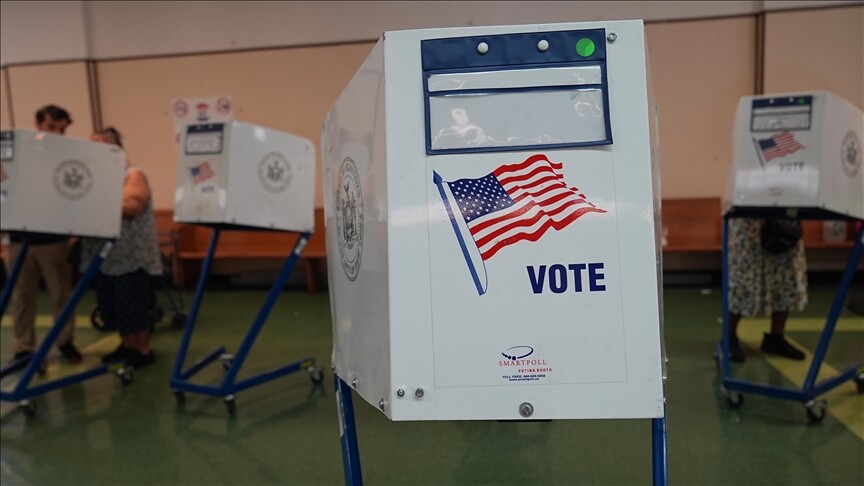
Democratic socialist Janeese Lewis George currently leads the vote tally as of Wednesday versus six other candidates in the Washington, DC Democratic mayoral primary, and if victorious, could be following in the footsteps of the most notable democratic socialist in the United States — New York Mayor Zohran Mamdani.
With 73% of the ballots counted since Tuesday’s primary election in the nation’s capital, the Associated Press (AP) has Lewis George leading with 52.9% of the vote. Her closest challenger is Kenyan McDuffie, who currently holds 36.5%.
The mayor’s office in the District of Columbia has traditionally been a Democratic stronghold, and political experts have said that any Republican challenger is not expected to put up meaningful competition for the mayor’s seat in the general election.
If Lewis George keeps her current lead and wins the majority, she will head to the November election as the favorite to replace three-term Mayor Muriel Bowser, who decided not to run for a fourth term.
A victory for Lewis George would be to the ire of US President Donald Trump, who told reporters that he could attempt a federal takeover of Washington if she won the mayor’s race, according to local media reports.
“We won’t put up with it,” Trump told reporters at a news conference.
Yet Trump has already seen a democratic socialist take power in America’s largest city, with the election of Mamdani as mayor of New York City.
Not to be outdone, the race for the mayor’s office in Los Angeles, California — the second largest city in the US by population — has a democratic socialist, Nithya Raman, in the runoff to vie for the position in November’s general election. Raman will face incumbent Democratic Mayor Karen Bass, who narrowly edged out Raman in the primary 34.3% to 29.0%.
In California’s 14th congressional district, two candidates will head to a runoff election to replace former US Rep. Eric Swalwell, who resigned from Congress in April amid allegations of sexual assault, including rape.
Aisha Wahab secured the first runoff spot on Tuesday with 38.3% of the vote, with the AP on Wednesday calling the second position to go to Melissa Hernandez, who tallied 17.2%.
The runoff election will be held on Aug. 18, with the winner finishing out the rest of Swalwell’s term.

At time of writing, the Associated Press estimates that around 64% of votes have been counted. Races where no candidate wins a majority of first choices will proceed to a ranked choice voting count – most likely the at-large Council and Ward 1 Democratic primaries. With RCV, all nominees will have support from a majority of their party – as will the winner in an at-large Council special election.
Mayor
In the closely watched mayoral race, Councilmember Janeese Lewis George leads with 52.8% of voters’ first choices, followed by former Councilmember Kenyan McDuffie at 36.6%. If Lewis George remains above 50% as the remaining votes are counted, a ranked choice tabulation will not be necessary to determine the winner.
Congressional delegate
Five candidates ran in the Democratic primary to succeed retiring Delegate Eleanor Holmes Norton. Councilmember Robert White won that election with 63.2% of first choices. Councilmember Brooke Pinto came in second with 21.5% of first choices.
At-large Council Democratic primary
Nine candidates ran for the Democratic nomination to succeed at-large Councilmember Anita Bonds. No candidate has won a majority of first choices. Oye Owolewa leads with 33.8%, followed by Lisa Raymond at 15.2% and Kevin Chavous at 13.8%. The result will likely be determined by a ranked choice voting count.
| Candidate | Share of first choices |
| Oye Owolewa | 33.8% |
| Lisa Raymond | 15.2% |
| Kevin B Chavous | 13.8% |
| Greg Jackson | 11.0% |
| Candace Tiana Nelson | 7.7% |
| Dwight Davis | 6.0% |
| Fred Hill | 5.4% |
| Dyana N. M. Forester | 3.7% |
| Leniqua’dominique Jenkins | 3.0% |
| Write-in | 0.4% |
In a choose-one election, Owolewa would have won the nomination despite 66% of voters voting for another candidate. In 2022, for instance, Councilmember Anita Bonds won the Democratic primary for this seat with only 36% of first choices. Now, ranked choice voting will ensure the nominee – whether Owolewa or someone else – has majority support.
At-large Council special election
In the special election for at-large Council, former Councilmember Elissa Silverman is leading with 54.8% of first choices, followed by appointed Councilmember Doni Crawford and Board of Education President Jacque Patterson, with 25% and 19% respectively. If Silverman maintains a majority of first choices, there will be no ranked choice tabulation.
Ward 1
In the competitive Democratic primary for Ward 1 councilmember, Aparna Raj leads with 47% of first choices. Depending on remaining ballots, Raj may win with a majority of first choices, or the winner may be determined by a ranked choice voting count.
Candidate
Share of first choices
Aparna Raj
46.7%
Michael Trindade Deramo
20.3%
Rashida Brown
17.2%
Jackie Reyes Yanes
10.0%
Terry Lynch
5.8%
Write-in
0.1%
Notably, in three Council races – the at-large Council Democratic primary, at-large Council special election, and Ward 1 Democratic primary – candidates cross-endorsed each other, asking voters to rank each other on their ballots. Past elections show that voters often listen to cross-endorsements by candidates they support, so it’s possible candidates who cross-endorsed will benefit when their races go to RCV tallies.
DC’s ranked choice voting elections offer a sharp contrast with the District’s recent past, in which candidates regularly won key primaries without majority support. Since 2012, every districtwide office and six of the eight wards have seen Democratic primaries won with less than 50% of the vote. Since 2020, Ward 2 and Ward 7 have had Democratic Council primaries won with less than 30% of the vote.
FairVote will post more analysis of the DC election over the coming week. In the meantime, visit Grow Democracy DC to learn more about RCV in DC.
-

 Oklahoma5 minutes ago
Oklahoma Adds OF Adi Hansen From Southern Idaho
-

 Oregon12 minutes ago
Oregon man sentenced to 77 months in prison after pleading guilty to attempted kidnapping
-

 Pennsylvania15 minutes ago
Pennsylvania lawmakers push for data center regulations as development accelerates
-

 Rhode Island20 minutes ago
Rhode Island Pride marks 50th year as early marcher recalls Providence’s first parade
-

 South-Carolina27 minutes ago
South Carolina family raises awareness of rare Batten disease
-

 South Dakota30 minutes ago
South Dakota man whose life sentence was commuted by Noem now implicated in his niece’s death
-

 Tennessee42 minutes ago
8 Biggest Winners, 4 Losers from Tennessee Titans’ Minicamp
-

 Texas45 minutes ago
Sweep in the heart of Texas: Twins beat Rangers again

