Lifestyle
Peru: Chicha, the electric pulse of cumbia

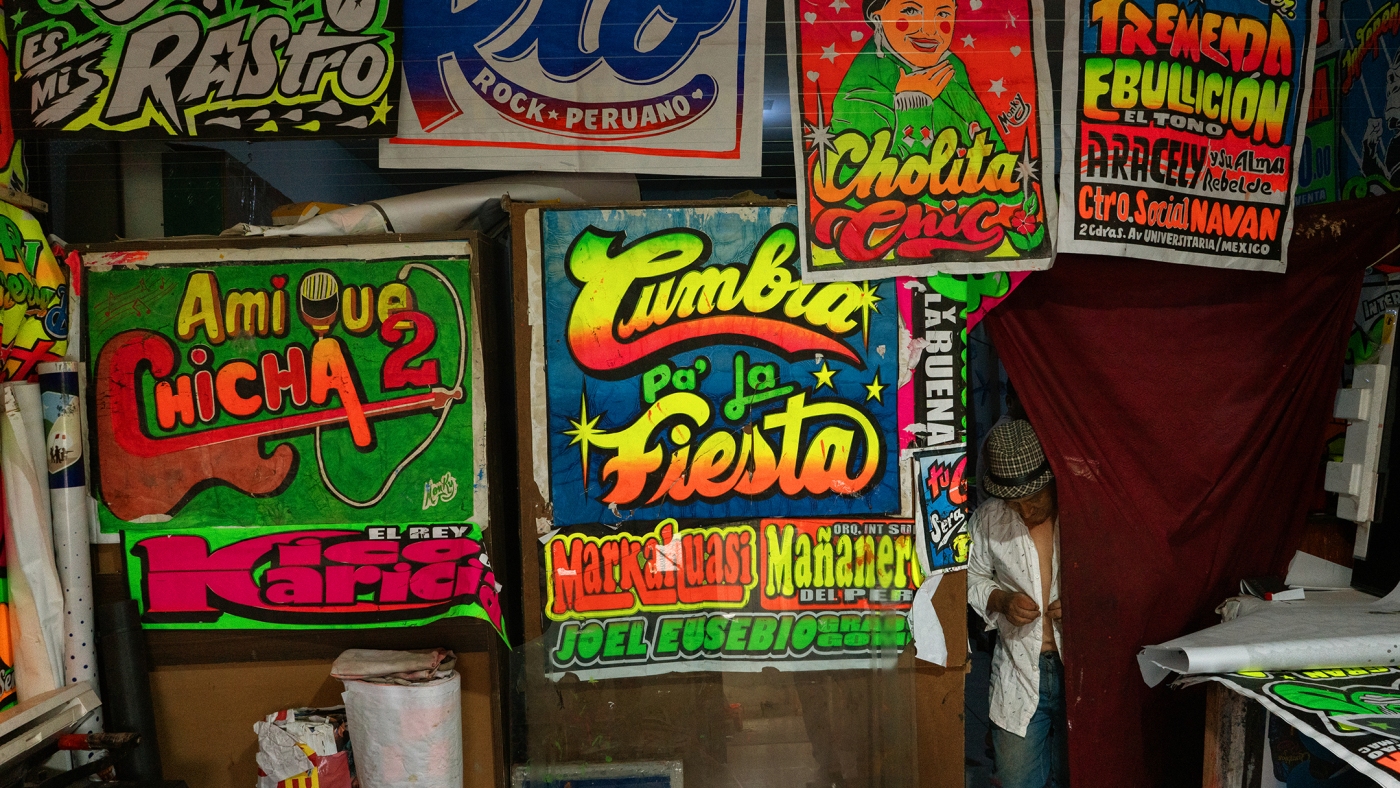
Pedro Tolomeo Rojas, known as Monky, enters his studio in Lima on Oct. 21, 2024. Monky was a pioneer in the making of the posters that publicize cumbia concerts and are now considered chicha art. His posters still cover Lima and cities beyond, advertising upcoming concerts.
Ivan Kashinsky
hide caption
toggle caption
Ivan Kashinsky
This is part of a special series, Cumbia Across Latin America, a visual report across six countries developed over several years, covering the people, places and cultures that keep this music genre alive.
The people of Peru have many definitions for the word chicha: a sacred fermented corn drink, popular culture, popular art and, of course, Peruvian cumbia. It has also been used as a derogatory term, mocking immigrant culture in Lima during the mass migrations of Indigenous Andean people to Lima in the 20th century. When it comes to music, the term has become extremely controversial.

High school students dance folkloric music, such as huayno, in the Plaza de Armas in Cusco, Peru, on Nov. 3, 2024.
Ivan Kashinsky
hide caption
toggle caption
Ivan Kashinsky

Women gather after a celebration for the 137th anniversary for the city of Sicuani, Peru, on Nov. 4, 2024. Armonía 10, a Peruvian orchestra that plays cumbia and was originally founded in 1972, played in Sicuani that night.
Ivan Kashinsky
hide caption
toggle caption
Ivan Kashinsky

Berardo Hernández Jr., known as Manzanita Jr., holds his guitar in his kitchen in Lima, Peru, on Nov. 2, 2024. Hernández’s father, Manzanita, is known for having a part in creating chicha’s sound.
Ivan Kashinsky
hide caption
toggle caption
Ivan Kashinsky
In a small peña, or neighborhood club, in Lima, two legends — Berardo Hernandez Jr., the son of Manzanita, and Pancho Acosta, of Compay Quinto — filled the venue with intricate and melodic electric guitar sounds, soloing at a rapid pace, using their fingers instead of picks. Fans smiled and danced, soaking in the magical sonic experience. Acosta, Manzanita and Enrique Delgado, of Los Destellos, all had a part in creating the chicha genre, which emphasized electric guitar and was uniquely Peruvian.
Berardo, known as Manzanita Jr., aligns with the theory that all Peruvian cumbia can be considered chicha. Pancho, on the other hand, insists that chicha is specifically Tropical Andina, a sub-genre that mixes Colombian cumbia with Andean folkloric music, known as huayno. Alfredo Villar, an author and art historian, says chicha “is the most complex moment of Peruvian identity, because it mixes everything — from its deepest roots to its most extreme and complex external influences. This is why it is so difficult to define … Chicha will always surprise you.”

People drink chicha in Calca, Peru, on Nov. 6, 2024. A fermented corn drink, chicha was sacred to the Indigenous of the region before it became a term to describe Peruvian cumbia.
Ivan Kashinsky
hide caption
toggle caption
Ivan Kashinsky

A woman stands next to an “Inca cuy” in Lamay, Peru, on Nov. 6, 2024. Like chica, the fermented corn drink, cuyes, or guinea pigs, were sacred to the Indigenous of the region.
Ivan Kashinsky
hide caption
toggle caption
Ivan Kashinsky

Helner Misael Sánchez Casanova, known as Tacto, a member of Los Wembler’s de Iquitos, plays a bombo in his house in Iquitos, Peru, on Oct. 26, 2024. Los Wembler’s was founded in 1968 and was one of the first to play a new sub-genre of Peruvian cumbia, known a cumbia Amazonica. The band mixed Colombian cumbia with Amazonian rhythms, psychedelic electric guitar, animal sounds from the jungle and other styles of music to create a unique genre.
Ivan Kashinsky
hide caption
toggle caption
Ivan Kashinsky

A view of the barrio of Belén seen from the city of Iquitos, Peru, on Oct. 26, 2024.
Ivan Kashinsky
hide caption
toggle caption
Ivan Kashinsky
The inconceivable mix of Colombian cumbia, Cuban guaracha, Andean huayno and psychedelic rock, as well as countless other genres, including jazz and bossa nova, that melted together in Lima at the end of the 1960s created a truly delicious sound. Chicha peaked in the ’80s as Lorenzo Palacios Quispe, known as Chacalón or El Faraón de la Cumbia, and Los Shapis, an Andean band from Huancayo, brought chicha to the masses.

Art by José “Ashuco” Araujo, a Amazonian chicha artist, covers the walls of El Refugio, a bar in Iquitos, Peru, that’s known for live cumbia as and couples dance and talk on Oct. 26, 2024.
Ivan Kashinsky
hide caption
toggle caption
Ivan Kashinsky

Alfredo Villar Luquin, a writer who has immersed himself in the world of chicha, puts his hand over a painting of Chacalón in his house on Nov. 11, 2024. The painting is by Pedro Tolomeo Rojas, the pioneering chicha artist better known by “Monky.” Lorenzo Palacios Quispe, known as Chacalón, brought chicha to the masses in Lima.
Ivan Kashinsky
hide caption
toggle caption
Ivan Kashinsky

Fans of Armonía 10 watch as the band plays at the 137th anniversary celebration for the city of Sicuani, Peru, on Nov. 4, 2024. A Peruvian orchestra that plays cumbia, Armonía 10 was originally founded in 1972.
Ivan Kashinsky
hide caption
toggle caption
Ivan Kashinsky
Chacalón, who was the son of migrant parents and grew up in a barrio on the cerro of San Cosme, working odd jobs, became a megastar among marginalized migrants in the capital. Thousands would come down from the barrios on the mountains above Lima to see him sing from the heart about the struggles of daily life and the migrant experience, giving birth to the saying, “When Chacolón sings, the mountains come down.” Los Shapis made history in 1983 when they filled a stadium in Lima, demonstrating the power of chicha and the new Andean residents of Lima. Chacalón died at the age of 44; 60,000 people attended his funeral. Los Shapis would go on to tour the world.

Estella Gonzalez, a member of Son Estrella, sings on the streets of Iquitos on Oct. 27, 2024, to promote the band.
Ivan Kashinsky
hide caption
toggle caption
Ivan Kashinsky

Jose Luis Mendoza Zapata, bongo player, and Leandro Lozada, singer of Armonía 10, pose for a photo in their hotel room before a concert in Sicuani, Peru, on Nov. 4, 2024.
Ivan Kashinsky
hide caption
toggle caption
Ivan Kashinsky

Pancho Acosta, of Compay Quinto, poses for a photo with his guitar in his home in Lima, Peru, on Nov. 2, 2024.
Ivan Kashinsky
hide caption
toggle caption
Ivan Kashinsky
Last November, in Lima’s cemetery of El Sauce, throngs of people crowded around graves bringing food and drink to the deceased during Dia de Todos los Santos, or All Saints’ Day. As the light began to fade over the desert mountains surrounding the capital, four saxophonists played huayno music from Huancayo. The sound echoed off the walls of graves as families danced and drank beer. Chacolón could be heard from the speakers of a street vendor, and a family played Los Shapis on portable speakers while visiting their loved ones. Forty years later, chicha was still very alive in the Peruvian capital.

People sell flowers outside of a cemetery as motorcycles drive by in the Iquitos, Peru, on Oct. 28, 2024.
Ivan Kashinsky
hide caption
toggle caption
Ivan Kashinsky

Helner Misael Sánchez Casanova, known as Tacto, a member of Los Wembler’s de Iquitos, visits the grave of his father, Salomon Sánchez Saavedra, at Lima’s cemetery of El Sauce on Oct. 28, 2024. Salomon founded the band with his five sons in 1968.
Ivan Kashinsky
hide caption
toggle caption
Ivan Kashinsky

Four saxophonists from Huancayo, Peru, play huayno music as a family dances while they visit their deceased loved ones on Día de Todos los Santos, or All Saints’ Day, in Lima’s cemetery of El Sauce on Nov. 1, 2024.
Ivan Kashinsky
hide caption
toggle caption
Ivan Kashinsky
This coverage was made with the support of the National Geographic Explorer program.
Ivan Kashinsky is a photojournalist based in Los Angeles. You can see more of his work on his website, IvanKphoto.com, or on Instagram, at @ivankphoto.


Paul Tremblay has made a career of pushing the horror genre – and the novel format – in strange and exciting new directions.
In his latest, Dead but Dreaming of Electric Sheep, the author offers an amalgamation of genre elements that can be best described as psychological-dystopian-science-fiction horror. It’s a mouthful, but the narrative does all of that and more in a way that defies categorization.
Julia Flang is a former semiprofessional gamer working two mediocre jobs she dislikes and living in a modest ranch house in a San Fernando Valley suburb with her retired uncle, whom she calls Uncle Fun. Julia likes movies and gaming but there’s little else going on in her life, so when her estranged mother, the CFO of a large tech company, contacts her with a possible job offer – a “once-in-a-lifetime thing” that pays handsomely just for doing the interview – she hesitantly agrees.

The job is relatively simple and perfect for someone with gaming skills: using a controller built into a phone to get a man, who is stuck in a vegetative state, from California to the East Coast. It will require her to learn how to control his body – walking, moving, sitting, standing, using his arms – so she can maneuver him out of the facility where he is located and into cars and planes and through crowded airports. A fan of movies, Julia decides to call the man Bernie – after the movie Weekend at Bernie’s. When the ethics of the job start to bother her, Julia realizes it’s too late and she must go through with it. However, she’s soon contacted by people interested in sabotaging the whole thing, people who, like her, don’t align with the shady interests of conglomerates and those set to make “gobs of money” from this new, somewhat inhuman technology.

As with every Tremblay novel, any synopsis barely scratches the surface. The novel’s chapters alternate between Julia and you (yes, you). Julia’s chapters are “normal” in the sense that they obey a chronological order and have action, basic descriptions of movement and places, and dialogue. The chapters in second person are like fever dreams from a shadow world; the desperate experiences of a man trapped inside his own body with no control of it, no clue what’s happening to him, and only a few fragmented memories of his life. Also, Tremblay uses a similarly fragmented style of storytelling (including words and sentences trapped in boxes and/or “moving” on the page) to keep things interesting but also confusing and creepy.
This novel operates on several different levels and – planes of existence? Bernie has a head full of AI that controls his body, but his consciousness is still there and struggling to regain control, struggling to remember things. There are monsters, leeches, mysterious rabbits, and eerie shadows in his world, but the true horror comes from the lack of control, from being moved around against his will and having no clue what comes next. Bernie is the embodiment of losing control to AI, and when taken together with the commentary of creativity and AI and the meta interludes in which the author takes a wrecking ball to the fourth wall and addresses readers, this is the best anti-Generative AI story horror has produced so far.
Despite the horror of it, this is a very funny novel. Julia is sarcastic and struggles to keep her comebacks in line, but the conversations she has and messages she writes are always entertaining. However, the humor is far from the crown jewel here. That title belongs to a plethora of big ideas Tremblay juggles. The nature of life, death, and consciousness, the evils of conglomerates, inhuman practices in the name of capitalism, and AI, and even what it means to be human are all explored here: “Is Bernie alive? Is he feeling pain? Is he experiencing everything as a prisoner looking through the bars of his body? Has his consciousness been winnowed to a metaphysical keyhole? Where does consciousness begin or end?” There are no definite answers here, but the way Tremblay infuses humanity, love, the importance of relationships, and humor throughout the narrative provides the kind of answers that can’t and don’t need to be spelled out.
A genre-bender full of big ideas that constantly switches between a world full of real or uncomfortably plausible nightmares and a bizarre hellscape in which loss of self, memory, and autonomy are only the tip of the proverbial iceberg, Dead but Dreaming of Electric Sheep is a horrific and terrifyingly disorienting novel that invites readers to consider a future that already started. Tremblay has always been an innovator, but this beautifully written collection of real and imagined grotesqueries cements him not only as one of the most original and exciting voices in horror but also as one of the smartest, most engaging authors in contemporary fiction.
Gabino Iglesias is an author, book reviewer and professor living in Austin, Texas. Find him on X, formerly Twitter, at @Gabino_Iglesias.


Give a girl a bow and arrow, take her to the woods, and anything feels possible.
That’s what I was thinking as I positioned myself in front of bales of hay in an open field at the Woodley Park Archery Range in Van Nuys. Channeling my inner Katniss, I took a “power stance:” shoulders back, legs slightly bent, bow cradled in my upper body. I slid a small but fierce-looking arrow bearing orange feathers onto the bow “nock,” filled my lungs with air, then heaved the tense bowstrings back to my jaw, one eye closed and the other narrowed in concentration.
Then I did what often feels impossible for me: I let go.
-
Share via
The arrow hurdled forward, unleashing an audible woosh followed by a distant thwack. I missed my target entirely, stabbing the hunk of hay more than a foot away from the bull’s-eye. But the feeling of release as the bowstrings were left vibrating in my arms was palpable, intensely satisfying.
This was Mindful Archery.

Angie Fadel, founder of Soulcare, leads Mindful Archery.
(Eric Thayer / Los Angeles Times)
The seemingly militaristic act of archery and peaceful meditation may seem diametrically opposed. But at Angie Fadel Soulcare, they make perfect sense together. Fadel leads workshops in Mindful Archery that combine meditation, somatic practices such as breathwork, immersive nature therapy and archery instruction.
The idea, Fadel says, is for participants to gather in a healing nature setting while becoming mindful of something they want to either let go of (an unfulfilling job or toxic relationship, for example) or something they’re aiming for and want to bring into their lives. Fadel leads a short guided meditation at the start of the workshop for participants to relax and get grounded, followed by a nature walk so they can further sink into the moment and become clear on what, exactly, their targets will be for the day — what they’ll be shooting for, or at. Then participants draw their individual targets on paper with colored markers that Fadel provides.

Attendees hold up their targets during a Mindful Archery class.
(Eric Thayer / Los Angeles Times)
One target might look like an abstract drawing representing a feeling, another might be a jumble of words and symbols such as “Love,” “$” and “Health.” Or an illustration of Donald Trump, as one past archer aimed for.
“I’ve seen everything,” Fadel says. “People have put their parents, their exes, people have put rapists — the most damaging things that have happened to them — on a target because if you can hit that thing, it feels better in your body. The same thing happens when you hit something good, it’s a hopeful mechanism in the body.”
Fadel’s archery instruction is as much about how the sport feels in the body as it is about technical precision. The slow and steady, intentional steps of deep breathing, taking aim and shooting at a carefully considered target is a powerful act, she says.
“Even if the arrow doesn’t go where you want, there’s this immediate thing that happens in your body that feels good,” Fadel says. “When you let go of that string, there’s an energy, there’s a movement — actual, physical energy moves. Something magical happens. It helps the things that are stuck in the body get unstuck. It’s somatic. Then it’s an extra bonus if you do hit your target, because the slap of the paper feels even better.”

Angie Fadel readies bows.
(Eric Thayer / Los Angeles Times)
Fadel, who lives in Portland, Ore., and calls herself “a soul-collaborator,” has a masters in spiritual companionship and spent a decade working as a pastor in a Portland church helping members find untraditional spiritual paths. She’s also been an archer for more than 15 years. She came to both practices — spiritual companionship and archery — separately before they organically entwined. Midway through pursuing her master’s in 2011 she discovered a friend was a master archer. She’d always wanted to learn archery, since she was a kid growing up in rural Washington, and she persuaded him to give her a lesson.
“It was just one lesson, but it changed my life,” Fadel says. “I was doing something that I’d always dreamed of doing. It unlocked something I didn’t realize could be unlocked.”

Targets pinned to a hay bale allow participants to take aim at what they want to bring into their lives.
(Eric Thayer / Los Angeles Times)
Fadel found archery increasingly therapeutic. She was doing a lot of introspective Jungian journaling at the time. As life challenges came up in her journaling — the stress of school or a difficult roommate, “or just society as a whole,” she says — she’d put them on targets in the form of words. Shooting at them helped her process the conflict. She thought the beneficial side effects of archery were particular to her, however. Then she took a struggling friend out for her first archery lesson and the response was profound.
“I realized, you know what? This works. I can take you from never touching a bow to your leaving with your nervous system relaxed. I thought: I have to figure out how to give this to other people.”
Now with Soulcare, Fadel conducts multiple types of archery workshops in Portland and around the country, including in Colorado, Texas and throughout California. She comes to Los Angeles to lead workshops several times a year. One workshop is a Mindful Archery class, not to be confused with her other course Meditative Archery, which involves Jungian journaling; and there’s a one-on-one archery session with spiritual guidance.
Empowering women and minorities, Fadel says, is a key part of her archery workshops.
“An archery range can be a very white, male-dominated space,” she says. “And the stance, with a bow and arrow in your hand, shooting — it’s very male. And [men] don’t have any problem, most of the time, taking up space. So it is a practice to remind ourselves, as a queer woman, a trans person, nonbinary person, anybody that’s kind of othered in our society, to be able to take up space. To adopt a power stance and be, like, I’m allowed to be here.”
Inside the Mindful Archery workshop
Our workshop began with gentle stretching in an open field. It was a cool, overcast day and as the wind rustled the tree leaves, a baby coyote raced across the lawn in the distance. During introductions, attendees shared why they were here.

Archery is about “letting go” and here, a student lets her arrow fly.
(Eric Thayer / Los Angeles Times)
“I’m actually a very anxious person,” said Rachel Clipper, 26, “so I’m always looking for something to help me feel more grounded and promote mind-body connection.”
Kati Lee, 29, said that as a “‘Hunger Games’ girlie,” she’d always thought archery was cool. “But what drew me to keep coming back was the mindful part of it,” she said. “My favorite part is that we make our own targets.”
During the nature walk, we ambled down a tangle of dirt trails as Fadel pointed out wild rose bushes, Aspen trees and elderberry, giving a recipe for syrup. When we came to a body of water in a clearing — the Woodley Park Wetlands — we watched as a majestic-looking cormorant stretched its wings in the distance.
“Think about what would feel good to either annihilate,” Fadel said as we returned to the range. “Or bring in, or let go of, or make peace with. You can put all of it on your target.”
And so we did. We hunkered down at a picnic table by the archery range for crafting and snacks that Fadel provided, every one of us falling into silent sketching and scribbling as we munched on peanuts and granola bars. It felt like summer camp.
Lee set her markers down. “Done,” she said, contemplating her target. It was adorned with words such as “Health,” “Love,” “Family” and “Friends” inside concentric hearts.
Yvonne Golomb, 70, said she’d done archery as a high school student in gym class. She was shy back then, but archery had made her feel bold. Now that she’s retired, she’s craving that feeling again and is returning to the sport for sustenance.
“It’s this nice memory, it made me feel strong, it was freeing,” she said. “Now that I’m retired I’m exploring it. I wanted to bring back those memories.”
When it was time for our archery lesson, Fadel conducted one last somatic exercise to loosen us up. She had us tap up and down our body parts, from our feet to our ears, before shaking out any remaining stress.
Then she coached us, individually, as we took aim at our targets in sets of three.
“Breathe, zero in on your target, OK, now smooth …,” she said, hovering over one attendee.
May Claire La Plante, 31, said she was doing archery today, in an “adaptive stance” Fadel had taught her, to build up her arm strength after a surgery.

Kati Lee, right, and Tristan Gonzales affix their targets during a Mindful Archery class.
(Eric Thayer / Los Angeles Times)
“I was feeling very frustrated that I couldn’t get it at the beginning,” La Plante said. “I didn’t even finish my arrows. But getting back up and the act of trying again — despite the injury and all the baggage that comes with it — is really empowering.”
“Bull’s-eye!” Clipper cheered nearby, her anxiety seemingly dissipated. She’d hit her target, dead center. What was on it? A labyrinth-like spiral of words with “Peace,” “Love” and “Creative Control” at the epicenter.
I wasn’t having as much luck and was missing my target repeatedly.
“Try loosening your grip,” Fadel coached. She adjusted my stance. “Now breathe.”
It seemed counterintuitive to slacken my grip given such a precise goal — to land a slender arrow in the epicenter of a black dot. But I did, letting the edge of the bow sit loosely, even wobbly, between my fingers. I took aim and shot. This time the arrow flew strong and straight.

One participant hit the bull’s-eye, which calls for “peace” and “love,” dead center.
(Eric Thayer / Los Angeles Times)
Another round later and it landed smack on the paper target, just above my bull’s-eye.
“See?” Fadel said, elated. “Archery isn’t about doing it right, it’s about repetition. The more you can be in your body, and relaxed with the repetition, the better you are. Rarely do I have someone not hit their target at least one time.”
She squinted at my target, then turned to me.
“It’s because they’re relaxed and it’s because they trust me,” she added. “And they learn to trust themselves more.”

-

 Cleveland, OH4 minutes ago
Wide spread power outages plaguing Cleveland
-

 Austin, TX7 minutes ago
Three of Texas’ 10 Most Wanted Sex Offenders arrested in Houston, Plano, and Hidalgo
-
 Alabama12 minutes ago
Former Alabama wide receiver on pace to go from good to ‘truly elite’ in the upcoming NFL season
-

 Alaska19 minutes ago
Alaska moves to award $350M contract to replace 62-year-old Tustumena ferry
-

 Arizona22 minutes ago
What areas are affected by the Pocket Fire near Oak Creek Canyon?
-

 Arkansas27 minutes ago
Northwest Arkansas-based Community Clinic aims to acquire multiple Baptist Health-Fort Smith clinics | River Valley Democrat-Gazette
-

 California34 minutes ago
Billionaire tax measure heads to California’s November ballot, with Kern County watching
-

 Colorado37 minutes ago
Smokey skies and critical fire danger conditions continue in southern Colorado

