Science
Commentary: A candid take on mortality and the power of friendship

They gather several times a week in the parking lot of a Vons supermarket in Mar Vista, and no subject is off-limits. Not even the grim medical prognosis for 70-year-old David Mays, one of the founding members of the coffee klatch.
“It’s one of our major topics of conversation,” said Paul Morgan, 45, a klatch regular.
Mays is a cancer survivor with a full package of maladies, including diabetes, a faltering heart and failing kidneys. But since I met him almost two years ago, he has told me repeatedly that he doesn’t want dialysis treatment, even though it might extend his life.
“I get it, because it’s a lot of hours out of your day,” said Morgan, a schoolteacher who lives nearby. “People think you go in for dialysis for 15 minutes before you go straight to work. But really, it’s a part-time job.”
Steve Lopez
Steve Lopez is a California native who has been a Los Angeles Times columnist since 2001. He has won more than a dozen national journalism awards and is a four-time Pulitzer finalist.
His treatment would require that he visit a dialysis center three times a week, for four hours each time, Mays said.
“For the rest of my life.”
“I don’t think I could do it,” said klatcher Kit Bradley, 70, who lives in a van near the supermarket with his dog, Lea.
I met Mays in October 2023, when he was living in his Chevy Malibu in a downtown garage that was part of the Safe Parking L.A. program. Mays later moved into an apartment in East Hollywood and still lives there, but his health has continued to deteriorate.
“He is Stage 5,” said Dr. Thet Thet Aung, Mays’ nephrologist at Kaiser Permanente West Los Angeles.

David Mays, center, enjoys a morning get-together with Paul Morgan, left, and Kit Bradley in a Vons parking lot in West Los Angeles on June 25, 2025.
(Genaro Molina / Los Angeles Times)
For such patients, Aung said, death can be imminent. She told me she’s had many conversations with Mays about his treatment options, including dialysis in a clinic or self-administered at home. But not everyone does well on dialysis, she added, and when a patient makes an informed choice, “we respect their wishes.”
Mays has a refreshingly healthy attitude about mortality. Multibillion-dollar industries cater to those who want to look younger and live longer, and about 25% of Medicare’s massive outlay is spent on patients in the last year of life, many of whom choose life-extending medical procedures.
Mays, in the time I’ve known him, has been realistic rather than fatalistic. He has told me he doesn’t think bravery, faith or spirituality has anything to do with his desire to let nature take its course.
“It transcends those things,” he said.
He’s at peace with his fate, he explained, because he’s got friends, love and support.
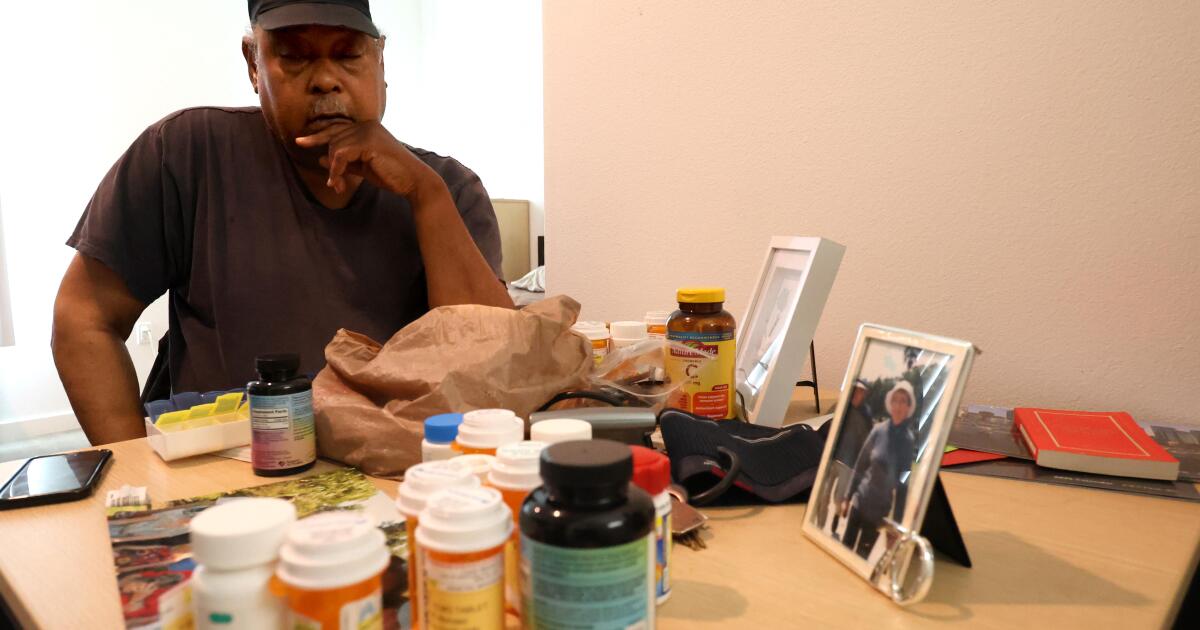
On a recent day at his apartment, I watched Mays load medication from more than 20 vials into a weekly pill organizer.
“I could almost do this in my sleep,” he said as he arranged meds that resembled miniature jelly beans. This one for his kidneys, that one for his heart, his blood pressure, and on and on.

Bottles of medication and photos of close friends rest on David Mays’ table at his apartment in East Hollywood.
(Genaro Molina / Los Angeles Times)
There were 18 pills in each compartment. And none of that will cure any of what ails him, he said.
“You just have to keep doing it, and doing it, just to stay at a sustained level,” he said. “It’s not like … I feel great because I took this stuff.”
Two women in Mays’ life are heartbroken about his condition but respectful of his refusal to try dialysis.
“I don’t want him to suffer for the sake of placating other people,” said Mays’ daughter Jennifer Nutt, 47, of Merced.
Her parents divorced when she and her brother were young, and Nutt had no relationship with Mays until recently. She’s had her own trials, Nutt said, including homelessness.
Father and daughter began connecting in the fall of 2024.
“We spend hours every day talking. It’s like a nonstop festival of catching up,” and they’ve discovered they have the same cheeky sense of humor and pragmatism, and similar traits and interests.
“We like big words and thick books,” Nutt said.
The other woman is Helena Bake, of Perth, Australia, a registered nurse Mays affectionately refers to as “Precious.” They met in 1985, when Mays was visiting London, and Bake, 18 at the time, was working in a restaurant he visited with friends. After Bake moved to Australia, Mays visited her many times and became close to her entire family.
“He was lovely,” said Bake, who is not surprised by Mays’ attitude about his deteriorating health. “He’s always very positive and so pragmatic. He has this wonderful view of the world and the people in his life. It’s such a gift that he has.”
Mays, who gets by on Social Security payments, has set up a GoFundMe page to help pay for his cremation and send his ashes to Bake, to be scattered in his favorite places in Australia.
Lately, medical appointments with his several doctors, and the occasional ER visit, have gotten in the way of one of Mays’ favorite activities — the gatherings in the Vons parking lot.

David Mays is “always very positive and so pragmatic. He has this wonderful view of the world and the people in his life. It’s such a gift that he has,” a longtime friend says.
(Genaro Molina / Los Angeles Times)
Mays worked for many years in the Mar Vista area as a live-in elder care provider, and he’d bump into Bradley at a park, or Morgan in the strip mall that includes the grocery store. Several years ago, they made a habit of grabbing coffee around 7 a.m. and hanging out near Mays’ car. Bradley’s dog often hops into the vehicle, a Vons employee named Elvis comes out for a smoke break, and others come and go.
“I had a cousin who had diabetes, and he called my mom one day and said, ‘I’m not doing it anymore,’ ” Morgan was saying the other day. His mother wasn’t supportive at first, he told the klatch, but she listened to her nephew’s explanation and came around. “Who could judge someone for the choices they make in that situation?”
“There’s a waiting list for kidneys of two to eight years,” Mays said. “Let’s say [in] four or five years, there was a kidney available. Your body can reject it … and then you’re back to the drawing board…. I told Precious about this like a year and a half ago … and she said, ‘I have to hang up now because I have to process this.’ And the next time I talked with her, she said, ‘I get it.’ ”
Mays said he doesn’t want to be “a prisoner to a process, like a machine or something.”
“And you have to do this indefinitely. It’s not like you’re on it for two or three years…,” he said. “It is. The. Rest. Of. Your. Life.”
“I’ve seen people that were on dialysis,” said Bradley, a former musician. “I think I’d rather be just, if I gotta go, I gotta go.”
Morgan said his father, who died last year, had kidney problems in the end and resisted extreme measures to extend his life.
“It’s not like he was at all suicidal, just like David’s not,” Morgan said. “The thing about David is, he’s always been so resolute about it. We’ve never had a discussion where I felt like we could waver him, or like he was on the fence.”
When he first resisted dialysis, Mays said, doctors set him up in a room with a video that explained the process.
“I watched the whole thing, and that was the clincher,” Mays said. “By the time I got through looking at that, I’m just going, ‘Oh HELL no.’”
It’s not that he wants to die, Mays said. It’s that he wants to live on his terms.
“The irony of the whole thing is, it’s all the people that I have around me — they’re the reason I’m willing to go like this. What I get from them in the way of being … uplifted and loved, well, when you have all that, you can deal with anything.”
He has his klatch buddies, he has Precious, he has his daughter in his life again.
“With people around that give a damn about you, care about you, you can deal … with death, you can deal with dying…. And I told my doctors I would rather live a shorter period of time, but with what I feel to be some decent quality of life, than live a longer period of time and be miserable. And I would be miserable on dialysis,” Mays said.
“Plus, I’m 70. It ain’t like I’m 30 and there’s so much life to live. I am the age that I am, and I would like to go further, sure, but it has to close out soon. And I’m fine with that, because I have lived.”
steve.lopez@latimes.com


new video loaded: NASA Announces Artemis III Crew
transcript
transcript
NASA Announces Artemis III Crew
NASA announced the crew of Artemis III mission, which will fly to low-Earth orbit to test rendezvous and docking maneuvers with one or two lunar landers.
-
“I am excited to welcome you as the next crew in the Artemis journey to successfully return to the moon — this time to stay.” “I’m honored by the role that I’ve been given. I’m also very humbled by the task in front of us. But first and foremost, I’m grateful.” “So with that, the Artemis II crew, comrade, hands you the baton. You got the controls.” “As you know, we had a significant anomaly at our Launch Complex 36A on May 28. We’ve redoubled our efforts and are moving forward.”
By Alisa Shodiyev Kaff
June 9, 2026
Science
Santa Monica Mountains’ last steelhead trout survived the Palisades fire — and even had babies

Scientists feared the Santa Monica Mountains’ last remaining steelhead trout were dead, smothered by debris flows unleashed by the Palisades fire.
But the endangered fish surprised them: A team of biologists recently spotted 30 of the rare trout — and 21 babies — in Topanga Creek.
“There was a lot of happy dancing in the creek,” said Rosi Dagit, principal conservation biologist for the Resource Conservation District of the Santa Monica Mountains, which works with public and private landowners to conserve natural resources.
That’s because the steelhead here are endangered, at both the state and federal levels. Once, they swam in most streams of the Santa Monicas, but their numbers plummeted amid overfishing and coastal development. Increasingly frequent wildfire has further stressed their habitat. Topanga Creek, a biodiversity hot spot, is home to their last known population in the mountains that stretch from the Hollywood Hills to Point Mugu in Ventura County.
The trout that were spotted, including this one, are part of a distinct Southern California population that’s listed as endangered at the state and federal levels.
(RCDSMM Stream Team)
The California Department of Fish and Wildlife spearheaded a complex mission to rescue trout threatened by the Palisades fire that sparked in January 2025.
Time was of the essence. The fire hadn’t yet been fully contained. But rain was on the way, which would sweep massive amounts of sediment from the denuded hillsides into the water. Fish are often killed this way.
Crews stunned the fish with electricity, scooped them up in buckets, trucked them to a hatchery and ultimately moved them to Arroyo Hondo Creek in Santa Barbara County.
Within days, Topanga Creek was choked with mud. Some assumed the fish left behind were goners.
But in March, the conservation district’s team found four. The following month, when water conditions were clearer, they saw more.
“These fish continue to amaze me,” said Kyle Evans, environmental program manager for the state Department of Fish and Wildlife, who had seen the damage to the creek. “I had seen populations get wiped out in similar situations. So when I heard, I was thrilled.”
Evans surmises the fish that survived were in an area of the creek where less charred material and sediment were swept in.
“These fish likely hunkered down, were hiding under some rocks or places to try to get away from the main concentration of flow,” he said. “And luckily they weren’t buried.”
The ones that were spotted were fairly small, around 6 to 14 inches. Rainbow trout and steelhead trout are the same species, but with different lifestyles. If the fish remain in freshwater, they’ll be considered rainbows. However, they can migrate to the ocean and become steelhead, where they typically grow larger before returning to their natal waters to spawn.
Topanga Creek hasn’t fully recovered from the damage it sustained, but scientists say it’s looking better. Surveys last year were “so depressing,” Dagit said, with very few animals, and stretches that were essentially transformed into flat roads from all the sediment buildup. Some of the riparian canopy burned right down to the creek.
Then came 32 inches of rain over the last nine months, scouring out and moving sediment, creating deeper pools. Dagit said they recently found newt egg masses for the first time in years, as well as a few adult newts and many frogs. Plants that provide cover are starting to recover.
She provided photos comparing certain pools last year and this year, some dramatically transformed. In September 2025, the Shrine Pool could have been an overgrown hiking trail. This April, it was filled with shallow water.

The Shrine Pool in September 2025, left, and the same location in April 2026, right, with RCDSMM’s Isaac Yelchin donning a wetsuit.
(RCDSMM Stream Team)
Topanga Creek is home to another endangered fish, the small but hardy northern tidewater goby, often described as cute. Not long before the trout operation, Dagit led a rescue of hundreds of these fish too. Many were repatriated to the lagoon at the mouth of the creek in a moving ceremony last June.
There’s still the matter of what to do with the trout that were moved to Santa Barbara County last year. Evans would like to bring them home to the Santa Monicas at some point, but isn’t sure if it will happen. On one hand, they could bolster the small, genetically isolated surviving population. On the other, they might inadvertently bring in a disease or bacteria. There is some time to decide. Evans estimates the creek still needs to recover for two to three more years.
For now, the fish are functioning fine in their adopted creek. Experts worried the trauma wrought by the move would disrupt their spawning process, but they had babies that spring. This year, they spawned again.

The Pacifica Municipal Pier was shut down and taped off Thursday after city workers noticed cracks running through the landmark structure and concrete chunks falling into the ocean.
It’s just one of many coastal California structures that have recently crumbled under pressure from a rising and relentless ocean.
Officials from the small, beach city south of San Francisco said the pier was closed due to “cracking, separation, and displacement of the concrete walkway and structural elements.”
It will stay closed while structural engineers asses its safety.
Photos taken by city employees show a wide crack that runs from top to bottom and across the structure as well. Other photos show a large horizontal crack under the foundation of a small restaurant on the pier, the Chit Chat Cafe.
The cafe was also shut down.
This is not the first time the 53-year-old pier has shown signs of stress. In 2021, part of it was shut down after handrails along the edge collapsed. And in 2023, after a series of storms pummeled the Central California coast, damaging parts of the pier, the structure was partially closed for more than year.
Those same storms caused extensive damage in Aptos and Capitola, 70 miles south, where piers and waterfront infrastructure were swept away or damaged.
In 2024, a 150- to 180- foot section of the Santa Cruz wharf was ripped off by powerful waves.
At least 10 of the state’s dozens of coastal public piers were closed for part or all of 2024 due to structural damage sustained in winter storms since 2022. At least five others have longer-term upgrades planned to address structural issues.
“These things are costly to maintain,” said Zach Plopper, senior environmental director at Surfrider. “They are a part of our California coastal culture in many ways, but we’re going to need to reckon with, one, the state that they’re in, and two, the continuous and worsening threats they’re going to experience,”
He said most of the piers were constructed in the early 1900s, and they weren’t built to withstand decades of rough seas, storms and rising sea level.
“With this incoming El Niño, which is forecasted to be significant, and this marine heat wave we’re in the midst of, we’re kind of in uncharted waters as far as what this winter could bring in terms of storms and swells to the California coast, and we’re likely going to see a lot more damage,” he said. “Not just piers, but roads and other coastal infrastructure up and down the state.”
There was no storm in Pacifica earlier this week, so no single event could be blamed for the destruction.
However, a 2025 report from an outside engineering firm, GHD, found that several sections of the pier were in “poor” or “serious” condition, and they recommended closure before anticipated storms or events that could “subject the piles to high winds, swells and large waves.”
The firm found several areas of the pier where concrete was missing and rebar was exposed and corroding.
“The pier has continued to experience high winds and large waves in a harsh marine environment,” the engineers wrote in the report, noting that continuous exposure to seawater or marine spray was “detrimental” to the structure.
A 2023 city report estimated it would cost $19 million to repair.
That same year, a state law was enacted to require local governments along the California coast to plan for sea level rise in the coming decades.
Sea level has risen some 8 inches, on average, along the coast in the past 150 years, Plopper said, and researchers anticipate another foot in the next 25 years.
“We’re going to see profound shifts on our coastline, none that we have ever experienced before, and building static structures on the coast just doesn’t work all that well,” he said. “We’re going to have to make some really hard decisions.”
-

 Arkansas3 minutes ago
Arkansas lands grant to battle deadly cattle tick disease
-

 California8 minutes ago
Operation Hands Down disrupts Central California gangs – Inside CDCR
-

 Colorado15 minutes ago
$25.7M Colorado private ski mountain property heads to auction
-

 Connecticut18 minutes ago
Connecticut driver spots snake in car while driving, police say
-

 Delaware23 minutes ago
Delaware Bay’s new oil spill response boat officially christened
-

 Florida30 minutes ago
Sheriff’s Office investigating fatal shooting of child in Florida City
-

 Georgia33 minutes ago
Northwest Georgia Congressman pushes for impeachment of federal judge for misconduct
-

 Hawaii38 minutes ago
A wet start to the dry season in East Hawaii – West Hawaii Today

