Politics
Newsom, Democrats announce $321-billion California budget deal

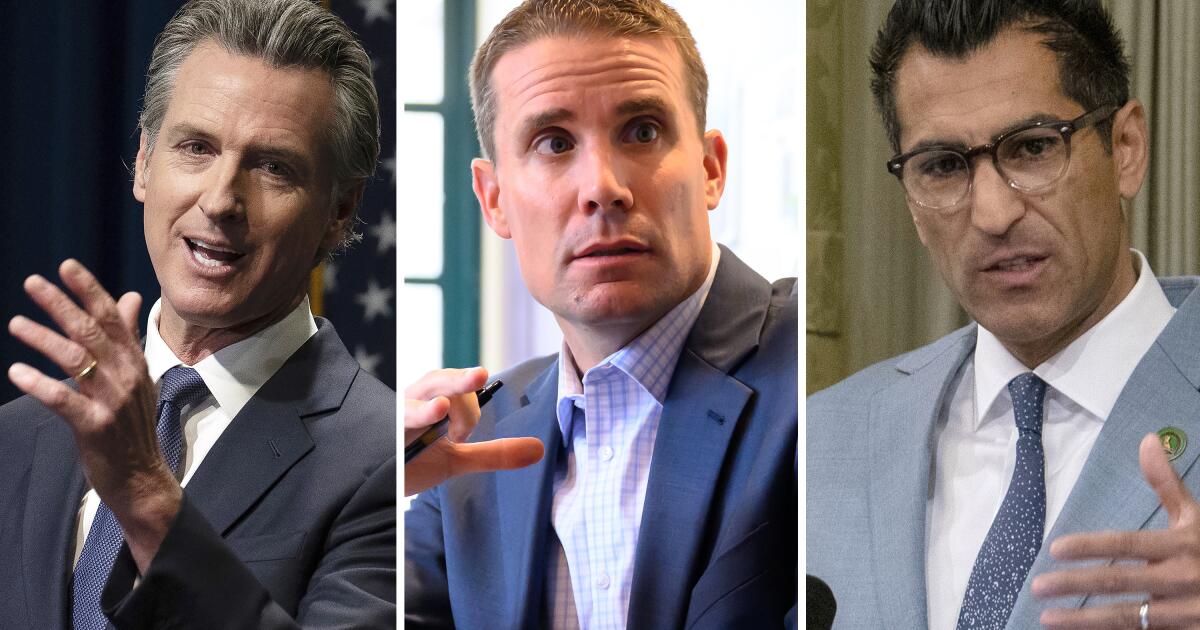
California leaders reached a tentative agreement Tuesday night on the state budget, which hinges on Gov. Gavin Newsom’s demand that the Legislature pass a housing reform proposal.
The eleventh-hour negotiations about the spending plan, which takes effect July 1, speak to the political challenge of overhauling longstanding environmental regulations to speed up housing construction in a state controlled by Democrats.
The party has been loath to do more than tweak the California Environmental Quality Act, or approve one-off exemptions, despite pressure from the governor and national criticism of a law that reform advocates say has hamstrung California’s ability to build.
The proposal is among a series of policies Newsom and Democratic lawmakers are expected to advance in the coming days as part of the $321.1-billion budget. The deal reflects the Legislature’s resistance to the governor’s proposed cuts to reduce a $12-billion budget deficit expected in the year ahead, citing uncertainty about the scope of the state’s financial problems.
“We appreciate the strong partnership with the Legislature in reaching this budget agreement,” said Izzy Gardon, a spokesperson for Newsom. “The governor’s signature is contingent on finalizing legislation to cut red tape and unleash housing and infrastructure development across the state — to build more, faster.”
The consensus comes after weeks of conversations about how to offset the deficit, caused by overspending in California, and start to address even larger financial problems anticipated in the future, including from potential federal policy changes.
The tentative deal largely relies on borrowing money, tapping into state reserves, and shifting funding around to close the shortfall. By reducing and delaying many of the governor’s proposed cuts, the budget continues a practice at the state Capitol of sparing state programs from immediate pain while avoiding taking on California’s long-term budget woes.
Assembly Republican Leader James Gallagher (R-Yuba City) said the budget deal papers over the state’s financial problems.
“We’re in this situation because of overspending,” Gallagher said. “We’ve made long-term commitments to programs that Democrats have championed, and now, just like everybody warned, the money is not there to support them all, and they don’t want to cut back their program that they helped expand.”
The cuts lawmakers and the governor ultimately agreed to will reduce the expansion of state-sponsored healthcare to undocumented immigrants and reinstate asset limit tests for Medi-Cal enrollees. The final deal, however, achieves less savings for the state than Newsom originally proposed.
The plan restores cost-of-living adjustments for child-care workers, which the governor wanted to nix, and rejects his call to cap overtime hours for in-home caregivers.
Democrats in the Legislature successfully pushed to provide another $500 million in funding for Homeless Housing, Assistance and Prevention grants. The governor originally resisted giving more money to counties, which he has chastised for being unable to show results for the billions of dollars in state funding they have received to reduce homelessness.
Assembly Budget Chair Jesse Gabriel (D-Encino) pushed back on the notion that the Legislature hasn’t done “real belt-tightening.” Lawmakers are trying to balance compassion and fiscal responsibility before making drastic cuts to safety net programs that Californians rely on, he said.
“That is the balance that we are trying to strike here with this budget of being responsible, of focusing on the work that we need to do regardless, but also understanding that there is a pretty high delta of uncertainty for a lot of reasons,” Gabriel said.
The budget also preserves Newsom’s plan to provide $750 million to expand the California Film and Television Tax Credit, a proposal supported by Hollywood film studios and unions representing workers in the industry.
The tentative agreement is expected to serve as a precursor to more challenging financial discussions about additional reductions in the months ahead.
California expects to lose federal funding from the Trump administration and state officials predict a potentially greater funding dilemma in 2026-27.
Here are few key elements of the budget deal, detailed in summaries of the agreement and legislation:
A housing caveat
Described colloquially as a “poison pill” inserted into the budget bill, the agreement between the Legislature and Newsom will only become law if legislators send the governor a version of a proposal initially introduced by Sen. Scott Wiener (D-San Francisco).
Wiener’s bill is expected to lessen the number of building projects that would require a full environmental review under CEQA and make the process of developing environmental impact reports more efficient.
Paired with another proposal that could exempt more urban housing developments from CEQA, the legislation could mark a significant change in state policy that makes it easier to build.
Newsom is effectively forcing the Wiener proposal through by refusing to sign a budget deal without the CEQA exemptions. The proposal was still being drafted as of Tuesday evening.
The governor declared lofty goals to build more housing on the 2018 gubernatorial campaign trail, but he has failed to spur enough construction to meet housing demand and make homes more affordable.
New York Times columnist Ezra Klein effectively called out the inaction in California caused by the state’s marquee environmental law and a lack of political will in his recent book “Abundance,” which increased pressure on the governor and other Democrats to reconsider their approach and push for more substantial fixes this year.
The CEQA reform bill must be passed by Monday under the budget agreement, which omits a separate Newsom call to streamline the Delta tunnels project.
Changes to Med-Cal funding
Medi-Cal cost overruns are causing major problems for the California budget. The challenges stem from a higher-than-expected price tag for the expansion of state-sponsored healthcare to all income-eligible undocumented immigrants and medical care for other enrollees.
Newsom’s budget proposal in May suggested substantial trims to the healthcare program for people who are undocumented. His plan included freezing new enrollment as of Jan. 1, requiring all adults to pay $100 monthly premiums, eliminating long-term care benefits and cutting full dental coverage. The changes offered minor savings in the year ahead but could save billions of dollars in future years.
Lawmakers ultimately agreed to require undocumented immigrant adults ages 19 to 59 to pay $30 monthly premiums beginning July 2027. They plan to adopt Newsom’s enrollment cap but give people three months to reapply if their coverage lapses instead of immediately cutting off their eligibility.
Democrats agreed to cut full dental coverage for adult immigrants who are undocumented, but delayed the change until July 1, 2026.
State leaders agreed to reinstate much higher limits than the governor originally proposed on the assets Medi-Cal beneficiaries may possess and still get coverage. The new limits would be $130,000 for individuals and $195,00 for couples, compared to prior limits of a few thousand dollars.
They also adopted Newsom’s proposal to withdraw Medi-Cal benefits for specialty weight-loss drugs.
Shifting money around
The negotiations resulted in less general fund spending than the Legislature proposed in a counter to Newsom’s budget revision in May, dropping from $232 billion to an estimated $228 billion for 2025-26.
Officials are using more money from California’s cap-and-trade program, which sets limits on companies’ greenhouse gas emissions and allows them to buy pollution credits from the state, including $1 billion next year. They are also using $300 million from climate change bonds instead of the general fund to pay for environmental programs.
Lawmakers and the governor agreed to delay a $3.4-billion payment on a loan to cover Medi-Cal cost overruns and increase the loan by another $1 billion next year.
Trump uncertainty
The plan continues an agreement to take $7.1 billion from the state’s rainy day fund to help cover the deficit and taps into another $6.5 billion from other cash reserves to balance the budget.
California leaders for months have warned about the so-called Trump effect on the state budget.
Financial analysts at UCLA predict that the state economy is expected to slow in the months ahead due to the effects of Trump’s tariff policy and immigration raids on construction, hospitality, agriculture and other key sectors.
Meanwhile, the state is warning that federal funding reductions to California could require lawmakers to adopt additional budget cuts in August or September, during a special session in the fall or early next year.
State officials expect future deficit estimates to range from $17 to $24 billion annually, according to an Assembly summary of the budget deal.
More to come
The final budget agreement is being publicly released in bits and pieces this week through a series of trailer bills that appear online at random hours.
Lawmakers are expected to pass a main budget bill on Friday and approve additional legislation by Monday, before the July 1 deadline for the budget to go into effect. Some legislation, such as the CEQA housing exemptions, will not appear in print until the end of the week.
Other decisions, such as reauthorizing California’s cap-and-trade program, will be considered later in the year outside of the budget process.



Prosecutors on Monday began laying out their case against the man accused of murdering Charlie Kirk. It was the first day of a weeklong preliminary hearing that will determine whether or not there is enough evidence against the accused killer to stand trial.

NEWYou can now listen to Fox News articles!
Support for embattled Maine Senate candidate Graham Platner is cratering among Democrats, with one of his most prominent supporters calling on him to exit the race following a harrowing rape allegation.
Rep. Ro Khanna, D-Calif., rescinded his endorsement and called on Platner to suspend his campaign following a bombshell Politico report detailing a rape allegation by Maine resident Jenny Racicot, 41, who previously dated the scandal-plagued candidate.
Platner immediately denied Racicot’s account — which alleges that he barged into her home in 2021 and forced her to have unprotected sex — but has said his campaign is determining its next steps.
She also went on CNN Monday evening shortly after the report was published to tell host Jake Tapper that “by dictionary definition” Platner “raped” her.
Rep. Ro Khanna, D-Calif., speaks at a town hall event on Feb. 20, 2026 in Stanford, California. The town hall focused on taxing billionaires and the future of AI. (Benjamin Fanjoy/Getty Images)
DEMOCRATS BREAK WITH SCANDAL-PLAGUED GRAHAM PLATNER, WARN OF ‘CIVIL WAR’ IN PARTY
“I thought, here’s a man who was drunk and who, by dictionary definition, raped me. And he’s blaming drunk women,” Racicot said. “So I just felt like that was a very odd take to have on that. And I also feel like with all of the comments that he made about women, sexual assault, rape, even, um, you know, the comments that he had made that was in The New York Times article about, you know, threatening people with rape, like, why does this person have this issue, like scattered throughout their life, throughout their commentary, like it‘s on their mind?”
“I’ve been very clear that sexual assault or violence against women is a red line,” Khanna said in a post on social media Monday evening. “These allegations are very serious and credible. Graham Platner should drop out from the race. I am withdrawing my endorsement.”
Khanna’s statement preceded Senate Minority Leader Chuck Schumer, D-N.Y., and Sen. Kirsten Gillibrand, D-N.Y., the head of Senate Democrats’ campaign arm, issuing a joint statement calling on Platner to “immediately” leave the race, so the party can choose a new nominee.
The pair said the Democratic Senatorial Campaign Committee (DSCC) would not invest in Maine — a top pick-up opportunity for Democrats in November’s midterm elections — if he continued to seek the battleground seat held by Sen. Susan Collins, R-Maine.
Both Schumer and Gillibrand supported Gov. Janet Mills, D-Maine, in the contentious primary and did not endorse Platner until he won the party’s nomination.
Meanwhile, Khanna, a far-left populist with likely presidential ambitions, had embraced Platner’s insurgent Senate campaign for months amid a patchwork of controversies.
Khanna personally campaigned with the Maine Senate hopeful in June shortly before Platner became the party’s nominee. The campaign stop came just one day after Lyndsey Fifield, a former Platner girlfriend, accused Platner of abuse — an allegation first reported by The New York Times that Platner has fiercely denied.
By that point, Platner was also facing scrutiny for sending sexually explicit messages to at least half a dozen women while married, making a plethora of offensive online statements over the period of a decade and getting a Nazi-linked tattoo that he wore for most of his adult life.
Shannon Watts, a Democratic strategist and founder of the gun control group Mom Demands Action, slammed the timing of Khanna’s statement.
“You flew to Maine to campaign with him AFTER he was accused of assault against another woman,” Watts wrote on social media.
Khanna previously appeared to dismiss the severity of Fifield’s account alongside many Democratic lawmakers, who seized on her background in Republican politics. He also argued that Platner, a combat veteran who has struggled with PTSD, had overcome a dark past and was deserving of redemption.
“Here you have a case of someone who had a dark chapter in his life, was in toxic relationships, was ashamed about it, who served this country, and the Maine voters are saying, ‘Look, let’s give him some grace, and his focus is stopping these wars, and it’s getting national health insurance, and it’s taking on economic inequality,” Khanna told CBS News in an interview.
Democratic U.S. Senate candidate Graham Platner speaks at his primary election event in Blue Hill, Maine, on June 9, 2026. (CJ Gunther/Getty Images)
WATCH: DEM SENATORS EXCUSE PLATNER’S CONDUCT AT CRISIS HUDDLE WITH EMBATTLED MAINE CANDIDATE
And Khanna told Fox News’ Martha MacCallum in June that he asked Platner if there were any credible allegations of sexual assault that had yet to be revealed. He said Platner denied it.
“I made it clear that, for me, is a red line,” the California lawmaker said. “And he said, no, there is not.”
“Now, obviously, he had texts that were allegedly consensual, and while he was married, And that’s a matter for him and his wife. And his wife came out and said that she forgave him. And so that is a different matter for me than abuse or assault or what people did in the Epstein class. It’s a very different matter.”
Khanna was not the only prominent Platner supporter to disavow the Senate hopeful following Monday’s rape allegation.
Sen. Martin Heinrich, D-N.M., an early Platner supporter, was the first prominent Democrat to rescind his endorsement after Politico’s report broke.
Meanwhile, Sen. Ruben Gallego, D-Ariz., rescinded his endorsement Monday evening, but stopped short of calling on Platner to exit the race.
Gallego, a former ally of disgraced ex-Rep. Eric Swalwell, D-Calif., has faced scrutiny over his past treatment of women. The Senate Ethics Committee recently dismissed a complaint brought by Rep. Anna Paulina Luna, R-Fla., in a bipartisan manner.
His Arizona colleague, Sen. Mark Kelly, D-Ariz., who did not endorse Platner, also called on the Senate hopeful to suspend his campaign.
“Character and accountability matter regardless of party,” Kelly wrote on social media. “It’s time for Graham Platner to drop out and allow for someone else to be nominated and give Democrats the best chance to win this seat in November.”
Far-left Twitch streamer Hasan Piker, who has championed socialist candidates across the country, also distanced himself from Platner on Monday.
Sen. Ruben Gallego, D-Ariz., talks to reporters as he heads for a vote at the U.S. Capitol on Jun. 1, 2026 in Washington, D.C. (Chip Somodevilla/Getty Images)
CLICK HERE TO DOWNLOAD THE FOX NEWS APP
“This is beyond red flags. This is irredeemable,” Piker said during his livestream.
Fox News Digital reached out to Platner’s campaign for comment.

WASHINGTON — The leaders of Europe are bracing for another turbulent summit with President Trump this week as NATO members gather for their annual meeting in the Turkish capital.
European diplomats view Trump’s decision to attend as a positive sign of his continued commitment to the alliance. But the president’s grievances with several European governments over their refusal to join the U.S. war with Iran have cast a pall over a summit already strained by Trump’s wavering support for the continent.
The secretary-general of the transatlantic alliance, Mark Rutte, told reporters on Monday that Trump had aired his resentments in a recent phone call. But Rutte countered with a mix of flattery and countervailing facts that has thus far kept Trump engaged.
While Trump has accused European leaders of denying U.S. forces access to allied bases for takeoffs and refueling during the war, Rutte noted that about 5,000 sorties supporting Operation Epic Fury launched from European airfields. And last Friday, France and Britain committed to a joint military mission with Oman to support freedom of navigation in the Strait of Hormuz — “an extremely important development,” Rutte said.
At last year’s summit, held in The Hague, all NATO member states — with the exception of Spain — agreed to spend 5% of their GDP on defense by 2035, marking a significant increase in historic spending goals for modern Europe. The pledge is divided into two categories, with 3.5% of spending allocated to core military requirements, and the rest committed to a broad set of security-related investments.
Trump’s tough love on the alliance “is, I think, bringing NATO closer together,” the secretary general told reporters.
“You could argue that he is the first president of the U.S. since Eisenhower who was able to come to this situation where the Europeans and the Canadians will spend the same as the Americans” on security, Rutte said. “This equalization was a wish for 50, 60 years, and now it’s happening — I think in large part due to his leadership.”
NATO Secretary-General Mark Rutte speaks to reporters Monday ahead of the NATO summit in Ankara, Turkey.
(Hussein Malla / Associated Press)
In a video message posted on social media Monday, Trump’s ambassador to NATO, Matthew Whitaker, said the summit this week would serve as a “report card” to determine whether countries were beginning to fulfill their commitments from last year.
He offered a note of optimism and suggested the president’s goal is to enhance, rather than undermine, the alliance.
“The United States will be here, but we also need our allies to be here. We cannot do it alone, and the American taxpayer should no longer bear the burden,” Whitaker said.
A White House schedule for Trump’s trip lists bilateral meetings with Rutte and the leaders of Turkey, Syria and Ukraine, in between alliance-wide meals and conferences.
Ukraine will remain at the top of the agenda, Trump told reporters Monday, expressing hope that the war could soon come to an end after four brutal years of fighting.
Russia’s invasion of Ukraine has caused the greatest loss of life in Europe since World War II, resulting in more than 1 million casualties, including an estimated 600,000 dead. Since Russian President Vladimir Putin launched his full-scale invasion in 2022, following his covert invasions of Ukraine’s Crimean peninsula and eastern regions in 2014, Russian forces have captured roughly 12% of Ukraine’s territory.
The war has settled into a deadly stalemate since a 2023 Ukrainian counteroffensive failed to break Russian defensive lines. While Russian forces have occasionally advanced, they have only managed to hold marginal gains along the front, at tremendous cost.
In recent weeks, however, expanded Ukrainian drone and missile capabilities have shifted the dynamic, striking military production sites deep inside Russia and targets near Moscow, bringing the war more directly into the Russian public consciousness and raising questions in the Russian capital whether the war effort is sustainable.
Ukraine’s boldness has impressed the Trump administration, Alexander Stubb, the president of Finland, told the Financial Times this week.
“I think he does feel pressure,” Trump said of Putin, addressing reporters in the Oval Office before departing for Turkey on Monday.
The president referred to an ongoing U.S. effort to end the war, a goal that has remained elusive for Trump since returning to office.
“I think we’re getting much closer than people realize,” he said. “President Putin wants it to end, I will tell you that. Very strongly. Had a good call. And President Zelensky actually wants it to end now.”
“We’re going to be going to NATO, and we’re going to be talking about it,” Trump added. “And I think we’re going to get it ended. It’s been terrible.”
-

 Los Angeles, Ca40 minutes ago
Missing 13-year-old with autism last seen at Los Angeles beach
-

 Videos48 minutes ago
Charlie Kirk’s alleged killer appears in court
-
Detroit, MI58 minutes ago
GET TO KNOW: Wide receiver Kendrick Law
-

 San Francisco, CA1 hour ago
Multiple people lose eyes, hands in illegal fireworks-related injuries in San Francisco
-
 Dallas, TX1 hour ago
Texas took this Dallas couple’s newborn baby for 3 weeks. A judge says their rights were violated
-

 Miami, FL1 hour ago
South Florida foundation empowering thousands of young girls through education, mentorship, community support
-

 Boston, MA1 hour ago
Where to watch Boston Red Sox vs Chicago White Sox: TV channel, start time, streaming for July 7
-

 Denver, CO1 hour ago
House fire in Denver fully engulfs power pole, detached garage mostly destroyed

