News
A Jan 6 rioter convicted of assaulting police scored a visit to the White House


Shane Jenkins, seen here in police bodycam footage from Jan. 6, 2021, was convicted of multiple charges in connection with the Capitol riot, including assaulting police. Months after receiving a pardon from President Trump, Jenkins visited the White House along with another former Jan. 6 defendant.
U.S. Department of Justice
hide caption
toggle caption
U.S. Department of Justice
Just months after being freed through a pardon from President Trump, two men convicted of felonies for their roles in the Jan. 6, 2021, attack on the U.S. Capitol scored visits to the secure grounds of the White House.
During their visit, the men took turns posing for pictures and videos behind the lectern in the White House press briefing room.
“Thank you so much President Trump, if you’re seeing this, we appreciate you setting us free,” said Shane Jenkins, in a video he posted on social media.
Jenkins, who had a criminal record before Jan. 6, was sentenced to seven years in prison for assaulting police protecting the Capitol and using a metal tomahawk to try to smash a window. The day after the attack, Jenkins wrote in a text message, “I have murder in my heart and my head.”
“Never would have thought in only a few short months I would be going from the big house to the White House,” said another pardoned Jan. 6 defendant, Dominic Box, who also recorded a video from the briefing room.

Dominic Box appeared exuberant as he recorded videos for social media in the White House press briefing room this month. Box was convicted of felony civil disorder and other nonviolent misdemeanors in connection with Jan. 6. His case was dismissed by the Justice Department before he was sentenced.
Screenshot by NPR/@DomFreePress
hide caption
toggle caption
Screenshot by NPR/@DomFreePress
Box was convicted of felony civil disorder and nonviolent misdemeanor charges related to the Capitol breach. He had not yet been sentenced when Trump returned to office and issued mass clemency to all Jan. 6 defendants, including the most violent offenders. Separately, in 2023, Box was arrested in Florida on a DUI charge. According to the police report, while in the back of the squad car, Box used “various racial slurs,” including the n-word. In a message to NPR, Box said , “I am not racist,” and noted that he did not use “the hard r” when he said the n-word.
The circumstances of the visit to the White House were somewhat murky.
“An individual within the Trump Administration extended the invitation,” Box told NPR, “but I am not at liberty to disclose their identity.”
In a message to NPR, Jenkins said he was also “not at liberty to discuss” how the tour was arranged, adding, “but of course J6 Hostages were wronged and will be welcomed to the White House.”
The two men said that, in addition to the press briefing room, they saw the Oval Office and the Roosevelt Room, though they did not post any videos or photos of those areas.
The White House did not respond to NPR’s messages seeking comment.

Since taking office, Trump has continued to embrace Jan. 6 defendants as “political prisoners.”
“I pardoned J6 people who were assaulted by our government,” Trump told reporters in February. The Department of Justice estimated that 140 police officers were injured in the attack.
The Trump administration is also currently negotiating a settlement in a wrongful death lawsuit filed by the estate of Ashli Babbitt, the rioter who was shot and killed by a Capitol police officer while trying to climb through a broken window.
Capitol Police Chief Thomas Manger condemned the news of the pending settlement.
“I am extremely disappointed and disagree with this settlement,” Manger said in a written statement. “In 2021, the DOJ investigation determined no wrongdoing by police. This settlement sends a chilling message to law enforcement nationwide, especially to those with a protective mission like ours.”
Enrique Tarrio, the former leader of the far-right extremist group the Proud Boys, also said he briefly met with Trump while visiting the president’s Mar-a-Lago resort earlier this month. Tarrio was convicted of seditious conspiracy for his role in the Jan. 6 attack and sentenced to 22 years in prison.
According to Tarrio, Trump called him over while he was dining at the resort.
“I thanked him for giving me my life back,” Tarrio wrote on social media. “He replied with…I Love You guys.”
There is no indication that Jenkins or Box met with Trump when they visited White House. (Trump spent most of the day at his golf club in Virginia, according to his public schedule.) Both men have declined to disclose the precise details of their visit.
“Thank you to our friend, who shall go unnamed, for giving us that opportunity,” Box said on a video live stream.
The visit occurred on a Sunday – outside of the regular public tour schedule, which typically runs from Tuesday through Saturday, according to the White House website. In a break with the Biden administration, the Trump White House has stopped releasing visitor logs.
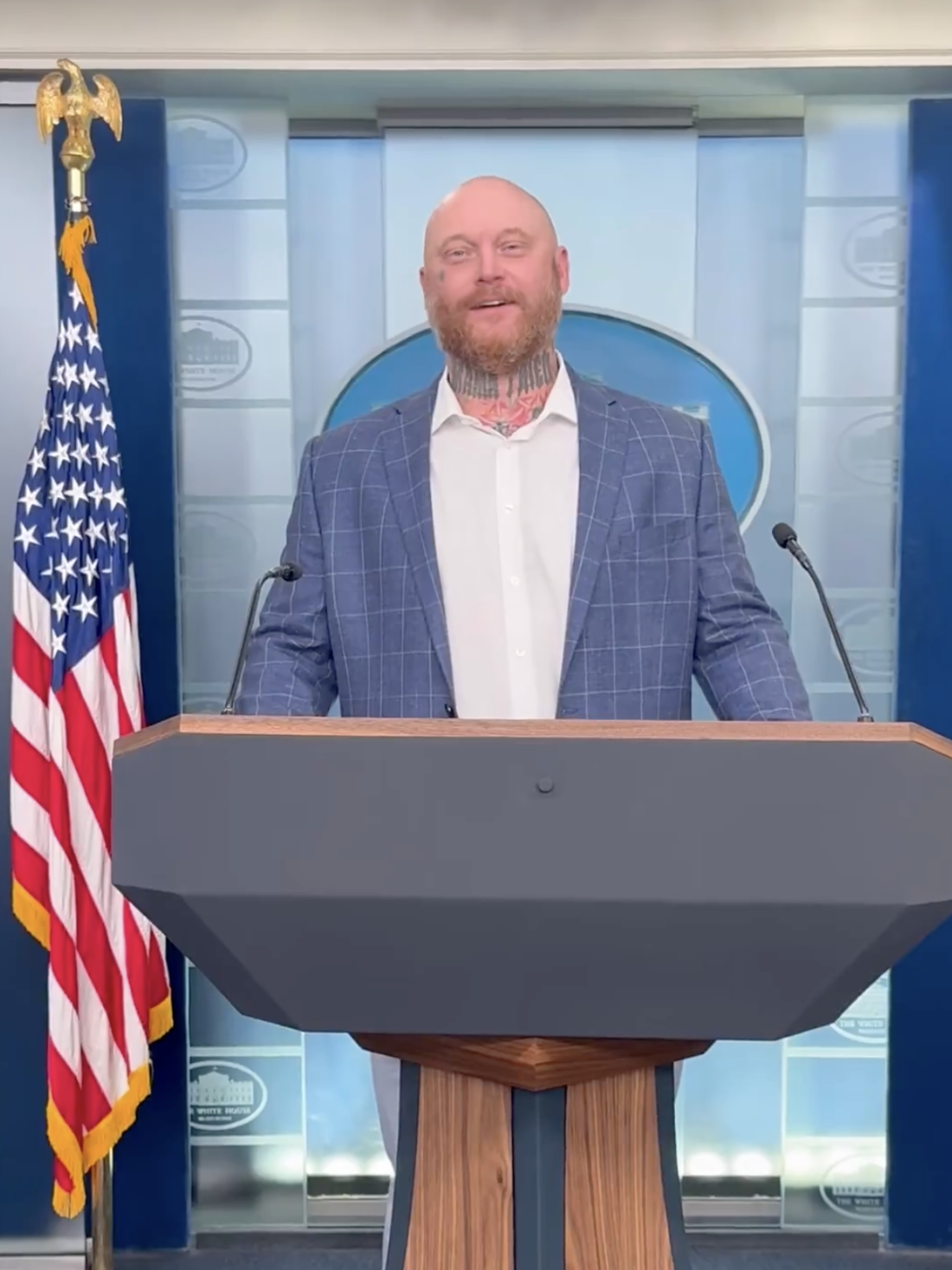
Jenkins, who also had a criminal record before Jan. 6, smiled and posed for photos and videos behind the lectern in the White House press briefing room. Months earlier, he was serving a seven-year prison sentence for his actions during the Capitol riot.
Screenshot by NPR/TheRealJ6Shane
hide caption
toggle caption
Screenshot by NPR/TheRealJ6Shane
Jenkins’ appearance at the White House was especially striking given his convictions for assaulting police on Jan. 6, and his extensive criminal record, which stretches back to the late 1990s.
“I was in and out of prison from 23 on,” Jenkins said at his sentencing hearing.
Prosecutors said Jenkins assaulted police officers on Jan. 6 using nine different objects, including “a flagpole, a metal walking stick, and a broken wooden pole with a spear-like point on one end which he launched like a javelin.” At his trial, prosecutors pointed out his large neck tattoo reading “MAMA TRIED.”
In his defense, Jenkins’ lawyer said he was a victim of “the poisonous propaganda of a former president.”
“[Trump] cares nothing about his supporters, nor anyone else,” defense attorney Dennis Boyle said in closing arguments. “To him they’re just cannonfodders [sic] to serve his needs and his needs alone.”
Jenkins told NPR he disagrees with his lawyer’s remarks. He maintains that he did not injure any police officers on Jan. 6, and said his actions were justified.
“We were standing not for Trump but in opposition to a stolen election,” Jenkins said in a message. “It was my duty as a citizen to object. In the process we were assaulted and responded in kind.”
“I’m thankful no one was hurt by what I did but am I sorry, f[***] no!” he wrote.
Jenkins’ legal troubles began long before Jan. 6. According to court documents filed by the Department of Justice, he had prior convictions for assault, resisting arrest, drug possession, making a “terroristic threat” and driving while intoxicated.
When he was 20 years old, Jenkins shot and killed his stepfather. At his sentencing, he testified that he acted in self defense and murder charges against him were ultimately dropped.
Like Jenkins, Box has also faced criminal charges unrelated to Jan. 6.
In Aug. 2023, while awaiting trial for his Capitol riot case, Box was arrested in Florida for driving under the influence. According to the police report, a witness saw Box back into a pole and pass out. When officers arrived, they found Box slurring his speech, along with an open can of Natural Light beer and a bottle of Skol vodka in the car.
NPR asked Box about the allegation that he used “various racial slurs” after the arrest.
“At one point, in an admittedly & regrettably intoxicated state after being woken up while in the back of the squad car I said, ‘what’s up n[****]?’” Box wrote. “I am not a racist, have dated women of all racial backgrounds & the majority of my friends in both Jacksonville & Savannah are black.”

Following the DUI arrest, Box was jailed for violating the terms of his pretrial supervision orders in the Jan. 6 case. He later pleaded no contest to the Florida DUI charge, and said he is “actively working a program of recovery” from substance abuse.
In a statement to NPR, the Secret Service said it followed standard protocol when they allowed Jenkins and Box to enter the White House.
“Mr. Jenkins and Mr. Box were subject to a rigorous security screening prior to their entry being approved,” the agency wrote. “In all cases, the U.S. Secret Service works in conjunction with White House staff to review pertinent visitor information and develop plans to ensure a safe and secure visit for all.”
“Secret Service knew who we were and they were cool,” Box said in a livestream video. “They weren’t looking at us like we were suspicious.”




Supreme Court Justice Amy Coney Barrett speaks at the Reagan Library on Sept. 9, 2025, in Simi Valley, Calif. Barrett discussed and signed copies of her new book, Listening to the Law: Reflections on the Court and Constitution.
Mario Tama/Getty Images
hide caption
toggle caption
Mario Tama/Getty Images
Even as the Supreme Court was handing down one legal thunderbolt after another last week, the justices were quietly releasing their annual financial reports. Justice Samuel Alito was the only sitting justice to request an extension, which he has done for 15 years. The disclosures do not give a complete account of the justices’ total income and wealth, but they give insights into their concertgoing, guest professorships and even their involvement in youth sports.
In addition to their salaries, much of the justices’ reported income came from their book deals. Justice Ketanji Brown Jackson led the pack earning more than $1.1 million last year for a total of roughly $4 million since her memoir, Lovely One, was published in 2024.

Justices Sonia Sotomayor, Neil Gorsuch, Amy Coney Barrett and retired Justice Anthony Kennedy also reported income from published books. Earnings from their books ranged from $849,000 for Barrett, to $300,000 for Gorsuch and $88,000 for Sotomayor, whose books include her 2013 autobiography and five children’s books. Justice Clarence Thomas, who previously earned $1.5 million for his 2007 memoir, listed no publisher payments last year, and Justice Brett Kavanaugh, one of 13 co-authors of a 2016 legal treatise, also received no payments last year. Kavanaugh is said to be working on a memoir but he listed no payments for the anticipated book. Alito does have a book coming out in the fall, but with his financial report still outstanding, there is no data on how much he was paid for the work in 2025.
The only two sitting justices who have not written books are Chief Justice John Roberts and Justice Elena Kagan.
Many justices also earned income from teaching at law schools. Roberts reported income from New England Law, located in Boston, and Gorsuch reported teaching income from George Mason University in Virginia. Thomas taught classes at Catholic University in Washington, D.C., and Barrett and Kavanaugh taught at Notre Dame Law School. Barrett graduated from the school and began teaching there 23 years ago; Kavanaugh has family connections to Notre Dame.
The disclosures also report gifts, travel, food and lodging that the justices received in 2025. Jackson and Sotomayor were the only two to report gifts. Jackson was given a painting for her chambers valued at $2,500, and Sotomayor reported a trip to Kansas City to watch the opening of a musical based on her children’s book, Just Ask.
In addition, she reported receiving free tickets worth $4,333 while on “a private trip to Puerto Rico.” The tickets were from the record label that represents Bad Bunny, and her trip coincided with the artist’s months-long concert series in San Juan. Sotomayor’s parents were from Puerto Rico, and she has spent much time there over the years.
The justices also disclosed significant reimbursements for travel throughout 2025. Thomas’ travel, food and lodging expenses were paid for by the Hoover Institution for speaking at a celebration of conservative economist Thomas Sowell.
Sotomayor, Gorsuch, Barrett and Jackson were reimbursed for international travel, where they gave speeches, spoke about their books or taught. Roberts was the only sitting member of the court not to report any gifts or travel reimbursements.
The annual filings also shed some light on the justices’ activities off the bench. Kavanaugh reported that in addition to his duties as a Supreme Court justice, he serves as a coach to multiple D.C.-area Catholic Youth Organization girls’ basketball teams. Coach K, as he is known by his players, wrote the court’s June decision declaring that states can ban transgender women and girl athletes from playing on women’s and girls’ sports teams.

The justices’ salaries are established by law. The chief justice earns the most, at $320,700 per year. The eight associate justices earn $306,600 per year. While that is a lot of money to most Americans, the justices and even their law clerks could earn more the minute they leave their Supreme Court jobs for large law firms.
Roberts was the only member of the court to report investing in individual stocks. Alito in the past has also owned shares of individual stocks, but his report is not due for three months when his extension runs out. For the most part, the justices do not own individual stocks, but do invest in index funds, mutual funds and other such investment programs in order to both make money and limit potential conflicts of interest that would require their recusal from certain cases.
However — and this is a big however — the financial reporting forms the justices are required to fill out are so unspecific and the reporting ranges for investment earnings are so broad that it is impossible to determine any justice’s overall wealth. In addition, the current value of the justices’ homes isn’t reported. Neither is their spouses’ income, which in the case of the chief justice, for instance, likely far exceeds his take-home pay.

At least two structural columns buckled and failed in a 37-story office tower in Midtown Manhattan on Tuesday, prompting evacuations of nearby streets and buildings. While city officials asserted that the tower was in no danger of collapsing completely, outside engineers said further failures in the structure could not be ruled out.
A pair of columns that failed completely were part of the tower’s existing structure. A New York Times review of images and videos from inside the building has found that several floors were added atop these columns.
City officials said in a news conference on Tuesday that the building was continuing to move, while they simultaneously assured the city that the building would not suffer “total collapse.” “The way this building is constructed, it’s a steel-frame building,” John Esposito, a chief in the Fire Department in New York, said at the afternoon news conference. “So, it would not be a total collapse. It would be more of a localized collapse.” Still, he said, “that remains our concern, that it’s moved.”
Engineers said that the movement itself was cause for concern. In a properly designed steel building, they said, loads should redistribute quickly to surviving structural supports if columns failed.
Joe DiPompeo, a former president of the Structural Engineering Institute at the American Society of Civil Engineers, said that if the structure had been overloaded, he would expect any movement “to happen very quickly,” rather than gradually.
“Generally when a column buckles, it’s a sudden failure,” Mr. DiPompeo said. He said that a full collapse remained unlikely given the redundancies built into the building codes.
Engineers often refer to the most dangerous possibility as a progressive collapse, a process in which structures near the initial failure become overstressed and also fail, potentially bringing down the building if the sequence continues. While unlikely, it cannot be ruled out, Mr. DiPompeo said.
Footage recorded from inside the building shows at least two structural columns appear to have failed completely, Mr. DiPompeo said. Other nonstructural, interior walls — or at least the metal “studs” that were in place to hold them up — also appear to have deformed.
“The only way that really happens is if the floor above them dropped. It looks like the floor above could have dropped a foot or two, which is obviously not a good situation,” Mr. DiPompeo said.
The 37-story building is in the process of being converted from office space into residential units. Four new floors and a large vertical portion were added onto the existing building in recent months. The vertical portion consists of a stack of over a dozen new floors cantilevered out over the existing building below.
Engineers said that there was nothing inherently wrong with adding residential floors or the cantilevered section above the columns that failed, as long as the original structure and the modifications had properly accounted for the added weight and wind loads.
“The cantilever alone doesn’t change anything,” Mr. DiPompeo said, but it does put additional load on the columns underneath — a factor that should have been reflected in the design.
Nathan Berman, managing principal and founder of MetroLoft, the developer overseeing the conversion, said on Tuesday that “this incident is nothing more than a typical construction mishap.”
He said two columns near the northwest corner of the tower had bent under the weight of additions to the building above, most likely because those columns had not been properly reinforced, though he said an investigation would determine the cause. The rest of the columns, he said, “picked up the weight.” He estimated the affected floors above the failed columns had sagged by a maximum of four inches.
Mr. Berman said that he expected the problems to be fixed and the project to be completed with, at most, a slight delay.
On Tuesday evening, installation of temporary shoring was set to begin shortly, in order to help stabilize the 20th and 21st floors of the building.

The Justice Department sent letters warning election officials in all 50 states and the District of Columbia that they could face criminal prosecution over noncitizen voting, a spokesperson for the Justice Department confirmed Tuesday.
The letters, signed by Assistant Attorney General Harmeet Dhillon, who heads up the department’s Civil Rights Division, give states five days to explain how they will comply with federal voter eligibility laws and how they will maintain “clean voter lists.”
“The Department sent these letters to all 50 states and the District of Columbia, asking for voluntary compliance in a timely manner with their obligations under federal law to ensure only citizens vote in federal elections,” a Justice Department spokesperson said in a statement.
Noncitizen voting in federal elections is extremely rare, but Trump and his administration have falsely portrayed it as a widespread issue.
Michigan Secretary of State Jocelyn Benson, Nevada Secretary of State Francisco Aguilar and Utah Lt. Gov. Deidre Henderson are among those who said they received the letters from the Justice Department.
The letters say state election officers “could be criminally prosecuted for aiding and abetting” noncitizen voting. They further specify that any election officer who knowingly retains noncitizens on a statewide voting registration list or who facilitates noncitizens’ receiving and casting ballots could be subject to criminal liability.
“An intentional act that is aimed at diluting the votes of citizens could also constitute a violation” of federal law, the letters said.
Henderson wrote on social media that the threats constitute “truly bizarre behavior.”
“Got another love letter this morning from the DOJ sprinkled throughout with threats of criminal prosecution,” she wrote. “I’m sure I’m not the only chief election officer of a state who is being targeted for following state and federal laws by resisting DOJ’s demands for private voter data that have thus far been ruled illegal by at least a dozen courts.”
The letters are the latest move in the Justice Department’s campaign to assert more federal control over state elections.
While some states have complied with the administration’s demands that they hand over voter roll data, the Justice Department has sued 30 states and Washington, D.C., for resisting. So far, 11 different federal courts have dismissed the Justice Department’s efforts to seize voter rolls.
-
News8 minutes ago
Supreme Court financial disclosures reveal how their books add to their income
-

 Los Angeles, Ca2 hours ago
Waymo video could determine charges after teens’ bizarre California ride
-
Detroit, MI2 hours ago
DPD investigating after human remains found in home on Detroit’s west side
-

 San Francisco, CA2 hours ago
Bay Area Teen Waymo Riders Nabbed For Allegedly Shooting Projectiles From Robotaxi
-
Dallas, TX2 hours ago
Role Call: Tyrus Wheat looking to make most of second stint with Cowboys
-

 Miami, FL2 hours ago
2026 Miami Football Early Opponent Preview, Game 8: North Carolina
-

 Boston, MA2 hours ago
Boston sues social media companies over ‘addictive’ features, joining nationwide litigation
-

 Denver, CO2 hours ago
Peyton Watson landing spots: Could Nuggets star actually leave Denver?

