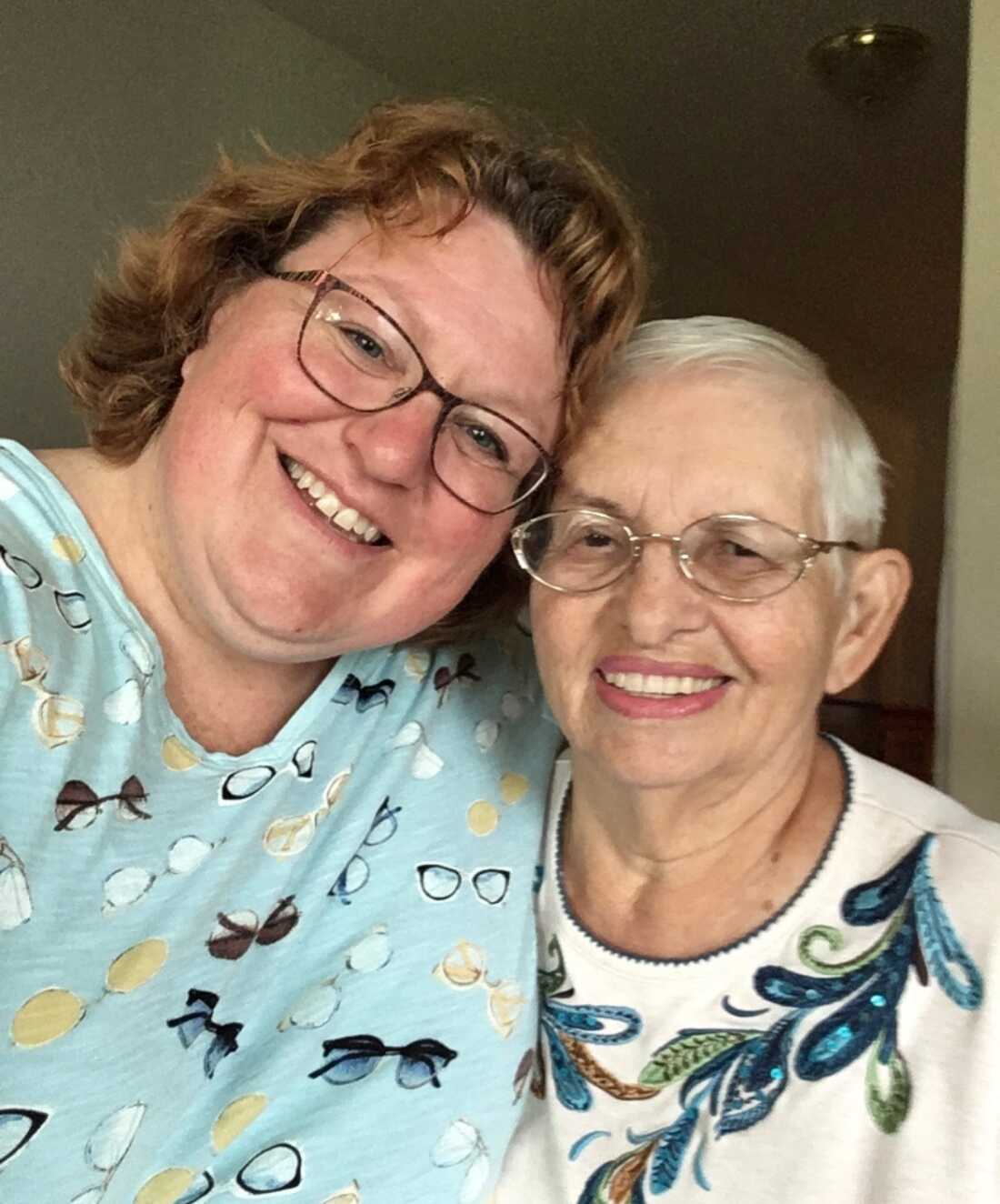
Connie Walton (left); Carmelia “Dinks” Hinkson; and Denille Andrus, with her son Joe Tanner, are among the mothers who are honored and remembered on Mother’s Day.
Julie Walton-Davidson, Lora Hinkson and via Joe Tanner
hide caption
toggle caption
Julie Walton-Davidson, Lora Hinkson and via Joe Tanner
When Brianna McIndoe was growing up in Tampa, Fla., her mother, Lisa McIndoe, maintained a beautiful flower garden in front of their home that attracted neighbors who would stop by to admire it.
“To this day, I am impressed by her ability to grow something beautiful where there was nothing before,” recalls Brianna, now 34. “I remember sitting outside with her planting seeds in the early spring, and she would teach me about the different varieties.”
Among those seeds were various types of the cockscomb flower, a uniquely shaped, fuzzy plant that comes in many colors and was a favorite of both Brianna and her mother. The irony of it also being known as the “brain flower” held little significance for them at the time.
This past April, on a warm spring day while her children, ages 7 and 5, were on break from school, Brianna took them on a scenic 7 1/2-hour drive from their home in Augusta, Ga., to visit their grandmother Lisa in Lutz, a suburb of Tampa.
“When we arrived at the nursing home, my mom didn’t recognize me,” Brianna says.
After a couple of hours, Brianna and the kids left to visit other relatives and friends before heading back home. As they started their journey homeward, Brianna felt a strong urge to visit her mom again.
This time, they stayed for a few more hours. The kids worked on a puzzle, while Brianna attempted to engage her mother in conversation, even though it was mostly unsuccessful.
“Right before we were getting ready to leave, my daughter mentioned the puzzle, and I turned to my mom and asked, ‘Was I like this when I was younger?’ ” Brianna recalls. “For a brief moment, I saw a glimpse of my mom again. She laughed and said, ‘You were just like that as a kid. She is just like you.’ In that moment, I knew she remembered, and it brought me so much joy.”
Brianna’s story is among nearly 500 shared with NPR after we invited readers to submit their favorite memories of their moms, whether their mothers are still present for them to hug or live on in their hearts. Brianna’s experience is also one of many that highlight the struggles of mothers dealing with dementia. Brianna says her mother, 63, is in a nursing home, receiving full-time care due to early-onset dementia.
“My mom is both alive and gone,” Brianna says.
Amid this struggle, Brianna has contemplated the legacies that many think of when considering their mothers.
“Something she always tells me is to leave things better than you found them. I’m trying to do that with my kids, making sure they have a better life than I had.”
Brianna’s sentiments were reflected in numerous submissions from across the United States and beyond — as far away as Africa, the Caribbean, Europe and Asia. They came from people in their 20s to their 70s, representing many races, genders, ethnicities and religious beliefs.
NPR received a flood of nostalgic stories — memories of moms from childhood, along with adult reflections that often showed that no matter how old we become, moms still surprise us.
There were humorous tales of moms’ antics that left us laughing, valuable pieces of moms’ advice that we might just adopt, and stories that tugged at our hearts, especially those poignant stories about mothers who have passed away.
Many favorite memories of Mom stem from her advice
Michael Sweet’s mother, Donna Sweet, holds her 18-month-old great-granddaughter, Margot Higgins, during a family event celebrating her wedding anniversary.
Michael Sweet
hide caption
toggle caption
Michael Sweet
Unsurprisingly, stories about life lessons taught by moms are among the favorite memories people cherish. Even if you could barely walk when she dropped those gems, you may now be watching your own children carry on that legacy today.
Take Michael Sweet, 62, a father of four, for example. He recalls that of everything his mother, Donna Sweet, 83, instilled in him, the most vivid and life-changing moment occurred when he was just 4 years old.
At that time, Michael’s family lived in a small working-class town in Pennsylvania. It was a segregated neighborhood, but Michael remembers attending a preschool filled with “kids of all races and abilities.” The year was 1967, a tumultuous time in American history. Each evening with his parents, he would tune in to the CBS Evening News, getting “a rundown of the horrors” unfolding across the nation.
“Walter Cronkite had been showing news footage of a lot of people who happened to have darker skin color than mine marching down streets wearing Sunday-best clothing: men, women and, most impactful for me, kids,” Michael recalls.
“Then the film showed the same people being beaten by policemen. Firemen were knocking women and kids to the ground, and they were getting pinned against buildings by high-pressure firehoses. Worst, as far as I was concerned, was big German shepherds were being sent to bite all these people.”
The dog attacks were particularly incomprehensible to him, as his favorite TV show featured Lassie, a heroic collie. This shocking contrast upended his understanding of the world; to him, police and firefighters were figures who protected people, not ones who caused harm. Confused, he finally asked his mother why these people were being hurt.
“Was it because Black people are bad? That was the only logical answer I could come up with,” Michael says.
This question shook his mother, and she devised a plan to help him understand.
He remembers her saying, “Some people just won’t accept others if their shells are different colors.” His mother helped him understand that the protests he saw on TV were about people demonstrating against the mistreatment of Black individuals because of the color of their skin, and that such behavior was wrong.
Michael doesn’t recall many discussions about civil rights, but that conversation with his mother was “all I ever needed to set my moral compass.”
“From that moment, I knew I was going to protect anyone who was being treated mean[ly] even if it meant stopping the police.”
Later in life, Michael became a police officer in Ohio.
“I wasn’t able to help those kids back in 1967, but for 29 years, that was my number one job — protecting anyone in harm’s way.”
“Mary Had a Little Lamb”
Bobbi Jo Dziuk (left) with her mother, Eva Erbele.
Bobbi Jo Dziuk
hide caption
toggle caption
Bobbi Jo Dziuk
In the late 1940s, Bobbi Jo Dziuk’s dad was a bachelor farmer living in North Dakota. One of his brothers met a lovely woman from New York and got married. It turned out she had a lovely single cousin as well. Thus began the courtship between Bobbi’s parents, which initially took place through letters. They married in January 1956, and Bobbi’s mom, Eva Erbele, moved to bitterly cold North Dakota. This transition was particularly challenging for a woman who had grown up in tropical Puerto Rico before moving to the Bronx. But the newlywed couple believed their love would keep them warm.
Over the next 60 years, they were rarely apart. One year, Bobbi’s dad needed surgery and had to be hospitalized overnight. Since the hospital was a few hours away from home, Bobbi and her mom decided to stay at a hotel.
“As we shared a bed that night, she asked if I would lay my head right next to hers on the pillow, with our foreheads touching and holding hands, ’cause ‘that’s how we fall asleep every night,’ ” Bobbi recounts. “I teased my mom if I should sing her lullabies too. Her quiet reply, ‘I would love that!’ So forehead to forehead, holding hands, in the dark, I sang my mom lullabies until she fell asleep.”
Bobbi, 56, remembers she sang nursery rhymes like “Mary Had a Little Lamb.”
Her father made a full recovery but died three years later — during the winter. The following nine years were difficult for her mom, as she had rarely been apart from her husband.
Bobbi and her siblings did their best to bring her comfort, even as dementia and Parkinson’s disease started to take a toll. Eventually, they moved her into a senior care facility, which helped her to adjust to being alone.
Before her mother became ill, Bobbi was able to create many cherished memories with her, including moments with Bobbi’s now 22-year-old son. However, she says none stands out to her like that night at the hotel.
“This memory has become more precious since she passed away [March 20] at the age of 92,” Bobbi says.
Mom’s cooking is the best
Lora Hinkson still cherishes the sweet bread that her mother, Carmelia “Dinks” Hinkson (pictured), made.
Lora Hinkson
hide caption
toggle caption
Lora Hinkson
For many people, Mom’s food is the best, and countless memories are created around the cuisine that shaped their childhood and has even been passed on as tradition. For example, Lora Hinkson from Barbados cherishes her mom’s sweet bread, a Caribbean delicacy filled with coconut. Although her mother, Carmelia “Dinks” Hinkson, has been gone since 2016, Lora, now an accountant in her 40s, can still vividly recall the delicious aroma of that bread wafting through the house and even into the streets whenever she thinks of her mom.
“The scent was special, yes. The scent, slightly sweet and spicy from the coconut. Added to that, also the warmth of the oven,” Lora recounts. “On cold rainy days, when the house could be cold and miserable, the warmth of the oven just made the house feel cozy. Welcoming. Like home.”
New York attorney Subhan Ali fondly remembers the enticing curry flavors that filled his family’s home while he was growing up in India and in their new community after they moved to the U.S. His mother, Syeda Ali, insisted on making several dishes for him to freeze whenever they visited each other, ensuring he would always have a taste of home and her delicious cooking.
Despite his efforts to dissuade her, she wouldn’t hear of it.
Subhan Ali’s mother, Syeda Ali, receiving flowers on her birthday in 2017.
Subhan Ali
hide caption
toggle caption
Subhan Ali
“On what would become my last trip to see her, her health had declined, and she had to be admitted to the hospital,” he recalls. “The doctor called to inform me that she had stage 4 lung cancer. At 88, this meant she didn’t have much time left. After the call, I walked back to her room, and before I could say a word, she said rather longingly, ‘If I were back home, I could have cooked something for you.’ In that moment, it hit me that she would never cook for me again.”
His mother died on July Fourth in 2018.
“Long after her passing, I warmed up some frozen food she had prepared and ate it,” he says. “My mother would have been in her seventh heaven that her children were still enjoying her cooking, even after she had died!”
Let me tell you about legacy
An equally impactful memory was shared by Suzette Takacs, a 71-year-old retired teacher from Campbell, Calif., of her mom, Phyllis Rosnes, who is now 95. Suzette says it has guided her throughout her life, despite it occurring when she was just 11 years old.
At the time, they lived in Southern California. It was just a typical summer day, and they were at a grocery store, where a large table displayed fresh green grapes. Both mother and daughter loved grapes, and Suzette gazed at her mom with anticipation, longing for the juicy treats. But her mother just stood staring at the grapes, appearing in deep thought.
“Mom looked down at me then and said, ‘I would love to buy some of these grapes, but I’ve been hearing that the people who pick them are not being treated very well. That’s not right, so we’re not going to buy any,’ ” Suzette recounted.
This was in 1965 during a time when Cesar Chavez and the farm workers union were instrumental in organizing the Delano Grape Strike and boycott, which lasted until 1970 and advocated for farmworker rights.
Suzette reflects that in that moment, her mom took a stance that taught her to always consider the plight of others and to help them, even in small ways.
“I love my sweet mom, but I love her all the more for teaching me this valuable and life-altering lesson. I’m still so proud of her! Helping others in need has always brought us the greatest joy.”
Suzette’s own daughter, Erin, continues this legacy by working as a teacher for children with disabilities.
Dorothy Taffner and her son David Taffner bonded over their love of crossword puzzles.
via David Taffner
hide caption
toggle caption
via David Taffner
Similarly, David Taffner, a 56-year-old manager in pharmaceuticals from Michigan, reflects on his own learning experience from his mother, Dorothy Taffner, who loved crossword puzzles and would solve them with his dad. It wasn’t until well into his adult life that he finally bought a New York Times crossword puzzle book. When his parents visited and noticed his unfinished puzzles, his mom offered him a simple piece of advice: “If you think you know the answer, write it in — it’s probably correct.”
For years, David ignored this advice. However, recently, after 20 years of second-guessing and five years after his mom passed away, he started following her suggestion. “And damn, she was right! I’ve got the right answer more often than not,” he says.
“Now, my daily habit of working a crossword puzzle brings me more joy because I know Mom would be nodding her head at all the things I’ve learned,” David says.
Do what I do
Julie Walton-Davidson’s mother, Connie Walton, 83, always emphasizes seeing beyond superficial appearances, which inspired Julie to instill that in her own daughters.
Julie Walton-Davidson
hide caption
toggle caption
Julie Walton-Davidson
Some lessons are learned not from what is said directly to a child, but from what they overhear when adults are unaware that they’re listening. This was the experience shared by high school teacher Julie Walton-Davidson. Now in her 40s, Julie recalls a grocery store visit from her childhood with her mother, Connie Walton, who is now 83 years old.
“A neighbor stopped to chat. I had turned the aisle when I heard the neighbor referring to me, saying, ‘… she is stunning.’ My mom responded by saying, ‘You should see her heart.’ She didn’t know I had overheard her, but that day she raised the bar and set it,” Julie remembers. “Her words have been a constant reminder throughout my life of what’s most important.”
Now, Julie is raising her two daughters, ages 20 and 23, with similar ideals, teaching them to always recognize their value beyond superficial appearances and to be good and kind individuals.
Honoring Mom after she’s gone
Elisabeth Simons stands with her husband, Harold Simons, at their wedding.
via Bob Simons
hide caption
toggle caption
via Bob Simons
Not every memory of a mother is reminiscent of a Hallmark greeting card or a heartwarming holiday movie. Not all mothers are portrayed as the ideal parental figures their children wish for. But losing a mother is undoubtedly one of the most heartbreaking experiences.
Many people have shared the moment their mom passed away. While the pain of losing a loved one is unfathomable, some find remarkable ways to honor their memory.
“My mom passed away on my birthday in 2019, at the age of 89,” recounts Bob Simons, a dad of three who lives in Atlanta. “I am truly honored that she passed on the same day that she gave birth to me 58 years earlier.”
Now 64, Bob cherishes that last visit he had with his mom, Elisabeth Simons, a Holocaust survivor from Vienna. She escaped to the U.S. with her mom and sister. She spent much of her adult life in Boston as a doctor and medical school professor while raising Bob and his sister.
“On the evening before she died … I was blessed to be able to spend an hour and a half with her, just listening to her reminisce about her life,” Bob shares. “She started our conversation saying, ‘It’s been a good life …’ to which I responded, ‘Mom, it’s been a great life!’ “
Elisabeth Simons (left) with her children Bob and Lee Simons in 2015.
Bob Simons
hide caption
toggle caption
Bob Simons
After her passing, many of her students wrote tributes, and Bob’s brother-in-law compiled them into a book. On Bob’s birthday each year — the anniversary of his mother’s death — the family reads these tributes in her memory. Bob also keeps her memory alive with the opening line he used in her eulogy:
“I still talk with Mom every day, the only difference is that now I can get a word or two in every once in a while.”
Joe Tanner has a similar memory of his mother.
Sure, he loved her laugh, watching her dance around the kitchen while singing country music, and of course her comforting hugs, especially as they sat on the couch in their cozy Utah home, where she would ask him about his day. But nothing compares to the day she showed up at his place after receiving an important message.
“My mom has always been very loving, but was also very religious. I knew she would be kind, but I also knew that it would be something that would make her have to face some decisions that were tough,” Joe recounts. “I knew that she was going to worry about me. I was too nervous to have to see her face or worry about the heartbreak, so I came out to her in an email.”
Denille Andrus hugs her son Joe Tanner in Bear Lake, Utah.
via Joe Tanner
hide caption
toggle caption
via Joe Tanner
The timing was incredible, he recalls. The day before he sent the email, his mom’s computer had been hacked, so she took it for repairs.
“The day she got her computer back, she saw my email and drove two hours unannounced to come and see me,” he says. She initially made small talk, he says, then “just grabbed me and gave me the biggest hug she could give and started crying. She needed me to know what happened and that nothing could have changed the love that she had for me.”
He was 32 at the time.
“Then we sat and cried together and made sure that we each knew how much we loved and appreciated one another.”
Joe’s mom, Denille Andrus, died six years ago of cancer. She was 61.
“She wanted to show love and support to me, as well as give a nod to my religious siblings and wanted to have rainbows at her funeral. She asked my sisters to paint rainbows on her fingernails.”
Mom’s high jinks and love are unmatched
Janean Schmidt from Spokane, Wash., shares a riveting memory of her mom, Janet Joregsen, now in her 70s.
In the mid-1980s, while they were living in Los Angeles, the musical Cats was all the rage. Although Janean’s mom was not a fan of the genre, Janean was obsessed with it. For her 16th birthday, she insisted on going to see Cats and, surprisingly, her mom reluctantly agreed. They decided to make a whole day of it, including dinner near the theater.
Janean reminisces about how back then during intermission, attendees could walk onstage and get close to the oversized set pieces and even collect autographs from characters.
“We all walk onto the stage, and my mom turns around to face the audience, and belts out just the title word to the show’s biggest hit: ‘Meeeeeemmm-rrryyyyy… There, now I can say I’ve sung ‘Memory’ on the stage of Cats,” Janean hilariously recalls.
“I occasionally remind her of that moment, I loved it so much.”
In contrast to Janean’s mother, Angel Limb’s mom, Cora Mae, had a strong affinity for musical arts, especially the tunes of World War II, during which she came of age. Cora loved swing and Big Band music, which she called “war tunes,” and she frequently sang these to Angel. By age 4, Angel knew the lyrics to dozens of her mom’s favorite tunes, believing no other genre existed.
“On my first day of kindergarten, l knew none of the songs my teacher Miss Leonard sang with the class,” Angel, a Virginia resident, recalls. “She asked why l did not sing. I told her that l had never heard ‘The Itsy-Bitsy Spider’ or ‘Old MacDonald Had a Farm.’ “
Perplexed, Miss Leonard asked what songs she did know.
“l belted out a few bars of the Andrews Sisters’ 1941 hit ‘Boogie Woogie Bugle Boy,’ and added a few of their dance moves as well. I can still see the look on Miss Leonard’s face that clearly said, ‘What an oddball!’
“My first kindergarten report card described me as ‘… bright, confident, and offbeat.’ Unusual upbringing? Yes, please, and thanks, Mom!”
For Patricia Avila from San Benito, Texas, a similarly memorable moment occurred a decade ago when she took her mom, Aurora Avila, on a trip to Hawaii. Patricia was looking forward to her mother climbing to the top of the 750-foot Diamond Head, but her then-72-year-old mom felt daunted by the challenging ascent and opted to stay at the base. Patricia climbed with friends, and moments after reaching the summit, something unexpected happened.
“A friend tapped me on the shoulder and pointed to my mom,” Patricia recalls. “I remember feeling surprised to see her on the top of Diamond Head and proud of her accomplishment. It was the highlight of the trip!”
My mom’s the undefeated comedian
Overall, the responses to our callout show that even though some may not have the most joyful experiences with their mom, the memories that are most cherished are those precious moments that make a child feel most comforted, safe, cared for and valued. Scarcely would a child feel love without the undeniable support of their mom and presence of laughter.
English professor Makayla Steiner, 39, dares you to prove this notion wrong with her reflection on running for student council in ninth grade. She was quiet and shy, and neither she nor her mom, Camille Callister, a high school teacher, was sure she would be elected.
Makayla Steiner poses with campaign posters for student council that her mom, Camille Callister, helped her make.
via Makayla Steiner
hide caption
toggle caption
via Makayla Steiner
However, her mom diligently helped her make campaign posters and treats. When the winners were announced, Makayla was shocked to see her name on the list. She gathered posters and walked home, excited to tell her mom. As she entered the front door, her mother looked at her in anticipation.
“I smiled, shrugged, and said, ‘I won!’ ” Makayla recalls.
Her mom screamed with joy, hugged her, and they danced around. Then, Camille pulled a cake out of the oven.
Makayla Steiner (left) with her mom, Camille Callister.
Camille Callister
hide caption
toggle caption
Camille Callister
“It was colorfully decorated and she had piped ‘The thrill of victory!’ on top,” Makayla remembers.
Makayla was pleased, but she wondered aloud what her mother would have done if she had lost.
Her mom grinned sheepishly, then went back to the oven and pulled out a smaller cake.
“She had decorated it with blue foot-shaped candies and had piped ‘Da Agony of Da-Feet!’ on it. I laughed, and in the 20-plus years since then, I have remembered fondly that lesson: that win or lose, my mom was going to be there for and with me, and in good humor. She’s the best!”
Happy Mother’s Day to all moms — whether alive or living on in our hearts!