Politics
Elon Musk’s Use of X Mimics Hearst’s and Ford’s Manipulation of Media


An entrepreneur who revolutionized the automobile business decides he now needs to change how the world thinks, so he buys a media property to use as a megaphone. His rants validate many people’s worst impulses while also encouraging enemies of democracy around the world.
This sounds like Elon Musk and his social media site X in 2025, but it was also Henry Ford and his paper, The Dearborn Independent, in the 1920s. Ford, the inventor of the Model T, bought a suburban weekly and remade it to push his antisemitic views. The Dearborn Independent published a long-running series called “The International Jew,” which blamed Jews for the world’s ills, and publicized “The Protocols of the Elders of Zion,” a hoax document. The Nazis gave Ford a medal.
Ford was perhaps the most blatant example in a long tradition of moguls who bought media platforms and then used them to promote odious views. These tycoons often used the latest in technology to reach the widest audience, whether it was high-speed newspaper presses or, in Ford’s case, his network of car dealerships.
Drive off in your new Model T and there would be The Dearborn Independent on the seat. Newspapers at the time were local businesses. With the dealerships, The Dearborn Independent became one of the highest-circulated papers in the country, printing more than 750,000 copies of each issue at its peak.
The biggest difference between Ford and other media titans like Rupert Murdoch was that the latter generally promoted their views by hiring like-minded editors and anchors. The Dearborn Independent announced on its cover that it was the “Ford International Weekly,” and it included a full-page editorial signed by Ford.
Mr. Musk’s actions signal a return to Ford’s personal approach. The Tesla and SpaceX billionaire has enthusiastically posted, reposted and endorsed incorrect or inflammatory claims on X that Social Security is fraudulent, that the Democrats are importing immigrants to win elections and that the federal judges who are ruling against the Trump administration should be impeached.
There are plenty of precedents for what Mr. Musk is doing with X. But he has taken the process to a level unimaginable even a short time ago. The site says he has 220 million followers, an assertion impossible to verify. Even if it is only a fraction of that number, X has been optimized to blast its owner’s posts as widely as possible. People see them and hear about them.
Mr. Musk’s $44 billion purchase of what was then Twitter in 2022 at first seemed to be a mistake, even to him. Then it was perceived as a billionaire’s toy. In last year’s election, it became a weapon. He used his political views to form an alliance with Donald J. Trump, which he then leveraged to put himself into the government expressly to shut down as much of it as possible.
The repercussions are still unfolding. But for Mr. Musk, it was a clear victory. In the name of government efficiency, agencies fired regulators who were in a position to oversee his empire. Mr. Musk now has a much freer hand with his cars and rockets. (An X spokesman did not provide a comment.)
“This is like nothing we’ve ever seen,” said Rick Perlstein, author of a four-volume chronicle of modern American conservatism. Noting Mr. Musk’s frequent use of memes and images, the historian added: “It’s the politics of the nervous system, not the higher functions of the brain. There’s no argument, just fear mongering.”
Moguls in the United States and Britain have owned media with the purpose of exerting influence since the creation of the modern newspaper in the late 19th century. During World War I, Viscount Northcliffe of Britain controlled roughly 40 percent of the morning circulation and 45 percent of the evening circulation there. His properties included The Daily Mail, read by the working class, and The Times, read by the elites.
The viscount, whose name was Alfred Harmsworth, played a crucial role in deposing Prime Minister Herbert Asquith in December 1916. Winston Churchill wrote that the press baron “aspired to exercise a commanding influence on events.” Viscount Northcliffe’s influence on the war was so great that the Germans sent warships to assassinate him in 1917, shelling his seaside home.
In the United States, the control of the media was often more of a local phenomenon. In West Texas in the early 1960s, the ultraconservative Whittenburg family owned The Amarillo Daily News, the NBC television station and the dominant radio station. There were few competing voices.
“If you feed people a far-right media diet, you’ll end up with a population almost exclusively on the far right,” said Jeff Roche, a historian who wrote “The Conservative Frontier,” a forthcoming study of the politics of the region. “Amarillo became the most right-wing city in America.”
“Media ownership and political influence have gone hand in hand since the earliest days of the newspaper industry,” said Simon Potter, a professor of modern history at the University of Bristol who studies mass media. “For just as long, people have worried about this intimate relationship between the media and politics — does it really serve the public interest?”
Behind that question is another: Does their megaphone really give them power, or is it shouting into a void? An American forerunner of Mr. Musk — William Randolph Hearst — provides an answer. Hearst, the owner of the upstart New York Journal, sent correspondents to Cuba in 1897 to cover a war with Spain. His interests were less humanitarian than promotional. He was in a circulation war.
One version of how that story played out showed Hearst as an all-powerful media magnate:
The Journal correspondents discovered there was no war. “Everything is quiet,” Frederic Remington, the paper’s illustrator, cabled Hearst. “There will be no war.” They wanted to leave.
Hearst replied: “Please remain. You furnish the pictures and I’ll furnish the war.” He then agitated in his papers for the war that President William McKinley in short order began. It liberated Cuba and acquired for the United States prized parts of the Spanish empire.
The story was first published in a book by a colleague of Hearst’s named James Creelman and later immortalized in Orson Welles’s “Citizen Kane.” It has been thoroughly debunked over the years. There was no evidence that Hearst ever said he would supply a war. The correspondents found plenty to illustrate. But the anecdote persisted because it showed a mogul so powerful that he could make wars out of nothing.
When Hearst tried to move on from his wartime endeavors to advance his own political career, he stumbled. He secured a seat in the House of Representatives in 1902, but bids to become the mayor of New York faltered twice. He lost a 1906 campaign for New York governor, too.
David Nasaw, who wrote “The Chief: The Life of William Randolph Hearst,” thinks Mr. Musk’s use of X to rally supporters is as illusory as Hearst’s supposed creation of a war.
“I haven’t seen anywhere that Twitter gets out the MAGA vote,” he said.
Hearst, in Mr. Nasaw’s view, reflected the sentiments of his readers rather than leading them. But the historian agreed that something new was going on with Mr. Musk. Hearst, Ford, even Viscount Northcliffe and the other British press lords before World War II, all had something in common that ultimately limited them.
“They were outside the room, screaming,” Mr. Nasaw said. “Twitter was important for Musk but only to get him inside the room, into the government. He’s unique in being both inside and outside with no constraints on his behavior. There’s never been anything quite like that.”
Tesla sales are plunging. Hearst and Ford could have warned Mr. Musk: Courting controversy with hateful views is bad for your reputation and usually bad for your business, too.
Ford was sued for libel over The Dearborn Independent and became the subject of boycotts. He closed the paper in 1927, although he did not repent his views. A stain lingered.
Hearst went up against President Franklin D. Roosevelt in the 1930s, putting his anti-Roosevelt screeds on the front page of his papers. As the editorials became increasingly abusive, readers had to choose: Whom are we going to support, the president or the publisher?
“They chose Roosevelt,” Mr. Nasaw said. “Which meant Hearst eventually destroyed himself and his newspapers.”



new video loaded: Erika Kirk’s Message for Women at Turning Point USA

By Vivian Yee, Christina Shaman, Lauren Pruitt, James Surdam and Melanie Bencosme
June 18, 2026

NEWYou can now listen to Fox News articles!
FIRST ON FOX: Americans are nearly evenly split between favoring Iranian regime change and a negotiated U.S. settlement with Iran, according to a new survey.
Some 39% of respondents favor a negotiated settlement where Iran’s current government remains in place, with verifiable limits on its nuclear and missile programs, according to the findings of the Reagan Institute Summer Survey, while 36% favor replacing Iran’s current government with one more favorable to the U.S.
Another 16% favor a weakened regime where the current government stays in place but is significantly diminished militarily and economically, and 8% responded that they don’t know.
The findings underscore the political challenge facing President Donald Trump as his administration pursues a newly signed memorandum of understanding with Iran. While the agreement seeks to curb Iran’s nuclear ambitions through negotiations, Americans remain divided over the ultimate objective of U.S. policy toward the Islamic Republic.
Americans are nearly evenly split between favoring Iranian regime change and a negotiated U.S. settlement with Iran, according to a new survey. (Mandel NGAN / AFP via Getty Images)
AMERICANS AGREE WITH TRUMP THAT IRAN POSES THREAT TO UNITED STATES: POLL
Republicans who responded to the survey favored replacing Iran’s government by a 2-to-1 margin over a diplomatic deal.
Republicans were far more likely than Democrats to favor a more aggressive outcome in Iran. Half of Republican respondents said they would prefer to see Iran’s current government replaced with one more favorable to the United States, compared to 25% who said they would favor a negotiated settlement that leaves the regime in place in exchange for verifiable limits on its nuclear and missile programs.
The findings were nearly identical among self-identified MAGA Republicans, 51% of whom favored regime change while 25% backed a negotiated settlement.
SHARP PARTISAN DIVIDE EMERGES OVER IRAN STRIKE, TRUMP’S STRATEGY: POLLS
Democrats, meanwhile, largely favored diplomacy. A majority, 52%, said they would prefer a negotiated settlement with Iran’s current government, while 25% favored regime change. Another 14% favored leaving the regime in place but significantly weakened militarily and economically.
The Reagan Institute Summer Survey was conducted May 26 through June 3 among 1,555 respondents nationwide and carries a margin of error of plus or minus 2.5 percentage points. The survey used a mixed-mode methodology that included live telephone interviews, an online panel and text-to-web responses.
Smoke rises over Tehran following an explosion amid ongoing U.S. and Israeli military strikes on Iranian targets on March 2, 2026. (Majid Saeedi/Getty Images)
The findings underscore the political challenge facing President Donald Trump as his administration pursues a newly signed memorandum of understanding with Iran. (Hamid FOROUTAN / ISNA / AFP via Getty Images)
Republicans were far more likely than Democrats to favor a more aggressive outcome in Iran. (Pool via WANA/Reuters)
To better reflect the U.S. population, the results were weighted using demographic benchmarks from the U.S. Census Bureau’s 2023 American Community Survey, including age, gender, race, region and education levels. The poll also included an oversample of 331 MAGA Republicans under age 30, a group with a margin of error of plus or minus 5 percentage points.
The Reagan Institute is a Washington-based policy organization that advocates the Reagan foreign-policy tradition of “peace through strength” and sustained American leadership abroad.
The findings come as Trump has defended a newly signed memorandum of understanding with Iran as a way to reduce tensions and create a pathway toward a broader agreement addressing Tehran’s nuclear program.
The memorandum establishes a 60-day negotiating period during which the United States and Iran will attempt to reach a more comprehensive deal. The agreement also includes provisions aimed at restoring commercial shipping through the Strait of Hormuz and provides limited sanctions waivers tied to continued negotiations. Several of the most contentious issues, including the long-term future of Iran’s nuclear program, are expected to be addressed in subsequent talks.
Trump has described the arrangement as a means of avoiding a wider conflict while pursuing what he called a “great settlement” with Tehran. He has also argued that the agreement could help stabilize energy markets by reopening the Strait of Hormuz, a critical global shipping route, while creating an opportunity to negotiate additional restrictions on Iran’s nuclear activities.
CLICK HERE TO DOWNLOAD THE FOX NEWS APP
The president added that he agreed to a settlement to avoid “economic catastrophe.”
“I didn’t want to see economic catastrophe. If you kept this going, that could have happened,” he told reporters at the G7 Summit in France.
WASHINGTON — The White House pushed back Thursday against growing bipartisan criticism of a negotiated settlement to the war with Iran, arguing its concessions to the Islamic Republic were contingent on its conduct and essential to securing peace.
The administration’s defensive posture came as details of the framework agreement, known as a memorandum of understanding, were finally shared with the public, revealing a raft of compromises with Tehran long opposed by Republicans.
Vice President JD Vance, who helped negotiate the deal, told reporters Thursday that the deal was structured to reward Iran for good behavior. But the text of the agreement suggests otherwise.
The Trump administration agreed to release billions of dollars in Iranian assets that were frozen and restricted by the United States “upon the implementation” of the memorandum — before any further actions are taken or additional negotiations begin. The president will issue sanctions waivers on Iranian oil, allowing Tehran to resume trading its most valuable export and breaking with decades of policy. And to facilitate that trade, boosting Tehran’s revenues, Trump agreed to immediately end a U.S. naval blockade of Iranian ports.
Still more concessions were offered to the Iranians, including a commitment by the U.S. administration to establish a fund of “at least $300 billion for the reconstruction and economic development of the Islamic Republic” — in effect providing reparations for the war Trump started.
“All required licenses, waivers and permissions needed for the relevant financial transactions will be granted by the United States of America,” the memorandum reads.
Taken together, the document reads as a stunning reversal of U.S. policy toward Iran after decades of concern across administrations in Washington — including throughout Trump’s two terms — that the Islamic Republic represents the nation’s greatest security threats as the world’s largest state sponsor of terrorism.
Criticism from Republican senators, in particular, has been sharp and swift.
Sen. Roger Wicker (R-Miss.), chairman of the Senate Armed Services Committee, said the $300-billion fund “would make Iran’s payoff under President Obama’s 2015 deal look like a pittance by comparison.” And Sen. Ted Cruz (R-Texas) accused the Trump administration of giving Iran money it would use to kill Americans.
“History demonstrates that giving billions of dollars to theocratic lunatics who want to murder us is an exceptionally bad idea, and I think, unfortunately, the president is receiving some really bad advice on this deal,” Cruz said. “I don’t want to see us send a penny to the ayatollah. And I hope that we don’t.”
The Obama-era deal, known as the Joint Comprehensive Plan of Action, included structured sanctions relief for Iran in exchange for concrete and verifiable steps by Tehran to dismantle much of its nuclear program — a framework that Republicans broadly criticized at the time.
By contrast, Trump’s agreement commits the United States to pursuing economic relief for Iran while providing no clarity about the future of Iran’s nuclear program — the very issue Trump cited as the rationale for launching the war.
The memorandum includes a pledge by Iran to never purchase or construct nuclear weapons — a vow the Islamic Republic has made multiple times before, including by signing the Nuclear Non-Proliferation Treaty, in a religious edict issued by the late supreme leader and in the Obama-era nuclear accord.
Vice President JD Vance speaks to reporters at the White House on June 18, 2026.
(Manuel Balce Ceneta / Associated Press)
Detailed negotiations over Iran’s nuclear program — including whether Tehran could continue domestic uranium enrichment, at what level, and under what monitoring regime — were left for another day.
For more than a decade, the U.S. intelligence community has assessed that Iran sought a threshold nuclear capability, securing the strategic advantages of a nuclear power without incurring the costs of openly pursuing a bomb.
The agreement does include a commitment by Iran to do its “best” to bring commercial shipping traffic through the Strait of Hormuz, a vital international waterway, back to prewar levels. But critics of the president said he had to make deep, historic concessions just to secure a status quo ante upended by the war he started. And in the document, Tehran agreed to refrain from imposing a toll on ships transiting the strait for only a 60-day period.
“Unless you were homeschooled by a day drinker, no one’s confident that Iran is going to do anything,” Sen. John Kennedy, a Republican from Louisiana, told reporters this week.
Sen. Bill Cassidy, Kennedy’s Republican counterpart from Louisiana, called the deal “the worst foreign policy blunder in decades” that would have President Reagan “rolling over in his grave.”
“Iran’s nuclear ambitions were not curbed, and they have learned that threatening the Strait of Hormuz works and will undoubtedly leverage it in the future. Now, Iran gets to build brand-new infrastructure under this deal,” Cassidy said.
“Before the war, the strait was open, Iran was being crushed by sanctions, and 13 service members were still alive,” he added. “Now, 13 Americans are dead, families have paid billions at the pump, sanctions will be lifted, and the bombing has stopped.”
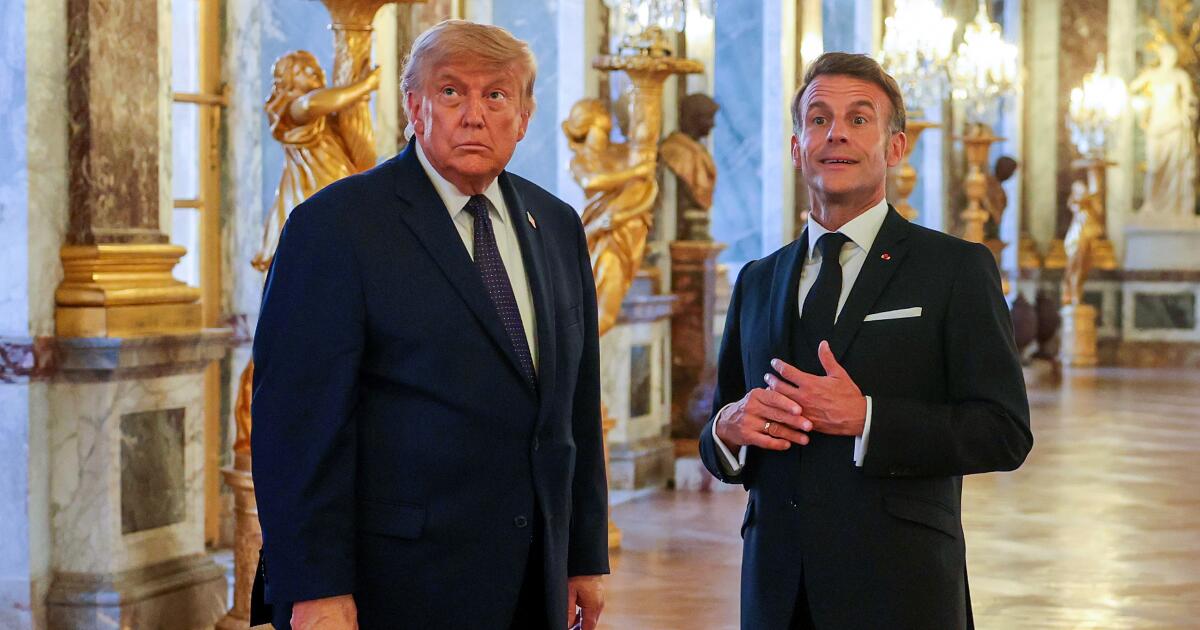
Despite mounting criticism, Trump put his signature to the memorandum on Wednesday night while attending a dinner with the French president in Versailles, a palace infamous for hosting a treaty signing that disgraced Germany at the end of the First World War.
He defended the agreement while in Europe and suggested further concessions might be forthcoming, including recognition of Iran’s claimed right to enrich uranium and a new willingness to tolerate its continued ballistic missile development — another program that Trump had vowed to eliminate as a central war aim.
“He took America to war — killing 13 soldiers, thousands of Iranian civilians and costing taxpayers $60 billion — to get rid of Iran’s missile program. And now that he’s lost the war, he pretends like it’s no big deal,” said Sen. Chris Murphy, a Democrat from Connecticut.
“Just unforgivable,” he added. “What a charlatan.”
-

 San Diego, CA6 minutes ago
NASCAR makes history with inaugural Naval Base Coronado race
-
 Milwaukee, WI8 minutes ago
Stolen Oak Creek couple’s car found by viewer dumped near Milwaukee apartment complex
-

 Atlanta, GA14 minutes ago
18 essential Atlanta restaurants, from neighborhood gems to MICHELIN-starred destinations
-

 Minneapolis, MN21 minutes ago
Hmong in Minnesota: 50 Years of Resilience
-

 Indianapolis, IN24 minutes ago
1 critical after shooting on near east side of Indianapolis
-

 Pittsburg, PA29 minutes ago
SportsNet Pittsburgh parts ways with Penguins rinkside reporter Hailey Hunter after three seasons
-

 Augusta, GA36 minutes ago
Progress continues on James Brown Linear Park in downtown Augusta
-

 Washington, D.C39 minutes ago
Vans Warped Tour Day One at RFK Festival Grounds in Washington, DC – Loud Hailer Magazine

