News
Americans Wrestle With How Trump’s Tariffs May Change Shopping Lists


Charlene and Phil Willingham had been thinking for a while about replacing the 20-year-old appliances in their kitchen, but with the sudden prospect of rising costs, they decided that this was the moment. The Willinghams, both retired, turned up at a store in the suburbs of Chicago on Friday with a long shopping list: stove, refrigerator, microwave oven and dishwasher.
“We were going to take our time to get new appliances, but now because of these tariffs, I want to get them before any price increases take place,” Ms. Willingham, 64, said while shopping at the Abt Electronics store in Glenview, Ill. Of the Trump administration’s sweeping announcement of tariffs across the globe last week, she said, “It sort of set the fire.”
In grocery stores, car dealerships, malls and big discount chains around the country, interviews with more than two dozen Americans this weekend showed that many were racing to figure out how to get ahead of the new tariffs plan, quickly making calculated purchases, big and small.
“The panic is enough to make me want to buy,” Shali Santos, 28, said, after stocking up on essentials in bulk — water, soap, mouthwash — at a Costco Wholesale store in Marina del Rey, a waterfront community in Los Angeles County, and noticing that many people around her seemed to be stocking up more than usual on similar staples.
Others said their shopping habits were unchanged by the tariffs announcement, largely because they had patience and trust in the president’s long game, and figured that any short-term pain, including potential cost increases, would work itself out.
“I’m confident it will recover,” Gregg Harris, 61, said as he shopped for food at a Walmart in Nashville.
Nearly all, though, expressed lingering uncertainty about exactly how these tariffs — at least a 10 percent government surcharge on nearly all goods imported into the United States as well as higher rates on goods from many countries — would play out in their daily lives. How and when might prices be affected by President Trump’s moves? What items might be most hard hit? Even if they knew the answers to such questions, some asked, could they really afford purchasing big ticket items right now to avoid higher costs later?
“He’s doing a lot, which, I mean, that feels like a change, which can be refreshing,” said Mitchell Kwapick, 28, as he shopped for a nephew’s birthday gift at Target in suburban Milwaukee. “But it’s a lot of stuff that’s scary right now.”
The announcements of the tariffs quickly tanked global markets, dealing a blow to investment portfolios, and economists say many of the costs associated with the tariffs will be passed on to consumers. Supporters said the tariffs would ultimately bring jobs back in the United States, while opponents said they would upend the economy.
Among people interviewed at stores this weekend, levels of concern about rising prices — and new urgency to beat any effects of tariffs — seemed closely tied to partisan alliances.
At the Abt Electronics store in Glenview, where business was swift, Laura Papa, 44, came in with her family looking for a new wall oven and refrigerator.
“We were hoping to wait until the summer, but then this fiasco happened,” said Ms. Papa, an accountant who voted for Kamala Harris in November. She said that she viewed tariffs as likely to wreck the nation’s economy and offered advice to others browsing in the store: “You better get stuff before the price increases come.”
In Marina del Rey, Tamela Plaine, who also works as an accountant and voted for Ms. Harris, said she began to worry about tariffs immediately after Mr. Trump was elected, and rushed out to buy a Hyundai S.U.V. before he took office to avoid rising prices.
After the tariffs were announced last week, Ms. Plaine, 48, said she felt compelled to shop in bulk for a wide range of items at Costco in case their price tags started rising. But she said she also was hemmed in by circumstances that many Americans may be facing: a sense that the costs of ordinary items already are too high and that front-loading big expenses now is not affordable.
“I did panic when I got in there,” Ms. Plaine said of her urge to stock up as much as possible while at Costco. “But I was just like, I have to calm down, because I’m still check-to-check.”
Ms. Plaine said her worries about budgeting and rising costs have even led her to lose sleep in recent days. “I try not to freak out,” she said.
But many shoppers who had voted for Mr. Trump said they were not adjusting their buying habits at all based on tariffs.
“I love them,” Dixon Witherspoon, 66, said of tariffs as he shopped for an oven lightbulb at a Target in Nashville. “The problem with America is everybody is worried about their quarterly stock report and everything is short-term vision, which is not good for anything.”
Mr. Witherspoon, a retired executive in the insurance sector who said his own stock portfolio had seen significant losses, said he expects tariffs to enhance the nation’s manufacturing independence and make a fairer playing field for U.S. businesses. “Tariffs are going to be painful in the short run, but in the long run, they are going to be wonderful,” he said.
In Milwaukee, J.J. Kennedy, who said he strongly supports President Trump, said he did not expect his shopping habits to shift following the launching of tariffs.
Mr. Kennedy, who owns an architectural design company and was buying computer keyboards at a Best Buy, acknowledged that tariffs had sparked concern and confusion in the construction industry, and that new home prices could be affected.
Still, he did not expect it to matter.
“People are just going to pay the difference,” Mr. Kennedy, 45, said. “Inventory is so low around here, it’s unbelievable.”
Many shoppers said the prospect of tariffs simply added to anxiety about an already unforgiving economy. Even if prices had yet to surge, uncertainty about what was ahead and sudden declines to retirement savings accounts were worrying signs.
“Either directly or indirectly, everyone’s impacted — 401(k)s, my stocks have been impacted, my mother’s pension is being impacted, a lot of people’s investments are being impacted,” said Alonzo Beyene, the owner of a technology business who was shopping in Miami on Saturday morning.
In Milwaukee, Juanita Norris said her retirement account lost $8,000 in just two days.
“That’s $8,000 that could have gone toward a car for my kids,” she said.
She was planning to help them buy a car this spring, she said, but if prices rise, she will need to wait anyway.
Back at the appliance store in Illinois, the Willinghams studied a stainless steel six-burner stove.
Both Democrats, they contemplated the point of the tariffs.
“I don’t see how it benefited the American people,” Ms. Willingham said. “I really hope and pray things can be resolved soon.”
Mr. Willingham, 65, was more resigned: “It is what it is,” he said.
Robert Chiarito contributed reporting from Glenview, Ill., Mimi Dwyer from Los Angeles, Jamie McGee from Nashville, Dan Simmons from Milwaukee, and Verónica Zaragovia from Miami.



A former CIA official was arrested last week after FBI agents allegedly found $40 million worth of gold bars at his home while investigating whether he lied about his educational and military background, according to court records and sources familiar with the matter.
David Rush is currently being held in jail while both his defense attorneys and federal prosecutors “gather and evaluate additional information” to assist the court in determining whether he should remain detained, court filings say. They have jointly requested to postpone his detention hearing until June 5 in the U.S. District Court for the Eastern District of Virginia.
In a joint statement from the FBI and CIA, both agencies said that Rush was arrested following a referral from the CIA, after an internal investigation identified “potential violations of law.”
The CIA and FBI added they are continuing to investigate the matter.
Jessica Carmichael, a defense attorney representing Rush, declined to comment.
Rush was charged with one count of stealing public money. In an unusual criminal complaint, the FBI accuses Rush of taking the gold bars, “obtaining a fraudulently inflated salary and fraudulently obtaining military leave” and making a litany of false statements about his background. The complaint does not specify exactly what alleged conduct led to the charges.
Between November 2025 and March of this year, Rush allegedly made several requests to the government to obtain large amounts of foreign currency and tens of millions of dollars in gold bars for work-related expenses, the complaint says.
Rush’s employer at the time, which sources confirmed was the CIA, was not able to later locate the gold bars or determine their intended use.
When FBI agents searched his home on May 18, they found approximately 303 gold bars, in a value estimated to exceed $40 million, the complaint says. They also recovered $2 million in U.S. currency and 35 luxury watches.
The FBI also accused Rush of lying to the U.S. Navy when he enlisted in 1997 by providing them with transcripts and other records falsely indicating he had earned an undergraduate degree from Clemson University. Because of his ostensible degree, Rush was commissioned as an ensign in the U.S. Navy Reserves in 2004 and was honorably discharged in 2015.
The complaint says he then applied for employment with the federal government three times, citing degrees from Clemson University, Rensselaer Polytechnic Institute and the Naval Postgraduate School. He also listed those schools when he applied for his security clearance.
Later, in 2018, he submitted an application to enter senior executive service and claimed to be a graduate of the United States Air Force Test Pilot School, as well as the current director of test for a 145-person, 18-aircraft joint Army/Navy weapons test organization, the complaint says.
“The FBI’s investigation has revealed that Rush’s applications contained false information about his education background and work with the United States military,” the sworn statement accompanying the complaint says, noting that he did not graduate from Clemson or RPI, and never served as a pilot for the Navy.
The FBI also accused Rush of telling the government he was in the Navy Reserves even though he had been honorably discharged, allowing him to claim tens of thousands of dollars in compensation for military leave.

Since the massacre at Robb Elementary in Uvalde in 2022, school districts across Texas have spent billions of dollars to station police officers on every campus in the state. The effort, the most ambitious in the nation, was intended to protect students from similar tragedies.
But the constant presence of officers has transformed the way many public schools manage discipline, subjecting students to heavy-handed police tactics for behavior that once would have landed them only in the principal’s office, The New York Times and The San Antonio Express-News found.
Officers in Texas displayed startling belligerence at times, grabbing or tackling students a fraction of their size over misconduct that often appeared to be minor. Children in elementary school, including one as young as 6, were handcuffed. Teenagers were arrested, charged with crimes and even jailed. In the most extreme cases, they wound up in hospitals, bruised or concussed, after being body-slammed or shocked by Tasers, which are prohibited in the state’s juvenile detention facilities but allowed in its public schools.
There is no comprehensive record of use-of-force incidents across the more than 1,000 public school districts in Texas. Many districts and police agencies declined to disclose their data to our journalists; others did not respond to public records requests. More than 200 provided some information, but in most cases, it was limited.
Still, by examining even that small share of records, our reporters identified more than 2,600 use-of-force incidents that occurred from January 2022 through December 2025. About 450 of those interactions were described in detailed reports, which we reviewed. We also watched video footage from over two dozen encounters.
The records provide a first-of-its-kind look at how Texas’ initiative around school policing has played out in districts large and small, urban and rural.
Many incidents began over misbehavior such as dress-code violations, vaping or schoolyard scraps. Officers, often summoned by principals or teachers, escalated some situations by shouting obscenities or insults. They used physical takedown tactics in about 60 situations when students ignored their commands, talked back or pulled away.
In the Judson school district, which includes parts of San Antonio, an officer slammed a 15-year-old boy onto a table after he threw a cheese stick at another student, according to witnesses cited in public records. In a statement, the school district said that the student had tried to walk away from the officer, who used “necessary force to gain control of the situation.”
In the Cypress-Fairbanks district, near Houston, an officer hogtied a 10-year-old boy with a behavioral disorder who had kicked the principal, using a cord to bind his hands and feet behind his back, an internal investigation found. The officer had twice before used the same restraint technique, when the boy left campus during school, the records show. The district later banned the practice.
Tayshawn Chadwick, 17, was suspended from his school in the Aldine district for threatening to fight another student in December 2023. When he tried to retrieve his house keys from a classroom before leaving campus, a school officer pinned him against a window, according to records. Another officer pressed a Taser against his skin and shocked him repeatedly.
“It felt like a lightning bolt,” Tayshawn recalled in an interview.
Tayshawn was charged with resisting arrest and held in the county jail. The charge was dismissed after he completed an anger-management program. The school district declined to comment on the incident; records show that the officers’ supervisors deemed their actions in compliance with department policy.
In interviews, dozens of parents, teachers, principals and students said that they believed police officers were needed to keep schools safe. Many praised officers for stopping violent fights. Almost everyone cited fear of school shootings. As recently as March, a student at a high school in the San Antonio area shot a teacher and then killed himself. School officers have confiscated dozens of guns in that region alone, and some have thwarted potential attacks.
“Just look at the TV,” said LaTres Essien, who teaches third-grade math in Dallas. “There’s no school in America that should not have some kind of officer.”
Police chiefs said physical force was necessary in police work, even at schools. “We can’t be lackadaisical and say, ‘Well, we’re in a school, and maybe we shouldn’t go hands on with this student,’ and then it rises to a level that he or she does hurt someone,” said Charles Carnes, who in December retired as chief of the Northside school district’s department in San Antonio.
Some departments disciplined officers for going too far, including in the hogtie incident and the pepper-spray and vape cases shown in the videos above. (Neither the officer involved in the lunchroom brawl case nor his department provided comment.)
But in Texas, no state agency has the power to routinely review school officers’ actions and weigh in on possible overreach.
Lawmakers here have embraced school policing without establishing safeguards required for meaningful accountability, policing experts said. A 2019 law meant to keep officers out of “routine student discipline” does not define the term or detail repercussions for violations. Police departments in Texas are not required to report incidents of force in schools unless they shoot someone.
School boards and police agencies are responsible for oversight, state officials said. But in interviews, two dozen board members from across Texas said they did not consider that part of their job. “We just approve what they need to buy,” said Michael Valdez, a board member in the Edgewood school district in San Antonio.
Several said they were unaware that their officers used force on students at all.
A review of use-of-force policies from more than 200 school district police departments found that many were largely copied from those used by municipal police agencies. Some addressed how to handle livestock and animal control calls. Most provided no specific guidance on handling students.
‘Eyes Wide Open’
Police officers have been assigned to some schools in Texas for nearly a century. In the 1930s, newspaper articles show, the Houston Police Department employed part-time “school policemen” to help direct traffic.
But it was not until the 1980s and ’90s, amid concerns about drugs and violence, that the ranks of school officers began to swell. The 1999 shooting at Columbine High School in Colorado led to a larger rise.
Elsewhere in the country, school districts typically tapped the local sheriff’s office or police department for officers. Texas was unusual in that many districts formed their own departments instead.
As police presence in schools grew, some educators became wary of harsh punishment and practices that could push students into the criminal justice system. Even in law-and-order Texas, concerns seemed to break through. In 2019, the Legislature passed a law saying that school boards should not task officers with routine student discipline.
Then came Uvalde, the deadliest school shooting in Texas history, which claimed the lives of 19 students and two teachers.
A year later, in 2023, lawmakers passed legislation to require at least one licensed police officer at each of the state’s public schools. While other states had taken steps to increase school security, few relied as heavily on the police.
Before the Texas law was adopted, some parents, teachers and advocates warned that it would lead to more arrests and incidents involving force. Alycia Castillo, the associate director of policy and advocacy for the Texas Civil Rights Project, a nonprofit based in Austin, said that several groups had already raised concerns about heavy-handed police tactics in schools. Lawmakers, she said in an interview, had their “eyes wide open.”
In the two years that followed, statewide annual spending on school security rose to more than $1.3 billion from about $900 million.
Today, Texas is home to nearly 400 school district police departments, more than all other states combined. Most of the remaining districts have contracts with outside police agencies. The number of officers trained to work in schools — about 11,000 — exceeds the total number of police officers in at least two dozen states.
Most of what school officers do is mundane. They secure external doors, usher students through metal detectors and monitor hallways for fights. Some mentor students and offer advice.
But routine interactions have been punctuated at times by physical encounters. Officers grabbed or tackled students hundreds of times, data and records show. They used pepper spray in dozens of cases and shocked students with Tasers in at least nine incidents. On four occasions, reporters found, officers held teenagers at gunpoint.
Some large school districts reported using force more than 100 times in a school year. In an interview, Kirby Warnke, the chief of the Corpus Christi school district police department, said that his officers got physical with students “almost every day,” often to restrain or redirect them.
Students were left with bruises, scrapes or other injuries in nearly a quarter of the 450 cases reviewed by reporters. Two teenagers suffered concussions, according to medical records and an interview with one family’s lawyer.
About two dozen of the overall cases involved children in elementary school. In the Northside school district, an officer handcuffed a 6-year-old boy who kicked a school employee during a tantrum.
State law prohibits using restraints on children in fifth grade or below in all but the most dangerous situations. In a statement, the district said that the officer had perceived an “immediate risk of harm.”
The boy was still in cuffs when his father arrived a few minutes later and began filming on his cellphone.
“The police wants me to die!” the child cried.
‘The Heavy Hand’
In May 2024, Anabelle Jaramillo rang a plastic doorbell outside a classroom at Texas City High School. The $13 bell came off and Anabelle walked away with it, according to a description of surveillance footage included in a police report.
The next day, administrators accused the 17-year-old honor student of theft and assigned her three days of in-school suspension.
Certain there had been a misunderstanding, Anabelle showed up at the office of Sonia Davis, an assistant principal. She told Ms. Davis that she had accidentally dislodged the doorbell and tucked it into a nearby planter so that she would not get in trouble, she recalled in an interview.
Still, Ms. Davis summoned the Galveston County sheriff’s deputies at the school and, body camera footage shows, asked them to speak with Anabelle about theft.
Anabelle continued to plead her case. She texted her mother, and Ms. Davis extended her suspension by two days for using a cellphone in the office. Ms. Davis told Anabelle to leave. But the teenager would not budge from her seat.
Anabelle gasped for air for about three minutes before going still, body camera footage shows. Ms. Davis called for the school nurse. Deputy Ruiz took her pulse. Anabelle later told reporters that she had passed out.
Other cases reviewed by reporters similarly escalated.
A staff member called for an officer when a 17-year-old in a special education class threatened a classmate and threw a “sanitizer can” at the student, the police report said; the officer dragged the boy to the ground and, after a scuffle, punched him in the face twice, video footage shows.
A teacher alerted an officer to a 15-year-old who was swearing in a hallway; the officer took the student down, records show, and dragged him into a room by his leg.
In interviews, educators said that they sometimes needed help managing unruly students. Many feel pressure to be tough on misbehavior, said Anita Wadhwa, a former teacher who now runs a nonprofit in Houston focused on alternative approaches to school discipline.
“No adult wants to look like a kid is talking back to them,” she said.
Some school district leaders said that they had sent a clear message: Officers should get involved only if a student is accused of a serious crime or if someone is at risk of physical harm.
“Our officers are not disciplinarians, period,” said Sean Maika, who was the superintendent of the North East Independent School District in San Antonio until January.
But in many places, that message seems to have gotten lost. Michelle Parsons, who teaches a training course required for school officers in Texas, said that officers frequently described being pulled into minor disciplinary matters. At a recent training attended by a reporter, officers were told to stay out of incidents that would not otherwise prompt a 911 call. Several scoffed and said their principals would be unhappy.
Mrs. Parsons said that principals and teachers often see officers as “the heavy hand.” Texas does not require them to be trained on when to call school police.
Shortly after Anabelle’s arrest, her mother, Martha Jaramillo, arrived at the school to find her on the ground, footage shows. “She was very rude to us,” Ms. Davis, the assistant principal, told Mrs. Jaramillo.
Mrs. Jaramillo told the nurse about her daughter’s health conditions, including asthma. One of the deputies called for paramedics, who took the teenager to an emergency room.
Two weeks later, Anabelle turned herself in at the county jail for the theft charge. There, she said, she had another panic attack.
Neither Ms. Davis nor Texas City school district officials agreed to be interviewed for this article. In a statement, the district said Ms. Davis had not violated its policies. The Galveston County Sheriff’s Office declined to comment. The deputies involved in the case did not respond to multiple efforts to reach them.
Kim Simon, a national expert on school policing and a former officer from Virginia who reviewed the case for The Times and The Express-News, said that Ms. Davis and the officers had escalated a minor offense unnecessarily.
“Nobody was acting in the best interest of a child,” Ms. Simon said.
Command and Control
Across the state, officers directed obscenities, insults and threats at students just before or after using physical force, records and video footage show.
“Stop crying like a little girl,” a school police officer in San Antonio ordered a seventh-grade boy who had gotten in trouble for being disruptive.
“Boy, I will hurt you,” an officer in Houston told a high school student who talked back to him.
“Get your fucking hands up before I shoot you!” an officer in Galveston shouted while pointing her gun at a 17-year-old she had cornered in a yard. The teen had run off campus after he was caught with a vape.
Most officers employed by a Texas school district previously worked for municipal police agencies, an analysis of police certification data found. More than 1,000 worked as jailers.
In those roles, officers are encouraged to have a commanding presence in order to take control of dangerous situations.
“The notion of policing requires force,” said Aaron Kupchik, a professor of sociology and criminal justice at the University of Delaware, who writes about school policing. “It requires that you compel people to obey your authority.”
But dealing with young people, he and other law enforcement experts said, calls for a different approach. Research shows that adolescents, whose brains have not yet fully developed, often have difficulty with impulse control. Yelling at or physically dominating them, the experts added, can backfire.
In Texas, the state-mandated training for school police officers includes instruction in child psychology, conflict resolution and managing students with behavioral issues. But at only 20 hours, the program is half the minimum recommended by the National Association of School Resource Officers. Kentucky, which also mandates officers at all public schools, requires 120 hours.
When officers used force on students, department leaders almost always had the final say on whether they acted within bounds or overstepped.
Supervisors often reviewed forms describing the incidents, and they noted on some whether they approved of the officers’ actions. Reporters examined more than 100 such documents, finding that supervisors almost always determined that the force had been appropriate.
In some other cases reviewed by reporters, officers were disciplined, but received little more than verbal warnings or orders to get additional training.
In 2024, Officer Linda Holland used pepper spray to stop a group of girls from fighting and then kneed one of the girls in the face, video footage shows. She was required to complete four training courses, including one on ethics, according to an internal report. A supervisor wrote that her actions were “not a good look.”
Officer Holland hung up when a reporter called for comment. In a statement, the district described the scene as “chaotic,” adding that the officer did not intend to hurt the girl.
Some parents, records show, took concerns about officers to the Texas Commission on Law Enforcement, which licenses all of the state’s police officers. But the commission says it cannot investigate excessive force complaints unless the officer was criminally charged.
In at least two cases, when parents have filed federal lawsuits against officers over use of force, the appellate court that covers Texas ruled against their claims. In 2023, the court ruled in favor of an officer who used a Taser on a 17-year-old boy with an intellectual disability when he tried to leave school. The court said that the officer’s actions were akin to corporal punishment, which is legal in Texas.
Alienated and withdrawn
Some students who were subject to physical force from police officers said that they had suffered lingering consequences.
Tayshawn Chadwick, who was stunned with a Taser, said he stopped leaving the house. Julian Montes, who was slammed into a lunch cart, is now afraid of police officers.
Anabelle Jaramillo said the doorbell incident led her to become withdrawn from even close friends.
Prosecutors dismissed the theft charge after she completed an online course about stealing. But she was mortified when a crime website posted her mug shot. She finished her classes from home and skipped her graduation ceremony.
Two years later, Anabelle has finally begun to put the trauma behind her. She gave birth to a son and completed community college. She plans to attend a nearby university in the fall in hopes of becoming a veterinarian. But the police episode has made her less trusting. The adults at her high school, she said, had failed her.
“I thought they’re there to hear you out, to build you up and get you into the future,” she said. Instead, “They broke me down.”
Justin Mayo, Melissa Manno, Liz Teitz, Maggie Allwein and Teresa Mondría Terol contributed reporting. Susan C. Beachy, Kitty Bennett, Alain Delaquérière, Georgia Gee, Sheelagh McNeill and Kirsten Noyes contributed research. Produced by Nico Chilla, Jerry Vienna and Rumsey Taylor. This article was reported in partnership with Big Local News at Stanford University.

Texas Attorney General Ken Paxton speaks at an election night watch party held by the Lone Star Liberty PAC Tuesday in Plano, Texas. Paxton defeated Sen. John Cornyn, R-Texas, in a Senate primary runoff election and will face Democrat James Talarico in the November general election.
Stewart F. House/Getty Images
hide caption
toggle caption
Stewart F. House/Getty Images
Stay up to date with our Politics newsletter, sent weekly.
President Trump’s stamp was all over Tuesday’s Texas primary runoff results as his pick for Republican Senate nominee, Texas Attorney General Ken Paxton, toppled Sen. John Cornyn, and his endorsed candidates proceeded to the general election in other races up and down the ballot.
But Democrats put their mark on this race too, even without a marquee race like the Senate primary, which was decided in March. Ousting longtime Democratic Rep. Al Green was the first sign that voters are ready for something new in Washington — and that Texas Republicans’ redistricting hopes might be working out.

Here are four takeaways from Texas’ primary runoffs.
Ken Paxton v. James Talarico sets up expensive Senate race
Texas held one of the first Senate primaries on March 3. Now that the general election matchup is set, though, don’t expect to stop hearing about it. With Paxton’s win on Tuesday night, the Senate seat in Texas became much more competitive than it would have been had Cornyn won. Cook Political Report moved the race from rated as Likely Republican to Lean Republican just moments after the race had been called Tuesday night.
A University of Texas/Texas Politics Project poll from mid-April that tested the matchup between each Republican candidate and the Democratic nominee, state Rep. James Talarico found that Talarico came out ahead of each Republican by roughly the same amount.
But more importantly, nearly 1 in 5 voters polled had not made their minds up in the race between a Republican and Talarico. While some of that support will likely solidify given Trump’s endorsement of Paxton and his win in the primary, that still leaves a lot of voters up for grabs.
The Texas Senate race is already the second most expensive race in the country this year, after the California governor election. According to NPR’s partners at AdImpact, overall, more than $108 million has been spent on that one race this year. Republicans spent almost $75 million of that.
The most recent quarterly campaign finance data shows Talarico has built a significant war chest of his own and he has not had to spend anything as Paxton and Cornyn battled it out. Texas has long been a dream for Democrats, even though one has not won statewide here since 1994 — it’s been even longer than that for a Democratic Senate nominee.

Texas Democratic Senate candidate James Talarico speaks at a campaign rally on March 2 in Houston, Texas.
Danielle Villasana/Getty Images
hide caption
toggle caption
Danielle Villasana/Getty Images
The Talarico/Paxton race gives Democrats their best hope in a long time. But the party often gets ahead of itself in Texas, which is still a solidly red state with Republicans controlling pretty much everything in Austin. Remember, those same Republicans drew the map that led to some of the congressional runoffs seen Tuesday night.
Turnout is really going to matter in November
It’s a cliche, right? It will all come down to turnout in Texas. In Tuesday’s primary, NPR’s Senior Political Editor and Correspondent Domenico Montanaro crunched the numbers. Paxton saw a decisive victory — his race call came right as polls closed statewide which is a sign that he was so far ahead there was no mathematical way for Cornyn to catch up.
But the Texas Republican Senate primary runoff had a lot fewer voters to contend with. In 2022, Greg Abbott won the Republican primary for governor outright — no runoff — with a similar margin that Paxton enjoyed over Cornyn. He got 1.2 million votes. Paxton has significantly fewer than a million.
Republicans have seen this kind of lackluster turnout in primaries across the country and despite high profile races. Meanwhile, Democrats have been showing up in 2026 in a big way, starting in Texas. So if Republicans cannot appeal to voters more than the couch and Democrats continue to enjoy this enthusiasm, Texas may see more than a few blue cracks in its red wall.
Democratic voters are asking for new leaders
It is a tough time to be a long-serving Democrat incumbent in Congress. Several of those incumbents will be tested by better-funded challengers in California on June 2 but one, Rep. Al Green, who has represented part of Houston for more than 20 years, lost to fellow incumbent, Rep. Christian Menefee, in the newly redrawn 18th Congressional District.
But Green was also targeted by Texas redistricting which drew part of his original district, including his home, into the 18th. His current district, the 9th, is now a solidly Republican seat in the new map.
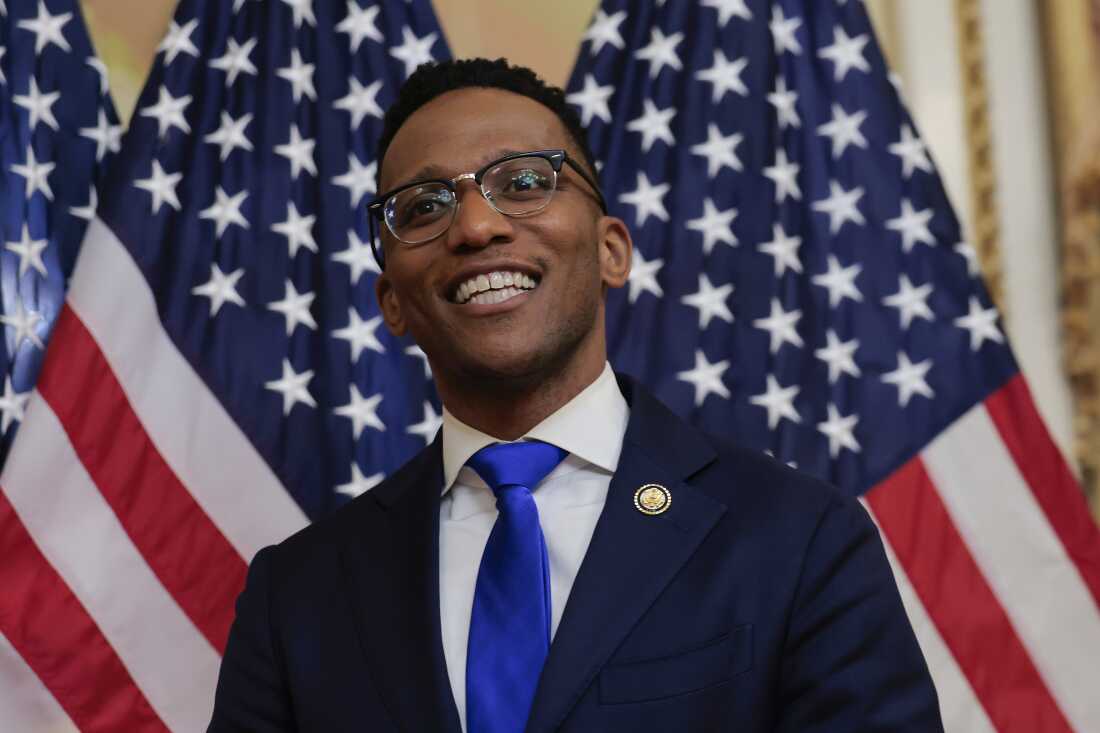
Rep. Christian Menefee, D-Texas, smiles during his swearing-in ceremony at the U.S. Capitol on February 2, 2026 in Washington, D.C.
Heather Diehl/Getty Images
hide caption
toggle caption
Heather Diehl/Getty Images
Another incumbent, Rep. Julie Johnson, also lost Tuesday to a familiar face. Former Rep. Colin Allred challenged her for the nomination. Johnson replaced Allred in the House when he left to run against Sen. Ted Cruz in 2024. Now, he’ll likely retake the newly renumbered, safe blue seat in November.
Democrats did manage to avoid nominating a controversial pick in the somewhat competitive 35th Congressional District. Maureen Galindo drew criticism after she made antisemitic comments but ultimately lost Tuesday.
Still, Democrats may have to pin their hopes on the Senate race. Both of the most competitive House seats in November are already being held by Democrats and pickup opportunities look less and less likely.
Republicans are forecast to win 3-5 seats House seats in Texas alone, and Trump’s influence over the Republican Party led to victories for several of his endorsed candidates. In the 9th Congressional District — a prime Republican pickup opportunity — and the aforementioned 35th, the candidates Trump endorsed won. In both cases, they beat Republicans backed by Texas Gov. Greg Abbott.
The YOLO caucus gets its newest member … maybe
When Cornyn delivered his concession speech Tuesday evening, he did not mention Paxton by name, but he said he remained committed to the Republican Party.
“There’s a simple rule in elections. You’ve heard me say it before, and that is the candidate who gets the most votes wins. The party in the majority gets to govern. And my hope is to keep my party in power for generations,” Cornyn said.
The generally mild-mannered lawmaker is the newest potential member of what NPR is calling the “YOLO caucus” in Congress. Shorthand for “you only live once,” the slang is used to signal things that you might not do in normal circumstances. In this case, Cornyn joins the likes of fellow Republicans defeated by Trump-backed challengers, Sen. Bill Cassidy of Louisiana and Rep. Thomas Massie of Kentucky. Sen. Thom Tillis of North Carolina, a fellow YOLO caucus-er, chose not to run for reelection this year rather than face Trump’s wrath.
With narrow margins in both the House and the Senate, just a few lawmakers who want to burn it all to the ground on the way out the door could change things entirely for the president’s legislative agenda. Trump may have sacrificed his policy hopes for political wins in party primaries. The candidates he has backed in more competitive general election matchups are not always the most popular to the wider electorate.
But Cornyn hasn’t signaled what he’ll do with his final seven months in office, keeping it vague in his concession speech.
“I intend to continue my work to help make this nation a better place for all Texans and all Americans.”
-
 Lifestyle28 minutes ago
Keke Palmer steals the (fashion) scene in ‘I Love Boosters’ : Pop Culture Happy Hour
-

 Technology41 minutes ago
YouTube will let you ask AI to make a custom video feed
-

 World47 minutes ago
Crash involving speeding train, minibus in Belgium leaves 4 dead including 2 children
-

 Politics53 minutes ago
RFK Jr. responds to snake-handling critics with new video showing him wrangling a venomous rattlesnake
-

 Health59 minutes ago
Doctors push new blood tests for colon cancer as cases surge in younger adults
-

 Sports1 hour ago
Caitlin Clark listed as probable for Fever-Valkyries rematch following early season back issues
-

 Technology1 hour ago
Are bank text codes enough to protect you?
-
 Business1 hour ago
Dark Horse Comics to close all Things From Another World storefronts

