Politics
Under Trump, Texas firm pushes to restart Santa Barbara oil drilling. Is it skirting California laws?


More than 50 years ago, a catastrophic oil spill along Santa Barbara’s coastline served to galvanize the modern environmental movement and also helped to usher in one of the state’s strongest conservation laws: the California Coastal Act.
Now, as the Trump administration seeks to encourage oil and gas production within federal lands and waters, that watershed conservation law is being tested along the same stretch of coastline — and in a way it never has before.
For months, a Texas-based oil company has rebuffed the authority of the California Coastal Commission — the body tasked with enforcing the act — and has instead pushed forward with controversial plans to revive oil production off the Gaviota Coast.
Ten years after another spill brought oil production here to a halt, Sable Offshore Corp. has begun repairing and upgrading the network of oil pipelines responsible for that 2015 spill, without Coastal Commission approval and ignoring the commission’s repeated demands to stop its work, officials say.
Crews bag oiled sand and kelp at Refugio State Beach in May 2015, after a ruptured pipeline near Santa Barbara leaked an estimated 140,000 gallons of crude oil.
(Al Seib / Los Angeles Times)
“This is the first time in the agency’s history that we’ve had a party blatantly ignore a cease and desist order like this and refuse to submit a permit application,” Cassidy Teufel, deputy director of the California Coastal Commission, told a packed town hall recently.

Aggressive and impactful reporting on climate change, the environment, health and science.
Sable has accused the commission of “overreach” and insists that it has acquired the necessary approvals for its work.
The company intends to revive operations at three oil platforms known as the Santa Ynez Unit, which connects to pipelines that have been the focus of the ongoing repair work after a corroded section of those pipes ruptured near Refugio State Beach in 2015. That pipeline failure, which occurred under different ownership, spewed an estimated 140,000 gallons of crude oil, harmed hundreds of miles of coastline and cost millions to clean up.
In a new report, Coastal Commission staff allege that Sable’s activities — which include excavation, grading, removing vegetation and placing cement bags on the seafloor — “have adversely impacted, and continue to adversely impact, coastal resources as a result of Sable’s outright refusal to comply with the Coastal Act.”
The report recommends that commissioners fine Sable almost $15 million, issue another cease and desist order for all development along the pipelines and require restoration work.

The requested sanctions will be considered next week at a public hearing — one of the first such venues for citizens to weigh in on reactivation of the offshore oil rigs and how that could affect the local environment, which has long concerned Santa Barbara residents and climate activists.
Sable insists it does not need to comply with the latest Coastal Commission requests.
“The repair and maintenance work done to ensure the safe condition of the Santa Ynez Unit and onshore pipelines was fully authorized by coastal development permits previously approved by the California Coastal Commission and Santa Barbara County,” Steve Rusch, Sable’s vice president of environmental and governmental affairs, said in a prepared statement. “Commission staff’s unreasonable overreach is an attempt to exert influence over the planned restart of the Santa Ynez Unit oil production operations.”
In a statement of defense submitted to the Coastal Commission, Sable noted that due to updated requirements, “this pipeline will meet more stringent environmental and safety requirements than any other pipeline in the state.”
The company called the commission’s findings on environmental impacts exaggerated, and noted that it has “implemented several construction best management practices to limit impacts to coastal resources, biological resources, and archaeological resources,” Sable wrote.
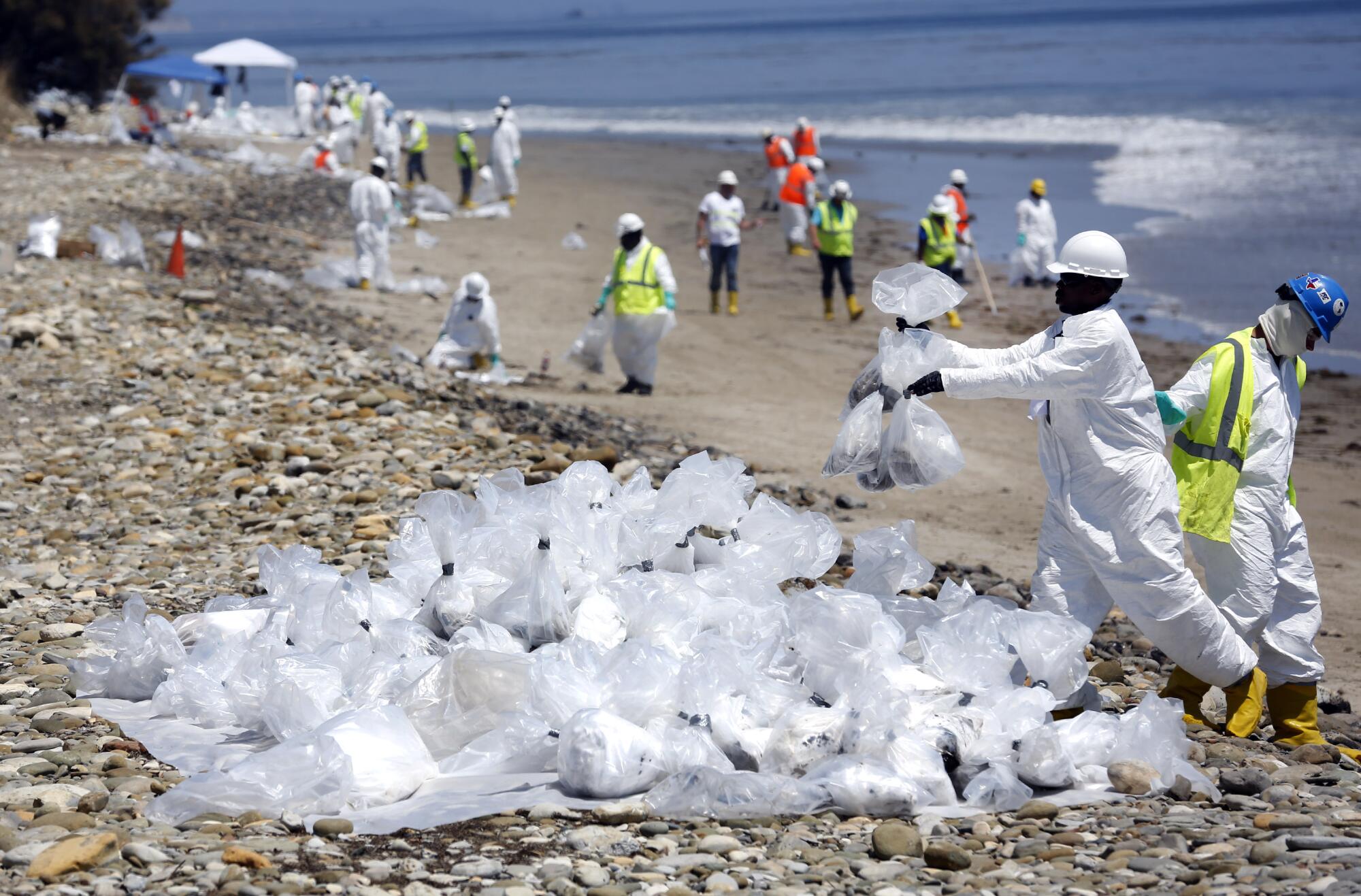
Cleanup workers pile bags of oil-soaked sand at Refugio State Beach in Goleta after a 2015 oil pipeline rupture.
(Mel Melcon / Los Angeles Times)
So who’s in charge of such projects?
If Sable succeeds in restarting operations, it would mark a surprising reversal for California’s oil and gas industry in recent years, as climate-focused policies have slowly reduced the state’s production of fossil fuels.
The Houston-based company estimates that once the Santa Ynez Unit is fully online, it could produce an estimated 28,000 barrels of oil a day, according to an investor presentation.
The unit has three offshore platforms — Hondo, Harmony and Heritage — located in federal waters a few miles off the coast. These platforms are connected to the Las Flores Canyon processing facility, inland from El Capitan State Beach, and other distribution lines that run onshore. The 2015 Refugio oil spill was caused by the rupture of a buried onshore pipeline.
Sable has said it anticipates restarting offshore oil production in the second quarter this year, but the company acknowledges that some regulatory and oversight hurdles remain. Most notably, its restart plan must be approved by the state fire marshal.

Though Sable has already cleared some of that agency’s major regulatory steps, State Fire Marshal Daniel Berlant has said the company’s final restart plan wouldn’t be approved without agreement from a handful of other state agencies, including the Coastal Commission.
“Before we would ever sign off on a pipeline, [we will make] sure that each of these departments has agreed that all of the rules have been followed,” Berlant said at the March town hall.
Berlant also assured Santa Barbarans that since the 2015 spill, the fire marshal’s office has implemented more stringent standards for oil infrastructure, which are part of Sable’s plan. He said his office requires 67 new conditions focused on safety and corrosion protection, stricter and more frequent monitoring and repair standards.
Sable, however, has most heavily relied on recent approval from Santa Barbara County Planning & Development, which in October said the company could proceed with its corrosion repair work under the pipeline’s original county permit from the 1980s. The company contends it is still relevant because its work is only repairing and maintaining an existing pipeline, not constructing new infrastructure.
After concern from the Coastal Commission and environmental groups, county officials confirmed its position in February, concluding that Sable’s repair work on the corroded pipeline “is authorized by the existing permits … [and] was analyzed in the prior Environmental Impact Report/Environmental Impact Statement.”

A worker cleans oil from the rocks and beach at Refugio State Beach in Goleta, Calif. in 2015.
(Mark Ralston/AFP via Getty Images)
Coastal Commission staff have questioned how a permit from nearly 40 years ago can adequately take into account current technology, requirements to remedy corrosion issues and environmental conditions.
“The removal of the pipeline’s insulation and implementation of this new strategy for managing corrosion risk represents such a fundamental shift in the pipeline’s design and operation that resuming operations under this new system would not be consistent with the existing permit,” the staff report said. It also argues that old permits don’t take into account current habitats or sensitive species in the area, including those newly considered endangered or threatened, such as the steelhead, the tidewater goby and the California red-legged frog.
Ultimately, the matter may be determined in court. In February, Sable sued the Coastal Commission claiming it doesn’t have the authority to oversee its work.
“Sable’s representatives have told us that they’ll only stop if a court makes them, so we’ve been working with the attorney general’s office for the past month to move in that direction,” Teufel said at a town hall last month in Santa Barbara. The event drew hundreds of attendees — clearly divided between those donning Sable hats and others holding signs that read, “No polluting pipeline” and “No coastal permit, no restart.”
But as of yet, California Atty. Gen. Rob Bonta hasn’t weighed in. A spokesperson for the office declined to respond to questions from The Times, referring inquiries to the Coastal Commission.
A controversial legacy
Since 1969, when the blowout of on an offshore oil platform spewed more than 3 million gallons of crude oil into the Santa Barbara Channel and devastated the coastline, environmentalists have fought to shut down offshore oil rigs along the Gaviota Coast. In their view, Sable’s behavior has been beyond the pale.
“So far this has been happening with no environmental review,” said Alex Katz, the executive director of the the Environmental Defense Center, which was founded after the 1969 spill. “For a project that’s this big and has this much risk, it’s very strange.”
At the same time, other residents see economic value in oil extraction.
1

2

3

1. Men in boats and on shore gather in straw being used to soak up oil in Santa Barbara Harbor. A boom helps contain the worst of the oil slick, which has stained 30 miles of coastline. This photo was published in the Feb. 10, 1969 Los Angeles Times. The Santa Barbara oil spill of 1969 (Don Cormier/Los Angeles Times) 2. Cormorant’s bill is held by rubber band during bath to remove oil after the Santa Barbara oil spill. This photo was published in the Feb. 10, 1969 Los Angeles Times. (Mary Frampton/Los Angeles Times) 3. Workman Dave Kirkwood sprays live steam rocks at the harbor at Santa Barbara breakwater to clear oil smears. This photo was published in the Feb. 10, 1969 Los Angeles Times. The Santa Barbara oil spill of 1969 (Don Cormier/Los Angeles Times)
Santa Barbara County Supervisor Bob Nelson has called much of the concern around the pipeline “political theater.” He said he generally agrees that Sable has the necessary permits to restart oil production, and noted that local oil is better than the alternative, especially when there’s still demand for such fuel.
“If you really cared about climate change, you’d want to use this oil,” Nelson said in an interview, arguing that it’s better to use local resources than oil shipped from around the world, where there are likely fewer environmental regulations and no local tax revenue or jobs. Sable has reported it expects the project to initially generate $5 million a year in new taxes for the county and, upon restart, would support an additional 300 jobs.
At the town hall last month, Assemblymember Gregg Hart (D-Santa Barbara) called on California’s attorney general to get involved in this process to uphold the state’s environmental laws, noting that there are clear risks, as with any offshore drilling project.
“It is a false choice to say we have to choose between protecting our environment and growing our economy,” Hart said at the packed hearing that included representatives from at least eight state agencies.. “We have experience here in this community of the tragedies that come from companies that don’t operate responsibly. … We have some serious concerns about what’s being proposed with the Sable pipeline.”
Some of those state agencies, including the California Department of Fish and Wildlife, the State Water Resources Control Board and the California Department of Parks and Recreation, have also raised concerns about Sable’s work. The regional water board in December issued Sable a noncompliance notice for unauthorized discharge into waterways, while wildlife officials alerted the company of a potential Fish and Game Code violation. Sable’s response to those issues remain under review.
Yet, the full extent of completed or possible environmental damage from this project remains unclear, the Coastal Commission argues, because Sable hasn’t shared detailed plans or applied for permits. And that’s a precedent that should be concerning for all Californians, said Linda Krop, chief counsel for the Environmental Defense Center.
“This is the biggest threat to the California coast,” Krop said. “They should not be allowed to operate when they’re violating state laws.”
Staff writer Tony Briscoe contributed to this report.


new video loaded: Jan. 6 Rioter Hired by Pentagon
transcript
transcript
Jan. 6 Rioter Hired by Pentagon
Elias Irizarry, who pleaded guilty to climbing through a broken window at the Capitol on Jan. 6, 2021, now works for an office responsible for uncovering and defending against terrorism plots at the Pentagon.
-
“Full pardon or commutation?” “Full pardon.”
By Alisa Shodiyev Kaff
June 4, 2026

NEWYou can now listen to Fox News articles!
Democrats splintered over a resolution seeking to block the U.S. from assisting Israel’s war against Hezbollah, an Iranian-backed terrorist group, on Thursday.
The measure, offered by progressive Rep. Rashida Tlaib, D-Mich., would require President Donald Trump to withdraw U.S. forces from Lebanon. For months, Israel and Hezbollah, a U.S.-designated terrorist group and Iranian proxy, have been at war in southern Lebanon, but the United States has not joined the conflict.
A bipartisan coalition of lawmakers, including House Minority Leader Hakeem Jeffries, D-N.Y., rejected the measure. Critics argued the resolution could aid Hezbollah and potentially hamstring U.S. military operations in the country.
Tlaib’s resolution failed 92-324, with more than half of House Democrats joining nearly all Republicans to vote it down.
The Lebanon war powers resolution divided Democrats, with House Minority Leader Hakeem Jeffries, D-N.Y., joining Republicans in rejecting the measure. (Aaron Schwartz/Bloomberg)
REP RASHIDA TLAIB MOVES TO BLOCK US OPERATIONS IN LEBANON BUT IGNORES HEZBOLLAH
Rep. Thomas Massie, R-Ky., an Israel critic, was the lone Republican to support Tlaib’s measure. Meanwhile, Reps. Derek Tran, D-Calif., and Betty McCollum, D-Minn., voted present.
House Democratic leaders said shortly before the vote they would oppose Tlaib’s resolution and work with the progressive lawmaker on a narrower measure exempting some U.S. military operations in the country. Their statement also denounced Hezbollah as a “violent terrorist organization” and a “sworn enemy of the United States.”
Tlaib, who has accused Israel of committing “ethnic cleansing” in Lebanon, did not mention Hezbollah in her resolution. She and other proponents of the measure also avoided discussing the Iranian proxy force during heated floor debate over the measure.
Republicans highlighted the omission and accused the legislation’s supporters of serving as “proxies for Hezbollah.”
“Apparently they don’t want to see Israel killing Hezbollah, even though it’s Hezbollah that is killing Israeli children, Israeli adults, Israeli elders,” House Foreign Affairs Committee Chairman Brian Mast, R-Fla., said Wednesday, referring to his Democratic colleagues.
Tlaib asserted that her resolution would only affect U.S. forces actively engaged in hostilities. Republicans, however, disputed that claim and suggested it would hurt U.S. efforts to counter Hezbollah.
“It doesn’t say anything about [whether] you can keep the Marines that are in the embassy,” Mast said, referring to the U.S. embassy in Beirut. “That’s a pretty big oversight. It doesn’t say anything about whether we can keep United States armed forces that are training missions with the LAF [Lebanese Armed Forces]. Again, pretty big oversight.”
Rep. Rashida Tlaib, a Democrat from Michigan, attempted to bar U.S. forces from joining Israel’s war in Lebanon. (Tierney L. Cross/Bloomberg)
RASHIDA TLAIB HIT WITH HOUSE CENSURE THREAT, ACCUSED OF ‘CELEBRATING TERRORISM’ IN PRO-PALESTINIAN SPEECH
The debate turned personal when Rep. Max Miller, R-Ohio, a member of the House Foreign Affairs Committee, linked Tlaib to Hezbollah.
“Hezbollah is a terrorist organization … and its members are butchers that you like to hang out with to a certain extent,” the Ohio lawmaker said, referring to Tlaib.
A shouting match between the two then broke out, with Tlaib demanding that Miller’s remarks be stricken from the record.
The presiding chair ultimately complied with her request, but Miller doubled down on his remarks.
CLICK HERE TO DOWNLOAD THE FOX NEWS APP
“Yes, I said it. I own it, and I stand by it,” Mast said on behalf of Miller on the floor.
Tlaib’s failed war powers resolution comes as Iran has sought to tie Israel’s invasion of Lebanon to its ceasefire negotiations with the United States.
Hezbollah, which has long helped Iran project power in the region, rejected a ceasefire agreement between Israel and Lebanon’s government Thursday.

WASHINGTON — Initial efforts in the Senate failed Thursday to block the $1.8-billion fund that the Trump administration has sought to establish to pay people who claim the government wronged them, though further attempts were likely to come Thursday afternoon.
Republicans narrowly voted down a Democratic amendment to ban the payout fund and then Democrats killed a Republican amendment, which would have prohibited the use of federal money for the fund but would have sent $1.7 billion to the Justice Department’s fraud division.
It was the second effort in Congress to rebuke President Trump in two days, following the House vote Wednesday to rein in Trump’s war powers in Iran.
The dueling amendments were proposed by Senate Minority Leader Chuck Schumer (D-N.Y.) and Sen. Thom Tillis (R-N.C.). They were attached to the reconciliation bill that would fund Immigration and Customs Enforcement and the Border Patrol, a high priority for Republicans.
The votes came as the Senate began a “vote-a-rama,” during which lawmakers were expected to propose a stream of amendments to the immigration bill on various topics.
The Trump administration’s plan for the payment fund — widely seen as a way for Trump to compensate his political allies, including those who participated in the Jan. 6, 2021, attack on the Capitol — set off particular ire from some GOP lawmakers.
The plan has fueled growing unrest within parts of Trump’s party over his governance, compounded by the president’s endorsement of primary challengers to Sens. John Cornyn (R-Texas) and Bill Cassidy (R-La.), as well as Rep. Thomas Massie (R-Ky.), which angered some Republican senators.
Cassidy, who lost his primary and has since voiced strong opposition to Trump’s $1.8-billion fund, became a key player in the Thursday votes, voting down Schumer’s amendment but supporting Tillis’.
On Wednesday, Cassidy joined with Sen. Cory Booker (D-N.J.) to argue in a court filing that the $1.8-billion fund circumvents Congress’ authority and violates the Constitution’s spending and appropriations clauses.
“It is an unconstitutional attempt to spend the People’s money without Congressional approval,” Cassidy and Booker wrote in an amicus brief filed in the federal court case challenging the fund.
The fund was created by the Justice Department to settle a lawsuit brought by Trump against the Internal Revenue Service over the leak of his tax returns. Trump and his sons agreed to drop their personal lawsuit against the government in exchange for the creation of the $1.776-billion fund. Critics immediately questioned the plan, and it drew a rare backlash from Republicans.
In late May, GOP senators derailed plans to vote on the immigration bill over their displeasure with the payout fund and with Trump’s desire to use taxpayer funds for his planned White House ballroom. Senate Republicans removed the ballroom funding from the immigration package Wednesday, another setback for Trump.
The Trump administration sought to back away from its plans for the fund this week, following bipartisan outcry and a federal court ruling that temporarily blocked any payouts from the fund. Acting Atty. Gen. Todd Blanche said Tuesday the administration would end its plans to move ahead with the concept.
But Trump on Wednesday told reporters he didn’t know whether the fund was dead, calling it “a beautiful thing.”
After Schumer proposed the first amendment to ban the fund Thursday morning, the Senate came to a standstill as three key Republican senators deliberated. Schumer framed his effort to ban the fund Thursday as a way to force a referendum on Trump’s plan.
The amendment “offers Republicans a choice: Do you support Donald Trump’s $2 billion taxpayer-funded slush fund, or do you want to protect the American people and their paychecks?” Schumer said on the Senate floor before the vote.
Sen. Bernie Moreno (R-Ohio) urged Republicans to reject the amendment, saying Democrats were planning to “play so many games” on Thursday during the marathon session.
“We are going to fund immigration enforcement and border patrol, and I urge my Republican colleagues to stay united on that singular mission,” Moreno said.
The amendment failed after Cassidy voted against it. Republican Sens. Susan Collins of Maine, Jon Husted of Ohio and Dan Sullivan of Alaska voted in favor.
Schumer’s amendment was uniformly supported by Democrats, including California Sens. Adam Schiff and Alex Padilla.
Tillis, who also voted against Schumer’s amendment, immediately proposed his amendment. Sen. Jeff Merkley (D-Oregon) urged Democrats to oppose it, saying that the proposal would create “a new slush fund” by giving the money to the Justice Department.
“We heard over the last 48 hours that the acting attorney general said that this fund’s not moving forward. All this amendment does is codify what I believe the policy of the DOJ is,” Tillis said on the floor before voting began on his amendment. “This [fund] is unpopular, this administration has said they’re not moving forward with it; this is an opportunity for us to put it to bed.”
Responded Merkley: “Taking one slush fund and eliminating it and then creating a new slush fund still under control of the attorney general is not the way to go. The way to go is to get rid of these slush funds altogether.”
Trump has faced a recent string of failures, including the House vote Wednesday, a court ruling to remove his name from the Kennedy Center and a record-low approval rating among Americans as concern rises about economic issues, gas prices and Trump’s war with Iran.
On Wednesday, Trump lashed out against the four Republicans who backed the House war powers resolution, calling it “an unpatriotic thing” to do and calling the vote “meaningless.”
“They’re GRANDSTANDERS! They should be ashamed of themselves. MAGA!!! President DJT,” Trump wrote.
Times staff writer Ana Ceballos, in Washington, contributed to this report.
-

 Minnesota1 minute ago
The Scoop – June 4
-

 Mississippi6 minutes ago
Mississippi lawmakers talk school consolidation, closures in state
-

 Missouri13 minutes ago
Arapahoe County Mounted Unit heading to Missouri for the 2026 FIFA World Cup
-

 Montana16 minutes ago
Montana Republican Party called on to end GOP fighting • Daily Montanan
-

 Nebraska28 minutes ago
Nebraska Basketball To Renew Missouri Rivalry in Kansas City for Non-Conference Matchup
-

 Nevada31 minutes ago
Washoe DA GOP primary is winner-take-all because of 2015 law signed by Gov. Sandoval
-
 New Hampshire36 minutes ago
More businesses would be exempt from a key state tax under a proposal heading to Ayotte’s desk
-

 New Jersey43 minutes ago
New details on plane collision on New Jersey Turnpike

