Business
Trump’s Car Tariffs Worry Toyota and Japan’s Automakers


Before the election, Toyota Motor and other Japanese automakers thought a second Trump administration could be good for them.
President Trump had campaigned on dismantling policies aimed at swiftly accelerating the U.S. auto industry’s shift away from fossil fuels and to electric vehicles — directives that Toyota and other leading manufacturers of gasoline and hybrid gasoline-electric cars had also long opposed.
Toyota donated $1 million to Mr. Trump’s inauguration in January, and attendees at the company’s dealership meeting in Dallas that month said it was brimming with Trump cheer.
But as Mr. Trump’s agenda has taken shape, much of that optimism has turned to alarm.
In February, the administration signed an executive order imposing 25 percent tariffs on goods from Mexico and Canada, where Toyota and other Japanese companies assemble many of the cars they sell in the United States.
The administration has said that on April 2 it will announce “reciprocal tariffs” on countries that run large trade surpluses with the United States — a move widely expected to affect Japan and its cars.
Japan is one of the world’s largest automobile exporters, and the United States is the biggest market for companies like Toyota, Honda, Nissan, Mazda and Subaru. So, as the tariff deadline approaches, Japan is now preparing for a blow that could be devastating not only to the profits of the nation’s automakers but to its overall economy.
With Japan’s economy already stifled by inflation, some economists estimate that if Mr. Trump’s automotive tariffs take effect as threatened, they could wipe out 40 percent of potential economic growth this year.
Mr. Trump has long had a combative relationship with Japanese car companies. In the 1980s, when he floated the possibility of a presidential run, Mr. Trump railed against auto giants from Japan, once telling Oprah Winfrey that they come to the United States and “knock the hell out of” local manufacturers.
Shortly after Mr. Trump was first elected in 2016, Toyota came forward with plans to invest $10 billion in the United States. Japan’s former prime minister Shinzo Abe — who was considered a skilled Trump whisperer — leveraged the president’s love of adulation and secured a promise not to impose additional duties on Japanese cars.
Japan’s success in fending off tariffs the first time around was part of the reason many leaders in the automotive industry were sanguine — and even hopeful — about another Trump term. The other reason, especially for Toyota, involved electric vehicles, which Mr. Trump had mostly ridiculed before recently declaring himself a fan of Tesla, the company run by his close adviser Elon Musk.
In the early 2020s, when many of its competitors rushed into electric vehicles, Toyota held firm to the hybrid gas-electric cars it had pioneered decades earlier. The company argued that the world was not fully ready for electric vehicles. They were expensive for consumers and the infrastructure needed to charge their batteries remained incomplete.
Automakers were also mostly selling electric vehicles at a loss. The prospect of Mr. Trump’s rolling back initiatives intended to rapidly spur the transition to electric cars was seen as a way for Toyota to buy time, given that it had only one mass-market electric vehicle available in the United States.
Toyota lobbied against stricter Biden-era tailpipe pollution limits and supported politicians in the United States who were against what it viewed as “mandates” to sell more electric vehicles. Much of this lobbying came via Toyota’s network of car dealerships, some of which, after being prompted by Toyota, conveyed their concerns about a swift transition to electric vehicles to elected officials, according to correspondence viewed by The New York Times.
A spokesman for Toyota said providing customers with affordable vehicles and a variety of options was the best way to reduce emissions as soon as possible, which is the company’s goal. “A consumer-driven market will bring more stability and healthy competition to the auto industry,” he said.
At the January dealership meeting in Texas, leaders of Toyota’s North America business said that they believed the company had held firm during the presidency of Joseph R. Biden Jr., and that they were now hopeful they had more “like-minded politicians” in positions of power, according to two people who attended the event who were not authorized to talk publicly.
The next month, Mr. Trump outlined plans for tariffs that could hit exports of cars from Canada, Mexico and likely Japan.
The Trump administration’s plans for tariffs have shifted often. But the prospect of new taxes on foreign-made cars is already weighing on Japanese auto companies and some of their dealerships in the United States.
In Maine, Adam Lee is the chairman of Lee Auto Malls, one of the state’s largest auto dealership groups. Lee Auto Malls sells brands including Toyota, and last month it had its worst February in terms of net profit since 2009.
As Mr. Trump has unveiled his tariff agenda over the past two months, “faith in the economy has seemed to be the lowest it has been in a long time,” Mr. Lee said. “People don’t buy cars when the world is in chaos,” he added.
Analysts expect Japan and South Korea, because of their large presence in the United States and tendency to import many of the cars they sell there, to be the automaking countries most exposed to Mr. Trump’s proposed tariffs.
Toyota made about one million of the 2.3 million cars it sold in the United States last year outside the country. Executives at Nissan and Honda have warned that Mr. Trump’s tariff plans would carve deeply into their earnings.
For Japan, whose top export is cars, a 25 percent tariff on automobile exports to the United States could reduce the country’s gross domestic product by around 0.2 percent this year, according to estimates from Japan’s Nomura Research Institute.
Given that Japan’s economy has a potential growth rate of only around 0.5 percent this year, a 0.2 percent hit to G.D.P. would represent a “considerable blow,” according to the research institute.
For now, some Japanese car companies are trying to accelerate shipments to the United States before April 2. They are also beginning preparations to ramp up production to the extent they can at the 24 manufacturing plants they operate inside the United States.
Over the past seven decades, Toyota has invested more than $50 billion in the United States, and it will continue to deepen those investments, a spokesman for the company said. Including in the United States, where it directly employs more than 49,000 people, Toyota’s philosophy has always been to “build where it sells and buy where it builds,” he said. Toyota is also fully compliant with the United States-Mexico-Canada trade agreement, he added.
Groups representing the automakers in Washington have also been working their contacts on Capitol Hill. They are hoping lawmakers can help make the case for how much Japanese auto manufacturers invest in the United States and how tariffs could hurt American consumers by raising prices.
So far, Japanese officials have failed to gain promises of exemptions from tariffs.
Three people involved in the lobbying efforts, who spoke on the condition of anonymity to discuss private conversations, say they are repeatedly asked: Are there any new investments they can commit to or ones in the pipeline they can repackage as inspired by the new president?
At the moment, the people said, they do not have new large projects to show.
Most Japanese automakers do not have excess production capacity in the United States, according to Michael Robinet, a vice president at the automotive intelligence provider S&P Global Mobility. That means that if they want to manufacture more vehicles, they would have to build new factories.
But factories would take years to build and demand significant investments from companies currently facing a “highly unstable trade environment,” Mr. Robinet said. “Automakers are not going to make decisions that have lots of zeros behind them unless they know that they have a solid business case,” he said. “And right now they don’t.”



A landmarked downtown Los Angeles apartment building designed by famed Los Angeles architect John Parkinson is on the market as its owners face foreclosure.
Residences in the Metropolitan, a 10-story tower built in 1913, are nearly filled with tenants but its ground floor retail spaces on Broadway and 5th Street are unoccupied, as are other street-level stores in downtown’s Historic Core.
The historic building was once considered one of the best in the city and is owned by the Fallas family, which operated a chain of value-priced clothing stores based in Gardena including one called Fallas Paredes in the Metropolitan.
Fallas-Paredes at 449 S. Broadway, Los Angeles, CA 90013.
(Google Maps)
Around 2011, Michael Fallas, who once worked in family’s downtown store as a stock boy, converted the upstairs floors from offices to apartments while continuing to operate Fallas Paredes. The store closed more than five years ago in the wake of a 2018 filing by its parent company for Chapter 11 bankruptcy protection.
Earlier this month in state Superior Court, a special servicer representing Fallas’ lender asked for a judicial foreclosure of the property, alleging that Fallas had stopped making payments on a $32 million loan dating to 2017. After leasing the property for years, Fallas bought the building in the 1990s.
Fallas didn’t respond to requests for comment.
The location of the Metropolitan where the buildings stands was hailed in a Times story in 1912, saying “it is regarded by many realty men as the most valuable piece of real estate in Los Angeles.”
The building today is recognized as a city historic-cultural monument because “Broadway became the commercial center of the Southland, a title it retained until well after World War II,” with its development, the city said. One of the architects who designed the Metropolitan in the Beaux-Arts style was John Parkinson, who is credited with designing such well-known local structures as City Hall, the Los Angeles Memorial Coliseum and Union Station.
Notable tenants in the Metropolitan have included the Los Angeles Public Library, Owl Drug Co., variety store J.J. Newberry and real estate company Janns Investment Co., which sold the land where UCLA is built and developed Westwood Village, among other Los Angeles neighborhoods.
In recent years, the buildings around the Metropolitan have struggled to keep retail tenants after a spurt of residential conversions of historic buildings starting in the early 2000s brought commerce to the neighborhood. Many downtown businesses have struggled since the pandemic reduced occupancy in offices downtown and reduced the flow of visitors.
“The lack of bodies on the street is generally hurting downtown, and that’s one of the reasons that has building has problems,” said downtown real estate broker Hal Bastian, who lives in the Historic Core.
There are close to 1,000 residential units in historic buildings at the intersection of Broadway and 5th Street, Bastian said, but all the ground floor stores are closed. Drug stores there suffered substantial losses from shoplifting he said, and now, “our challenge on Broadway is leasing.”
The 88 apartments in the Metropolitan are 91% rented, according to a listing for the property by the Zacuto Group, which also touts its roof deck with pool, fitness center and barbecue grills. No sale price is set.
Business
January 2025 wildfire victims seek tougher penalties against State Farm over claims handling
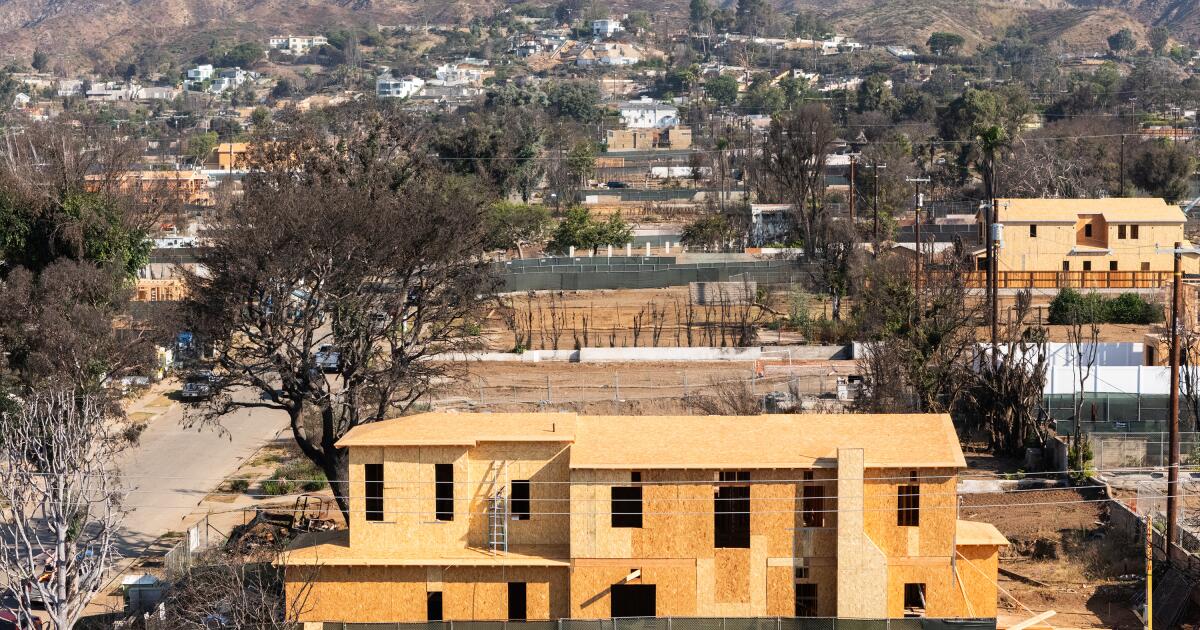
A fire survivors’ group announced Thursday it was seeking tougher penalties against State Farm over its handling of January 2025 wildfire claims.
The Every Fire Survivor’s Network said it was petitioning to join a state enforcement action announced this year against the company to make sure the case results in meaningful changes at California’s largest home insurer.
“We’re seeking a systematic review of all their claims and penalties calibrated to the actual scale of the harm — and we’re seeking the payouts that families are owed,” said Joy Chen, executive director of the group, at a Pacific Palisades news conference joined by victims of the fires.
The Department of Insurance in May filed an administrative action against State Farm General — the subsidiary of the giant Bloomington, Ill., insurer that handles California home insurance — after completing a “market conduct” exam.
The Jan. 7, 2025, fire damaged or destroyed more than 18,000 structures and killed 31 people.
State Farm has received more January 2025 claims than any other insurer — more than 13,700 auto and homeowners claims as of May 4, with payouts totaling $5.7 billion, according to the company.
The market conduct exam looked at 220 sample claims filed by the victims and found 398 violations of state law in about half of them.
Among other alleged violations, it found that the company failed in numerous cases to pursue a “thorough, fair and objective investigation” into claims, failed to come to “prompt, fair, and equitable settlements” and made settlement offers that were “unreasonably low.”
In announcing the action, Insurance Commissioner Ricardo Lara called the company’s claims handling “unacceptable” and said his department was taking “decisive action to hold them accountable.”
The state is seeking a “cease and desist” order to stop the insurer from engaging in unfair or deceptive practices.
It also has threatened to suspend State Farm’s license over the alleged violations, which each carry a penalty of up to $5,000 — or twice that figure if found to be willful. That could amount to a penalty of $2 million or more.
The threat to actually suspend State Farm’s license and its authority to write policies has been viewed skeptically by some, given its roughly 20% market share of the state’s home insurance market.
The company, which had an opportunity to include its responses in the exam report, denied fault in some cases and admitted fault in others. It often blamed problems on individual adjusters and denied systemic issues with its claims handling.
The petition filed by the wildfire survivor’s group criticizes the sample size of the market conduct exam as too small to capture all the alleged deficiencies in State Farm’s claims handling, which it claims are a “general business practice” of the company.
The group is seeking to conduct discovery, cross examine witnesses, present testimony from fire victims and bring more that 1,600 firsthand policyholder statements regarding State Farm’s practices into evidence, according to the petition.
It also wants State Farm to reopen cases in which claimants were paid too little, and it is seeking to participate in settlement discussions in order to increase any penalty State Farm would pay.
It calculated that a $2-million penalty would amount to a minute fraction of the assets of the State Farm Group.
“I submit to you that doesn’t defer bad conduct, it just allows you to continue to do it,” said Michelle Meyers, an attorney for Every Fire Survivor’s Network, at the news conference.
Consumer Watchdog, which has been a harsh critic of State Farm, also is providing legal support for victims’ effort.
Sevag Sarkissian, a spokesperson for State Farm, said the company was aware of the petition.
“We recognize that many wildfire survivors, including those that are State Farm General policyholders, continue to face difficult recovery challenges,” he said. “Our focus remains on helping customers recover.”
Michael Soller, a spokesperson for Lara, said the department is “acting with urgency to assist wildfire survivors in their ongoing recovery by investigating formal complaints filed by survivors and conducting the expedited market conduct exam that led to this enforcement action.”
He added that the department’s position is the state’s Administrative Procedure Act does not contemplate the commissioner or department staff authorizing intervention requests in the case.
He said that would be a hearing officer’s or administrative law judge’s decision when one is assigned to the case.
Meyers acknowledged the request was novel but said her reading of the law is that Lara can make the decision because no judge is yet assigned.
In response to the criticism, State Farm pledged earlier this year to improve its claims handling, including by providing single points of contact and improved communication so there are “fewer handoffs, fewer repeated explanations, and seamless support.”
It also named a new vice president of customer relations for State Farm General.

The state’s trial attorneys and Uber say they have reached a last-minute deal to scrap their dueling ballot measures and avert what was gearing up to be one of most expensive battles of the November election.
The deal, which comes a day after both measures qualified for the November ballot, has Uber agreeing to bulk up safety measures, while the trial attorneys will limit how much they can claim for lien-based medical treatment of victims who get in Uber or Lyft accidents, according to spokespeople for both sides of the campaign.
“Both sides agree: Californians deserve a system that’s safe, fair, and accountable,” read a joint statement from Uber and the Consumer Attorneys of California, a powerful attorney trade group. “This agreement protects patients from unnecessary treatment or getting overcharged, ensures access to medical care and legal representation, and strengthens safety measures.”
The agreement, finalized Thursday, means the ride-share giant will kill its ballot measure to cap how much attorneys can earn in vehicle collision cases and limit medical damages to rates based on insurance. Uber has argued that the costs for medical treatment done on a lien, which allows doctors to get paid from a cut of the plaintiff’s payout, far exceed what it would cost if the victim had used their own insurance.
In return, the Consumer Attorneys of California will cancel its competing ballot measure that sought to increase legal liability for ride-share companies if a passenger is sexually assaulted by a driver. The measure followed an investigation by the New York Times into sexual assault by drivers.
Both sides had poured tens of millions into the campaigns, plastering billboards across Los Angeles.
Lawyers claimed the fight had turned existential with the measure threatening to decimate the profit margin of many personal injury cases and leave drivers with small or thorny cases unable to find an attorney willing to take their case.
Spokespeople say the deal is predicated on their agreement being codified into a bill within the next week. Otherwise, they said, each side will move forward with its ballot measure.
-

 Technology2 minutes ago
NASA selects Eric Schmidt’s rocket company for a 2028 mission to Mars
-

 World9 minutes ago
British Prime Minister Keir Starmer faces potential leadership challenge from newly-elected Andy Burnham
-

 Politics12 minutes ago
Reporter’s Notebook: How Trump’s surprise move on DNI confirmation upended key Senate deal on FISA
-

 Health24 minutes ago
Weight-loss drugs linked to ‘Ozempic ears’ and other cosmetic complaints, surgeons say
-

 Sports27 minutes ago
Florida AG launches civil rights investigation into MLB’s warning to Christian pitchers over Pride Night caps
-

 Technology32 minutes ago
Fox News AI Newsletter: Bezos predicts labor shortage
-
Business39 minutes ago
Landmark downtown apartment tower faces foreclosure
-
 Entertainment42 minutes ago
Bob Dylan is absolutely cooking on the road right now

