Wyoming
Don Day's Wyoming Weather Forecast: Monday, March 24, 2025


Mostly to partly sunny in much of Wyoming on Monday with clouds, chance for rain and snow in a few areas. Breezy. Highs from the low 40s to the upper 60s. Lows from the mid 20s to the low 40s.
Central:
Casper: Mostly sunny and windy today with a high near 61 and wind gusts as high as 43 mph. Partly cloudy and breezy overnight with a low near 41 and wind gusts as high as 32 mph.
Lander: Mostly sunny and breezy today with a high near 58 and wind gusts as high as 26 mph. Partly cloudy overnight with a low near 37 and wind gusts as high as 21 mph.
Shoshoni: Mostly sunny and breezy today with a high near 64 and wind gusts as high as 37 mph. Partly cloudy and breezy overnight with a low near 34 and wind gusts as high as 34 mph.
Southwest:
Evanston: Mostly sunny today with a high near 58 and mostly clear overnight with a low near 28.
Rock Springs: Mostly sunny and breezy today with a high near 55 and wind gusts as high as 32 mph. Mostly clear and breezy overnight with a low near 34 and wind gusts as high as 30 mph.
Cokeville: Partly sunny today with a high near 43 and partly cloudy overnight with a low near 27.
Western Wyoming:
Pinedale: Mostly cloudy today with a high near 42 and mostly cloudy overnight with a low near 27.
Afton: Slight chance of rain before 9 a.m., mostly cloudy today with a high near 41 and partly cloudy overnight with a low near 31.
La Barge: Mostly sunny and breezy today with a high near 49 and wind gusts as high as 24 mph. Partly cloudy overnight with a low near 30 and wind gusts as high as 20 mph.
Northwest:
Dubois: Mostly sunny and windy today with a high near 48 and wind gusts as high as 44 mph. Partly cloudy and breezy overnight with a low near 37 and wind gusts as high as 34 mph.
Jackson: Partly sunny today with a high near 46 and mostly cloudy overnight with a low near 33.
Old Faithful in Yellowstone National Park: Chance of snow then rain, mostly cloudy today with a high near 44 and wind gusts as high as 20 mph. Partly cloudy overnight with a low near 29.
Bighorn Basin:
Thermopolis: Mostly sunny and breezy today with a high near 64 and wind gusts as high as 32 mph. Partly cloudy and breezy overnight with a low near 37 and wind gusts as high as 30 mph.
Cody: Partly sunny and windy today with a high near 57 and wind gusts as high as 41 mph. Partly cloudy and breezy overnight with a low near 41 and wind gusts as high as 30 mph.
Powell: Partly sunny and breezy today with a high near 62 and wind gusts as high as 21 mph. Partly cloudy overnight with a low near 38.
North Central:
Buffalo: Partly sunny and breezy today with a high near 54 and wind gusts as high as 25 mph. Mostly cloudy and breezy overnight with a low near 42 and wind gusts as high as 24 mph.
Sheridan: Slight chance of rain, mostly cloudy today with a high near 60 and wind gusts as high as 38 mph. Mostly cloudy overnight with a low near 37 and wind from 17-22 mph.
Clearmont: Slight chance of rain after 3 p.m., otherwise partly sunny today with a high near 57 and morning wind from 16-26 mph. Mostly cloudy overnight with a low near 37 and wind from 18-23 mph.
Northeast:
Gillette: Slight chance of rain, mostly cloudy and breezy today with a high near 54 and wind gusts as high as 31 mph. Mostly cloudy overnight with a low near 41 and wind gusts as high as 28 mph.
Newcastle: Chance of snow then rain, mostly cloudy and breezy today with a high near 51 and wind gusts as high as 34 mph. Partly cloudy and breezy overnight with a low near 40 and wind gusts as high as 30 mph.
Sundance: Chance of snow then rain, mostly cloudy today with a high near 48 and wind gusts as high as 30 mph. Mostly cloudy overnight with a slight chance of rain before 9 p.m., a low near 37 and wind gusts as high as 25 mph.
Eastern Plains:
Torrington: Mostly sunny and breezy today with a high near 68 and wind gusts as high as 35 mph. Partly cloudy and breezy overnight with a low near 37 and wind from 15-20 mph.
Douglas: Mostly sunny and windy today with a high near 65 and wind gusts as high as 45 mph. Partly cloudy and breezy overnight with a low near 36 and wind gusts as high as 30 mph.
Guernsey: Mostly sunny and breezy today with a high near 68 and wind gusts as high as 35 mph. Partly cloudy and breezy overnight with a low near 37 and wind gusts as high as 30 mph.
Southeast:
Cheyenne: High wind watch until 3 p.m. today. Sunny and windy today with a high near 62 and wind gusts as high as 45 mph. Mostly clear and breezy overnight with a low near 37 and wind gusts as high as 35 mph.
Laramie: Mostly sunny and windy today with a high near 56 and wind gusts as high as 40 mph. Mostly clear and blustery overnight with a low near 31 and wind gusts as high as 30 mph.
Pine Bluffs: Mostly sunny and windy today with a high near 67 and wind gusts as high as 45 mph. Partly cloudy and breezy overnight with a low near 37 and wind gusts as high as 35 mph.
South Central:
Rawlins: Mostly sunny and windy today with a high near 58 and wind gusts as high as 45 mph. Mostly clear and breezy overnight with a low near 34 and wind gusts as high as 35 mph.
Saratoga: Partly sunny and breezy today with a high near 57 and wind gusts as high as 35 mph. Partly cloudy and blustery overnight with a low near 31 and wind gusts as high as 30 mph.
Wamsutter: Mostly sunny and windy today with a high near 54 and wind gusts as high as 38 mph. Mostly clear and blustery overnight with a low near 31 and wind gusts as high as 31 mph.

Wyoming
Wyoming Cultural Trust Fund awards $529K in grants, including several Fremont County projects


CHEYENNE, Wyo. — Wyoming is a state known for cowboys, rodeos, and beautiful plains, but is also known for being the first territory to grant women the right to vote, something historian Jennifer Helton explored in her Suffrage Stories presentation.
Helton was invited to highlight Wyoming’s remarkable role in the fight for women’s suffrage as part of the museum’s special America 250 Discover & Discuss series on Jun 18, but the recorded version was just released. This is a part of Cheyenne Frontier Days Old West Museum’s goal of exploring Cheyenne and the greater state of Wyoming’s history.
Helton’s presentation not only celebrates Wyoming’s role in suffrage, but also how the state’s pioneering women helped shape the future of voting rights across the nation.
Born and raised in Wyoming, Jennifer Helton left the state at age 18 to attend college, “which left a giant, Wyoming-sized hole in my heart,” Helton said, “and the way that I fill that hole is by conducting research on women’s suffrage.”
Upon realizing that most people outside of the state of Wyoming did not know the West’s progressive role in suffrage, she became obsessed with bridging this knowledge gap and researching the history of suffrage.
“My kids would tell you it’s an obsession, not just an interest or a hobby,” Helton said. “They always joke that I have three kids, the two of them and then Esther Morris.”
During her presentation, Helton’s admiration for Esther Morris was apparent due to her trailblazing nature as suffragist, her courage to stand up to torch-bearing mobs, and abolitionist activities.
Interestingly enough, her sons were also instrumental in shaping Wyoming’s history. E.A. Slack is known as the “Father of Frontier Days” and citizens of Wyoming can thank Robert C. Morris for Cheyenne’s public library, as he brought the Carnegie Public Library System to Wyoming.
.
” data-large-file=”https://i0.wp.com/capcity.news/wp-content/uploads/2026/06/image-2.png?fit=780%2C863&ssl=1″ alt=”” class=”wp-image-170117″ style=”aspect-ratio:0.90332473687879;width:464px;height:auto” srcset=”https://i0.wp.com/capcity.news/wp-content/uploads/2026/06/image-2.png?resize=925%2C1024&ssl=1 925w, https://i0.wp.com/capcity.news/wp-content/uploads/2026/06/image-2.png?resize=271%2C300&ssl=1 271w, https://i0.wp.com/capcity.news/wp-content/uploads/2026/06/image-2.png?resize=768%2C850&ssl=1 768w, https://i0.wp.com/capcity.news/wp-content/uploads/2026/06/image-2.png?resize=780%2C864&ssl=1 780w, https://i0.wp.com/capcity.news/wp-content/uploads/2026/06/image-2.png?resize=400%2C443&ssl=1 400w, https://i0.wp.com/capcity.news/wp-content/uploads/2026/06/image-2.png?resize=706%2C782&ssl=1 706w, https://i0.wp.com/capcity.news/wp-content/uploads/2026/06/image-2.png?w=960&ssl=1 960w, https://i0.wp.com/capcity.news/wp-content/uploads/2026/06/image-2-925×1024.png?w=370&ssl=1 370w” sizes=”auto, (max-width: 780px) 100vw, 780px”/><figcaption class=) Photo of Esther Morris, the first female justice of the peace (Cheyenne Frontier Days Old West Museum). Credit: Cheyenne Frontier Days Old West Museum (Jennifer Helton Presentation) / Cheyenne Frontier Days Old West Museum
Photo of Esther Morris, the first female justice of the peace (Cheyenne Frontier Days Old West Museum). Credit: Cheyenne Frontier Days Old West Museum (Jennifer Helton Presentation) / Cheyenne Frontier Days Old West Museum
Throughout the course of her presentation, Helton revealed the results of her research by tracing the course of American history in order to highlight the intersection between Wyoming, women, and winning the right to vote.
The talk also highlighted incredible Black women such as Lucy Phillips and Nancy Phillips, some of the first Black women to vote.
As America celebrates its 250th anniversary, the museum invites visitors to explore the stories of trailblazers like the nation’s first woman justice of the peace Esther Morris, the first woman governor, the first Black women to vote, and many other extraordinary leaders who made history.
The museum is hosting its special America 250 exhibit and allows visitors to discover the stories, artifacts, and moments that connect the community to the nation’s history. The exhibit even features six U.S. presidents who visited Cheyenne or Cheyenne Frontier Days, and is currently running at the museum. For those who cannot attend, lectures such as this are filmed and provided online.
As Helton closed her lecture, she read the words of Esther Morris, “I say do all the good you can while you do live.”
“Because women like Esther Morris, like Theresa Jenkins, had the courage to stand up and do all the good that they could in their lives we are all able to live the lives that we are living today,” Helton said.
“So, we should be grateful to them, and I think we should also be asking ourselves what is it that we need to be doing so that future generations can preserve the same opportunities we have, and perhaps more.”
Watch Jennifer Helton’s full presentation at the link provided here.
To learn more about historian Jennifer Helton visit jenniferhelton.org.
.
” data-large-file=”https://i0.wp.com/capcity.news/wp-content/uploads/2026/06/image-3.png?fit=780%2C519&ssl=1″ alt=”” class=”wp-image-170141″ srcset=”https://i0.wp.com/capcity.news/wp-content/uploads/2026/06/image-3.png?resize=1024%2C681&ssl=1 1024w, https://i0.wp.com/capcity.news/wp-content/uploads/2026/06/image-3.png?resize=300%2C200&ssl=1 300w, https://i0.wp.com/capcity.news/wp-content/uploads/2026/06/image-3.png?resize=768%2C511&ssl=1 768w, https://i0.wp.com/capcity.news/wp-content/uploads/2026/06/image-3.png?resize=1536%2C1022&ssl=1 1536w, https://i0.wp.com/capcity.news/wp-content/uploads/2026/06/image-3.png?resize=1200%2C799&ssl=1 1200w, https://i0.wp.com/capcity.news/wp-content/uploads/2026/06/image-3.png?resize=780%2C519&ssl=1 780w, https://i0.wp.com/capcity.news/wp-content/uploads/2026/06/image-3.png?resize=400%2C266&ssl=1 400w, https://i0.wp.com/capcity.news/wp-content/uploads/2026/06/image-3.png?resize=706%2C470&ssl=1 706w, https://i0.wp.com/capcity.news/wp-content/uploads/2026/06/image-3.png?w=1605&ssl=1 1605w, https://i0.wp.com/capcity.news/wp-content/uploads/2026/06/image-3-1024×681.png?w=370&ssl=1 370w” sizes=”auto, (max-width: 780px) 100vw, 780px”/><figcaption class=) Jennifer Helton’s information (Cheyenne Frontier Days Old West Museum).
Jennifer Helton’s information (Cheyenne Frontier Days Old West Museum).
Related
Wyoming
At 6,000-year-old crossing, Gov. Gordon OKs Wyoming’s first-ever designated pronghorn migration route – WyoFile

SUBLETTE COUNTY—Gov. Mark Gordon heralded Wyoming’s first-ever designation to protect a pronghorn migration corridor — a more than 2 million-acre web of habitat — at Trapper’s Point, which he called a “wonderful passageway.”
“How incredibly valuable it is that you are standing here today,” Gordon told the crowd, “to witness this remarkable moment.”
Gordon commemorated the moment with his feet planted on the narrow bulge of high country that splits the Green and New Fork rivers. Thousands of years ago, the site was a well-used hunting ground for Native Americans — it’s the earliest known killing and processing site for pronghorn in North America. Now it boasts a wildlife overpass.
No pronghorn were to be seen during the especially windy Friday afternoon gathering, which attracted 75 attendees from nearby Pinedale and other western Wyoming communities.
Now Trapper’s Point is officially classified as a “bottleneck” for the Sublette Pronghorn Herd — one of 13 such bottlenecks. That classification is supposed to prevent any surface-disturbing activity, with the intent that pronghorn can keep passing through Trapper’s Point for generations to come.

Protecting the ability of the fleet-footed, tawny-and-white ungulates to migrate is a “key factor” in sustaining their population, Wyoming Game and Fish Director Angi Bruce said.
“This becomes even more important in severe winters or extreme droughts,” Bruce said. “Pronghorn are long overdue for recognition.”
Pronghorn in Sublette, Teton, Sweetwater and Lincoln counties travel a long road — some migrate more than 200 miles to escape harsh winters, trekking south into the lower Green River Basin, a semi-arid sweep of sagebrush steppe between Pinedale and Rock Springs. Then in the spring, they retrace those paths, returning to summer ranges, lush with verdant vegetation, even going as far as Grand Teton National Park.
There was also a long road of bureaucracy to get to this point.
Nearly three decades of effort preceded the formal designation of the migration routes used by the Sublette Pronghorn Herd, which is the farthest-traveling and among the largest pronghorn herds in the West.
Jackson Hole biologists long knew that the valley’s pronghorn left in the winter. But details were hazy on where they went and how they got there until around the turn of the century. Using data from tracking collars, biologists like Joel Berger, Steve Cain, Hall Sawyer and Doug Brimeyer helped delineate the route.

In 2008, a Bridger-Teton National Forest plan amendment established a portion of the path as the nation’s first designated wildlife migration corridor.
Popularized by its branding as the “Path of the Pronghorn,” the route has received press in national publications like High Country News and the New York Times.
But the southern reaches of the migration through the energy-rich Green River Basin have faced major political opposition since the early 2000s. Wyoming first attempted to protect those travel corridors in 2019, under a policy administered by the Wyoming Game and Fish Department. That effort was halted after a coalition of industry trade groups and counties protested.
Then, in early 2020, Gordon revamped the migration policy with an executive order. Still, the Sublette Pronghorn Herd proposal gathered dust, even as development threatened the route.
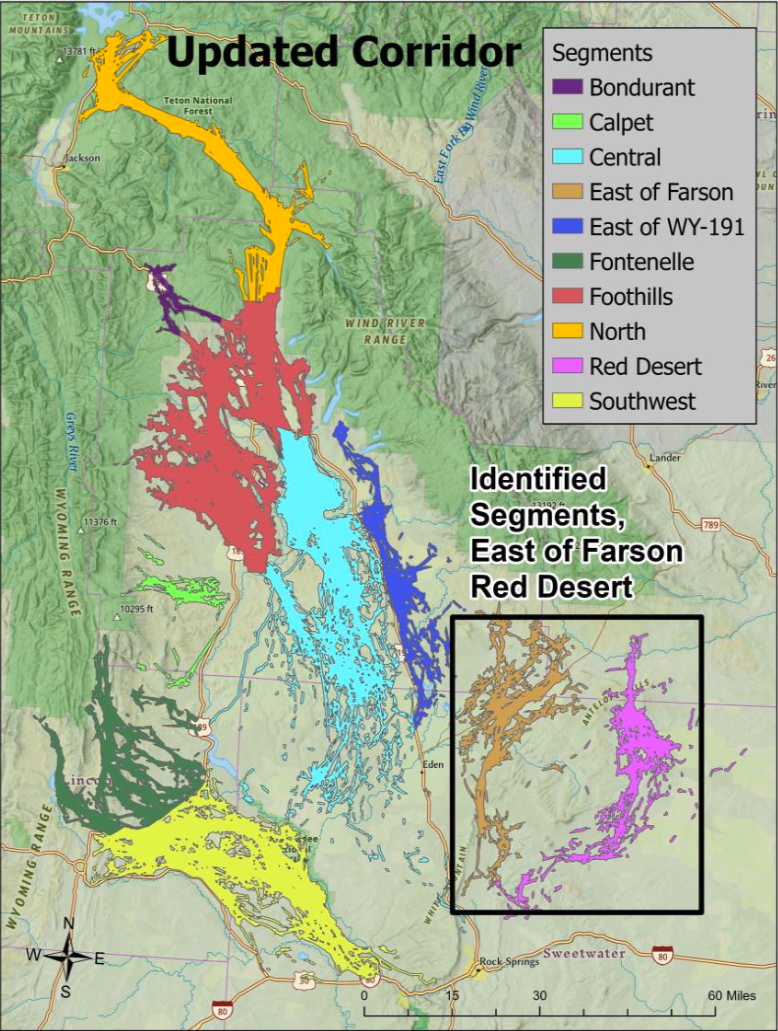
Game and Fish revived efforts to protect the migration in late 2023 and early 2024. Biologists pulled together one of North America’s most comprehensive migration datasets, benefiting from approximately two decades of GPS collar information collected from more than 400 pronghorn.
Some controversy followed the process until near the end. There was a debate about whether to designate the migration’s two easternmost segments, in the Red Desert and east of Farson. The Game and Fish Department proposed excluding the routes, but was overridden by its commission. Then Gordon upended that decision, excluding the two segments.
Vetting the migration corridor through a Gordon-appointed working group was the second-to-last step in the designation process.
“Today’s designation demonstrates that voluntary, locally driven conservation works,” said Robb Slaughter, who chaired the group, during the commemoration at Trapper’s Point.
Time will tell if that’s the case. Wyoming’s migration policy is, by design, permissive of development. Private land is exempt from protections, and designation is not an assurance that new stressors won’t be added to the landscape.

“Today is not the end of the process,” Slaughter said. “It’s the beginning of the next chapter. Continued monitoring, adaptive management, research, and cooperation will ensure these recommendations remain effective as conditions change.”
But Friday was the end of the migration designation process. The governor’s informal OK — no signature was needed — was the last step, said Sara DiRienzo, the governor’s deputy policy advisor.
Wildlife advocates celebrated the moment.
“This is historical,” Bruce said. It’s the first effort to protect the full length of a pronghorn migration corridor in the nation, she said.
-

 San Francisco, CA4 minutes ago
Suspect arrested after shooting near San Francisco Pride events, police say
-

 Dallas, TX6 minutes ago
Dallas shooting injures 2 as police search for suspect
-

 Miami, FL12 minutes ago
Colombia wins Group K after 0-0 draw with Portugal in Miami Stadium; both teams advance to World Cup knockouts
-

 Boston, MA19 minutes ago
Beyond the frame: ‘Where’s Boston?’ revisited through new oral histories – Boston News, Weather, Sports | WHDH 7News
-

 Denver, CO21 minutes ago
Arizona Cardinals will face Denver Broncos QB Bo Nix for 1st time
-

 Seattle, WA26 minutes ago
3 Primary Reasons Seattle Seahawks Will Repeat as NFC West Champs in 2026
-

 Milwaukee, WI37 minutes ago
Venezuela earthquakes: Milwaukee donation drive to help families affected
-

 Atlanta, GA41 minutes ago
DR Congo advances to knockouts after defeating Uzbekistan 3-1

