Politics
Biden's prisons chief tapped to fix lagging mental health care in California lockups

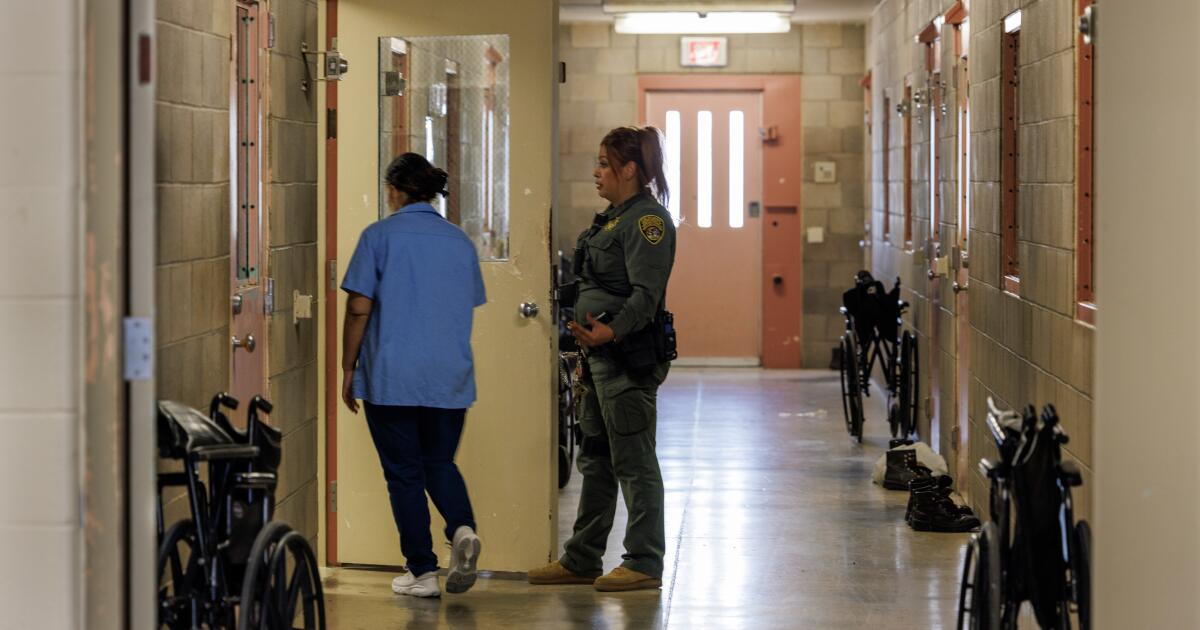
SACRAMENTO — Following through on intentions broadcast a year ago, a federal judge is putting control of California’s troubled inmate mental health programs into the hands of an outsider: President Biden’s former chief of prisons.
With inmate suicide rates at an all-time high, U.S. District Senior Judge Kimberly Mueller said her aim is to force changes in California’s prison mental health system, which a federal judge in 1995 deemed to be so poor as to constitute cruel and unusual punishment.
To do that, Mueller is naming a federal “receiver-nominee” to develop an oversight plan for psychiatric services for California’s prison population. Three prior candidates, for varying reasons, passed up the job.
Mueller’s pick to tackle the prisoner mental health care system is Colette Peters, who stepped down as Federal Bureau of Prisons director the day Donald Trump returned to the White House. The choice was announced Tuesday during a closed-door meeting with lawyers for inmates and Gov. Gavin Newsom, and published Wednesday as an order. Participants in the case said Peters has accepted a four-month position.
In that time, Mueller proposes that Peters work with opposing sides to come up with a plan of attack. Her full appointment as receiver would hinge on that plan. Lawyers for the state and for inmates have 10 days to comment on the judge’s proffer.
Newsom’s office would not immediately comment on what it described as “pending litigation.” State lawyers Tuesday told Mueller that while Peters was an acceptable choice, they reserved the right to contest California’s loss of control over a critical and expensive component of its sprawling incarceration system, a hearing participant said.
In that vein, a state lawyer in December argued that the “weighty decision” for a court takeover requires evidentiary hearings. At the time, Supervising Deputy Atty. Gen. Damon McClain said the need for a receiver was negated by improving conditions — namely the hiring of more social workers, just one of the positions for which the prison system has chronic shortfalls.
The state’s rosy depiction of improvements drew a rebuke Wednesday as the 9th Circuit Court of Appeals upheld Mueller’s July 2024 civil contempt findings against the state. The state argued it had “substantially complied” with orders to hire mental health staff “by taking all reasonable steps to comply.”
The appellate panel said that was untrue. It pointed to delays in responding to job applicants, and unaddressed grievances from staff frustrated with high workloads, lack of security protection, insufficient supplies and lousy workspaces “which often took the form of windowless converted cells in old and unheated prisons.”
The appellate opinion noted the state did not rebut this evidence or show why it could not address those problems.
Lawyers for inmates in the long-running class-action lawsuit described Mueller’s decision to name a receiver-nominee as a breakthrough. Plaintiff’s attorney Michael Bien said a receiver is empowered to make decisions that otherwise could be entangled in years of litigation. Dockets show lawyers for both sides have been wrangling for years over a policy to permit half of mental health staff to work remotely and deliver care by video and phone.
More than 34,000 inmates — more than a third of the California prison population — are considered to have some sort of serious mental disorder. According to court findings, not once in 35 years of litigation has California had enough mental health staff to provide an acceptable minimum level of care.
Court declarations cite a 2023 state analysis that found that of the 30 inmates who killed themselves in 2023, more than a fourth had received inadequate mental health care because of understaffing. One who hanged himself with a bedsheet had not had a mental health visit for more than seven months.
A special master appointed by the court to do fact-finding in the case said last year that a “bona fide mental health staffing emergency” persisted and in some prisons had gotten worse. The report concluded that only 38% of reviewed patients received adequate care.
The class-action lawsuit is named after a 1990 complaint filed by inmate Ralph Coleman, objecting to a lack of psychiatric services at Pelican Bay State Prison. It was expanded by prison rights attorneys to address what they allege are lapses in care that have resulted in inmate suicides, mentally ill prisoners being held naked in barren isolation cells and lengthy waiting lists for treatment.
In the course of the proceedings, prison rights attorneys have shown videotapes documenting the use of pepper spray, restraints, hoods and batons on mentally ill inmates in the throes of psychotic episodes.
Mueller, a former Sacramento City Council member who studied law at Stanford, was named to the Eastern District bench in 2010 by President Obama. She inherited the Coleman case from Judge Lawrence Karlton, who died in 2015 after retirement.
The Coleman case is one of two landmark class-action suits against California’s prison system that have been overseen by a three-judge panel that 10 years ago issued sweeping orders requiring California to reduce prison crowding.
The companion case found medical care in the prisons to be so poor as to cause preventable deaths, and resulted in appointment of its own federal receiver in 2006. Still present, that receiver has mandated increased funding for medical care and electronic health records, among other changes. Given the improvements, the court in 2015 began returning control of medical services to the state, one prison at a time. That process is nearly complete.
The Coleman case has so far failed to bring about similar improvements in inmate psychiatric care. As the prison population overall has decreased, the percentage of inmates in need of mental health services has risen.
Citing “ongoing constitutional violations,” Mueller in 2023 asked the U.S. attorney general to weigh in on California’s staffing for inmate mental health care and lagging efforts at suicide prevention.
“The state repeatedly has fallen short of its constitutional obligations in a number of critical areas: suicide prevention; the treatment of mentally ill inmates in administrative segregation; those inmates’ access to higher levels of care, including mental health crisis beds; and staffing,” she wrote in her 2023 petition.
Though the Ninth Circuit upheld Mueller’s 2024 contempt finding against California, the appellate panel asked the judge to show calculations for the associated monthly fines, which now exceed $197 million. The amount is intended to reflect the savings the state realizes from leaving prison mental health jobs unfilled.
In 2024, Mueller wrote that the contempt order and fines were having little impact.
“The court has exhausted virtually every mechanism for prodding defendants to finally achieve compliance,” Mueller wrote in a July 2024 order contemplating appointment of a receiver.
In the prison medical care case, the receiver crafted a turnaround plan for the state, ramped up physician salaries and negotiated with the administration for funding to build medical facilities. The medical receiver launched an electronic records system, tackled disease outbreaks including Valley Fever, and even monitored the health of prisoners staging a systemwide hunger strike.
It’s not yet clear what powers a mental health receiver would be given.
As head of the federal prison system under Biden from 2022 to early 2025, Peters confronted issues such as crumbling infrastructure, inadequate staffing and a scandal at a federal women’s prison in Alameda County so beset by allegations of sexual abuse that it was dubbed “the rape club.” She ordered that prison closed down.
Prior to that, she ran Oregon’s state prison system.


new video loaded: Jan. 6 Rioter Hired by Pentagon
transcript
transcript
Jan. 6 Rioter Hired by Pentagon
Elias Irizarry, who pleaded guilty to climbing through a broken window at the Capitol on Jan. 6, 2021, now works for an office responsible for uncovering and defending against terrorism plots at the Pentagon.
-
“Full pardon or commutation?” “Full pardon.”
By Alisa Shodiyev Kaff
June 4, 2026

NEWYou can now listen to Fox News articles!
Democrats splintered over a resolution seeking to block the U.S. from assisting Israel’s war against Hezbollah, an Iranian-backed terrorist group, on Thursday.
The measure, offered by progressive Rep. Rashida Tlaib, D-Mich., would require President Donald Trump to withdraw U.S. forces from Lebanon. For months, Israel and Hezbollah, a U.S.-designated terrorist group and Iranian proxy, have been at war in southern Lebanon, but the United States has not joined the conflict.
A bipartisan coalition of lawmakers, including House Minority Leader Hakeem Jeffries, D-N.Y., rejected the measure. Critics argued the resolution could aid Hezbollah and potentially hamstring U.S. military operations in the country.
Tlaib’s resolution failed 92-324, with more than half of House Democrats joining nearly all Republicans to vote it down.
The Lebanon war powers resolution divided Democrats, with House Minority Leader Hakeem Jeffries, D-N.Y., joining Republicans in rejecting the measure. (Aaron Schwartz/Bloomberg)
REP RASHIDA TLAIB MOVES TO BLOCK US OPERATIONS IN LEBANON BUT IGNORES HEZBOLLAH
Rep. Thomas Massie, R-Ky., an Israel critic, was the lone Republican to support Tlaib’s measure. Meanwhile, Reps. Derek Tran, D-Calif., and Betty McCollum, D-Minn., voted present.
House Democratic leaders said shortly before the vote they would oppose Tlaib’s resolution and work with the progressive lawmaker on a narrower measure exempting some U.S. military operations in the country. Their statement also denounced Hezbollah as a “violent terrorist organization” and a “sworn enemy of the United States.”
Tlaib, who has accused Israel of committing “ethnic cleansing” in Lebanon, did not mention Hezbollah in her resolution. She and other proponents of the measure also avoided discussing the Iranian proxy force during heated floor debate over the measure.
Republicans highlighted the omission and accused the legislation’s supporters of serving as “proxies for Hezbollah.”
“Apparently they don’t want to see Israel killing Hezbollah, even though it’s Hezbollah that is killing Israeli children, Israeli adults, Israeli elders,” House Foreign Affairs Committee Chairman Brian Mast, R-Fla., said Wednesday, referring to his Democratic colleagues.
Tlaib asserted that her resolution would only affect U.S. forces actively engaged in hostilities. Republicans, however, disputed that claim and suggested it would hurt U.S. efforts to counter Hezbollah.
“It doesn’t say anything about [whether] you can keep the Marines that are in the embassy,” Mast said, referring to the U.S. embassy in Beirut. “That’s a pretty big oversight. It doesn’t say anything about whether we can keep United States armed forces that are training missions with the LAF [Lebanese Armed Forces]. Again, pretty big oversight.”
Rep. Rashida Tlaib, a Democrat from Michigan, attempted to bar U.S. forces from joining Israel’s war in Lebanon. (Tierney L. Cross/Bloomberg)
RASHIDA TLAIB HIT WITH HOUSE CENSURE THREAT, ACCUSED OF ‘CELEBRATING TERRORISM’ IN PRO-PALESTINIAN SPEECH
The debate turned personal when Rep. Max Miller, R-Ohio, a member of the House Foreign Affairs Committee, linked Tlaib to Hezbollah.
“Hezbollah is a terrorist organization … and its members are butchers that you like to hang out with to a certain extent,” the Ohio lawmaker said, referring to Tlaib.
A shouting match between the two then broke out, with Tlaib demanding that Miller’s remarks be stricken from the record.
The presiding chair ultimately complied with her request, but Miller doubled down on his remarks.
CLICK HERE TO DOWNLOAD THE FOX NEWS APP
“Yes, I said it. I own it, and I stand by it,” Mast said on behalf of Miller on the floor.
Tlaib’s failed war powers resolution comes as Iran has sought to tie Israel’s invasion of Lebanon to its ceasefire negotiations with the United States.
Hezbollah, which has long helped Iran project power in the region, rejected a ceasefire agreement between Israel and Lebanon’s government Thursday.

WASHINGTON — Initial efforts in the Senate failed Thursday to block the $1.8-billion fund that the Trump administration has sought to establish to pay people who claim the government wronged them, though further attempts were likely to come Thursday afternoon.
Republicans narrowly voted down a Democratic amendment to ban the payout fund and then Democrats killed a Republican amendment, which would have prohibited the use of federal money for the fund but would have sent $1.7 billion to the Justice Department’s fraud division.
It was the second effort in Congress to rebuke President Trump in two days, following the House vote Wednesday to rein in Trump’s war powers in Iran.
The dueling amendments were proposed by Senate Minority Leader Chuck Schumer (D-N.Y.) and Sen. Thom Tillis (R-N.C.). They were attached to the reconciliation bill that would fund Immigration and Customs Enforcement and the Border Patrol, a high priority for Republicans.
The votes came as the Senate began a “vote-a-rama,” during which lawmakers were expected to propose a stream of amendments to the immigration bill on various topics.
The Trump administration’s plan for the payment fund — widely seen as a way for Trump to compensate his political allies, including those who participated in the Jan. 6, 2021, attack on the Capitol — set off particular ire from some GOP lawmakers.
The plan has fueled growing unrest within parts of Trump’s party over his governance, compounded by the president’s endorsement of primary challengers to Sens. John Cornyn (R-Texas) and Bill Cassidy (R-La.), as well as Rep. Thomas Massie (R-Ky.), which angered some Republican senators.
Cassidy, who lost his primary and has since voiced strong opposition to Trump’s $1.8-billion fund, became a key player in the Thursday votes, voting down Schumer’s amendment but supporting Tillis’.
On Wednesday, Cassidy joined with Sen. Cory Booker (D-N.J.) to argue in a court filing that the $1.8-billion fund circumvents Congress’ authority and violates the Constitution’s spending and appropriations clauses.
“It is an unconstitutional attempt to spend the People’s money without Congressional approval,” Cassidy and Booker wrote in an amicus brief filed in the federal court case challenging the fund.
The fund was created by the Justice Department to settle a lawsuit brought by Trump against the Internal Revenue Service over the leak of his tax returns. Trump and his sons agreed to drop their personal lawsuit against the government in exchange for the creation of the $1.776-billion fund. Critics immediately questioned the plan, and it drew a rare backlash from Republicans.
In late May, GOP senators derailed plans to vote on the immigration bill over their displeasure with the payout fund and with Trump’s desire to use taxpayer funds for his planned White House ballroom. Senate Republicans removed the ballroom funding from the immigration package Wednesday, another setback for Trump.
The Trump administration sought to back away from its plans for the fund this week, following bipartisan outcry and a federal court ruling that temporarily blocked any payouts from the fund. Acting Atty. Gen. Todd Blanche said Tuesday the administration would end its plans to move ahead with the concept.
But Trump on Wednesday told reporters he didn’t know whether the fund was dead, calling it “a beautiful thing.”
After Schumer proposed the first amendment to ban the fund Thursday morning, the Senate came to a standstill as three key Republican senators deliberated. Schumer framed his effort to ban the fund Thursday as a way to force a referendum on Trump’s plan.
The amendment “offers Republicans a choice: Do you support Donald Trump’s $2 billion taxpayer-funded slush fund, or do you want to protect the American people and their paychecks?” Schumer said on the Senate floor before the vote.
Sen. Bernie Moreno (R-Ohio) urged Republicans to reject the amendment, saying Democrats were planning to “play so many games” on Thursday during the marathon session.
“We are going to fund immigration enforcement and border patrol, and I urge my Republican colleagues to stay united on that singular mission,” Moreno said.
The amendment failed after Cassidy voted against it. Republican Sens. Susan Collins of Maine, Jon Husted of Ohio and Dan Sullivan of Alaska voted in favor.
Schumer’s amendment was uniformly supported by Democrats, including California Sens. Adam Schiff and Alex Padilla.
Tillis, who also voted against Schumer’s amendment, immediately proposed his amendment. Sen. Jeff Merkley (D-Oregon) urged Democrats to oppose it, saying that the proposal would create “a new slush fund” by giving the money to the Justice Department.
“We heard over the last 48 hours that the acting attorney general said that this fund’s not moving forward. All this amendment does is codify what I believe the policy of the DOJ is,” Tillis said on the floor before voting began on his amendment. “This [fund] is unpopular, this administration has said they’re not moving forward with it; this is an opportunity for us to put it to bed.”
Responded Merkley: “Taking one slush fund and eliminating it and then creating a new slush fund still under control of the attorney general is not the way to go. The way to go is to get rid of these slush funds altogether.”
Trump has faced a recent string of failures, including the House vote Wednesday, a court ruling to remove his name from the Kennedy Center and a record-low approval rating among Americans as concern rises about economic issues, gas prices and Trump’s war with Iran.
On Wednesday, Trump lashed out against the four Republicans who backed the House war powers resolution, calling it “an unpatriotic thing” to do and calling the vote “meaningless.”
“They’re GRANDSTANDERS! They should be ashamed of themselves. MAGA!!! President DJT,” Trump wrote.
Times staff writer Ana Ceballos, in Washington, contributed to this report.
-

 Augusta, GA45 seconds ago
Gaines endorses Kendrick in Augusta mayoral runoff
-

 Washington, D.C8 minutes ago
Juvenile injured after gunfire reported in DC’s Michigan Park neighborhood
-

 Cleveland, OH11 minutes ago
Cleveland readies for pre-World Cup soccer match
-

 Austin, TX16 minutes ago
Texas lawmakers discuss rural hospitals
-

 Alabama23 minutes ago
Alabama has one of college football’s toughest schedule stretches in 2026
-

 Alaska26 minutes ago
Former Alaska corrections officer sentenced to 150 years in prison for killing wife and teen daughter
-

 Arizona31 minutes ago
Dozens charged under Preston’s Law in Arizona
-

 Arkansas38 minutes ago
Stockton rappers plead guilty to possessing machine gun, marijuana in Arkansas traffic stop

