Lifestyle
After developers gentrified her old neighborhood, cherished plant shop owner starts fresh


On any given weekend, Degnan Boulevard, bookmarked by West 43rd Street, vibrates with activity. As you walk down the street, the sound of African drums blends into Snoop Dogg’s “Drop It Like It’s Hot.” The music comes from massive speakers propped beside various street vendors: people selling clothes, books, cannabis, sea moss and more.
A customer lifts up a prayer plant.
(Juliana Yamada / Los Angeles Times)
If you continue this casual stroll north, you’ll eventually spot an orange wall with green accents. The vendors’ music — Stevie Wonder is playing now — flows through its low gate. As you follow it, you step into a verdant oasis. A wide open green space big enough for two boys to pass their soccer ball back and forth gives way to a greenhouse teeming with “wishlist plants.” And if you’re brave enough to step deeper into the lot, yet clearly not confident in ascertaining a Golden Pothos from a Pothos N’Joy, a woman with a warm smile will approach you kindly.
“Welcome to the Plant Chica. Have you visited us before?”
In spring 2023, developers in the quickly gentrifying West Adams neighborhood handed Sandra Mejia a 90-day eviction notice on the lease for her plant store, the Plant Chica, a business she started in 2018. Having a bricks-and-mortar store was a dream for the onetime medical assistant. Therefore, Mejia had to reckon with whether to open herself up to more emotional turmoil as she searched for a new location to reopen in.
“We were super sad about losing the space and we were having a really hard time letting go of it,” said Mejia, who co-owns the Plant Chica with her husband, Bantalem Adis. “I felt like I was never going to find anything as special as that space was — not just for me but for the community.”
While the Plant Chica continued to complete online orders after the eviction, Mejia doubted whether to continue the business at all. Business had been slow during winter 2023; and although the community poured into a GoFundMe page dedicated to helping the store stay afloat, Mejia and her husband had sold or given away nearly their entire inventory before closing. “Should I be doing this?” Mejia asked herself.
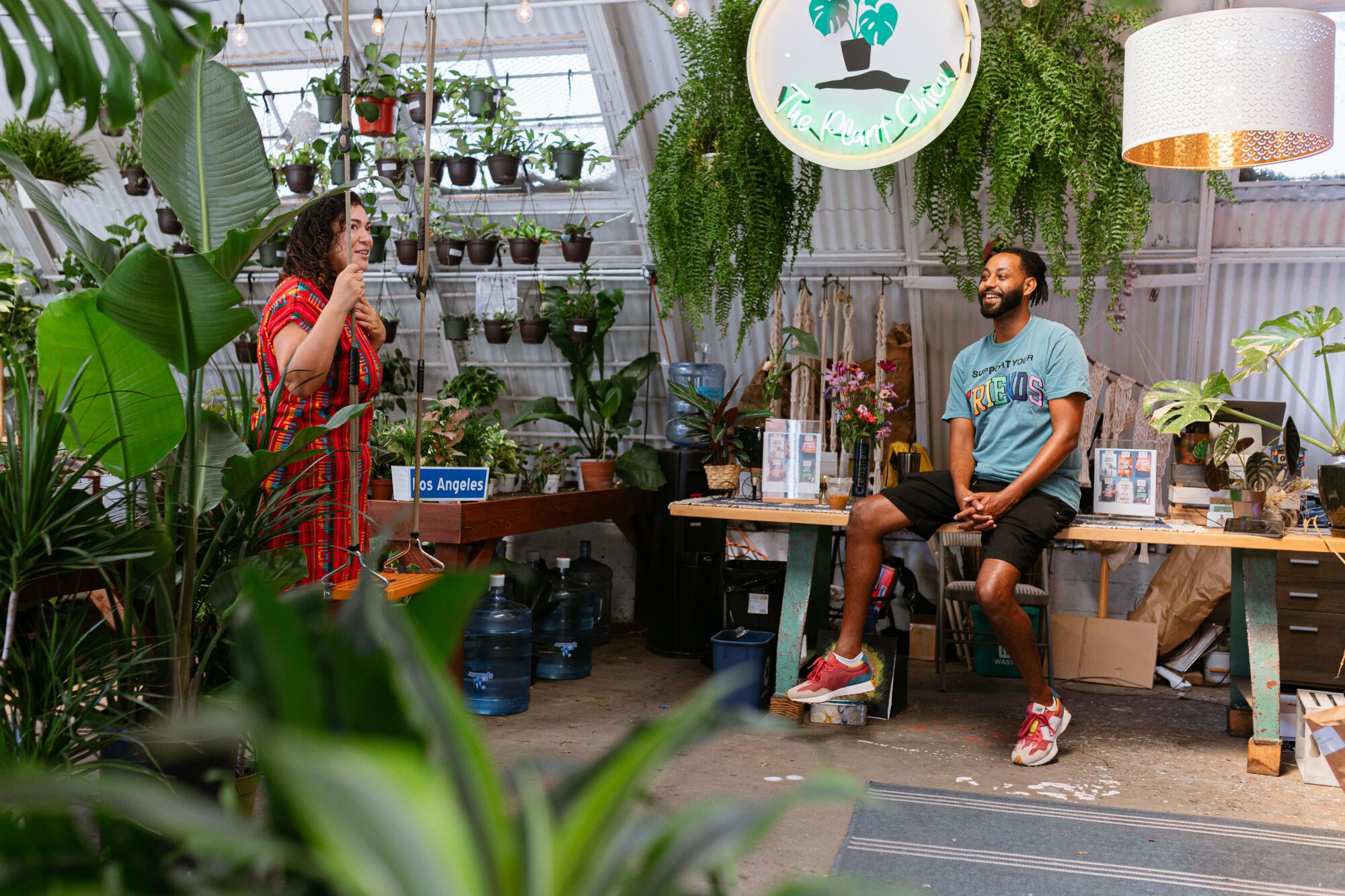
Co-owners of the Plant Chica, Sandra Mejia, left, and Bantam Adis, at their old West Adams location in 2022.
(Wesley Lapointe / Los Angeles Times)
Ironically, it was a 2023 Times story published about the store’s eviction plight that led Mejia to a solution. Robbie Lee, interim chief executive officer of the Black Owned and Operated Community Land Trust, read the article and thought Mejia might be a good fit for what his organization was trying to build in Leimert Park, the heart of Black Los Angeles.
“The energy that she brought to the area that she was at in West Adams was something that we specifically felt would be a good energy for Leimert,” Lee said. “She seemed to have some really strong ties to the South L.A. community and she seemed to also have an interest in being a part of a community that was really tied to a community of color and culture. And so we felt that it would be a good fit to try to help support her in identifying a space.”
At first, Lee showed Mejia a few bricks-and-mortar options on Degnan Boulevard, but they didn’t quite fit the greenhouse feel Mejia was looking for. Then Lee walked Mejia over to an empty lot managed by Community Build Inc., the L.A.-based nonprofit offering education, training, support services and employment placement assistance. The lot had previously been rented for various community and private events throughout the year, but otherwise it sat unattended to.

Dana Gills Mycoo, left, and Martin Mycoo shop for houseplants at the new Plant Chica store in Leimert Park.
(Juliana Yamada / Los Angeles Times)
Reopening would take a lot of sacrifice — namely, in March 2024, Mejia and her husband had to give up their place and move in with her parents to save money. But Mejia instantly knew she found the shop’s new home.
“It feels like the space was literally sitting here waiting for us because it cannot be any more perfect for us,” she said.
After signing the lease in June 2024, the Plant Chica reopened in Leimert Park Village in October.
Originally, the Plant Chica store, which opened on Jefferson Boulevard in West Adams in 2021, had been an old auto body shop that was retrofitted to be a greenhouse. But with the open lot in Leimert Park, Mejia could craft the plant shop of her dreams: a big dome-style greenhouse designed to be weather-resilient.
“It just feels so magical, especially when the sun is hitting the greenhouse, the way the sun bounces on the leaves,” Mejia said. “I always also wanted rocks, which I know is something so small, but to me, to be able to hear people walking on rocks is so therapeutic.”
The new space is also special for another reason: The open space allows Mejia to more easily facilitate the community events and collaborations she is well-known for.

Sandra Mejia, left, helps Reginald Alston pick out a plant.
(Juliana Yamada / Los Angeles Times)
“Most people see a plant shop,” said Jasmine Clennon, 36, a regular customer and friend of the store. “We see a communal space so we can come together.”
Clennon knows Mejia through their kids and recalls Mejia turning the new shop’s lawn into a Halloween party for the kiddos after trick-or-treating. Other hallmark Plant Chica events include queer poetry readings hosted by Cuties Los Angeles, yoga classes hosted by Black Women’s Yoga Collective, and of course, the store’s popular Adopt-a-Plant series.
“How do I say this without getting emotional?” said Clennon on a recent trip to the plant store as her school-aged daughter played at her feet. “Seeing her resiliency, opening it back up and specifically being intentional about it being in a Black community, is great.”

Customers browse the Plant Chica greenhouse.
(Juliana Yamada / Los Angeles Times)
This significance is also not lost on Mejia, who shared that the transplant identities of many of the business owners in West Adams precluded her from feeling connected to them.
“In West Adams, I was trying to create community, and it was kind of exhausting,” she said. “There’s already so much culture here [in Leimert Park]. I just get to add to that.”
Mejia added that she feels exceptionally seen and supported in Leimert Park, which lends itself to a natural reciprocity on her part.
“A lot of businesses will take, take, take and not put back into the neighborhoods they’re in,” she said. “But I think it’s different when you’re from the neighborhood. You’re like ‘No, I grew up here. I want to see this neighborhood thrive.’”
For her part, Mejia created maps of the historic Degnan strip to give to her customers. The idea, she said, is “Don’t just get back in your car after visiting the Plant Chica. Here’s this map. Go support the other businesses.”
That peer-support includes businesses found on the Plant Chica’s own lawn.

Owner Sandra Mejia offers free greenhouse space to other small businesses to sell their merchandise.
(Juliana Yamada / Los Angeles Times)
Amorette Brooms, 47, ran a storefront on Pico Boulevard for over a decade before financial shortfalls in the aftermath of the COVID-19 pandemic forced her to close down. When the Plant Chica reopened in Leimert Park, Brooms reached out to Mejia via social media to see if they could collaborate in some way. She was shocked when Mejia offered her a free space to sell her merchandise instead.
“I was like ‘What do you mean you’re not going to charge me?’” said Brooms, who sells planters. “It kind of restores my faith in humanity.”
Today, four businesses, Brooms’ Queen, Louis LIV Design, Golden Garden and Plant Man P, sell their products rent-free at the Plant Chica. The retail model allows small business owners to fully sell through their inventory without falling prey to pop-up events that typically leave them in the hole, Brooms said.
Now Brooms, in turn, is planning to bring her Tiny Plant Desk series — a play on NPR’s popular Tiny Desk series — to the Plant Chica. Which for Mejia is exactly the point of giving back.

Sandra Mejia, owner of the Plant Chica.
(Juliana Yamada / Los Angeles Times)
“I feel like people support us so much because they know that if they spend money here, there’s going to be an awesome event that’s going to be free to the community, which is hard to get,” Mejia said.
In addition to helping customers with their plant selections, Mejia also rings them up at the register and then busies herself with tidying and organizing the shop. She has no employees, but she still has ambitious goals. Two weeks ago, she officially filed the paperwork for her nonprofit, co-founded with Brooms, Plant Power to the People. And she’s hoping to organize a Los Angeles Earth Day Festival, hosted in Leimert Park, by April. To outsiders, Mejia’s pursuits and projects may seem overwhelming, but where Mejia had doubts about her future a year ago, she now knows she’s exactly where she’s meant to be.
“People are always like ‘Oh, you do so much for your community,’ and I’m like ‘Yeah, but my community does a lot for me too,’” she said, explaining that community members cleaned her wind-strewn lawn in the aftermath of the Eaton and Palisades fires while she was busy organizing donations for Altadena residents who lost their homes. “I’m being so fulfilled and feeling like I’m walking in my purpose, and as a person, I don’t know that there’s anything greater than to be like, damn, I love what I do.”
It’s impossible to not feel this love — this sense of community — when you walk through the Plant Chica’s Degnan Avenue gate humming the soulful tunes — Luther Vandross is playing now — of the vendors outside.
“I feel like everything is a lesson,” Mejia said. “[My son] saw us open on Jefferson and he cut the ribbon then. And then, he cut the ribbon again here in Leimert Park. I think that was super special because it shows him that if things sometimes may not go your way, you can’t just give up. You got to keep going and find new ways.”

The sign for the Plant Chica’s new location.
(Juliana Yamada / Los Angeles Times)

Lifestyle
Terry Tempest Williams on why women with big ideas get labeled ‘crazy’ : Wild Card with Rachel Martin
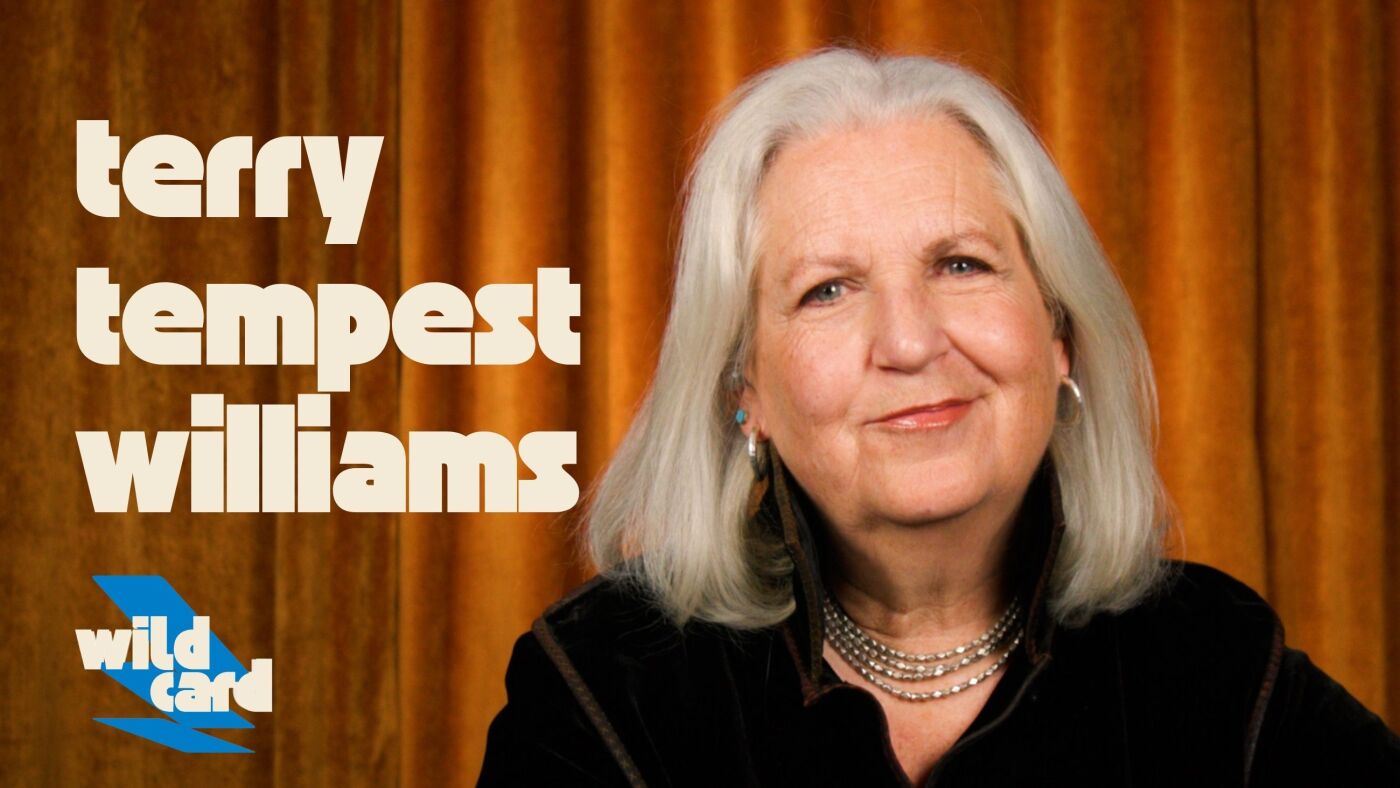
A note from Wild Card host Rachel Martin: I met Terry Tempest Williams about 25 years ago at a writer’s conference in Yosemite Valley. I was a young reporter who was there to do a story about how literature was addressing climate change and she made such a huge impression on me. I had never heard someone talk about the natural world the way Terry did and she had a spiritual depth I hadn’t encountered in my life at that point.
To this day, Terry’s writing always reorients me towards what is good, what is beautiful, and what is true. Her newest book is called “The Glorians.”

For its upcoming Los Angeles venue, experiential art firm Meow Wolf will focus on the art of storytelling, with a specific eye toward skewering our city’s moviemaking magic. To help bring that vision to life, Meow Wolf has entered into a creative partnership with Titmouse, one of L.A.’s most renowned independent animation houses.
The Hollywood-based studio behind popular series such as “Big Mouth” and “Star Trek: Lower Decks” will create animation that will be shown throughout the West L.A. venue, which is on target for a late 2026 opening at the Howard Hughes entertainment complex.
It’s a move that represents a shift for Santa Fe, N.M.-based Meow Wolf. Over the last decade-plus, the art collective has grown beyond its anything-goes, punk-meets-psychedelic roots into an organization with full-scale, maximalist installations in its hometown, Denver, Las Vegas, Houston and the Dallas suburbs. In the past, Meow Wolf kept most of its media in-house.
As part of its larger-than-life participatory art installations, Meow Wolf L.A. will feature a mix of live action and animation, the former filmed by Meow Wolf in its Santa Fe studio. Meow Wolf’s James Stephenson, a senior VP with the company and its creative director of emerging media, said the degree to which the L.A. exhibition will lean into various animation styles necessitated an outside partner. Titmouse’s work, in development by a number of directors with contrasting tones, will be shown on a variety of formats, ranging from cinema screens to full-room projections.
“I really believe in animation as an art form, and I know the Titmouse folks do too,” Stephenson says. “Animation is made by artists. It’s made by artists with their own hands. It’s something that is still very rooted in craft.”
Meow Wolf’s L.A. space is set in a former cinema complex, and will champion its location, taking guests on a journey through a converted movie house and beyond, into a sci-fi-inspired fantasyland with sentient spaceships and a 30-foot-tall mushroom tower. Meow Wolf creatives have spoken of the fantastical movie theater as one that will feature animated, self-aware candy before attendees enter the main exhibition space, making Titmouse’s work some of the first art guests will encounter. Titmouse co-founder Chris Prynoski has said the studio has lined up at least six directors for the exhibit.
An in-progress art installation destined for Meow Wolf L.A. at the art collective’s Santa Fe, N.M., headquarters. The L.A. exhibition will feature animation from Titmouse.
(Gabriela Campos / For The Times)
Titmouse, says Stephenson, is the right partner because “they’re known less for a house style, and more for a house vibe.” Over the years, Titmouse has been behind such diverse shows as “Scavengers Reign,” owning a Jean Giraud influence rooted in French and Spanish surrealism, the lively “Jentry Chau vs. the Underworld,” with an unique color palette that took inspiration from anime and Chinese mythology, the exaggerated comic book feel of Adult Swim’s “Metalocalypse,” and the approachable yet expressive tone of “Star Trek: Lower Decks.”
“Meow Wolf’s vibe is similar to Titmouse’s vibe,” Stephenson says. “It’s artist-first, artist-driven, independent and kinda edgy. They are always trying to find the edge of what’s possible. They try to see how far they can go, and it’s done for fun and in the spirit of taking risks.”
Prynoski says working with Meow Wolf will give Titmouse a sense of artistic freedom it doesn’t always have when delivering content for more traditional Hollywood partners. He says the multi-director approach is a callback to the early days of Warner Bros. Animation, when individual creators put their own stamp on Looney Tunes material.
“I use Bugs Bunny as an example,” Prynoski says. “You’ve got a Friz Freleng Bugs Bunny short. You’ve got a Chuck Jones Bugs Bunny short. You’ve got a Tex Avery Bugs Bunny short. They’re all different versions of Bugs Bunny, and people who are really paying attention can tell which director directed each one. Even though to the layman, these are all Bugs Bunny, but if you lined them up, they are drawing in different styles, sensibilities and techniques.”
Prynoski says that was a centerpiece of his pitch to Meow Wolf, noting that characters will reappear in multiple installations, each handled by a different artist. Meow Wolf L.A., in fact, will be the firm’s most character-driven exhibition, as guests will follow the storylines of three main protagonists throughout the space.
In announcing the partnership, Meow Wolf and Titmouse released an image from an animated work directed by Luca Vitale. It features a key character having a moment with a hummingbird and it’s done in an elegant, slightly anime-influenced style. It’s an image full of movement, reflecting a character in transition with inviting pastels and bold dashes.
“I like that image because I think it captures some of the sense of wonder that we want people to feel,” Stephenson says. “The character is having an encounter with the elusive nature of creativity and reality in a way that makes them have a different perspective of what’s possible.”
Other contributing animation directors to Meow Wolf L.A. include Space Dawg, Felix Colgrave, Alexander Vanderplank and Phimémon Martin, and Jun Ioneda.
Titmouse’s partnership with Meow Wolf will extend beyond the L.A. exhibition. The two will be working on the development of Meow Wolf New York, which is slated to open some time after Los Angeles, and are collaborating on a planned animated series, which Prynoski is spearheading.
Meow Wolf exhibits are the result of sometimes hundreds of disparate artists coming together in a shared space. Distilling that into a signature, singular style for a series could be a challenge. Stephenson pinpoints some guiding principles.
“You really need to feel the hand of the artist,” he says. “You need to feel a DIY aesthetic. You need to feel the materiality. Those are very specific to what we are.”

The Kennedy Center on June 28, with its facade signage still covered by a tarp and scaffolding.
Alex Wroblewski/AFP via Getty Images
hide caption
toggle caption
Alex Wroblewski/AFP via Getty Images
On Wednesday, a federal appeals court denied President Trump’s request to stop the removal of his name from Washington, D.C.’s Kennedy Center. The signage on the building has been covered with tarp and scaffolding since June 13, but in a court filing last month, the center’s current executive director said that Trump’s name has been removed.
In their decision, three judges from the U.S. District Court of Appeals for the District of Columbia Circuit said that the president had failed to prove that the arts center would be “irreparably injured” without Trump’s name attached to it.

NPR requested comment from the Kennedy Center, but did not receive an immediate reply.
This latest round of court decisions is part of the ongoing litigation filed by Rep. Joyce Beatty, D-Ohio, against President Trump and the board of the Kennedy Center. In a statement emailed Wednesday to NPR, Beatty said: “Today’s ruling again affirms that this administration’s efforts to rename the Kennedy Center were unlawful. His name no longer desecrates this sacred memorial, which belongs to the American people. Now it is time for the Trump administration to accept this, comply with the law, and take the tarps down.”
In previous court filings, Trump’s legal team had asserted that removing the president’s name from the arts complex, both on the physical building and in its digital materials, would inflict irreparable harm in both time and money already spent. In the denial, the three judges — Patricia Millett, Robert Wilkins and Gregory Katsas — wrote that since Trump’s name has already been removed, “a stay would not avert those harms.”
Furthermore, Trump had claimed that without his name attached, future fundraising would be threatened “and [will] contribute to the financial decline of the Center.” In response, the appeals judges wrote: “Appellants, however, have failed to support this assertion with any specific facts or evidence. They offer only the conclusory assertions of the Kennedy Center’s Executive Director that were made in a factually unsupported declaration.” The center’s current executive director, Matt Floca, specializes in physical plant management.

The presiding judge in the case, Christopher R. Cooper, has ordered that the center provide him a status report on the center’s operation and programming before the end of this month. As of Wednesday, the center’s calendar lists a small roster of programs, including outdoor free movie screenings, workshops for children, and five free live performances in July on its Millennium Stage. In the past, the Kennedy Center presented over 2,000 arts and education events each year, including free daily Millennium Stage performances.

-

 News5 minutes ago
Trump fires last members of election commission, inciting fears of midterm ‘chaos’
-

 Los Angeles, Ca1 hour ago
California teen e-biker baiting police to chase tracked by drone, arrested
-

 Detroit, MI2 hours ago
Our picks for state\nSenate from Wayne Co. | Endorsements
-

 San Francisco, CA2 hours ago
Man reported missing in San Francisco
-

 Dallas, TX2 hours ago
How to buy France World Cup semifinal soccer tickets in Dallas
-

 Miami, FL2 hours ago
Miami-Dade Schools names six semifinalists for superintendent
-

 Boston, MA2 hours ago
Lawsuit: ICE detained East Boston father despite legal status
-

 Denver, CO2 hours ago
Victor Marx wins GOP primary for Colorado governor, defeating veteran lawmaker after unorthodox campaign

