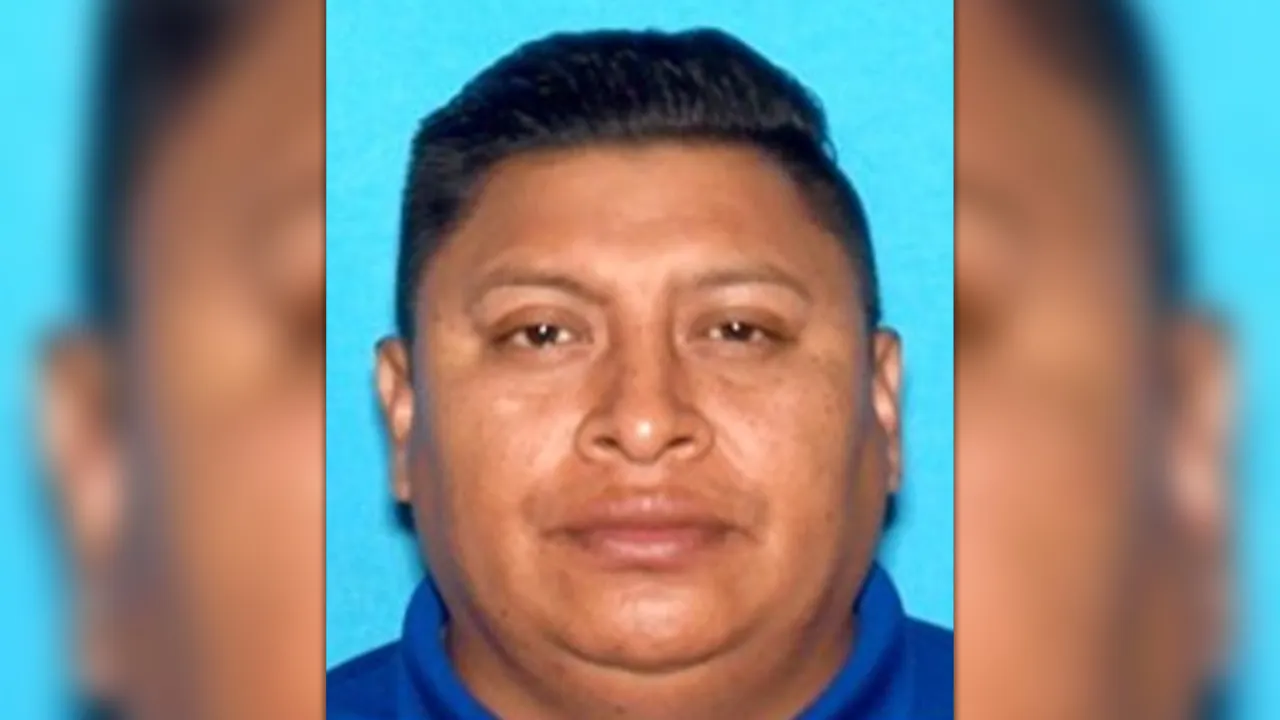
Federal agents arrested two Guatemalan men on Friday accused of operating one of the largest human smuggling operations in the United States.
The two were picked up near downtown Los Angeles and are accused of moving 20,000 illegal immigrants into the U.S. from Guatemala since 2019.
Eduardo Domingo Renoj-Matul and Cristobal Mejia-Chaj each appeared in federal court hours after their arrests, and a judge ordered each held without bond. If convicted, they could each face the death penalty.
“These smuggling organizations have no regard for human life and their conduct kills,” said acting U.S. Attorney Joseph McNally. “The indictment and arrests here have dismantled one of the country’s largest and most dangerous smuggling organizations. This work saves lives, and the members of the organization will now face significant consequences.”
PREVIOUSLY DEPORTED GUATEMALAN MAN CONVICTED OF CRIMES IN US ARRESTED IN NEW YORK
Advertisement
Helmer Obispo Hernandez, described as a “lieutenant” in the smuggling operation, remains at large and allegedly threatened to cut the head off of a federal agent last week.(U.S. Attorney’s Office – Los Angeles)
Two other men are also charged in the case; Jose Paxtor-Oxlaj, who is behind bars in Oklahoma for his role in a 2023 car crash that killed seven migrants – including five from the same family – and Helmer Obispo-Hernandez, who is described as a “lieutenant” in the smuggling operation.
“Every day, similar human smuggling organizations put profits ahead of the safety in these reckless and illegal endeavors,” said Homeland Security Investigations (HSI) Los Angeles Acting Special Agent in Charge John Pasciucco. “HSI Los Angeles and our partners are committed to continue identifying and dismantling these organizations, so no further lives are lost, and our borders are secure.”
Homeland Security Investigations Los Angeles Acting Special Agent in Charge John Pasciucco said the feds are working to identify and dismantle “reckless and illegal” human smuggling organizations.(Immigration and Customs Enforcement)
Prosecutors allege Renoj-Matul, who goes by the name Turko, was the ringleader of the operation. He was working with counterparts in Guatemala who would charge migrants $15,000 to $18,000 for safe passage to the United States.
Advertisement
Once here, the migrants were then charged again for additional transport across the country. Renoj-Matul’s indictment alleges migrants under his direction were moved to at least 20 states and Washington, D.C.
GUATEMALA READY FOR MORE DEPORTATIONS UNDER TRUMP, REPORT SAYS: ‘WE KNOW IT’S COMING’
It is believed that migrants who did not pay were held hostage in a stash house in the same Los Angeles neighborhood where Renoj-Matul and Mejia-Chaj were arrested.
Operation ringleader Eduardo Domingo Renoj-Matul, who goes by “Turko,” allegedly worked with counterparts in Guatemala who would charge migrants $15,000 to $18,000 for safe passage to the United States.(AP Photo/Eric Gay, File)
In one incident last year, prosecutors alleged Renoj-Matul called the mother of a migrant he was holding hostage and threatened that she “would come home in a box” if her smuggling fees were not paid.
Advertisement
Obispo-Hernandez remains at large and faces additional charges for threatening to cut off the head of a Homeland Security Investigations officer who served a search warrant at his house on Friday.
A look at where the Arizona Cardinals rank in new NFL power rankings based on level of interest.
We are in the dead of the offseason in the NFL, when we are simply waiting for training camps to start. It is a good time for more lists and rankings.
AZCentral Sports’ Bob McManaman put together NFL power rankings for all 32 teams, but based on interest level.
Advertisement
Where do the Arizona Cardinals fall?
As you can probably imagine, it is near the bottom. They find themselves in the tier of “watch at your own risk,” which includes the five lowest-ranked teams. The Cardinals come in at No. 30.
Who’s going to emerge as the starting quarterback and will it even matter? At some point, rookie Carson Beck is going to get his shot and by then, the season might already be heading toward a disaster. Stay tuned to learn how rookie Jeremiyah Love and the running backs will split time, how the defense hopes to rediscover itself and how first-year coach Mike LaFleur plans to get things off the ground.
For fans, there is fantasy intrigue for their pass catchers in Trey McBride, Marvin Harrison Jr. and Michael Wilson, and we want to know how big a season Love can be, but Jacoby Brissett is the least interesting starting quarterback in the league. He is neither young, nor accomplished nor has a track record of winning.
They have no flash defensively.
To say they are more interesting than the New York Jets and Cleveland Browns, the two lowest-ranked teams, is a stretch, although none of these three teams are remotely interesting.
Advertisement
The NFC West, outside of the Cardinals, has interesting teams. There are the defending champion Seattle Seahawks, the loaded LA Rams and then a San Francisco 49ers team that keeps up, even without as loaded a roster.
Training camp is coming soon!
Get more Cardinals and NFL coverage from Cards Wire’s Jess Root and others by listening to the latest on the Rise Up, See Red podcast. Subscribe on Spotify, YouTube or Apple podcasts.
California authorities unearthed at least 117 dogs in “various states of decomposition” on Friday, many of which appeared to have been killed by gunshot, as part of an ongoing investigation into an animal rescue organization.
The bodies were discovered during a search of Miranda’s Rescue in Fortuna, California, according to the Humboldt County Sheriff’s Office. Officials had been granted a warrant that included excavation of the property for evidence that dogs had been buried in “mass graves.”
The 117 canine remains were those found mostly intact at two sites, the sheriff’s office said. Nearly two dozen skulls, “hundreds” of bones, and 600 dog collars were also recovered on the property.
Humboldt County Sheriff William Honsal thanked the law enforcement teams and forensic veterinarians who assisted in the recovery. In a statement, he noted that the investigation is “just getting started.”
“The determination all of these professionals showed while working through this horrific scene is something we will not forget,” Honsal said.
NBC News was not able to reach Shannon Miranda, the founder of Miranda’s Rescue, by phone on Sunday. She did not immediately respond to an email requesting comment.
Advertisement
The sheriff’s office said in a news release last week that it had been contacted in April regarding allegations of fraud, animal abuse and animal cruelty at the rescue, and that the case had been assigned to the Major Crimes Division.
An initial search warrant was executed on May 1, at which time officials seized evidence related to the investigation. Investigators also determined that a “significant number” of animals surrendered to the rescue had not been accounted for.
Investigators executing a second search warrant at Miranda’s Rescue, where 117 canine remains were found, in Fortuna, Calif. last week.Stephen Lam / San Francisco Chronicle via Getty Images
A second search warrant, executed Thursday, led to the recovery of the canine remains.
Forensic veterinarians were able to examine 71 of the bodies on-site Thursday but did not have time to reach the remaining 46. A preliminary examination — including X-rays of the remains — found that “many of those animals showed evidence of bullet fragments.”
Investigators are working to identify dogs that were microchipped.
Other remains were found “in advanced stages of decomposition” and were deemed too severely deteriorated to be removed from their burial site, the sheriff’s office said.
Advertisement
This investigation is expected to be lengthy, the sheriff’s office cautioned in a statement to the public.
“The Humboldt County Sheriff’s Office understands the public’s desire for accountability and justice,” it said. “However, it is our responsibility to conduct a complete, impartial, and legally sound investigation while ensuring that the constitutional and legal rights of everyone involved are protected throughout the process.”
No charges were announced.
Miranda was not available for comment, but posted a statement on June 18 addressing “recent media coverage and online commentary,” on the rescue’s website. The statement described two incidents that had “drawn particular attention” both involving animals that were killed at the facility.
The first involved a dog that killed another animal and attacked a third; the second involved a dog that lunged at a stroller carrying a baby, according to the statement.
Advertisement
“These were not decisions made lightly and were based on my responsibility to protect both the public and the animals in our care,” Miranda wrote.
The statement also described Miranda’s Rescue is a no-kill shelter, meaning animals are not euthanized simply to free up space, but acknowledged euthanasia is sometimes necessary.
“Whenever euthanasia has been necessary, I have notified local authorities in advance, even when told that reporting is not required,” Miranda wrote. “I believe it is important to maintain a clear record of these difficult decisions.”