Science
Greenpeace Faces Tough Start in Trial Over Dakota Access Pipeline Protests


The opening week of the landmark trial of Greenpeace in a multimillion-dollar lawsuit by Energy Transfer over the Dakota Access Pipeline protests did not bode well for the defense.
Lawyers for Greenpeace said so themselves in a petition filed in North Dakota’s Supreme Court. They asked the court on Thursday to move the trial out of Morton County, arguing the jury is not impartial. Daily life was disrupted there for nearly a year, in 2016 and 2017, by protesters heading toward the Standing Rock Indian Reservation, just south of the county line.
The protests against construction of the pipeline, which since 2017 has carried oil from North Dakota across several states to Illinois, garnered international attention, attracted thousands of people and, at times, led to violent clashes.
The company that built the pipeline, Energy Transfer, first filed the lawsuit against Greenpeace in 2019. The suit accuses the environmental group of playing a key role in protests that delayed pipeline construction, as well as attacking workers and equipment and defaming Energy Transfer.
Greenpeace, one of the world’s most widely known environmental groups, says it played only a minor role in the protests, in support of Native American activists, and that the organization promotes nonviolence.
Lawyers for Greenpeace said the jury-selection process showed that the county court had erred in denying its previous motions to move the trial to the bigger city of Fargo. “With jury selection complete, it is clearer now than ever that Greenpeace Defendants will not get a fair and impartial trial in the county where the protests occurred,” they wrote in the motion.
If Greenpeace were to lose the lawsuit, a judgment could amount to hundreds of millions of dollars and force it to shut down operations in the United States.
The motion also pointed to newspapers that had been sent to Morton County residents in recent months containing negative articles about the protests. The three Greenpeace entities named in the lawsuit said in their petition to the State Supreme Court that they believe the newspapers “may have emanated from plaintiffs or from someone closely connected to them.”
Energy Transfer did not immediately respond to a request for comment about whether it was connected to the mailed newspapers.
As of Sunday afternoon, the court had not responded to the petition. The trial is scheduled to last five weeks.
Testimony began Wednesday in the courthouse in Mandan, N.D., just across the Missouri River from Bismarck, the capital. The protests took place about a 45-minute drive south.
The case is being heard by Judge James D. Gion, who is normally based in neighboring Stark County. Morton County’s judges had recused themselves, noting that they were “acquainted with the plaintiff/defendant, and feel that in the best interest of justice should disqualify themselves,” according to court documents.
Energy Transfer began to call witnesses on Wednesday.
Joey Mahmoud, who was a vice president at Energy Transfer overseeing Dakota Access, testified that the pipeline serves a crucial purpose in bringing oil from the Bakken fields of western North Dakota to refineries in the Midwest and beyond. The pipeline construction came amid a historic boom in fracked oil from the area that helped lead the United States to become the world’s biggest oil producer.
The protests against the project from the Standing Rock Sioux Tribe and its allies escalated in spring 2016, he testified. Tribal leaders said the project went through burial sites and other sacred land and that its construction would endanger the tribe’s water supply.
The company countered it had hired experts to survey the route and argued that those claims were unsupported. It also said pipelines were a safer way to transport oil than trucks or rail.
Energy Transfer’s lawyers also called the county sheriff to the stand and showed video depositions of former Greenpeace employees. Much of their questioning centered on the use of “lockboxes” — devices protesters can use to lock themselves to one another, or to items like fences or equipment — that Greenpeace sent to the protests.
The Morton County sheriff, Kyle Kirchmeier, testified that law enforcement had to scramble to respond to the influx of protesters and the escalation of conflicts. He had to ask for an emergency declaration from the state and to train officers in tactics like disabling lockboxes, he said.
Harmony Lambert, a former Greenpeace employee, said in her deposition that she traveled to Standing Rock in 2016 and also worked with an Indigenous activist group. Emails were shown that she had sent to Greenpeace colleagues at the time detailing her activities, including training people in blockade techniques and donating about 20 lockboxes.
A petition from media organizations, including The New York Times, to stream the proceedings online is pending with the State Supreme Court. Another petition for online access, from a group of left-leaning lawyers who traveled to North Dakota to observe the proceedings, has been denied. That group included the First Amendment lawyer Martin Garbus and Steven Donziger, who spent decades suing oil companies and then served time in prison for contempt of court.



Science
‘I’d rather my house burn down than get cancer’: Herbicide use upends California’s fight to save forests
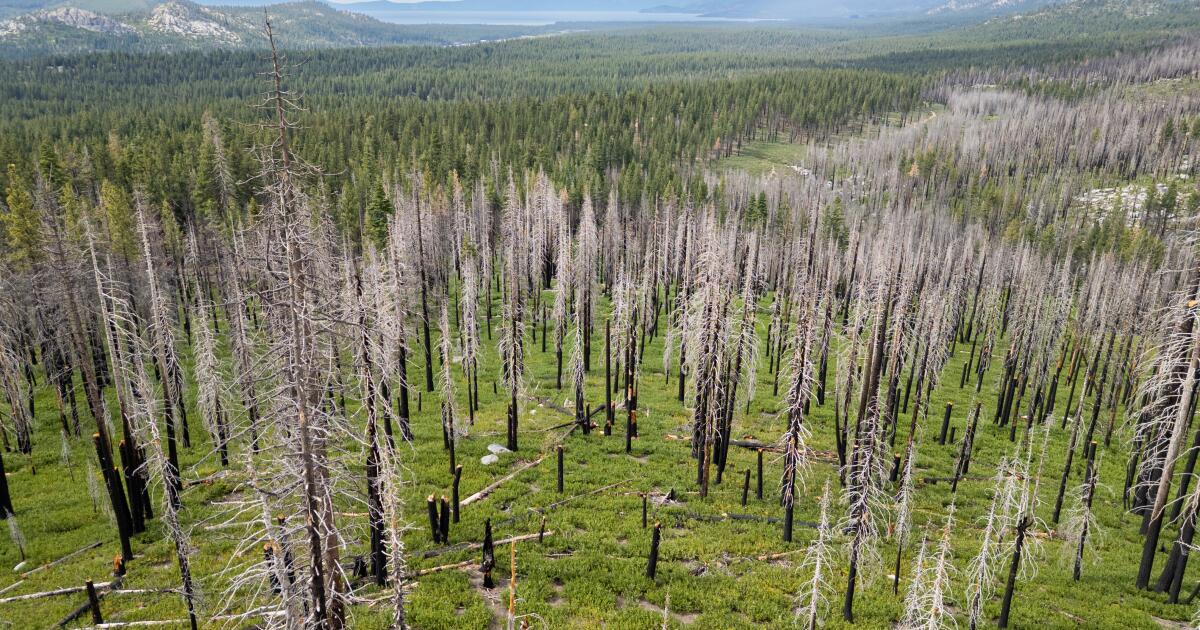
SOUTH LAKE TAHOE, Calif. — For years, Reid Reichardt walked the forest trails behind his Tahoe Basin cabin nearly every day with his dog Jasmine. Then in 2021, the Caldor fire swept through, incinerating it all.
“It was really a sense of mourning and grief to lose this,” Reichardt said, eyes fixed on the towering blackened sticks around him.
Since then, Reichardt has watched birds, flowers, a sea of green shrubs and baby conifers fill in the moonscape. It’s been a ray of hope for him, as Jasmine aged and eventually passed.
Reid Reichardt’s dog Jasmine.
(Reid Reichardt)
But two months ago, Reichardt got a text from a friend: The Forest Service had approved a plan to kill off shrubs it says are blocking the conifers from growing. It plans to use glyphosate, an herbicide California has determined causes cancer.
“I think many people, including me, would say, I’d rather my house burn down than get cancer,” he said.
Increasingly severe wildfires — fueled by climate change and more than a century of forest mismanagement — have forced an environmental reckoning on mountain towns nestled in California’s Sierra Nevada. Their residents face difficult questions: Will some kind of forest grow back? And, if not, should humans intervene to make that happen? Two communities, 100 miles apart, may be choosing different answers.
Many foresters and fire ecologists argue the plentiful baby conifers behind Reichardt’s home will struggle to compete with the fast-growing shrubs for sunlight, water and soil nutrients. Should another fire roll through, the seedlings are not yet tall enough to hold their branches above the flames.
But many Tahoe Basin residents say they are willing to live with whatever grows back, if it keeps glyphosate away.

Reid Reichardt stands next to Saxon Creek in the Caldor fire burn scar, near the area the Forest Service wants to use herbicide to kill the shrubs it says are crowding out the baby conifers.
(Scott Sady / For The Times)
“I’ll never see it like it was in my entire lifetime, and we need to be OK with that,” said Madeline Moritsch, who spent summers at her parents’ Tahoe cabin growing up and now lives in town. “It’s really sad … to lose connection to the forest, but then also, it is part of the forest life cycle. I have great trust that the forest is going to do what it’s going to do.”
In the Tahoe basin, opposition to the herbicide reached a fever pitch after an article chronicling the Forest Service’s use of the chemical across California appeared in Mother Jones magazine.
The agency had posted newspaper notices and sent emails mentioning herbicide use and seeking public input last year, but Tahoe residents said they had missed them or didn’t make much of them.
“We continue to welcome feedback from community members and appreciate the ongoing interest and involvement from the public,” the Forest Service said in a statement.
The controversy over reviving the forest is a shame, some say, because, done right, these projects can help restore the identity of forest towns and a feeling few have felt in decades: safety.
The stewards of the forest

Material to be burned is piled in an area the Konkow Valley Band of Maidu manage in the Dogwood District of Plumas National Forest.
(Sara Nevis / For The Times)
About 100 miles northwest of the Tahoe Basin, lower down in the foothills, survivors of the epic 2018 Camp fire that destroyed the town of Paradise have a very different relationship with forest stewards.
The Butte County Fire Safe Council — made up of three dozen foresters, former firefighters and local fire survivors — has countless stories of working with local landowners to heal forests and reduce wildfire risk.
In a ride with four of them in one of the council’s heavy-duty white pick-ups, conversation is constantly interrupted as they point out areas across the county’s rugged wild lands that they’ve worked on.
More than a third of Butte County’s 1 million acres have burned over the past decade. That has made taking action and having tough conversations — including about herbicide — unavoidable.

A flag marks a Konkow Valley Band of Maidu cultural site.
(Sara Nevis / For The Times)
Connor Gilmartin, the Fire Safe Council’s director of development, sympathized with residents in the Tahoe Basin. “It’d be completely reasonable that people feel slighted if they were to have something happening in their proverbial backyard without knowing about it,” he said. “It’s a non-option for us.”
The Fire Safe Council and forestry herbicide experts stressed that when herbicide is used, crews take significant precautions to protect ecosystems and communities. They post signs along trails and mix in dye so residents can see where the chemical has been used. It can’t be applied near streams and lakes.
Experts also said it is extremely unlikely for people using trails to get accidentally exposed to glyphosate levels that scientists deem unsafe.
Why use glyphosate
For well over a century, the state and federal government aggressively suppressed all fire in California forests — many of which were adapted to low-severity flames that rolled through the understory every five to 20 years. These free-range “good” fires, set by lightning and Indigenous tribes, thinned out and rejuvenated forests for millennia.
Without them, parts of the Sierra Nevada have grown five to six times as dense as they were a few hundred years ago.
Combine that with increasingly hotter and drier weather due to climate change, and forests in the Sierra Nevada are left with a ton of stuff that’s ready to burst into flames.
Now when a fire ignites, it’s often high-intensity, devouring virtually everything in its path — including hundred-foot-tall trees.
After such a fire, shrubs that usually fight for scarce sunlight on the forest floor suddenly have it all day and take over.

One of many conifers seedlings among the shrubs the Forest Service would like to eradicate using herbicide.
(Scott Sady / For The Times)
It’s for this reason many experts say intervention is necessary if the forests are to grow back within the next several decades.
Without intervening, “the Forest Service is not getting a forest back. That’s pure and simple,” said Scott Stephens, UC Berkeley professor of fire science. Hoping fire stays out of the forest during its slow recovery process, “I would call that risky business,” he said.
To cut back on the shrubs and give the conifers a chance, Stephens said land managers have a few options: Goats, hand crews and herbicides.
Goats are great at munching up unwanted vegetation; however, if they aren’t introduced immediately, the goats are no match.
Land managers can also send in hand crews to take down shrubs with loppers, hoes and chainsaws. But that is labor intensive, and when a fire burns thousands of acres, the time and cost involved can be too high.
That leaves herbicides.
Of those, glyphosate is one of the few reasonably priced, effective and, many argue, comparatively safe herbicides that land managers can rely on for restoration work.

Reid Reichardt hikes a well-known mountain bike trail, Toad’s Wild Ride, behind his home near South Lake Tahoe. Reichardt and others worry that hikers and bikers will be exposed to herbicide applied under a Forest Service plan.
(Scott Sady / For The Times)
In the Tahoe Basin, the Caldor fire restoration plan outlines roughly 3,600 acres where the Forest Service could use ground crews to apply herbicide directly to shrubs — no aerial spraying.
“Even though it’s gotten a bad name because so much attention has been focused on it, it’s actually effective and comparatively benign,” Jon Souder, retired Oregon State University forestry professor, said of glyphosate.
Whether glyphosate causes cancer is still debated.
The U.S. Environmental Protection Agency determined it is not likely a human carcinogen. The cancer research arm of the World Health Organization says it probably is.
For many residents near Lake Tahoe, it’s not a risk worth taking.
Teaching the land to trust
Matthew Williford Sr., tribal chairperson of the Konkow Valley Band of Maidu, shook his head as he stood on a dirt road overlooking the fire-ravaged Concow Basin, separated from Paradise by just one canyon.
“Nature needs help too, just like we need help from nature,” he said. “We don’t understand that because we went another way. We lost connection with the land. That’s why.”
“This is 3A,” he said, referring to the Forest Service’s name for this plot. “We have a tribal name for it — it’s called the Place of the Grasshoppers.”
Growing up, Williford heard stories of ancestors catching giant grasshoppers, wrapping them in a maple leaf, adding a berry, then roasting them in fire and eating them like popcorn.
But those grasshoppers were long gone.

Matthew Williford Sr., tribal chairperson of the Konkow Valley Band of Maidu, stands in front of a hand-made burn pile in the Dogwood District of Plumas National Forest.
(Sara Nevis / For The Times)
California outlawed cultural fire in 1850, the year it became a state. The forests grew dense. Conifers took over the oaks. The plants and animals Williford’s ancestors held relationships with became strangers.
Then everything burned.
The Forest Service began increasingly approaching the tribe for help.
With the blessing and support of the Forest Service, the tribe began working to restore parts of its homeland — not as a shrubland, or thick conifer forest, but an open and free tapestry anchored by oaks.
For the work, the tribe has sometimes leaned on herbicide — particularly to kill ornamental French and Spanish broom, which are invasive. The alternative, digging it up, risks damaging cultural sites.

Matthew Williford Sr. points out a native plant in the Concow Basin.
(Sara Nevis / For The Times)
On plot 3A, the tribe worked with the Forest Service to grow oaks and bring back good fire.
One day, Williford stopped by 3A.
As he hopped back into his truck, a loud buzzing startled him. His truck was covered in giant grasshoppers.
“It’s just getting the land to trust us and to see that we’re here to help it — like we used to,” he said. “The land will respond. There’s no doubt about it.”
Science
Not everyone is leaving California. A new commercial battery maker just landed in Sacramento

The lithium-ion batteries that supply much of today’s clean energy come with some infamous drawbacks, from fire risk to reliance on foreign mining.
Alternatives have been slow to get off the ground.
But California startup Peak Energy announced Wednesday it’s building a factory in Sacramento that will be the first in the U.S. to make sodium-ion battery packs at commercial scale.
Sodium-ion batteries have long held promise. They are made from cheap and abundant sodium ash deposits. The materials are less prone to overheating, so they don’t have the fire risk of lithium.
But they also store less energy per cubic inch. That means they have to be bigger and heavier, which makes them harder to fit into electric vehicles. So far, they’ve struggled to compete.
Peak Energy thinks it has an edge. The company focuses on storage systems big enough to power large data centers, factories and whole segments of the grid, where battery size matters less.
The company already delivers battery packs out of a small pilot project in San Francisco, but it has gotten $1.1 billion in preorders and now needs more space.
CEO and co-founder Landon Mossburg said its first products, each about the size of a shipping container, will begin rolling out in early 2027.
“We’re a 3-year-old company with over a billion in deposit-backed customer contracts, we’ve got grid deployment already, and all those products are exceeding expectations on the grid,” Mossburg said. “Those are really great signals.”
He founded Peak after working at Tesla and the now-folded Swedish battery company Northvolt. The battery cells, which make up the systems, will come from China.
Customers for Peak who have put down a deposit include independent power providers Jupiter Power, Energy Vault and RWE Americas, who are connecting utilities, and increasingly data centers, with batteries. Peak also works with utilities directly including one unnamed customer in California, and is “in fairly advanced discussions with two of the major hyperscalers,” Mossburg said.
Not everyone is so optimistic about the technology. Lithium-ion batteries are still cheaper, at least up front.
“Sodium-ion batteries attracted considerable interest when lithium-ion battery prices surged in 2022,” said Isshu Kikuma, an energy storage analyst at BloombergNEF. Since then, he noted, those prices have come down.
And as with lithium-ion battery chemistry, Asian manufacturers already have an edge.
“Sodium-ion cells are currently exclusively manufactured on a commercial scale within China,” said Evan Hartley, a research manager at the Benchmark Minerals consulting firm. Large producers such as BYD and CATL are spending enormous amounts to research and develop new products, he said.
Other U.S.-based sodium-ion startups have floundered of late. Natron Energy canceled plans to produce sodium-ion battery cells in North Carolina last year after funding difficulties. Bedrock Materials, which was making sodium-ion batteries for EVs, also closed up shop, citing a bet on a lithium supply shortage that hadn’t panned out.
But Peak Energy’s model is different, Mossburg said. Unlike Natron, it won’t be trying to make the batteries that go into their systems at first. They’ll import them, initially from China and later from other countries in Asia.
“While working at Tesla, I saw the advantage of focusing on a great end product that customers want before you try to bite off more of the scope,” Mossburg said.
Last month, Peak announced a partnership with General Motors to develop their own cells.
Once up and running, Peak Energy’s Sacramento factory will make three to four battery systems per day, each filled with almost 8,000 battery cells. One system can power hundreds of homes for four hours, Mossburg said. Customers will deploy tens or hundreds in a single project, “basically creating a power-plant sized battery” that can store power and supply the grid when energy is expensive, or directly serve facilities like data centers.
Although sodium-ion batteries cost more than lithium ones, Mossburg said Peak Energy’s battery systems still save customers money: The technology does not heat up like lithium, so it eliminates the need for expensive cooling technology.
“Because lithium-ion needs to actively cool, you’re basically paying to refrigerate your batteries or using energy to refrigerate your batteries, and we don’t need any of that stuff,” said Mossburg.
The upshot is a battery that’s cheaper, quieter, and safer.
“Safety is a major advantage for sodium-ion batteries,” Kikuma said.
That could matter in California, where battery opposition has surged after a fire at a Moss Landing energy storage facility drove the evacuation of 1,200 residents and contaminated nearby wetlands.
California has typically been a hub of battery research and development, not manufacturing. Mossburg said Peak Energy, which also has offices in Colorado, chose Sacramento for its proximity to a talented workforce, a growing energy storage market and the company’s engineering teams in Burlingame. He said the factory would create 239 new jobs.
The company hasn’t received any federal clean energy tax credits, but it got a $10.5-million tax credit from the state of California.
While sodium-ion is likely to remain a small fraction of the global battery market, Kikuma said stationary energy storage is one of the fastest growing applications for sodium-ion batteries.
Mossburg sees Peak as being ahead in this corner of the market.
“Everybody from CATL to GM have sort of validated now what we’re doing,” he said. “The market is trying to catch up.”

It seems like nothing is off limits these days in L.A.’s most woo-woo wellness scenes. From ayahuasca circles and mail-order ketamine lozenges to off-label peptide injections, IV drips and longevity treatments, there’s a seemingly infinite number of ways to look and feel better that people will swear by in this town. Coffee enemas — mostly for digestive issues, but also for a host of other emotional and physiological conditions — is on that alleged miracle menu, and far more common than I even realized before I started writing this article.
“Oh, I have a friend who does that,” “Oh, my cousin swears by it,” I began hearing from people as soon as I started looking for interviewees.
Reddit contains hundreds of anecdotes — both enthusiastic and cautionary — about coffee enemas, which involve a person, often on their own, but sometimes with the assistance of an alternative health practitioner, filling a bag with coffee fluid, inserting a tube into their rectum, and slowly allowing the liquid to be absorbed. “Beware of coffee enemas,” reads the subject line of a post from a woman who did them regularly for a decade and reports feelings of exhaustion, spaciness and cravings when she tries to stop. “Caffeine in any form only (temporarily) masks and provides salve toward bigger, unaddressed issue(s),” she writes.
In response, another user — a person with Stage 4 ovarian cancer — jumps in to defend the practice. “Let’s respect what we are all doing, whether we agree or not,” they write. “I am doing conventional [treatment] in conjunction with alternative (I believe there is a place for both). I haven’t felt this good since my diagnosis. I feel light, have never felt jittery and chemotherapy had me so constipated I would cry.”
Over the last couple of decades, the interest in digestive health has grown exponentially, prompted by research on the gut-brain connection. According to a report by Grand View Research, the global gut health market was valued at $60.31 billion in 2025 and is projected to reach $114.83 billion by 2033. The growing number of people who are quietly (and often devoutly) doing coffee enemas is a part of this larger trend, which also includes fasting, cleanses, colonics, probiotics, food allergy and stool tests, and a number of other products and services intended to address everything from irregular or uncomfortable bowel movements to energy levels and mood. But what’s the deal with coffee enemas? And are they actually good for you? We talked to a wide range of people with an equally wide range of opinions.
Five enemas a day? Inside the controversial Gerson therapy
The pro-enema Reddit user coping with Stage 4 cancer posted that they do three coffee enemas daily. They discovered the practice through Gerson, an institute founded in 1978 to promote a treatment plan initially developed for tuberculosis, and later for cancer, migraines and other chronic conditions, by German American physician Dr. Max Gerson in the 1930s. If you visit the Gerson Institute website, the supplies for a coffee enema — organic therapy blend coffee ($9.75) and the complete enema bucket kit with catheter ($19) — are listed in its store. It has clinics in Tijuana, Budapest and Shangri-La, China.
Nicole Ferrer-Clement, executive director of the Gerson Institute, says the treatment plan, referred to as the Gerson therapy, has four parts, with five coffee enemas per day being the first part and an essential component of the protocol. The other parts include a vegetarian, fat-free diet, three juices (carrot, carrot and apple, and a green juice) and supplements. The idea behind the coffee enemas, she says, is that compounds (theobromine, theophylline, caffeine) in coffee stimulate the liver to produce more bile, which helps carry toxins out of the body through the digestive tract. Ferrer-Clement says this is important for cancer patients, whose livers may already be compromised while processing toxins released during treatment. Even though many people reach out to Gerson about coffee enemas for general health and wellness and constipation, she says that’s not generally something they recommend. The therapy remains controversial among mainstream oncologists, in part because there are few rigorous clinical studies evaluating its efficacy.
“We want research on [coffee enemas], we’re happy and open to do that, if someone is going to fund it,” Ferrer-Clement says, estimating the institute has treated thousands of patients over the years.
In addition to using coffee enemas to treat cancer, the majority of users online report turning to them for constipation. Many anecdotes are from people who tried more conventional medicine for digestive issues and, from a place of desperation, decided to look elsewhere for solutions. Others, like Chevanni Davids, a 33-year-old South African man living in Bali, use them to maintain a general sense of well-being. Davids — who grew up in South Africa, where culturally it’s common for grandmothers to administer enemas to children in rural areas — does a coffee enema twice per month. He was introduced to the practice of enemas with coffee by someone he describes as a Brazilian grandmother or elder. He swears by the practice, saying it’s kept his bowel movements regular and his emotional state at an equilibrium. Davids warns against doing them too frequently, however. “The addiction is a thing,” he says, “because it feels so, so good. After you do it once, you’re going to say, ‘I’m going to do that tomorrow.’”
A doctor’s take
Unsurprisingly, given that most people tend to find coffee enemas after reports of being failed by Western medicine, mainstream gastroenterology is not on board with this practice. “Coffee enemas are based on the ill-conceived idea that you’re washing toxins out of your colon, but your colon is not an organ that clears toxins like the liver,” says Dr. Barry Zamost, a gastroenterologist who was in private practice in Long Beach for more than 40 years. “This just flies in the face of all logic and physiology that any doctor has learned for 100 years.”
Zamost remembers first hearing of coffee enemas decades ago when Michael Landon, an actor best known for his roles on “Little House on the Prairie” and “Bonanza,” decided to reject chemotherapy in favor of alternative treatments following a pancreatic cancer diagnosis in 1991. Over his four decades in private practice, Zamost says he frequently saw patients with constipation who were frustrated and trying alternate methods, but that oral therapies such as laxatives, supplements and prescription medications remain the most safe and effective treatments.
A review of case reports from nine people who self-administered coffee enemas also concluded that there’s insufficient evidence to prove that the practice is helpful, and that it could be harmful, to the colon. Zamost says he thinks it’s unlikely for someone to cause themselves serious harm by doing coffee enemas, although it’s happened. He also says that in rare cases that enemas — not with coffee — are appropriate for patients who are severely constipated to provide temporary relief. But, generally, he doesn’t see any benefit to using coffee. As for why people report loving them? That’s easy enough to explain, he says. “Everybody feels better after a bowel movement. So if you gave yourself an enema that really made you feel like you were emptied, you’ll feel good. It doesn’t mean your health is better.”
The takeaway
Coffee enemas are likely not harmful when done in moderation, but we don’t have much more than anecdotal evidence at this point to indicate that they’re helpful either.
-

 Louisiana5 minutes ago
Parasitic stomach illness that can cause explosive diarrhea rises in Louisiana
-

 Maine12 minutes ago
Is prison in play for Graham Platner?
-

 Maryland15 minutes ago
Office building in Glen Burnie evacuated after shift in parking garage floor
-

 Michigan20 minutes ago
Menominee, Michigan man arrested on sexual assault charges involving a minor
-

 Massachusetts27 minutes ago
Healey administration vows to appeal as Trump rejects Massachusetts blizzard aid request – The Boston Globe
-

 Minnesota30 minutes ago
Minnesota Looks to Add 1,100 Child Care Slots, With Melrose Among the 11 Funded Communities
-

 Mississippi35 minutes ago
Death of Mississippi teen Nolan Wells under investigation
-

 Missouri42 minutes ago
Missouri realtors hold statewide rally to vote no on Amendments 4 & 5

