Entertainment
No one has higher expectations for 'Suits LA' than the creator of the 'Suits' universe


Aaron Korsh hates thinking about expectations. He sees it as a pointless mind game that he has no real control over. But when you’re the creator of a cable legal drama — in this case, “Suits” — that concluded nearly six years ago and became, to the surprise of many, the most-streamed show of 2023 when it hit Netflix, it’s impossible to be oblivious to the pending opinions. But Korsh insists he’s more concerned about meeting the bar he’s set for himself and the quasi spinoff series, launching Sunday on NBC, to worry about everyone else’s.
“I’m incredibly stressed out all the time with the totality of making this thing be something that I feel like I’m proud of,” Korsh says on the set of “Suits LA” earlier this month while sitting in a corner nook lined with law books on shelves. “But because of that, I don’t really think about how it’s going to be received at all because I have zero control over that. The only thing I can control is, do I love it? Am I proud?”
Korsh, 58, is not usually on the “Suits LA” set — most of his time is spent with the show’s writers at a rented office space across town on the Fox lot in Century City — but he appreciates the ability to drop in when he can, especially for key scenes in the show’s world building. He didn’t get to do it as easily or as often with the flagship series, which was shot in Toronto.
Back then, Korsh was a first-time TV creator and showrunner helming one of the vestiges of USA network’s “blue sky” era, which consisted of bright and breezy dramas like “White Collar” and “Monk.” His glossy legal drama, which centered on hot shot corporate attorney Harvey Specter (Gabriel Macht) and the young guy with an insane memory (Patrick J. Adams) that he hired to be his associate even though he never attended law school, was originally conceived to revolve around investment bankers, Korsh’s former profession. But it became a legal drama because it was easier to create an episodic narrative around cases.
When “Suits” premiered in June 2011, typically a slower period for TV, the biggest hits then were tentpole reality fare like “American Idol” and “Dancing With the Stars.” And Netflix, which began as a DVD-by-mail business, was just beginning to grow its streaming division and move into creating original content.
Now, Korsh is a few days into filming the seventh episode on a soundstage on the NBCUniversal lot, and is sitting in front of an assortment of monitors, absorbed by the scene playing out on screen. A group of the show’s fictional lawyers are convening for a partner’s meeting in a glass conference room inside the firm’s luxe offices. Even in this fictional world of high stakes, just as in real life, the meeting could have been an email.
But tone is being established. And that has Korsh’s focus.
A side character, already eliciting some whispered chuckles from the show’s out-of-earshot team members as the scene unfolds, improvises a line about Harvard — the Ivy central to the lore of “Suits” — that causes Korsh to yelp with laughter.
Stephen Amell as Ted Black, left, and Bryan Greenberg as Rick Dodson in “Suits LA.”
(David Astorga / NBC)
For Korsh, who got his break in television as a writer’s assistant on sitcoms, it’s those moments of levity that became as integral to “Suits” over its nine-season run as the characters’ tension and power playing. So, he revels when they unfold organically, even if he isn’t quite sure if this zinger will make the final cut.
“Aaron’s writing has a very specific rhythm and tone to it,” says Anton Cropper, who directed on the original “Suits” and returns for the spinoff as an executive producer, in between takes of the scene. “That is part of what makes this original series so special. I don’t think he’s hard to make laugh. But when a moment does surprise him, it’s fun.”
“Suits LA,” like its predecessor, isn’t what it initially set out to be.
While working on the original “Suits,” Korsh had an idea for a show about Hollywood dealmakers anchored by a former prosecutor-turned-agent. He says it is loosely inspired by an agent who pursued him as a client; the agent spent his previous legal career putting away members of the mob. It wasn’t until after “Suits” wrapped, and pandemic-forced listlessness set in, that Korsh felt motivated to explore the idea on the page. The project was known as “Ted” then.
Korsh was in talks about it twice with NBCUniversal Television. (Netflix boss Ted Sarandos has also stated publicly that Korsh shopped it to the streamer.) The first time, the note was given to turn the agents into — you guessed it — lawyers. Just as Korsh saw how that tweak made the original “Suits” better, he saw the narrative potential this time around too. “And it wasn’t that difficult. I added the criminal law element as opposed to just entertainment law to give the show a bit of a wider foundation,” he says.
He also says the original pilot was flashback-heavy, with roughly 15 scenes set in the past. A note was also given to remove them all, he says. He got rid of some over the course of development. (“I’m gonna tell this flashback story throughout the course of the first season,” he says.)
Even with the changes, however, it was passed over by the studio. But the long-gestating idea finally met its moment after a series of events: there was executive restructuring at the studio, the dual Hollywood strikes commenced, and the Netflix effect hit “Suits.”
“I was 150% sure that the day the strike was over, I was going to get a call from them [NBCU] saying ‘we want to do this,’” says Korsh days later when we reconvene at his office. “I didn’t know that they were going to say, ‘We want to call it ‘Suits LA.’” I was perfectly fine with it, though. I don’t really care what the title of the show is.”
“Suits LA” ditches the high-rise battles for Tinseltown-style face-offs with a new group of ambitious and stylishly dressed lawyers. Stephen Amell (“Arrow”) anchors the series as Ted Black, a former federal prosecutor from New York with a troubled parental relationship who has reinvented himself as a heavyweight entertainment lawyer representing some of Hollywood’s biggest names at Black Lane, the firm he started with his best friend, criminal lawyer Stuart Lane (“The Walking Dead’s” Josh McDermitt). They’re joined by two ambitious proteges, played by Bryan Greenberg and Lex Scott Davis, battling it out for the coveted title of head of entertainment. It sets the stage for backstabbing, strained loyalties, romantic possibilities and plenty of name-dropping — albeit with considerably less curse words than the original “Suits.” And while the real-life intersection of entertainment and the legal world offer plenty of inspiration, don’t expect a ripped-from-the-headlines take on the Justin Baldoni-Blake Lively case anytime soon — though some of the show’s writers admit to discussing the Hollywood drama.
“Suits LA” may be an unintentional spinoff from Korsh’s legal universe, but it’s not the first. “Pearson” was an offshoot that followed Jessica Pearson, Harvey’s high-powered mentor played by Gina Torres, as she left law and entered Chicago politics. It launched in 2019, but was canceled after one season. Korsh is quick to note his pride at the attempt, but suspects its darker tone may have made it less appealing to “Suits” fans. “Suits LA,” like “Pearson,” will feature some characters from the original; Macht will reprise his role as Harvey in a recurring guest stint as Ted’s former colleague.
That’s where expectations come into play.
During its original run, “Suits” was one of the top-rated cable shows — and even spawned adaptations in South Korea and Japan. But it gained a new, bigger life in the streaming era. (In addition to Netflix, the series streams on Peacock.) U.S. viewers watched 57.7 billion minutes of “Suits” in 2023, making it the most-viewed series that year, according to Nielsen. The curiosity surrounding Meghan Markle’s most notable TV credit — as longtime star paralegal Rachel Zane in the series — because of her ties to the British royal family, likely contributed to some of the interest.
1

2

3
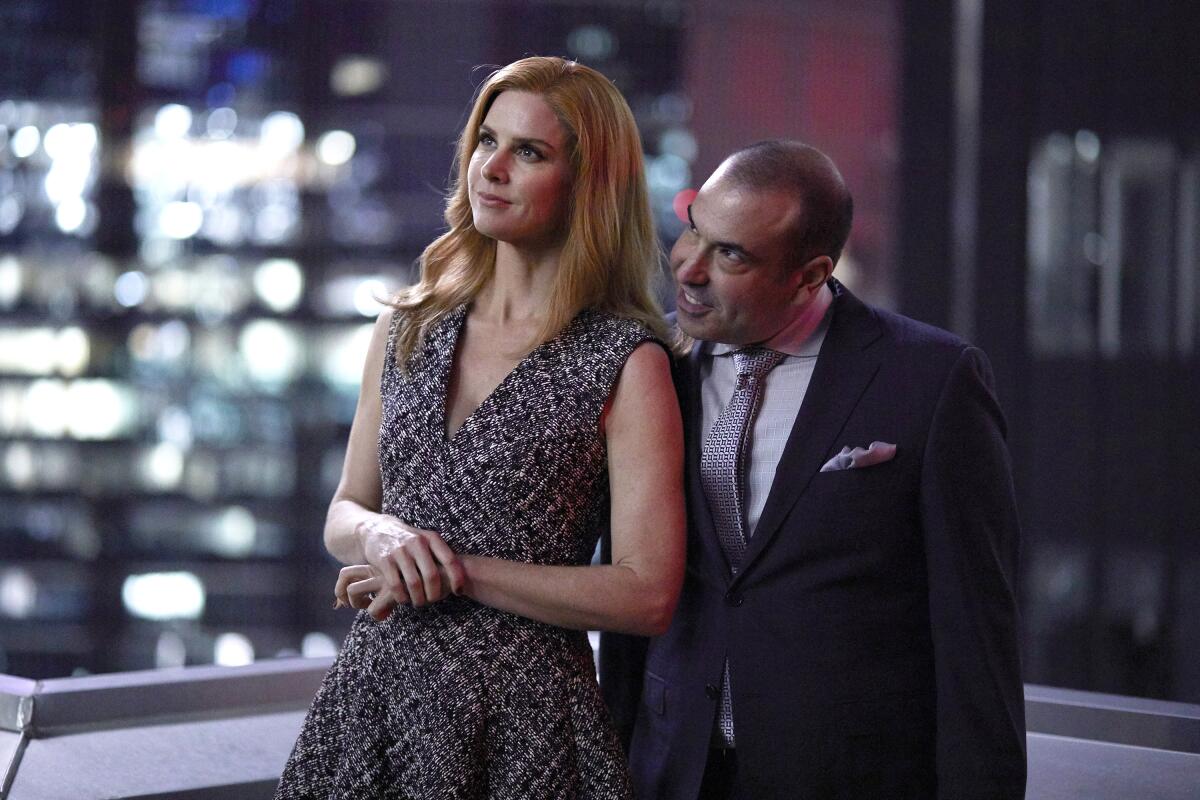
1. Patrick J. Adams, left, as Mike Ross and Gabriel Macht as Harvey Specter in “Suits.” (Steve Wilkie / USA Network) 2. Patrick J. Adams as Mike Ross and Meghan Markle as Rachel Zane in “Suits.” (USA Network / NBCU Photo Bank / NBCUniversal) 3. Sarah Rafferty as Donna Paulsen and Rick Hoffman as Louis Litt in “Suits.” (Shane Mahood / USA)
Clips of the show made the rounds on TikTok. Brands like e.l.f. Cosmetics and T-Mobile sought cast members for 2024 Super Bowl ads. Macht, Adams, Torres and Sarah Rafferty, in a nod to the show’s resurgence, were invited to present that year at the Golden Globes. Adams and Rafferty, who played Donna, the all-knowing assistant-turned COO in the original series, also launched a podcast, “Sidebar,” late last year to engage with fans.
Revisiting the series as a viewer, Adams has some thoughts on why “Suits” found a second wind: “Aaron and his team were really good at continuing to throw really interesting and dynamic problems at this group of people, week after week. … But fundamentally, what they did so well, and what we did so well, is we built that family and we made it a group of people that viewers wanted to return to and and wanted to see succeed, or fail, in some cases.”
Rafferty echoed the sentiment: “You felt his [Aaron’s] investment in the person you’re embodying, not just plugging the plot along,” she says. “I think it is magical that the energy of these characters live on.”
Some fans are curious to see how “Suits LA” fits alongside its predecessor. Others are skeptical, believing that it’ll feel like a copy-and-paste job of the original characters and their dynamics.
Amell, who says he experienced similar skepticism when he was cast as Oliver Queen/Green Arrow in the CW’s superhero drama, isn’t worried about it.
“It’s weird because I’m playing a new character that a lot of people feel like is a reimagining of another character, but he’s not,” he says, noting that Macht sent a text of support to Korsh that was shared with the “Suits LA” team. “Internet commentary is a very, very loud but very, very small portion of the overall fandom at large. If you are adamant that you’re not watching anything but the original show, God bless you. I kind of feel bad for you because it’s the same creative team and it’s an extension of the universe. None of it really matters until the show airs.”
Korsh puts it simply: “‘Suits LA’ is certainly not a copy of ‘Suits. These characters are unique people with their own drives, their own desires, their own senses of humor, and their own things that tick them off.”
Overseeing any series, let alone one with an engaged and protective fan base, is already a stressful undertaking. But last month Korsh also found himself confronted with the unthinkable: leading a show amid crisis — in this case, the wildfires sweeping through parts of L.A.
It was a scramble trying to make the right call under pressure. Production shut down on Jan. 8, a Wednesday, as the Palisades and Eaton fires raged. Korsh was asked by studio heads that same day if shooting should resume in the morning — “I said no. Though, I will say, I did not think I was the person that should be making the decision,” he says. Then, as Friday loomed, the studio communicated to Korsh that he had the greenlight to shoot the next day but was not obligated to do so. He chose to keep production on pause, though the writers continued to work in that time at their discretion. Greenberg, who stars in the series as entertainment lawyer Rick Dodson, lost his home, and Korsh said at least one member from the show’s crew did as well.
That weekend, after consulting with his agent, Korsh had his line producer check in with the crew to gauge their feelings about returning. Then, the decision was made to restart work.
“It was surreal,” he says, recalling those harrowing days, careful to make sure his emotions don’t strain his words. “I don’t think I have truly — or anybody I know has, really — grappled with what has happened … I really didn’t feel prepared to make the decisions, but with the collective wisdom of everyone, I think I am happy with the decisions we made.”
Being the decision maker for a TV series was not the path he was originally on.

“I don’t think I have truly — or anybody I know has, really — grappled with what has happened,” says Aaron Korsh about the Los Angeles wildfires, which halted production on “Suits LA” for a period.
(Annie Noelker / For The Times)
Korsh grew up in a suburb just outside of Philadelphia; his father was a computer science professor and his mother is a psychologist. He, however, wanted to be a businessman like his wealthier uncle: “I wanted to pursue making money.” After studying finance at Wharton, he landed on Wall Street when it was still reeling from the 1987 stock market crash. He was making the money he was after, but he hated his job. Around that time, a former college roommate died, forcing Korsh to confront his own mortality. It provoked a negative attitude — he describes himself then as a “bratty young kid” — leading to a wake-up call. Korsh’s boss pulled him aside and gave him three choices: change his attitude and stay, quit or get fired.
Korsh quit.
He eventually moved to Los Angeles and landed a temporary real estate investment job. He became a TV writer almost by chance. A college friend who was a TV writer took him along to a table read of a sitcom pilot starring Bryan Cranston, before his “Malcolm in the Middle” and “Breaking Bad” fame.
“No one knew I wasn’t a writer so I just sat there and got to watch what they did and I couldn’t believe it,” he says . “I was like, ‘This is what you do for a living? This is the greatest thing ever.’ This is what I want to do.”
Korsh obsessively called around. He landed a production assistant gig on “Everybody Loves Raymond” thanks to a production coordinator who was intrigued that a former investment banker was eager to take a minimum-wage job. The next year, the show’s co-creator Phil Rosenthal made an extra writer’s assistant position for Korsh. He worked as a writer’s assistant at different shows for eight years before landing a writing spot on the short-lived ABC sitcom “Notes From the Underbelly.” But it was his brief time on “The Deep End,” a show about a group of young L.A. lawyers, that gave him a taste of the legal world that would come to define his career since.
When asked if he was able to enjoy the experience of “Suits” as he made it, Korsh chuckles. He points out that when the “Suits” pilot was shot, his son was about 6 months old; his daughter was born while the show was in its second season.
“I was a first-time parent and unprepared for all three of my children, and I felt torn between my two responsibilities,” he says. “I was in a bad mood much of the time. Season 4, I was the angriest, I think. And I actually called Phil Rosenthal … to talk to him about it. He was like, ‘Is it because the network won’t let you do what you want to do?’ I’m like, ‘No, they’ll let me do whatever I want. It’s just a totality of how hard it is.’”
That’s not what stands out for him now, though. “I tend to look backwards with nostalgia, rose-colored glasses, which I’m happy that I do,” he says. “I only remember the positive and I miss it … I’m lucky to have this job and I was incredibly satisfied with the results of those nine years. The other side of hard things is deep satisfaction and growth.”
Right now, as he moves past the halfway point of shooting the first season and is days away from the “Suits LA” premiere, Korsh is enjoying the moment even with the stress on his shoulders.
“I’m older and I’m approaching it differently — I’m not sure how,” Korsh says. “I’m definitely less obsessive about the words being exactly right or things being exactly as I had imagined or as good as I’ve imagined, but I’m not less obsessive about making the show as good as it can be. Right this second, I’m feeling pretty good. I am very happy with everything we’ve gotten.”

Movie Reviews
‘Night Nurse’ Review: A Caretaker Explores Her Kink for Elder Abuse in the Year’s Strangest Erotic Thriller

There are any number of erotic thrillers in which rich old men are robbed blind and/or left for dead, but Georgia Bernstein’s admirably bizarre “Night Nurse” might be the first movie of its kind where elder abuse is the source — and possible subject— of its erotic thrills. If there are others, I’m not sure I want to know.
But this woozy debut feature doesn’t rely on its audience being turned on by the relationship between a nubile caretaker and her dementia-addled patient. Their psychosexual bond, meanwhile, hinges on cold-calling vulnerable old people under the guise of a grandchild in financial distress. (“I’m in trouble, nana, send me $10,000 or I’ll be left to rot in jail!” That sort of thing). With its slim wisp of a premise stretched into a Strickland-esque dreamscape that substitutes kink for conflict, the film itself hardly seems convinced by its own wrinkled lust — all desperate kisses and non-touching poses of subservience. More important to Bernstein is what that lust reveals about her characters’ deepest needs, specifically how their need to care and be cared for can be as easily perverted as any other form of desire.

As moody and weightless as the noir-accented score that blows through the movie like a curlicue gust of wind in an old cartoon (credit to musicians Sam Clapp and Steven Jackson), “Night Nurse” lacks the pulse required for its stray feelings to come alive. Still, the film ambiently taps into the latent eroticism of teasing out the distance between how you see yourself and who you really are. Bernstein plays with that distance like a telephone cord wrapped around her fingers, and Eleni — played by the excellent newcomer Cemre Paksoy, powerfully helpless — only frays even more as the receiver is brought near the hook. “Everything I did before today wasn’t me,” the nurse tells co-worker Mona (Eleonore Hendricks) after starting a new job at an Illinois retirement home. “It was somebody else.”
What she did before today remains unexplored (specifically, what she did to get herself fired from her last gig), but I’m guessing she’s probably changed less than she thought. There’s a faraway flicker in her eyes the moment she catches the vibe between Mona and Douglas (a ribald and elusive Bruce McKenzie), a white-haired seventysomething who shows early signs of dementia but still commands an undiminished sexual energy. “I’m not an invalid,” he coos as Mona bathes him in the tub, to which she replies, “yes, you are,” in a supplicant tone that hints at a rich history of power games between them.
Later that same night, Douglas will force Eleni to call a stranger, pretend that she’s their granddaughter, and ask for money — he’ll wrap the phone cord around the nurse’s body as she talks and shove her against the wall as they kiss. She’s into it. So into it that he has to clarify the terms of his whole deal: “If you’re looking for a pogo stick, I’m really not your guy.” But Eleni isn’t looking for anything to bounce on. She just wants to be needed, and maybe to need someone in return. Someone who will see her for who she really is and allow her the fantasy of pretending she isn’t being herself when she cons vulnerable strangers out of their money — when she exploits how enthralled those strangers are by the care they have for their loved ones.
“Night Nurse” doesn’t belabor the psychology, as Bernstein prefers to express her story through heavy-lidded suggestion. Somnambulating from the moment it starts, the film moves through a series of beautifully arranged poses that stretch their latent meaning thin across the surface (Lidia Nikonova’s cinematography lacquers every shot with a seductive dreaminess). We see Douglas smoking in a lawn chair with Mona and Eleni curled around his feet. Eleni riding in the backseat of a convertible as the wind blows through her curls. The full staff of nurses — all of them under Douglas’ sway — stumbling around his condo in a state of zonked out bliss as they roll on the prescription drugs they’ve stolen from the residents.
Once you’ve seen one shot of this movie, you’ve practically seen them all, at least until things escalate during a rushed and unsatisfying third act that forces Eleni into an honest confrontation with herself. People will do just about anything to feel needed — they’ll give whatever degree of care allows them to receive it in return. “Night Nurse” understands that desire, but remains far too numb to treat it.
Grade: C+
The Independent Film Company will relase “Night Nurse” in theaters on Friday, July 10.
Entertainment
Lucas Museum to give free annual passes to South L.A. neighbors, host community preview day

The Lucas Museum of Narrative Art, which is moving at light speed toward its Sept. 22 opening, announced Thursday that it will give free annual passes to its South L.A. neighbors living in the 90037 ZIP Code. The 300,000-square-foot, $1-billion museum located in Exposition Park will also host a special community preview day on Sept. 13, more than a week before the general public gets to step inside.
The 90037 ZIP Code has a population of more than 65,000 and is bordered roughly by the 110 Freeway to the west, Slauson Avenue to the south, Central Avenue to the east and Martin Luther King Jr. Boulevard to the north. Residents can register for passes at lucasmuseum.org/lm37 and will be alerted in August when the program launches. Pass holders can reserve tickets for themselves and one guest.
Tickets for non-pass holders go on sale July 21. They cost $25 for adults and $21 for seniors. Kids 17 and under are free.
“Storytelling has the power to bring people together and create a sense of community,” said Lucas Museum Chief Executive Tracey Bates in a news release about the program. “Through LM37, we are inviting our South Los Angeles neighbors to make the museum part of their lives and take their own path of discovery through the art, programs and experiences that will help shape this new cultural hub for Los Angeles.”
The community preview day is designed to give local business owners, community partners, civic leaders and registered LM37 pass holders a sneak peak of the 10,000 square feet of exhibition space, as well as the expansive gardens with 11 acres of park space.
The opening programming, curated by co-founder George Lucas, features 20 inaugural exhibitions across more than 30 galleries, including one titled “Star Wars in Motion,” containing vehicle designs, high-speed racers, flying vessels, props, costumes and illustrations from the first six films in the beloved franchise.
More than 1,200 objects will be on display from Lucas’ personal collection of narrative art. Highlights include work by Norman Rockwell and Dorothea Lange, as well as a variety of manga, children’s book illustrations and comics.

Last year’s “Superman” ended with Iggy Pop singing “Because I’m a punk rocker, yes I am” — an ironic coda for a superlatively square hero. But it rings straightforwardly true for Superman’s cousin.
Milly Alcock’s Kara Zor-El, or Supergirl, sports not a spandex suit but a Blondie T-shirt. When we meet her in Craig Gillespie’s “Supergirl,” she’s been on an interstellar bender for days. She’s more Courtney Love than Clark Kent.
Nonchalant and sarcastic, Kara is also a little Han Solo-ish, you might say, given that she moves capriciously through the galaxy in her junky spaceship while getting in fights in extraterrestrial bars. She’s a welcome, jagged riff on more buttoned-up superheroes, and Alcock is terrific in the role. If only “Supergirl” was as good as she is.
While the latest DC release, and second under James Gunn’s stewardship, has its moments, “Supergirl” struggles to match Kara’s punk-rock energy with an equally spirited supporting cast and story.
Skepticism seems to have gathered for “Supergirl” ahead of its release. Many fans have argued it wasn’t the right next step for DC Universe. But I’m not so sure. Alcock’s breezy cameo in “Superman” was one of that movie’s highlights. Handing the follow-up to her, and her faithful floating dog Krypto, strikes me as an extremely natural next step. When in doubt, follow the dog.
And much of “Supergirl” is winning. It resides almost entirely in space, touching down only momentarily on Earth. In its consistently creative production design, clever needle drops and underdog story arc, “Supergirl” resides a little closer to Gunn’s “Guardians of the Galaxy” movies than other DC entries. Its outer space is filled with cosmic detritus, mean characters and cute critters. Seth Rogen as the voice of a tiny alien co-piloting a space bus is an inspired concoction, as is a shabbier sci-fi realm with rest stops along the intergalactic highway.
-

 Los Angeles, Ca31 minutes ago
California teen e-biker baiting police to chase tracked by drone, arrested
-

 Detroit, MI51 minutes ago
Our picks for state\nSenate from Wayne Co. | Endorsements
-

 San Francisco, CA1 hour ago
Man reported missing in San Francisco
-

 Dallas, TX1 hour ago
How to buy France World Cup semifinal soccer tickets in Dallas
-

 Miami, FL1 hour ago
Miami-Dade Schools names six semifinalists for superintendent
-

 Boston, MA1 hour ago
Lawsuit: ICE detained East Boston father despite legal status
-

 Denver, CO1 hour ago
Victor Marx wins GOP primary for Colorado governor, defeating veteran lawmaker after unorthodox campaign
-

 Seattle, WA1 hour ago
Widower of pregnant woman who was shot to death in Seattle sues homelessness authority

