Lifestyle
Comedian Ronny Chieng is thankful he never got a job out of law school


A note from Wild Card host Rachel Martin: When you’ve watched Ronny Chieng’s comedy, it becomes pretty clear he’s a guy who takes none of his success for granted. He knows life could have turned out differently. What were the odds that a twenty-something Chinese Malaysian guy trying to launch a comedy career after law school in Australia would make it big in America? Whatever the odds were, Ronny Chieng beat them to become one of the biggest names in comedy.
He’s been a regular correspondent on The Daily Show since 2015 and is now a rotating host. He absolutely crushes his role as Jimmy O. Yang’s best friend in the Hulu show Interior Chinatown. And he’s got his third Netflix comedy special out now called Ronny Chieng: Love to Hate It, which made me laugh so hard I started recommending it to anyone within earshot.
The comedy in his specials is rooted in personal experience and observation, but this one is especially so. From stories about the challenges and absurdity of IVF to his dad’s death, he weaves in and out of these intimate places in the most hilarious way possible.
Throw in some razor-sharp observations about masculinity and YouTube in the Trump era, and boom! You got yourself an epic comedic journey well worth the ride.
The trailer for “Ronny Chieng: Speakeasy.”
YouTube
This Wild Card interview has been edited for length and clarity. Host Rachel Martin asks guests randomly selected questions from a deck of cards. Tap play above to listen to the full podcast, or read an excerpt below.
Question 1: How do you consciously try to emulate your parents?
Ronny Chieng: I don’t think anything is that impressive. [laughs]
That’s how I mimic them because they’re not easily impressed by much — but in a good way. So, I think in that way I try to see reality the way they see it, where they’re like, “Oh yeah, this is not that big of a deal. This is not that big of an achievement.” [laughs]
Rachel Martin: I think that would be helpful in your line of work, actually, because there is the risk that things spiral and all of a sudden, you think you’re really awesome.
Chieng: Yeah, yeah. It keeps you working to pursue perfection, right? You never think you’ve achieved it, so it’s good.
Martin: Did that ever cut the other way for you growing up? Like, if you did a thing and you wanted them to be proud of you and they were like, “Hmm?”
Chieng: I don’t know. I don’t think I was that impressive a kid. I didn’t have that many great achievements anyway, so I don’t feel like they wronged me by not being impressed. So, no, I don’t. I was like, “Yeah.” I was like, “You’re right. It’s not that impressive.” [laughs]
Martin: And do you find that people in your line of work are constantly seeking that kind of affirmation? Do you find yourself falling into that trap?
Chieng: You know, my line of work being stand-up comedy — undoubtedly, we seek affirmation through a crowd response to our jokes, right?
We are looking for a good reaction to a joke, specifically laughter. So, in that way our integrity is compromised.
But we don’t believe in our own marketing. Someone told me, “The best comics think that their material is bad.” And there’s something to that, I think. I don’t know any great comic who’s like, “Oh, my material is the best in the world,” you know?
You’re always looking at other comics and going, “Man, that guy’s really funny. I need to write a better bit,” you know? You never feel like you have the greatest joke in the world. You’re always impressed by someone else’s joke. That’s how I feel, anyway.

Jimmy O. Yang (left) and Ronny Chieng (R) at the premiere of Hulu’s “Interior Chinatown.”
Valerie Macon/AFP
hide caption
toggle caption
Valerie Macon/AFP
Question 2: What was a disappointing experience that now feels like a blessing?
Chieng: I couldn’t get a job coming out of law school. My grades were too bad, and I couldn’t get hired. And everyone around me was getting jobs because I went to a very good law school, so everyone around me was these very hyper-competitive type-A people who were getting really good jobs at these big law firms. And I felt a little left out at the time.
But in hindsight, I’m like, “Oh man, I’m so glad I never got hired,” because I think it would have been more difficult for me to quit a job and do comedy. As it was, I just — I didn’t have anything to lose, so I could just do comedy. It wasn’t like I had to pick between comedy and a corporate job. I was just not smart enough like my wife. I went to law school with my wife and she’s like a genius. Her grades are amazing. She got all these job offers. But I couldn’t get a single one.

Martin: So, were your parents disappointed that that didn’t pan out for you?
Chieng: No, they weren’t because I never told them.
Martin: What do you mean?
Chieng: I didn’t tell them I was doing comedy. They thought I was studying for the bar exam, which I was in fairness. But at that time, I was just doing comedy. And by the time they found out, it was almost too late.
Martin: Wait, that’s awesome. So you just led this separate life — assuming you were in a good enough place that when they found out, they weren’t traumatized. You’re like, “I’m a comedian — and I can pay my rent. So it’s okay?”
Chieng: Yeah. They only found out honestly when I got hired on The Daily Show.
Martin: Wow. Did they know what The Daily Show was?
Chieng: No, they didn’t know what it was, but after I told them I got hired, they googled it, they found out all about it, they were like, “Oh, you know, this is an important show, this is a very famous show,” and I’m like, “Yeah, I know, I know.”
They kind of trained me to be like, you know, it’s just an opportunity. It doesn’t mean you’re good. [laughs] It just means you have a chance to do something cool, right? Like that’s what it was, so that’s what I took it for. And that’s really what the strength of being on The Daily Show is. Like, more so than fame or whatever, it’s like this opportunity to work with extremely talented people and really become better yourself. Because everyone at that show is so good at their jobs that you don’t want to be the weakest link. And so you lift your game. So, that’s why it’s the best job in comedy. It makes you a better writer, performer, comedian, satirist, you know? That show is — it’s like the Harvard Business School of comedy.
Ronny Chieng on “The Daily Show.”
YouTube
Question 3: How have your feelings about death changed over time?
Chieng: Oh, yeah. It’s become more real. It used to be this kind of conceptual abstract, right? And then it’s become very real the last couple of years, seeing it up close. It becoming more real was kind of frightening. I was studying Buddhism recently, and there was this very interesting concept that I’m going to butcher because I’m going to give you the Cliff Notes of it in, like, five seconds. But the idea was something like: we are a different person in every moment, anyway. Our thoughts are different. Our cellular makeup is different in every second, every moment. Meaning — we are different people in every second of every moment anyway. So, the concept of “me” doesn’t really exist because I’m constantly changing anyway.
And so when I die, it doesn’t matter because I never really existed. So that is kind of like the Buddhist answer — one of the Buddhist answers — to that.
Martin: I like that idea. Does that mean that when a person dies, you think that it’s just another transition, or are they gone?
Chieng: I think that, unfortunately, as a person observing someone dying, that person is gone. I’m just talking about me, personally — for me to come to terms with my own mortality. That’s how I view it anyway — that I never really existed. I’m different every moment, so if I go, that’s just another change, right? Dealing with other people, that’s tough. I think that requires a different concept.



The scoreboard shows the results of the women’s singles final match between Iga Swiatek of Poland and Amanda Anisimova of the U.S. at the Wimbledon Tennis Championships in London, Saturday, July 12, 2025.
Kirsty Wigglesworth/AP
hide caption
toggle caption
Kirsty Wigglesworth/AP
Fifteen points in tennis? Nice. Thirty, 40 — even better. Advantage — that sounds good. “Love” — that also must be great, right? Well, not quite.
As the French Open rolls on and Serena Williams has announced her return to the sport, maybe you’ve been paying a little more attention to tennis. The sport’s scoring system is notably distinct, and can sometimes be hard to grasp for newcomers. But even tennis aficionados might not know why, or how, “love” became the unmistakable callout for zero points. For this installment of NPR’s Word of the Week, we’re exploring how a word that signifies trailing behind got such a sweet name.
“Love” comes from the heart — or an egg?
It’s hard to pinpoint when the first tennis ball went over the net. Tennis is a derivative of lots of other sports, such as “jeu de paume,” a handball game played in France, said JT Buzanga, the collections manager at the International Tennis Hall of Fame museum.

But tennis became a patented, official sport in 1874, said Steve Flink, a journalist whose tennis coverage got him inducted into the International Tennis Hall of Fame. It has retained its unique, mysterious scoring system ever since.
“By and large, the original system has held up almost entirely,” Flink said.
The use of “love” goes back to the late 18th century, said Jesse Sheidlower, a lexicographer. But it was used earlier than that in card games such as whist and bridge. Before the term made its way to tennis, the sport favored plain old “nothing,” or “nil,” he said.
Why love in the first place, though? Historians don’t really know for sure, but there are a few theories.
The French could have something to do with it. Some historians believe “love” derives from “l’oeuf,” which means “the egg” in French. Because eggs are shaped like zeros, terms such as “goose egg” and “duck’s egg” have been used in other contexts to mean zero, Sheidlower said.
It’s also possible English speakers mispronounced l’oeuf as “love.” But Sheidlower isn’t convinced that’s the answer.
“It’s the French equivalent of an English expression. But since that expression doesn’t appear in French, the French word wouldn’t have been used,” he said.
To be sure, France has had a lot of influence on tennis culture, Buzanga said. For example, “deuce” or a game tied at 40 points, comes from the French word for “two”: “deux.” But he prefers another prominent theory: that “love” comes from the idiom “for the love of the game.” Even if a player hasn’t scored, it doesn’t matter, because their heart is in it. It’s the theory Sheidlower said is the most plausible, because the idiom was used by the English before tennis was popularized.

Another variation of the “love of the game” theory is that the word could have come from the Dutch “lof,” or “honor” — or the Latin “amare,” meaning “to love,” Flink said.
But if tennis’ “love” doesn’t come from a French word, the theory at least has a French sensibility.
“I think the ‘for the love of the game’ is kind of romantic,” Buzanga said.
“Love” probably isn’t going anywhere
Tennis used to be a sport of leisure. The style of play has changed a lot over the years; players are more athletic and competitive, for instance, Flink said. But the rules of the sport are more steadfast, he said.
“There’s this incredible, enduring respect for tradition in tennis,” he said. “Changes are not made easily.”
There has been one major change in modern history: the tie-break. Matches can go on and on because players have to score two consecutive points to break a deuce, or by two games to break a tied set. But the onset of television meant matches would have to get shorter if the sport wanted to capture a larger audience, Flink said.

Change even came for “love.” An alternative sprouted up in the 1970s, and is still used today: “bagel,” named for its zero shape, Sheidlower said. Novices may say “zero,” and insiders will understand what they mean, but they “will needle them about it,” Flink said.
But “love” still prevails.
“People kind of like it,” Flink said. “It’s different. Why say zero when you can say love?”

On a 75-mile cliff-hugging stretch of highway in California, traffic is way up, despite soaring gas prices. And locals expect the busiest summer in years.
The road is Highway 1 in Big Sur, which reopened in January after three years of repair and reconstruction following a pair of landslides. Drivers can once again embark on the state’s most famous road trip, covering the 100 miles between Cambria to the south and Carmel to the north without leaving the two-lane coastal highway. And they’re heading out in big numbers.
Caltrans estimates that as of May, Big Sur restaurant and retailer guest counts are up 40% from last year, and that northbound traffic at Ragged Point, the southern gateway to Big Sur, has risen 900% year-over-year.
People pose for photos near Bixby Bridge. Monterey County’s Board of Supervisors voted to explore a 12-month ban on parking around the bridge.

Safety cones prevent parking along Coast Road near the Bixby Bridge.
“Take your time,” said Kirk Gafill, co-owner of the popular Nepenthe restaurant and president of the Big Sur Chamber of Commerce, offering advice to travelers. “You’re going to be sharing the road with a number of people.”
As travelers rediscover the road, the cost of driving has been shooting skyward. California’s average gas price ($6.11 per gallon as of May 26) is up 26% from the year before. In early April, rates hit $9.99 at the isolated gas station in the Big Sur community of Gorda.
For spring and summer travelers, these numbers would seem to pose a stark question: Stay home and save money, or head for the coast because the road is finally open and it’s still cheaper than flying?
So far, the latter answer is winning big.

Fog lingers off the coast of Highway 1.
“We are definitely seeing a huge uptick in our reservations,” said Megan Handy, assistant general manager at the upscale Treebones resort. She estimated that bookings are 30% or more ahead of last year, and rates are unchanged since then. But “it’s still not feeling super crowded, which is nice. Everything still feels kind of calm.”
But added traffic has raised some anxiety. On May 19, Monterey County’s Board of Supervisors voted to explore a 12-month ban on parking at Bixby Bridge, one of the region’s top photo spots.
Over the years, the number of cars parking near the bridge — often illegally, sometimes impeding emergency vehicles — has risen. The proposed parking moratorium won’t take effect until the supervisors discuss it further.

-
Share via
Busy as things are, several business owners pointed out that many international travelers have not yet returned — perhaps because most make their plans more than six months ahead, perhaps because of global politics, perhaps a little of each.
The biggest challenge for businesses during this resurgence? “Restaffing and retaining,” said Handy at Treetops.
At Nepenthe, Gafill said his business has seen a 45% boost in guest volume since the road’s reopening. Gafill said he would have expected a 35% pickup, “simply by virtue of reopening the highway.” The additional 10%, he said, might be “all that pent-up demand,” aided by “a very beautiful and very dry winter,” followed by a mild spring.

A lunch crowd dines at popular restaurant Nepenthe.
Another possible factor: Nobody can be sure how long the road will remain open.
To cope with the influx of people, Gafill said, “everybody is trying to recruit and retain their existing staff.”
At the Ragged Point Inn, where rates dropped as low as $149 nightly last fall, rates are back over $200 and staffers are suggesting that customers book at least six months ahead. The inn has reopened its snack bar for the first time since early 2023, and management is investing in capital upgrades and staging live music on weekends throughout the summer.
Business “is up over 100%,” said Diane Ramey, whose family owns the inn. “I know not all of our neighbors are having the same lift, but everybody is doing better.”
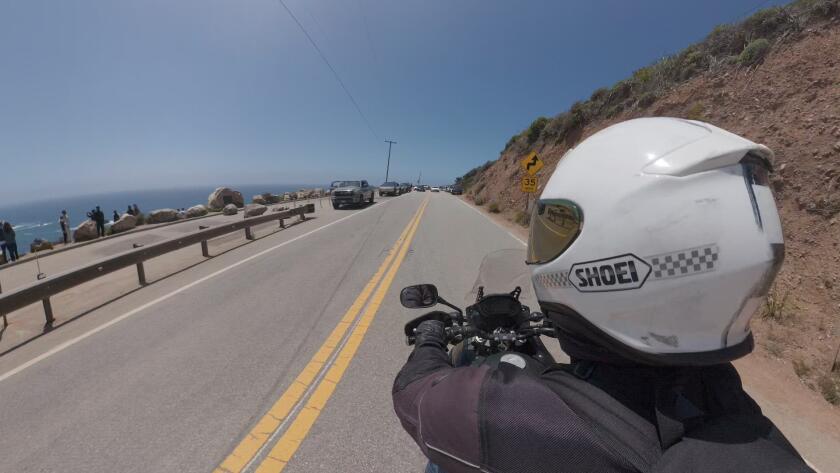
Traffic approaching Bixby Bridge.

A visitor poses in an oversized chair at Big Sur River Inn.
Even at the New Camaldoli Hermitage, a Benedictine monastery above Lucia, the road’s reopening and coming summer season have made a difference. Bookings are up an estimated 30% at the hermitage, which rent rooms and cottages (for two nights or more) to visitors who agree to its requirement of silence.
Big Sur business owners advise visitors to travel on weekdays for less traffic and the best hotel rates, and to get on the road as early as possible.
Since its opening in 1937, the highway has been vulnerable to landslides and shifting ground, operating on a longstanding cycle of landslide, closure, repair, reopening and then another landslide, or sometimes a fire. The U.S. Geological Survey has identified the Big Sur coastline as one of the most landslide-prone areas in the western United States. The 2023-2026 closure was the longest in the highway’s history.
Over time, road crews have used increasingly sophisticated strategies. In the most recent efforts, Caltrans said, it used drones to help survey the slopes and remotely operated bulldozers and excavators to reduce risks to workers.
During the closure, no traffic was allowed on 6.8-mile span from just north of Lucia until about a mile south of the Esalen Institute. Drivers detoured inland by way of U.S. 101.
-

 Health6 minutes ago
Popular weight-loss diet shows surprising impact on serious mental health condition
-

 Sports9 minutes ago
NBA bans two fans for life after court invasion during Knicks-Spurs Game 1
-

 Technology14 minutes ago
Charter breach warning: What customers should know
-
 Business21 minutes ago
Trump announces new coal export terminal in Oakland
-
 Entertainment24 minutes ago
Kathy Hilton won’t be WeHo Pride’s grand marshal after backlash from community
-

 Lifestyle29 minutes ago
OTB Takes Full Control of Viktor & Rolf
-
 Politics36 minutes ago
Senate rejects an initial attempt to ban Trump’s $1.8-billion ‘anti-weaponization’ fund
-
 Science39 minutes ago
Emergency room visits during heat waves available to the public in ‘near-real time’ in L.A. County

