Sports
From Super Bowls to Michael Jordan, Muhammad Ali to ‘last resort,’ the Superdome has seen it all


NEW ORLEANS — Spring 1982. Sixteen seconds left in the NCAA final, and a skinny freshman from North Carolina buries a jumper that delivers a championship and changes his life.
He showed up in New Orleans that week as Mike Jordan. He left as Michael.
By that point, the sprawling steel building that provided the stage for Jordan’s arrival into the national consciousness — the seven-year-old Louisiana Superdome — was used to gripping theater unfolding within its walls. In November 1980, as the seconds ticked away at the end of the eighth round of the world welterweight championship, boxer Roberto Durán, tired of chasing Sugar Ray Leonard around the ring, waved his glove at the referee and staggered to his corner. “No más, no más,” Durán muttered. It was the first time a world champ had voluntarily conceded the title in 16 years.
Two years prior, the same stadium witnessed the last of Muhammad Ali’s 56 professional wins, a unanimous decision over Leon Spinks that took back the WBA heavyweight title.
Pete Maravich ran the break here. Keith Smart’s jumper won Indiana the title here. Chris Webber called a timeout he didn’t have here.
In 1978, the venue hosted the first prime-time Super Bowl. Thirty-five years later the lights went out in another. Tom Brady won his first here; Brady’s idol, Joe Montana, won his last here.
In 1981 the Rolling Stones performed in front of 87,500 — then a record crowd for an indoor concert. The pope visited. Presidents, too.
But for native New Orleanians, nothing will match the night Steve Gleason’s blocked punt helped make a city feel whole again.
Not after the devastation wrought when Hurricane Katrina made landfall on Aug. 29, 2005. As levees broke and parishes flooded, the Superdome became “a refuge of last resort” for displaced citizens. Thousands crammed inside with nowhere else to turn. The plumbing failed. The air conditioning failed. Vicious winds peeled off parts of the roof. Urine pooled on the floor. Blood stained the walls. One man reportedly jumped to his death from a stadium balcony.
A city was left reeling, its citizens scarred, its iconic stadium battered.
Twelve months later the Superdome was restored, and with it, New Orleans. Doug Thornton, executive president of ASM Global, the company that runs the stadium, watched Saints fans file through the gates the night of the home opener with tears rolling down their cheeks. “They never thought they’d get to come back in,” he says now.
What followed was a moment so symbolic the team erected a statue to commemorate it.
After forcing the Atlanta Falcons into a three-and-out on the first possession of the game, Gleason laid out to block a punt attempt by Michael Koenen. Saints teammate Curtis DeLoatch recovered the ball as it rolled into the end zone for a New Orleans touchdown that kicked off a cathartic celebration. “I’ve never been in a stadium louder than that,” ESPN’s Mike Tirico later told NFL Films.
“Rebirth,” the statue commemorating Steve Gleason’s iconic 2006 punt block, was unveiled outside the Superdome in 2012. (Jonathan Bachman / Getty Images)
The Superdome’s eighth Super Bowl arrives Sunday; no other stadium has hosted more than six. It’s a testament to the rarest of American sporting venues, one that has stood the test of time despite a host of factors fighting against its longevity, including architectural advances and the worst Mother Nature has to offer. More than that, amid the era of multibillion-dollar, state-of-the-art stadiums, fewer and fewer NFL franchises call downtown home.
The Saints still do. And that’s how New Orleans prefers it.
Stadiums that have hosted the most Super Bowls
| Stadium | City | Super Bowls |
|---|---|---|
|
Caesars Superdome |
New Orleans, La. |
8 |
|
Hard Rock Stadium |
Miami Gardens, Fla. |
6 |
|
Orange Bowl |
Miami, Fla. |
5 |
|
Rose Bowl |
Pasadena, Calif. |
5 |
|
State Farm Stadium |
Glendale, Ariz. |
3 |
|
Tulane Stadium |
New Orleans, La. |
3 |
|
Raymond James Stadium |
Tampa, Fla. |
3 |
|
Qualcomm Stadium |
San Diego, Calif. |
3 |
“I’ve spent half my life in this building,” says Thornton, whose office for the last 28 years has been inside the since-renamed Caesars Superdome. “We’ve always joked that New Orleans viewed the Superdome as its living room. It’s where we watch our kids graduate high school. It’s where we come together for Saints games. For monster truck rallies. For all these major events we host every year like the Sugar Bowl.
“People just revere this place.”
Macie Washington tends bar at Walk-Ons a few blocks from the stadium. New Orleans without the Superdome? The thought lingers in her mind for a few moments. She grows quiet. She’s never considered it.
“Everything that happens in the dome, we feel it here,” she says. “It’s the heart of our city.”
Consider similar venues erected in the same era, during what was then a new wave of American ingenuity: Houston’s Astrodome (opened in 1965, closed in 2008), Detroit’s Pontiac Silverdome (opened 1975, closed in 2013); Seattle’s Kingdome (opened 1976, closed in 2000); Minneapolis’ Metrodome (opened 1982, closed in 2013), Indianapolis’ RCA Dome (opened 1984, closed in 2008). All but the Astrodome have been razed.
The Superdome still stands, and thanks in part to a recent $557 million facelift that was spread across four NFL seasons, will have a different look for Super Bowl LIX. More than $100 million of that came directly from Saints owner Gayle Benson, according to Jay Cicero, president and CEO of the Greater New Orleans Sports Foundation. “If that’s not proof they wanna stay put, I don’t know what is.”
Cicero doesn’t mean stay put in New Orleans. He means stay put in the Superdome.
“To continue to plan and fund renovations in the stadium rather than tear it down and build a new one from scratch?” Cicero continues. “That just speaks to how important it is to New Orleanians.”

GO DEEPER
Roger Goodell lauds Saints’ transparency on connection to archdiocese
Thornton says the original price tag for the building, way back in 1967, was around $42 million. But by its long-delayed 1975 unveiling, the cost had jumped to $160 million. It was a means to an end. The city wanted an NFL franchise. Legend has it longtime league commissioner Pete Rozelle told New Orleans businessman Dave Dixon — who spearheaded the push — that his city could have a team so long as it met one critical condition.
“You better build a stadium with a roof because of all the thunderstorms,” Rozelle said.
Dixon obliged. Louisiana erected the biggest domed stadium in the country. The building covers 13 square acres. At its apex, the roof is 273 feet from the floor. “Two million square feet under the roof,” Thornton marvels. “When it opened it was twice the size of the Astrodome.”
It is also the NFL’s fifth-oldest active stadium and will climb to fourth after the Bills vacate Highmark Stadium in the coming years (and third if the Bears ever leave Soldier Field). The recent renovations, spurred by Benson and the Saints organization, have modernized the facility and opened up the concourses for easier movement.
“It looks more like a nightclub now versus a coliseum,” adds Sam Joffray, who spent 25 years with the Greater New Orleans Sports Foundation and actually designed the stadium’s first website back in the mid-1990s. “It’s a pretty amazing example of what can happen if you keep reinvesting in a venue instead of tearing it down.”
NFL’s oldest stadiums
| Franchise | Stadium | Year opened | |
|---|---|---|---|
|
1 |
Soldier Field |
1924 |
|
|
2 |
Lambeau Field |
1957 |
|
|
3 |
Arrowhead Stadium |
1972 |
|
|
4 |
Highmark Stadium |
1973 |
|
|
5 |
Caesars Superdome |
1975 |
|
|
6 |
Hard Rock Stadium |
1987 |
|
|
7 |
EverBank Stadium |
1995 |
|
|
8 |
Bank of America Stadium |
1996 |
|
|
9 |
Northwest Stadium |
1997 |
|
|
10 |
M&T Bank Stadium |
1998 |
One message is plastered throughout the city this week, from the beads volunteers are handing out at the airport to signage lining the Ernest N. Morial Convention Center: This is what we do. New Orleans prides itself in its ability to host major events, and at the center of that is the colossal stadium — a short walk from just about anywhere downtown — that transformed the city’s potential from the minute it opened.
“The Superdome put New Orleans on the map,” Thornton says. “Before it was constructed, our major industries were oil and gas and shipping. Now, our major industries are tourism, oil and gas and shipping.
“I always joke,” he continues, “that as soon as someone shows up for the Super Bowl here, they’re handed a hurricane from Pat O’Brien’s at the airport and they head to the French Quarter and they never leave.”
Like Lambeau Field in Green Bay, Fenway Park in Boston, Wrigley Field in Chicago and Madison Square Garden in New York, the Superdome has forged a uniquely intimate relationship with a city and its residents. “We’re not the biggest market in the world. Actually we’re pretty small compared to most NFL cities,” Cicero says. “But we can compete for these major events and host these major events, and it starts with a truly amazing, amazing venue. The Superdome is just part of the fabric of New Orleans.”
It’s why the Saints have no interest in finding a new home.
It’s why the Super Bowl keeps finding its way back to New Orleans.
“This community has such a way of putting its stamp on it,” NFL commissioner Roger Goodell said earlier this week when asked why The Big Easy remains such a consistent player in the league’s Super Bowl rotation. “I think the people here wrap their arms around it and make it better. I think we’ve realized that this is a place that is sort of perfect for the Super Bowl.”
(Illustration: Dan Goldfarb / The Athletic; photos: Aaron M. Sprecher, Manny Millan, Bob Rosato, James Drake / Sports Illustrated via Getty Images)



NEWYou can now listen to Fox News articles!
The wait is over. The 2026 FIFA World Cup is coming to 16 different cities across Canada, Mexico and the United States this summer, and you’ll be able to catch all the action with FOX Sports, America’s English-language home for the 48-team soccer bonanza.
Here is the full broadcast schedule for the 2026 FIFA World Cup and how you can watch every game:
How to Watch the 2026 FIFA World Cup
The 2026 FIFA World Cup will run from June 11–July 19, 2026. Spread across three countries, the tournament will culminate with the final on July 19 at New York New Jersey Stadium in East Rutherford, New Jersey. All 104 tournament matches will air live across FOX and FS1 with every match streaming live and on-demand within both the FOX One and the FOX Sports apps.
JUMP TO: Group Stage | Knockout Rounds | World Cup Final
2026 World Cup Group Stage Schedule:
June 11, 2026
June 12
June 13
June 14
June 15
June 16
June 17
June 18
June 19
June 20
June 21
June 22
June 23
June 24
- Group B: Watch Switzerland vs Canada — BC Place Vancouver (3 p.m. ET, FOX, FOX One)
- Group B: Watch Bosnia vs Qatar — Seattle Stadium (3 p.m. ET, FS1, FOX One)
- Group C: Watch Brazil vs Scotland — Miami Stadium (6 p.m. ET, FOX, FOX One)
- Group C: Watch Morocco vs Haiti — Atlanta Stadium (6 p.m. ET, FS1, FOX One)
- Group A: Watch Mexico vs Czechia — Mexico City Stadium (9 p.m. ET, FOX, FOX One)
- Group A: Watch South Korea vs South Africa — Monterrey Stadium (9 p.m. ET, FS1, FOX One)
June 25
- Group E: Watch Ecuador vs Germany — New York New Jersey Stadium (4 p.m. ET, FOX, FOX One)
- Group E: Watch Curaçao vs Ivory Coastt — Philadelphia Stadium (4 p.m. ET, FS1, FOX One)
- Group F: Watch Tunisia vs Netherlands — Kansas City Stadium (7 p.m. ET, FOX, FOX One)
- Group F: Watch Japan vs Sweden— Dallas Stadium (7 p.m. ET, FS1, FOX One)
- Group D: USA vs Türkiye – Los Angeles Stadium (10 p.m. ET, FOX, FOX One)
- Group D: Watch Paraguay vs Australia — San Francisco Bay Stadium (10 p.m. ET, FS1, FOX One)
June 26
- Group I: Watch Norway vs France — Boston Stadium (3 p.m. ET, FOX, FOX One)
- Group I: Watch Senegal vs Iraq — Toronto Stadium (3 p.m. ET, FS1, FOX One)
- Group H: Watch Uruguay vs Spain — Guadalajara Stadium (8 p.m. ET, FOX, FOX One)
- Group H: Watch Cape Verde vs Saudi Arabia — Houston Stadium (8 p.m. ET, FS1, FOX One)
- Group G: Watch New Zealand vs Belgium — BC Place Vancouver (11 p.m. ET, FOX, FOX One)
- Group G: Watch Egypt vs Iran — Seattle Stadium (11 p.m. ET, FS1, FOX One)
June 27
- Group L: Watch Panama vs England —New York New Jersey Stadium (5 p.m. ET, FOX, FOX One)
- Group L: Watch Croatia vs Ghana — Philadelphia Stadium (5 p.m. ET, FS1, FOX One)
- Group K: Watch Colombia vs Portugal — Miami Stadium (7:30 p.m. ET, FOX, FOX One)
- Group K: Watch DR Congo vs Uzbekistan — Atlanta Stadium (7:30 p.m. ET, FS1, FOX One)
- Group J: Watch Argentina vs Jordan — Dallas Stadium (10 p.m. ET, FOX, FOX One)
- Group J: Watch Algeria vs Austria — Kansas City Stadium (10 p.m. ET, FS1, FOX One)
2026 World Cup Schedule: Knockout Round
Round of 32
June 28
June 29
June 30
July 1
July 2
July 3
Round of 16
July 4
July 5
July 6
July 7
Quarterfinals
July 9
July 10
July 11
Semifinals
July 14
July 15
World Cup Final
July 19
This page may contain affiliate links to legal sports betting partners. If you sign up or place a wager, FOX Sports may be compensated. Read more about Sports Betting on FOX Sports.
The World Cup will run from June 11–July 19, 2026. Spread across three countries, the tournament will culminate with the final on July 19 at New York New Jersey Stadium in East Rutherford, New Jersey. All 104 tournament matches will air live across FOX and FS1 with every match streaming live and on-demand within both the FOX One and the FOX Sports apps.

The U.S. men’s national team made its first World Cup game on home soil in 32 years one to remember, defeating Paraguay 4-1 in front of a sold-out crowd at Los Angeles Stadium (SoFi Stadium) in Inglewood on Friday night.
Here’s a look at some of the best moments before and during the game as captured by the Los Angeles Times photography staff:
U.S. fans march to Los Angeles Stadium (SoFi Stadium) before the start of the U.S.-Paraguay World Cup match Friday.
(Ronaldo Bolanos / Los Angeles Times)
1

2

3

1. David Beckham, right, and Tom Cruise waves to fans before the World Cup group stage match. (Allen J. Schaben / Los Angeles Times) 2. Katy Perry, right, and Tius Luka perform during the World Cup opening ceremony before the U.S.-Paraguay match. (Allen J. Schaben / Los Angeles Times) 3. U.S. players, left, and Paraguay players enter the pitch before their World Cup group stage match. (Allen J. Schaben / Los Angeles Times)

U.S. forward Christian Pulisic, right, controls the ball in front of Paraguay defender Juan Jose Caceres during the first half Friday.
(Ronaldo Bolanos / Los Angeles Times)

U.S. defender Antonee Robinson, right, and Paraguay midfielder Diego Gomez battle for the ball during the first half. (Kelvin Kuo / Los Angeles Times)

U.S. midfielder Weston McKennie celebrates after a U.S. goal in the first half against Paraguay. (Kelvin Kuo / Los Angeles Times)

U.S. star Christian Pulisic celebrates after a goal in the first half of a 4-1 win over Paraguay at the World Cup on Friday at Los Angeles Stadium (SoFi Stadium).
(Kelvin Kuo / Los Angeles Times)
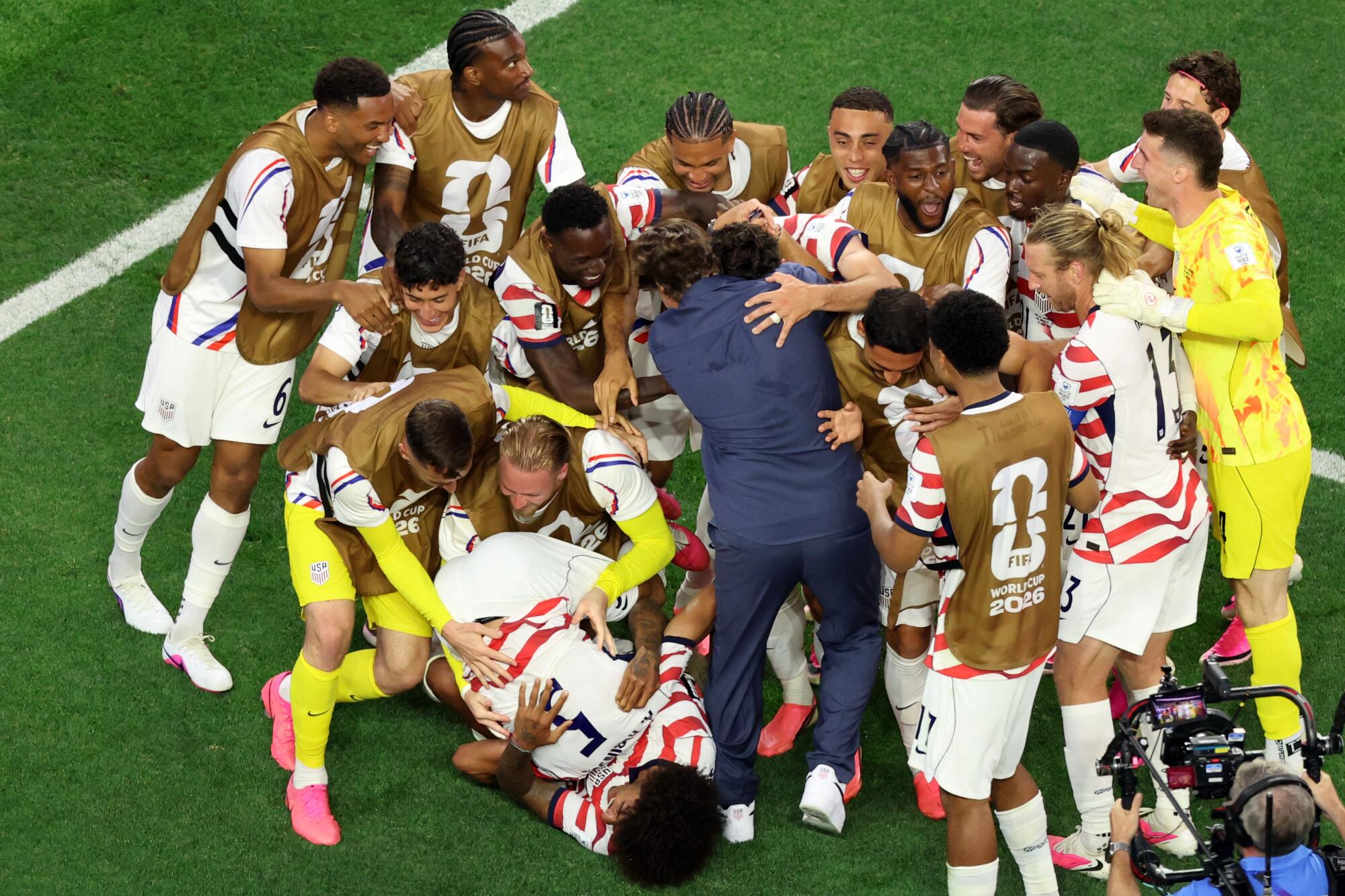
U.S. players and coach Mauricio Pochettino, center, celebrate after a 4-1 win over Paraguay in the World Cup at Los Angeles Stadium (SoFi Stadium) on Friday night.
(Allen J. Schaben / Los Angeles Times)
1

2

3

1. Paraguay midfielder Cristian Roldan heads the ball over U.S. striker Folarin Balogun during the second half. (Robert Gauthier / Los Angeles Times) 2. Paraguay forward Julio Enciso jumps over U.S. defender Chris Richards during the second half. (Robert Gauthier / Los Angeles Times) 3. A stage is placed for the opening ceremony before the start of the U.S. vs. Paraguay match at Los Angeles Stadium (SoFi Stadium) on Friday. (Robert Gauthier / Los Angeles Times)

Fans cheer during the United States’ 4-1 win over Paraguay at the World Cup on Friday.
(Robert Gauthier / Los Angeles Times)

NEWYou can now listen to Fox News articles!
The wait is officially over. The FIFA World Cup has arrived.
For the first time ever, three nations—the United States, Mexico, and Canada are co-hosting the tournament. It is also the largest FIFA World Cup in history, expanding to a 48-team field. Squads from around the world have arrived in North America with one ultimate goal: capturing the iconic World Cup trophy.
Here’s the latest look at some of the most notable news surrounding the World Cup.
June 12:
Official Injury Update On Neymar
Brazilian star Neymar Jr. will officially miss Brazil’s opening match against Morocco on Saturday. Neymar was named to Brazil’s 2026 FIFA World Cup squad despite a calf injury, and now won’t be available early on. Manager Carlo Ancelotti said that “Neymar is working very hard to recover as quickly as possible.
“The expectation is that he will recover and rejoin the group next week.”
Google Doodle Has World Cup Fever
In case fans didn’t already have World Cup fever, they can open their web browser.
Google is officially ready for USA’s opener against Paraguay, as the home page features a custom, USA-themed Google Doodle.
The Doodle features red text with a blue outline, as well as a soccer ball along with an interchanging USA crest replacing the “O’s” in Google.
James Cordon Stretches With Christian Pulisic
James Corden joined Christian Pulisic and the United States men’s national team for a training session ahead of their World Cup opener against Paraguay.
After meeting with head coach Mauricio Pochettino and going through a film session with the players, Corden and Co. hit the pitch for practice, where he helped serve as a water boy.
Corden tried to help Pulisic stretch out his legs after practice before he was stopped by a member of the coaching staff. As Corden walked off, Pulisic sprayed him with a water bottle.
DR Congo Arrives to the World Cup in Style
The DR Congo men’s national team isn’t set to play until Wednesday, June 17, against Portugal in Group K, but they’ve already made a statement upon arrival in Houston, Texas.
The squad arrived in style, stepping off the plane in striking black, jaguar-inspired outfits that quickly turned heads. The bold look fits their nickname, Les Léopards, and sets the tone for their World Cup presence before they even face Portugal.
DR Congo may be heavy underdogs, but they’re already winning where it counts off the pitch, taking the fashion battle before kickoff.
Canada’s Jesse Marsch Takes Dig At USA
The Canadian men’s national team is set to face Bosnia and Herzegovina on Friday afternoon. Ahead of the match, head coach Jesse Marsch took a subtle jab at the United States men’s national team during his remarks on Thursday.
“In the U.S., we had to beg players to sing the national anthem,” Marsch said.
The United States conducted a months-long search for a new head coach in 2023, with Marsch emerging as the frontrunner and making it clear he wanted the job. Instead, they chose to rehire Gregg Berhalter, a decision that may have left Marsch with some lingering resentment.
Marsch’s subtle jab could take on added stakes if the United States and Canada meet during the FIFA World Cup. The two nations could potentially face off as early as the Round of 32 or the Round of 16.
June 11:
The pressure of competing in the 2026 FIFA World Cup is high, but that hasn’t stopped players from enjoying some downtime with their teammates. Norway star Erling Haaland was spotted at the Stanley Cup Final between the Vegas Golden Knights and the Carolina Hurricanes.
Haaland appeared to be enjoying himself as the Hurricanes secured a Game 5 victory, taking a 3-2 series lead over the Golden Knights. The Manchester City striker drew plenty of attention from fans in attendance as he took in the action from the stands.
The Norway star was seen celebrating in the stands before turning his attention back to international duty, with Norway set to face Iraq in Group 1 play on Tuesday, June 16.
Australia Coach Popovic Signs Extension
Australia coach Tony Popovic has signed a contract extension through early 2027 on the eve of his team’s World Cup opening match against Turkey on Saturday.
Football Australia said Friday that the 52-year-old Popovic’s deal now extends through the Asian Cup, which will take place in January and early February in Saudi Arabia.
The former Australia international was hired in September 2024 and led the Socceroos to qualification for the 48-team tournament.
“I’m proud to lead my country into a World Cup, but most importantly, I want to ensure that our team is fully prepared and focused on our group matches against Turkey, the United States, and Paraguay,” he said of Australia’s opponents in Group D.
Canada Captain Sidelined For Opening Match
Canada’s captain and star defender Alphonso Davies will miss Canada’s World Cup opener against Bosnia and Herzegovina. Davies’ status has been questionable due to an ACL tear and other injuries during the club season, which limited Davies to appearing in two of Canada’s last 21 games.
Davies is one of the co-host’s more valuable players in terms of talent and experience, including 58 appearances in nine years with the national team. However, Davies’ injury does not rule him out of the entire tournament. His injury update and restraint from the opening match serves as a caution to heal his injury as the group stage unfolds.
After playing for the Vancouver Whitecaps in the MLS, Davies transferred to Bayern Munich, where he’s played since 2019. Canada is set to play Bosnia and Herzegovina on June 12, followed by Qatar on June 18 and Switzerland on June 24.
Captain Wataru Endo Withdraws From World Cup
Just ahead of Japan’s opening match against the Netherlands on June 14, captain and midfielder Wataru Endo has withdrawn his name from Japan’s World Cup squad and paired it with his national team retirement, per his statement on X. Endo has been dealing with an ongoing ankle/foot injury since February.
Endo has played for the Japan national team for over a decade, where he made 73 appearances and scored four goals. As a veteran anchor in the midfield, Endo has also served as Japan’s captain since their previous World Cup in 2022, where they reached the Round of 16.
As for Endo’s professional career, he first played for Shanon Bellmare from 2010-15, followed by the Urawa Red Diamonds from 2016-19, VfB Stuttgart from 2019-23 and has played for Liverpool FC since 2023. With Liverpool, Endo played a prominent role in the team’s Carabao Cup victory in 2024.
With Endo out, Japan has officially called Borussia Mönchengladbach midfielder Shuto Machino to join the 26-man roster. Machino is entering his second World Cup and his fifth year with the Japan national team.
Marco Senesi Called Up To 26-Man Roster
Following the injury of defender Leonardo Balerdi, Argentina has officially called up defender Marcos Senesi to the 26-man roster. Argentina is set to open their World Cup campaign on June 16 against Algeria.
Senesi has been training prior in case of a last-minute call-up, and was named to the roster after Balerdi’s muscle injury was ruled out. Senesi has played professionally since 2016, playing for clubs like San Lorenzo, Feyenoord, AFC Bournemouth and is currently with Tottenham Hotspur.
Joining Senesi in the back are defenders Lisandro Martínez, Nicolás Otamendi and Cristian Romero.
In what’s likely to be Lionel Messi’s last World Cup, Argentina will look to repeat their historic 2022 World Cup win this tournament.
Tyler Adams, USA Celebrate Shocking Knicks’ W
Tyler Adams, United States’ midfielder, is a fan of the National Basketball Association’s New York Knicks. The Knicks are in the NBA Finals, on the eve of the start of the 2026 FIFA World Cup, so members of the United States’ squad gathered together to watch what turned out to be the largest NBA Finals comeback in history, with the Knicks coming out on top.
When New York won, the room erupted, with Adams especially going wild. And we know this because the reaction was caught on camera in the moment.
That couch is destroyed, but at least no one watching the game ended up as damaged as it did after Adams went climbing and kicking all over it! If the United States ends up having a major comeback or win in the World Cup, maybe keep the players away from any obstacles like that, though. Just to be safe.
Morocco Loses 2 Players To Injury Before World Cup
Morocco replaced two injured players in its World Cup squad ahead of an opening game against Brazil, including star winger Abde Ezzalzouli.
FIFA confirmed late Wednesday that former Barcelona player Ezzalzouli and Marseille defender Nayef Aguerd were withdrawn from the Morocco squad for the tournament.
Ezzalzouli helped Real Betis qualify for next season’s Champions League and was a potential breakout star at the World Cup. Aguerd was a cornerstone of Morocco’s historic semifinals team at the 2022 World Cup in Qatar.
They were replaced by Amine Sbai of French club Angers and Marwane Saadane, who plays in Saudi Arabia for Al Fateh.
Morocco opens against Brazil on Saturday at MetLife Stadium near New York, then plays Scotland on June 19 near Boston and finishes Group C against Haiti on June 24 in Atlanta.
Ezzalzouli injured his right knee in a warmup game against Norway last weekend, though initial tests suggested he could be retained in coach Mohamed Ouahbi’s squad to play in the knockout rounds.
Surprise World Cup Comeback For Austrian Midfielder
The last time Dejan Ljubicic played for Austria was nearly three years ago. Now a teammate’s injury has given him a surprise comeback at the World Cup.
Austria coach Ralf Rangnick called up Ljubicic late Wednesday to replace key midfielder Christoph Baumgartner, who injured his right thigh while warming up for a pre-World Cup friendly against Tunisia last week and needed surgery.
Ljubicic is set to join Austria at the team camp in Santa Barbara on Thursday, ahead of the team’s first game on Tuesday against Jordan. Austria also plays Argentina and Algeria in Group J.
He’s more of a defensive midfield option than Baumgartner, who scored 17 goals in all competitions for Leipzig in Germany last season and has remained in camp to support the team.
Ljubicic also plays in Germany on the Schalke team which secured promotion from the second division last month.
Ljubicic has nine games for Austria but none at a major tournament. His last appearance was in a friendly against Moldova in September 2023, and he wasn’t in the squad for any World Cup qualifiers.
-

 Milwaukee, WI3 minutes ago
Milwaukee police searching for critically missing 31-year-old man
-

 Atlanta, GA6 minutes ago
Everything to know about getting to Atlanta Stadium on World Cup matchdays
-

 Minneapolis, MN11 minutes ago
Minneapolis Police investigating homicide on Golden Valley Road
-

 Indianapolis, IN18 minutes ago
Indianapolis Colts’ best chance to help Daniel Jones just got a major boost
-

 Pittsburg, PA21 minutes ago
Five WPIAL baseball and softball teams win PIAA state championships
-

 Augusta, GA26 minutes ago
How to set your Georgia AC thermostat for low temps and cost this summer
-

 Washington, D.C33 minutes ago
4 women hurt, 1 critically, in rollover crash in Southeast DC
-

 Cleveland, OH36 minutes ago
The Most Iconic Topps Football Cards of the 1960’s (Part 1)

