Washington, D.C
Thousands protest USAid workers being recalled from abroad or put on leave


Thousands gathered at the US Capitol on Wednesday after the shock announcement on Tuesday evening that the US Agency for International Development (USAid) was putting nearly all of its employees on leave and recalling thousands of officers from their postings abroad.
The news came only days after nearly a thousand contractors were laid off or furloughed, the USAid website was taken down, and its X account was deleted.
Protesters gathered near the Capitol under chilly, overcast skies and chanted: “Let us work!” and “USAid! USAid!”
“We are in a very, very dire place,” Jeremy Konyndyk, a top USAid health official under Barack Obama and Joe Biden, told the crowd. “The attempt to kill USAid will kill people.”
Competitors such as Russia and China were cheering this decision, he added.
His voice rose as he addressed members of Congress in the halls behind him – especially lawmakers, he said, who had supported the agency and its work for years.
“You know that what is being said about USAid is not true,” Konyndyk said. “Speak up! Where are you?”
“This is a dictatorship in the making,” Ed Markey, a senator from Massachusetts, told the crowd. “This is an example” of what the Trump administration can do to agencies such as the US Environmental Protection Agency (EPA), he said.
“We are the moral force of the world,” Markey said. “The only way to take back our government is to take to the streets by the millions to demand justice, not just for our country but for people around the world.”
Nearly all of USAid’s work, which includes preventing HIV and famine as well as rebuilding nations after conflict and improving education, was halted unexpectedly on 24 January for a 90-day review.
Experts say the erasure of the agency is a test run for the Trump administration, which has also put agencies such as the Department of Education and the National Oceanic and Atmospheric Administration (Noaa) in its crosshairs.
“This is showing that you can do a slash-and-burn to the American governmental apparatus, including foreign aid,” Joia Mukherjee, chief medical officer of the non-profit Partners in Health, told the Guardian.
While USAid has enjoyed bipartisan support in the past, it’s now a target for conservatives. But Mukherjee said that nothing about aid work had changed in Washington.
“I think the fidelity to Trump changed,” she said. Members of Congress are “afraid of Trump”, she added. “This is just a loyalty test.”
Pete Marocco, who was allegedly photographed and filmed at the January 6 riots, appeared to threaten aid workers with military action if they didn’t comply with evacuation orders, according to a source at USAid who read the recall letter.
Marocco was named deputy administrator of USAid on Monday by the secretary of state, Marco Rubio. That position needs confirmation by the US Senate before being filled.
after newsletter promotion
Rubio seized control of the agency to fold it into the state department after alleging that officials at the agency had been too “independent”, Rubio told reporters on Monday.
The aid agency was founded in 1961, but was enshrined into law as an independent agency by Congress in 1998. Only lawmakers have the power to dismantle or move it.
“What’s happening is unconstitutional and illegal,” said Sharon Baker, who worked on grants and contracts for USAid for 11 years before retiring.
“It’s enormous – it affects all Americans,” she said, before adding of USAid staff: “In global emergencies, they’re the first responders. [After earthquakes and tsunamis], they’re the ones who are there first. You see airplanes offloading supplies that say ‘from the American people’.”
The move to stop work and dissolve the agency into the state department without direction from Congress is unprecedented, said one contractor who worked for USAid for 20 years before being furloughed last week.
“It puts us and the world in danger in a way it never has before,” said the contractor, who requested anonymity to protect their job.
“I think this is Project 2025 in action. They’re doing what they said they would do.”
The stop-work order is “the most catastrophic thing we’ve seen in foreign aid since we started working on famine in Ethiopia in the 80s”, said Crickett Nicovich, who works for the non-profit Results.
“Congress needs to stand up and defend USAid. Conservatives have told us that they care about these issues for years,” Nicovich said.
“Without them pushing back, this dismantling of programs is costing hundreds of thousands of lives around the world.”

Washington, D.C
What’s that noise? What you need to know about D.C. flyovers Friday and Saturday – WTOP News

Reagan National Airport will close for America 250 flyover rehearsals Friday and celebrations Saturday featuring the Thunderbirds, Blue Angels and more.

Reagan National Airport will close from 10 a.m. to 1 p.m. Friday for rehearsals ahead of this weekend’s America 250 celebrations, meaning people around D.C., Arlington and Alexandria may hear and see low-flying military aircraft.
According to Freedom 250 event organizers, Friday’s “Wings of Freedom” demonstrations over the National Mall will feature parachute teams, helicopters and military aircraft, including the U.S. Marine Corps’ MV-22 Osprey and F-35B, the Navy’s F-18F and F-35C, the Air Force’s F-22 Raptor, the Thunderbirds and a tri-bomber formation.
On Saturday, the FAA will close the airport from noon to midnight for the full celebration. All arrivals and departures at Reagan National are scheduled to end before noon.
Flyovers and demonstrations are scheduled throughout the afternoon and evening along the National Mall and Washington Monument grounds, including appearances by Air Force One, the Thunderbirds, Blue Angels, military aircraft fleet reviews, parachute demonstrations and B-2 stealth bombers.
Highlights include an Air Force One flyover scheduled for 7:03 p.m., a Thunderbirds demonstration beginning at 6:25 p.m., a tri-bomber formation at 6:02 p.m. and a stealth aircraft flyover at 7:38 p.m.
Friday’s schedule of flyovers and demonstration rehearsals along the National Mall and Washington Monument
- 10 a.m.: Golden Knights, Leap Frogs
- 10:15 a.m.: Army Helo Flyover
- 10:20 a.m.: USMC V-22 Osprey Demo
- 10:35 a.m.: USMC F-35B STOVL Demo
- 10:50 a.m.: USN F-18F Demo
- 11:10 a.m.: USN F-35C Demo Team
- 11:30 a.m.: USAF F-22 Raptor Demo
- 11:50 a.m.: NASA F-5s
- 12 p.m.: HUGE (1) Formation
- 12:05 p.m.: USAF Thunderbirds
- 12:55 p.m.: USAF Tri-Bomber
Saturday’s schedule of flyovers and demonstration along the National Mall and Washington Monument
- 1:14 p.m.: – NASA F-5 Flyover
- 1:24 p.m.: -NASA Fleet Review
- 1:44 p.m.: USCG Helo Flyover
- 1:54 p.m.: USCG Fixed Wing Flyover
- 2:09 p.m.: Golden Knights, Leap Frogs
- 2:29 p.m.: Army Helo Flyover
- 2:44 p.m.: USAF Fleet Review – Wave 1 – Heavies
- 2:54 p.m.: USAF Fleet Review – Wave 2 – AFSOC
- 3:04 p.m.: USAF Fleet Review – Wave 3 – Fighters
- 3:29 p.m.: Executive Rotary Wing Airlift
- 3:39 p.m.: USMC Fleet Review – Wave 1 – Rotary
- 3:49 p.m.: USMC Fleet Review – Wave 2 – Fixed Wing
- 3:59 p.m.: USN Fleet Review – Wave 1 – Rotary
- 4:09 p.m.: USN Fleet Review – Wave 2 – Fixed Wing
- 4:19 p.m.: USN Fleet Review – Wave 3 – Fighters
- 4:21 p.m.: USN F-18F Demonstration
- 4:59 p.m.: USN Blue Angels
- 5:26 p.m.: USMC MV-22 Osprey Demonstration
- 5:44 p.m.: USAF Fleet Review – Fighters
- 6:02 p.m.: USAF Tri-Bomber Formation
- 6:05 p.m.: USN F-35C Demonstration
- 6:25 p.m.: USAF Thunderbirds Demonstration
- 7:03 p.m.: Air Force One Flyover
- 7:07 p.m.: USAF Thunderbirds Delta Break
- 7:17 p.m.: HUGE 1 Flyover Led by the Newly Renovated Air Force One
- 7:38 p.m.: U.S. Stealth Airpower Flyover
- 7:39 p.m.: F-22 Raptor Demo
- 7:53 p.m.: F-22 Raptor in Afterburner
- 7:59 p.m.: B-1 Flyover
- 8:07 p.m.: B-1’s in Afterburner
- 8:11 p.m.: HUGE ONE Fly Over Review
- 8:22 p.m.: Golden Knights Twilight Jump
- 10:36 p.m.: B-1 Afterburner Night Pass
Get breaking news and daily headlines delivered to your email inbox by signing up here.
© 2026 WTOP. All Rights Reserved. This website is not intended for users located within the European Economic Area.

An Air Force major was arrested in uniform on the steps of the Capitol after he called for the impeachment of President Donald Trump.
U.S. Capitol Police arrested Jason Watson, an active-duty service member, on Wednesday afternoon following remarks at a news conference where he said Trump and Vice President JD Vance should be removed from office.
The event was organized by the Removal Coalition, a group that lobbies members of Congress to impeach Trump, and attended by Rep. Al Green, D-Texas, who has repeatedly introduced articles of impeachment against Trump.
“I’m here with him because Rep. Green is the only member of Congress that has demonstrated the courage and conviction to … force a vote on articles of impeachment,” Watson said at the event. “If Congress followed his example, we could remove the entire Trump administration, but Congress remains unconvinced of the urgency and necessity for them to honor their oaths, so we must persuade them with our unrelenting, uncompromising civil resistance.”
Watson said he is not a Democrat and does not share policy positions with Green, who lost his re-election bid this year. Green’s office did not immediately respond to a request for comment on Watson’s arrest.
Capitol Police said in a statement that it “is generally against the law for the public to demonstrate on the House Steps unless they are with a Member of Congress.”
“Yesterday afternoon, a man was escorted to the House Steps by a Member of Congress,” the statement said. “When the Member of Congress left the area, our officers gave the man lawful orders to stop the illegal demonstration or he would be arrested. The man refused our lawful orders.”
Capitol Police identified the man as Watson, adding that he was arrested on charges of “Crowding, Obstructing, and Incommoding” and that it is legal to protest in other spots on the Capitol grounds.
Service members are subject to stricter laws than the average citizen when it comes to protesting. The Uniform Code of Military Justice prohibits officers from “using contemptuous language towards the President, Vice president, the Secretaries of War and of a military department, Congress, and certain other officials,” according to an Air Force memo last year.
An Air Force spokesperson said in a statement Thursday: “Service members must comply with all laws, regulations and policies governing conduct and the wear of the uniform. All Department of the Air Force personnel are expected to uphold the highest standards of discipline and professionalism, both on and off duty.”
All service members, not just members of the Air Force, are prohibited from participating in “political activities” in uniform.
Watson’s criticism of Trump and Vance focused on the administration’s actions in Venezuela and Iran, calling them “an unconstitutional usurpation of Congress’ authority and a violation of the War Powers Clause.”
“These violations resulted in the deaths of 13 service members and injuries of hundreds more,” he said, referring to the number of U.S. military deaths tied to the Iran war. “For this, the president and vice president must be impeached, convicted and removed.”
Watson also called the administration’s immigration policies and tactics unconstitutional.
The Removal Coalition did not immediately respond to a request for comment, and Watson could not be reached.
President Donald Trump responded to criticism of a financial disclosure that listed $1.4 billion in crypto earnings largely driven by meme coins.
Berk Kutay Gökmen
02 July 2026•Update: 02 July 2026
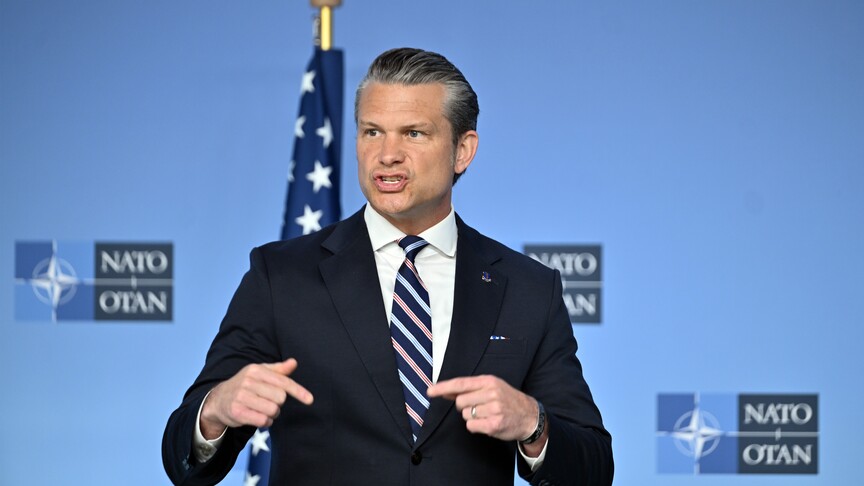
US Defense Secretary Hegseth on Thursday faced protesters while hosting the Trump administration’s DC Safe and Beautiful Task Force ceremony in Washington DC.
During the ceremony at Meridian Hill Park, which saw the gathering of National Guardsmen, dozens of demonstrators gathered near the park to protest Hegseth.
Footage shows the demonstrators chanting a short distance away from where Hegseth and roughly 200 members of the National Guard had gathered in the park
In social media posts, one protester was seen holding a Palestinian flag, while another person was holding a sign that reads “arrest Hegseth.” The protesters want a “Free DC,” according to social media posts.
In his address to the National Guard, Hegseth said that “this background noise is perfect,” referring to the protests.
“It’s the sound of ingrates, of ingratitude—of people who are so blinded by ideology they can’t see law and order and common sense in front of them,” he said.
Meridian Hill Park was repaired by the National Park Service and the Interior Department as part of a larger initiative to restore and enhance federal parks and public spaces throughout the nation’s capital in preparation for America’s 250th anniversary, which falls on this Saturday, July 4.
Though such beautification projects are typically popular with the public, the current initiative has been controversial both for its choice of projects and the use of no-bid contracts to hire firms to do the work, sometimes with disappointing results.
The work aligns with President Donald Trump’s DC Safe and Beautiful Task Force, established by a March 2025 executive order that directs federal agencies to coordinate public safety and beautification efforts across Washington.
-

 Missouri4 minutes ago
Missouri Highway Patrol investigates death of staffer at youth ranch in Reynolds County; 1 juvenile arrested
-

 Montana11 minutes ago
Montana DEQ warns of algal blooms ahead of holiday weekend
-

 Nebraska14 minutes ago
Some Nebraska communities ban fireworks in year marked by drought, wildfires
-

 Nevada19 minutes ago
How Chinese-Americans contributed to mining in Nevada
-

 New Hampshire26 minutes ago
Man From Concord Arrested On Drug Sale, Subsequent Possession Charges: Concord Police Log
-

 New Jersey29 minutes ago
Mikie Sherrill welcomes July 4 tall ships to NJ at Sandy Hook
-

 New Mexico34 minutes ago
Wildfire smoke moves through Taos Valley, Northern New Mexico
-
North Carolina41 minutes ago
More than 60 North Carolina cases tied to parasite behind ‘explosive diarrhea’


