Business
California still bullish on EV trucks, despite industry opposition and setbacks in Washington

It seemed like the death knell. The state of California failed to get required federal permission from the Biden administration — the Biden administration — to enforce new regulations that would phase out sales of diesel big-rig trucks to fleet operators at the state’s seaports, forcing them to buy zero-emission vehicles instead.
The regulations, known as Advanced Clean Fleets, faced pitched opposition from the trucking industry. But California plans to carry on anyway, hoping the carrot of subsidy money and the stick of other state regulations will accomplish its goals.
Infrastructure improvements will help. Liane Randolph, chair of the California Air Resources Board, was among officials on hand at the Port of Long Beach recently for a ribbon-cutting ceremony for a new electric truck charging depot — 25 chargers and 44 dispensers to serve up to 200 trucks a day.
“We are committed in California to continuing this process,” she said.
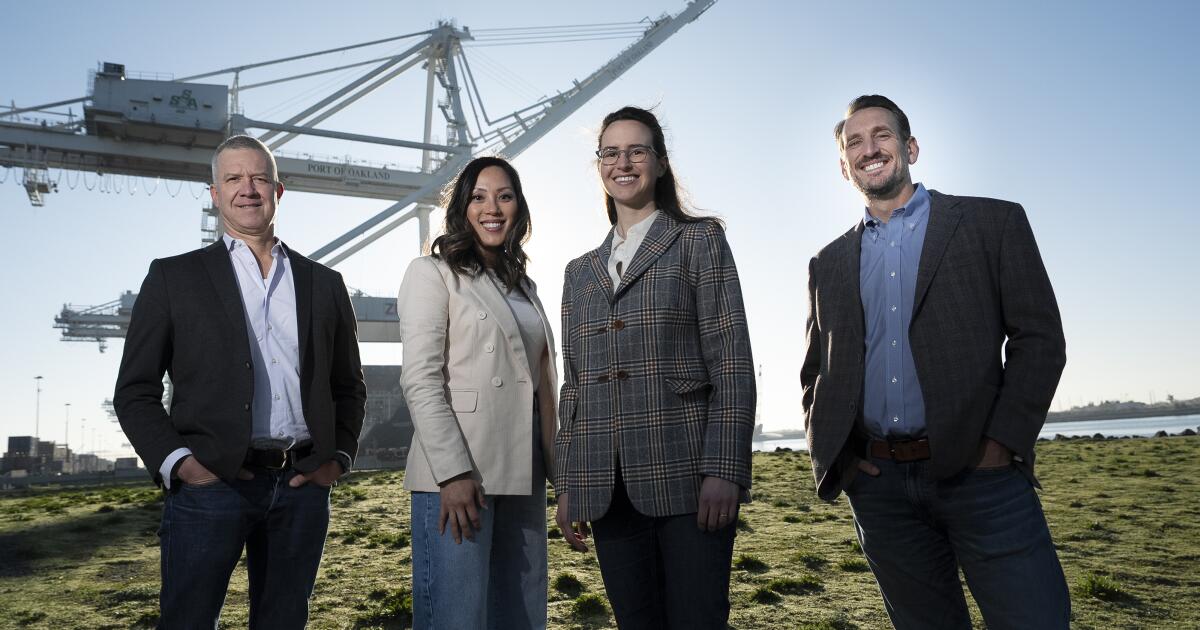
The $10-million-plus depot, funded through a mix of private investment and state, local and federal tax credits, subsidies and grants, will be run by a San Francisco startup called Forum Mobility, one of several heavy-duty truck charging companies seeking a foothold in a new business category called TaaS, or trucking as a service.
Forum charges truck fleet operators monthly “subscriptions” to use its charging depots. It also buys or leases electric trucks, in turn leasing them to truck fleet owners as part of a subscription package.
The success (or not) of companies such as Forum could determine whether California achieves its ambitious quest to slash local pollution and global greenhouse gas emissions by converting the state’s massive population of diesel trucks to zero-emission versions.
By January, the Biden administration’s Environmental Protection Agency had not acted on California’s 15-month-old request for a waiver to federal rules that would allow Advanced Clean Trucks rules to move forward. CARB withdrew its waiver request in January for fear the Trump administration would turn it down. Biden’s EPA never explained what was taking so long to reach a decision.
The rule would have applied to drayage trucks — semitrucks that haul shipping containers into and out of seaports. The goods are carried to nearby distribution centers, most of which are then transported by long-distance trucks and trains.
Because drayage trucks concentrate fume-pumping diesel engines in a tight location, the air quality in residential areas adjacent to ports suffers. To combat this pollution and global warming, the state is pushing for electric vehicle transport.
The rules would have applied to any truck operator who owned or leased between one and 50 trucks, if annual revenue topped $50 million, or to any truck fleet larger than 50 vehicles.
Forum Mobility electric trucks from Volvo, charging up.
(Kevin Krause / Forum Mobility)
Forum and other electric truck service providers aren’t panicking. While the state cannot now force fleet operators to buy electric trucks, it can still require truck manufacturers to sell them through its Advanced Clean Trucks regulations.
It’s similar to California’s Advanced Clean Cars program, which doesn’t require consumers to buy electric vehicles, but penalizes manufacturers if they don’t phase out sales of gasoline and diesel cars and light trucks by 2035. Truck manufacturers have until 2036 to fully convert to zero-emission sales of new trucks.
Most major U.S. big-rig truck and engine manufacturers signed a deal with the state in 2023, agreeing to go along with the plan and not file lawsuits against it, in return for more regulatory certainty — at least at the state level — and flexibility in meeting the state’s strict diesel pollution rule. That deal could protect the program from any action against it from the Trump administration. Signers include Ford, GM, Navistar, Volvo, Paccar, Cummins and others.
But with no state rules forcing zero-emission trucks on truck buyers, the budding electric truck industry will have to rely more on salesmanship — operating costs are cheaper for electric trucks — and more on government subsidy money to pay for the currently enormous costs of electric trucks.
“We’ll move forward with more carrots than sticks,” said Adam Browning, policy chief at Forum Mobility.
Truckloads of carrots will be required, and they’ll have to come from state and local governments, because federal support for electric trucks appears doubtful in the Trump administration.
By far the biggest barrier to diesel-to-electric conversion is the cost of electric trucks. Few electric big-rig assembly lines yet exist and an electric big-rig cab can cost up to three times as much as a diesel version — around $450,000.
Scaling up production — in a big way — could result in great cost reductions. State officials thought a diesel ban combined with state subsidies would sufficiently boost demand. Now it’ll have to rely mostly on subsidies.
How much the state will pay out is unclear, hinging partly on demand and partly on how much state revenue is available. CARB said it has paid $1.5 billion to subsidize purchase of commercial electric trucks, nearly $200 million last year alone.
Buyers can qualify for subsidies worth from 40% to 90% of the cost of an electric big-rig cab.
The state believes the cost is worth it in the long run, with reduced pollution improving public health and lowering medical costs, and greenhouse gas reduction helping to address hazards partly attributable to global warming. If left purely to the marketplace, any shift to zero-emission vehicles would take much longer than the state believes is necessary.
There are many sources of subsidy money in California for trucks and truck charging, including two carbon cap-and-trade programs, the Greenhouse Gas Reduction Fund and the Low Carbon Fuel Standard. Money is also available from CARB, from state air quality districts, from cities and from container fees levied by port operators.
With enough demand, truck manufacturers will scale up and add production lines, sending costs down. If the cost ever becomes competitive with diesel trucks, truck fleet owners, especially those with short- to medium-haul routes, may well find electric trucks more appealing.
Rudy Diaz is an early adopter. He owns Hight Logistics, a medium-size fleet operator for trucks that transfer freight in and out of the ports of Long Beach and Los Angeles. His drayage trucks are natural candidates for electric early adoption. With a typical range around 200 miles, heavy truck batteries don’t yet have the range to meet the demands of long-haul transport. But it’s plenty for most drayage jobs.

Rudy Diaz, chief executive at Hight Logistics, with an electric truck at Hight headquarters in Long Beach.
(William Liang / For The Times)
Diaz grew up in Watts and worked in freight logistics before launching Hight from his house with a small fleet of diesel cabs. Hight now operates a warehouse and truck yard near the Long Beach airport, with 70 trucks — 50 diesel, 20 electric. He’s hoping to grow the electric share.
He’s been a customer of Forum Mobility since December 2021.
“Forum reached out to me saying they were a startup company and wanted to start a program with turnkey solutions” — truck leasing, maintenance and charging, including chargers installed at the Hight truck yard.
“At the time I had no idea what a battery-electric truck was or even how you’d charge one,” he said.
But he’s an outdoors lover, a bicyclist, trim and fit, with a personal dedication to improving air quality.
“I genuinely do care about the environment,” he said. “If the environment is not considered, our survival is in question.”
Subsidies from state, local and federal sources flow through to Forum and Hight, allowing Diaz’s electric trucks — from Volvo, Daimler and BYD — to make a profit. But no question, he said, the electric truck market will have to stand on its own at some point to attract sufficient private capital and grow big enough to displace diesel technology.
Hight carries everything from clothes to car parts to consumer electronics, but the electric trucks are allowing it to branch out. The EV component was key to Hight’s getting a freight contract with Lime Micromobility, the electric scooter company.
“Decarbonization of the economy underpins everything we do,” said Lime co-founder Adam Savage. “We want to go carbon free as fast and aggressively as we can, whether producing our own vehicles our moving freight.”
One of Hight’s drivers, Marco Garrido of Anaheim, recently shifted from diesel to electric, and became an instant convert.
“I love it, I love it,” he said. The trucks are quiet, no exhaust, no cumbersome gear shifting, and the new models are fitted with the latest safety equipment, including backup sensors. It adds up, he said, to less stress.
Although it’s highly questionable whether federal money makes its way to the nascent electric truck market over the next four years, a nonprofit financial group called Climate United last August locked in nearly $7 billion in funding from the EPA to help for clean energy projects, part of which will be spent to boost truck maker production and pave the way for private lenders now stuck in neutral.
One way to do that: create a market in used electric trucks. Not only are electric trucks expensive, no one knows how much they’ll be worth once their leases run out.
“Traditional lessors are not set up to take risk on what that amount will be,” said Jacqueline Torres, head of finance at Forum.
That can scare private finance away, said Brooke Durham, the organization’s communications director. With the EPA money, it will buy trucks and lease them to Forum and other trucking-as-service companies, taking on the risk of creating a used truck market. As used truck prices become clearer, private lenders and investors will have hard data on which to base their financial decisions.
“This will be catalytic to have private capital step in,” said Forum Mobility Chief Executive Matt LeDucq.
The company is hoping that’ll help spark big new orders.
“Something needs to break the chicken or the egg loose,” said Forum’s Browning. “Once a 500-truck order comes in, the flywheel really gets going.”
California’s clean transportation goals depend on that happening.

Business
Commentary: Trump wants to let companies make fewer disclosures, thus keeping investors in the dark

Trump’s SEC is considering eliminating the mandate for quarterly corporate financial reports, but even some big investors call it a lousy idea.
This being the “information age,” it would be understandable if investors sometimes feel inundated with too much information to wade through about the stocks in their mutual fund portfolios.
The Securities and Exchange Commission, bowing like a puppy to the urgings of President Trump, is considering exactly the wrong solution to this supposed burden. It’s proposing to allow public companies to give their investors less information, as though that’s a good thing.
On May 8, the SEC proposed rescinding its mandate that public companies report financial results on a quarterly schedule. Instead, it suggests, semiannual and annual reports should suffice.
This takes an already-unlevel playing field where Main Street investors are already disadvantaged, and makes it more unlevel.
— Dennis Kelleher, Better Markets
The SEC left its proposal open for public comment for 60 days, meaning the window closed Monday. By then, the agency had received more than 68,000 comments, according to a tracker posted online by accounting professor Tzachi Zach of Ohio State.
Almost 99.9% of the comments were negative. Several organizations of institutional investors and auditing professionals, as well as a tsunami of individual investors, expressed opposition.
A similar initiative the SEC aired in 2018, during Trump’s first term, received an overwhelmingly negative response and was eventually dropped.
The tide of opposition coming from individual investors shouldn’t be surprising. “Taking away basic quarterly information means investors are blind for six months at a time,” says Dennis Kelleher, co-founder and chief executive of the investor advocacy nonprofit Better Markets.
That’s especially true for small investors, though perhaps not so much for major institutions, insiders or deep-pocketed individuals. “If you’re a big dog, you’ll get the information anyway,” Kelleher told me. “And insiders, who are trading in their own stock all the time, will have the information. This takes an already-unlevel playing field where Main Street investors are already disadvantaged, and makes it more unlevel.”
Trump set off the latest initiative with a social media post on Sept. 15, advocating the move to a six-month reporting schedule. It read, in part, “This will save money, and allow managers to focus on properly running their companies. Did you ever hear the statement that, ‘China has a 50 to 100 year view on management of a company, whereas we run our companies on a quarterly basis???’ Not good!!!”
As was usual with Trump, his argument was a string of uninformed and irrelevant non sequiturs.
It’s doubtful that eliminating quarterly reports will save much, if any, money. Most 10-Qs are cookie cutter documents disclosing financial figures already embedded in corporate records.
The idea that managers would become empowered to “focus on properly running their companies” if only they were relieved of the burden of preparing a report every three months is just malarkey: Any CEOs who feel the impulse to drop everything and involve themselves in what is essentially an automated process can’t be very good at their jobs.
As for China’s “50 to 100 year view on management of a company,” what would that even mean, even if it were true? China doesn’t operate on a 50 to 100 year corporate horizon, but rather on a string of five-year plans. The most recent of these was adopted by the government in March, covers the period up to 2030, and is its 15th in a row.
Despite the flaws in Trump’s arguments, Trump’s SEC Chairman Paul Atkins, a former corporate lawyer and securities industry consultant, fell into line. Within a few days of Trump’s post, he showed up on CNBC to minimize the potential effect of the change. Private companies rely on semiannual reports, after all, he noted, although the idea of taking private companies as models for publicly traded corporations might not strike experienced investors as the wisest thing.
Atkins cited an enduring chestnut, for which there’s no evidence, that quarterly reporting is responsible for “short-term thinking” in corporate suites (though he admitted that his evidence was “anecdotal”). And he suggested that small investors have ample access to corporate information even without quarterly reports — why, he said, they can just tune in to CNBC!
“To propose change in what our rules are now would be a good way forward,” he said. “So I welcome the president’s putting this up for discussion.”
Something more insidious undergirds the SEC’s proposal than its immediate effect on corporate behavior. The agency rationalizes its proposal as seeking “a tradeoff between reducing regulatory burdens … and promoting efficient financial markets through timely disclosure.”
The problem here, Kelleher points out, is that “reducing regulatory burdens” isn’t part of the SEC’s mission in any way, shape or form. It’s a regulatory agency, and its mission since its founding in 1934 has been to protect investors, not to make things fluffier for stock issuers.
The history of financial disclosure in the U.S. shows a long-term trend favoring more disclosure, not less. In the 1880s, quarterly reporting by railroads and other transportation companies were common.
Early on, pressure for more frequent disclosure came not from government regulators, who barely existed before 1934, but from investors. The reporting of quarterly earnings, notes corporate finance expert Owen Lamont of Acadian Asset Management, was “a bottom-up historical phenomenon reflecting voluntary arrangements between firms and investors, not a top-down phenomenon imposed by law.”
By 1931, according to financial historians, 63% of New York Stock Exchange-listed firms were publishing their quarterly earnings. The Big Board mandated that frequency for most listed companies in 1939. The SEC mandated semiannual reports in 1955 and quarterly reports, as Atkins said, in 1970.
The evidence in favor of dropping the quarterly reports is uniformly thin. Some advocates cite a 2018 op-ed in the Wall Street Journal by JPMorgan Chase CEO Jamie Dimon and Warren Buffett that was headlined “Short-Termism Is Harming the Economy.”
Couple of points about this: First, the target of Dimon and Buffett wasn’t quarterly financial reporting, but quarterly earnings guidance — that is, the practice of some top executives who project their earnings into the future. (This guidance usually comes at the same time they issue their SEC disclosures.)
It’s guidance, they wrote, that is “a major driver” of short-termism in corporate behavior. That’s because management is giving itself a target it feels obligated to meet, even if factors outside its control interfere with the quest.
Furthermore, Dimon and Buffett wrote, “Our views on quarterly earnings forecasts should not be misconstrued as opposition to quarterly and annual reporting.” They called transparency about financial and operating results “an essential aspect of U.S. public markets … so that the public, including shareholders and other stakeholders, can reliably assess real progress.”
Individual investors may be unmoved by the SEC’s proposal because — let’s be candid — how many of them read quarterly earnings reports, anyway? But that’s unimportant, Kelleher says, because other market participants are reading them. “So that information is in the marketplace, and that’s what actually enables price discovery, so stock prices roughly reflect what’s going on at a company, most of the time.”
More to the point, the quarterly reports reflect the highest-quality, detailed information, the information the SEC requires executives to disclose on pain of facing a civil lawsuit from the agency or even criminal liability for faking data. “Main Street investors, whether they read quarterly reports or not, are the real beneficiaries,” Kelleher says.
That’s so. The bottom line is that quarterly financial reporting helps investors. It doesn’t promote short-term behavior and its costs, modest as they are, don’t outweigh its benefits.
Over the decades, scandal-ridden corporations have hidden fraudulent behavior in the interstices between mandated disclosures—think Enron, WorldCom and Tyco, among others. Why give any corporation, even an honest one, the opportunity to disclose less?

The luxury shopping center in Pacific Palisades will reopen next month after more than $100 million in renovations forced by the January 2025 wildfire that devastated the Los Angeles neighborhood.
Palisades Village will reopen Aug. 15, owner Rick Caruso announced Wednesday. The outdoor center survived the blaze that destroyed homes and other businesses but needed refurbishment to eliminate contaminants that the fire could have spread.
Crews are putting finishing touches on mall buildings after tearing them down to the studs, treating the wood and rebuilding the walls, Caruso said.
“Everybody’s working, and stores are moving their products in,” he said. “It’s a really cool feeling that people have really locked arms and are working together.”
An electrician installs lighting for a restaurant at Rick Caruso’s Palisades Village on Thursday. The shopping center is scheduled to reopen mid-August.
(Myung J. Chun / Los Angeles Times)
Pacific Palisades resident Allison Polhill, who is rebuilding the home of 30 years that her family lost in the blaze, said she is “thrilled” at the prospect of returning to the mall she used to frequent. Its comeback is a boost for the community, she said.
“Every single step that we make to reopen our commercial corridors is going to bring more people back into the Palisades,” said Polhill, who expects to move back into her home at the end of August.
A total of 6,822 structures were destroyed in the Palisades fire, including more than 5,500 residences and 100 commercial businesses, according to the California Department of Forestry and Fire Protection.
Caruso previously attributed the mall’s survival to the hard work of private firefighters and the fire-resistant materials used in the mall’s construction.
The $200-million shopping and dining center opened in 2018 with a movie theater and a roster of upmarket tenants, including Erewhon, which may be the only grocer in the heart of the fire-ravaged neighborhood when it opens.
Caruso’s company was able to fill the mall with tenants despite the long shutdown.
Palisades Village is 99% leased, with the majority of tenants returning, said Jackie Levy, chief financial and revenue officer. Nearly one-third of the shops and restaurants are new to the property.

A firefighter carries a hose back to his rig while walking through a destroyed home from the Palisades fire in Pacific Palisades on Jan. 7, 2025.
(Genaro Molina / Los Angeles Times)
Last year, Pacific Palisades-based fashion designer Elyse Walker said she would reopen her eponymous store in Palisades Village after losing her 25-year flagship location on Antioch Street to the inferno.
Other neighborhood shops destroyed in the fire that are reopening at the mall include K Bakery and Loomey’s Toys, which caters to children up to age 12 and used to be across the street from Palisades Elementary Charter School.
“It’s been a journey and I’m excited because I wasn’t sure that there was going to be a place to come back to,” said toy store owner Amanda Rastegar. “Hopefully we can bring some of that magic back.”
Rastegar’s home in the Palisades survived but was damaged by the fire. The family returned about eight weeks ago. Her last memory of the fire was a burning supermarket.
“I just couldn’t wrap my brain around what was happening,” she said. “By the time I left, Gelson’s was on fire.”
Among the returning tenants is Angelini Ristorante & Bar. Well-known Los Angeles chef Gino Angelini said he will be in the kitchen next month for a return of the Italian restaurant.
“We won’t do a big celebrity open,” he said. “We want to have a very soft opening and see our customers come back.”

Construction takes place at Rick Caruso’s Palisades Village on Thursday. The shopping center is scheduled to reopen mid-August.
(Myung J. Chun / Los Angeles Times)
An elaborate celebration would not feel “correct for me,” Angelini said, because the devastation has been “very sad” for so many.
Other new tenants include local chef Nancy Silverton, who has agreed to move in with a new Italian steakhouse called Spacca Tutto. Women’s activewear retailer LESET will open its first West Coast location.
Caruso said he is optimistic that customers will return to the center, even though many Pacific Palisades residents are still dispersed. One tracking system estimated that about 30% of the Village’s customer base was impacted by the fire, he said.
“That means 70% did not get impacted, so there’s a lot of customers still left out there,” Caruso said. Historically, the center drew customers from as far away as Beverly Hills and Calabasas, as well as Malibu, Brentwood and Santa Monica.
He also hopes many will be inspired to visit the revived mall.
“I believe in the goodness of people and I believe that people are going to want to support the Palisades,” he said. “They’re going to want to be there and support the businesses that have had the courage and the heart to reopen.”

Walmart is rapidly expanding its network of electric vehicle chargers designed for customers to use while they shop.
The network could help fill gaps in EV infrastructure in states with greater need for chargers. Walmart, which has more than 5,000 locations in the U.S. and hundreds in California, says more than 90% of Americans live within 10 miles of one of its stores.
The chargers also offer an incentive for customers to choose Walmart — Walmart Plus members will receive a 10% discount off an average price of $0.46 per kilowatt-hour of energy at the company’s chargers.
Walmart chargers are already available at more than 75 locations in 17 states, with Texas boasting the most charging stations, followed by Florida and Arizona.
Matthew Nelson, Walmart’s director of energy policy, said last week on LinkedIn that the network will soon reach 29 states, including California.
“We are delivering on the promise of affordable, reliable and convenient charging,” Nelson said in his post.
According to Walmart’s website, six charging stations are coming to California soon, though the company did not offer a specific timeline.
The chargers will be installed at stores in Antelope, Brea, Fresno, Stockton, Suisun City and Vallejo.
Most charging sites in California will include eight to 16 fast-charging stalls, said Walmart spokesperson Kelsey Bohl.
The company first announced plans in April 2023 to install its own EV chargers at Walmart and Sam’s Club stores, with a goal of installing thousands of chargers by 2030. Partnering with ABB E-Mobility and Alpitronic, it added 25 new charging sites this past May and six more in June.
“Walmart is building a leading retail-integrated EV fast-charging network, focused on delivering an affordable, reliable and convenient charging experience where customers already shop,” Bohl said in an emailed statement. “Customers can charge while they shop, access stations through the Walmart app they already use, and benefit from affordable pricing.”
The charging stations already available include 612 individual charging stalls using 400-kilowatt chargers. Each stall has a dual charging cord with both Combined Charging System and North American Charging Standard connectors. The standard connectors, designed by Tesla, are smaller and lighter than the combined systems.
The primary way to pay for the chargers is through the Walmart app, but the company is also experimenting with built-in credit card readers to allow those without the app to use the stations.
Customers can check charger availability on the Walmart app. The company said the chargers will be available 24 hours a day.
-

 Oregon2 minutes ago
Pierce County Sheriff: Homicide ‘suspect was shot and killed by police in Seaside, Oregon’
-

 Pennsylvania8 minutes ago
‘Natural splendor at its best’: Penn’s Cave may become Pa.’s next state park
-

 Rhode Island12 minutes ago
Throwback: USS Rhode Island commissioned in Newport
-

 South-Carolina17 minutes ago
Watch out for SC’s 5 most common ticks and take steps to avoid bites
-
South Dakota24 minutes ago
SD Lottery Powerball, Lotto America winning numbers for July 8, 2026
-
Tennessee26 minutes ago
TN Lottery Powerball, Lotto America winning numbers for July 8, 2026
-

 Texas32 minutes ago
Texas reports 48 cyclospora cases and the source is still unknown
-

 Utah39 minutes ago
Utah Jazz vs Washington Wizards: Summer League Preview, start time, how to watch

