Lifestyle
The Self-Realization Fellowship Lake Shrine was surrounded by flames. Then a family came to its rescue


Tales of the miraculous have always encircled the Self-Realization Fellowship Lake Shrine.
The story of its 1950 founding goes that the spiritual guru Paramahansa Yogananda purchased the 10-acre Pacific Palisades property from an oil company president, after the oilman had a vivid dream in which his land became a “church of all religions.” Yogananda then established the grounds as a place of peace, solace and sanctuary for people of all faiths.
Swans on the lake at the Self-Realization Fellowship site.
(Self-Realization Fellowship)
The spring-fed lake in the center of the compound is its defining feature. Swans glide across its surface, new mothers push strollers around its perimeter, and people of many faiths and backgrounds meditate quietly along its shores.
The lake also played a key role in the shrine’s unlikely escape from the Palisades fire, as a family of three devotees used its waters to extinguish threatening flames.
Self-Realization Fellowship president and spiritual leader Brother Chidananda, in a livestream address to the group’s international membership, recounted the efforts of Billy Asad and his two adult children, Gabriella and Nicky, who came to the property’s rescue.
The Asads, he said, were “the divine instruments of God and guru who literally saved the Lake Shrine.”
It was the soot-covered swans, so dark they almost looked black, that first struck Gabriella Asad when she arrived at the Lake Shrine on the second day of the fire. Then, the lack of other animal life. No koi fish rose to the surface to greet her. The turtles that usually sun themselves on the scattered rocks were gone.

The Self-Realization Fellowship’s lush Pacific Palisades grounds include a historic houseboat, where guru Paramahansa Yogananda lived and wrote while directing the work around the Lake Shrine.
(Self-Realization Fellowship )
Looking around the smoldering grounds where she was baptized as a baby and now volunteers in the gardening department, Gabriella, 20, resisted the urge to fall to her knees in despair. Instead, she grabbed four fire extinguishers and, through her tears, set to work alongside her father, Billy, 54, and brother Nicky, 19.
As embers the size of golf balls pelted the property, she put out spot fires and hosed down the wood-shingled roofs of the Lake Shrine’s historic buildings.
“Just the way the sky was, all the smoke, the way the swans were covered,” she said with emotion in her voice. “It took everything in me to do the best I could.”
Her father, a former yoga teacher who lives on a houseboat in Marina Del Rey, had been tracking the explosive Palisades fire since soon after it broke out the morning of Jan. 7, when a monk spotted flames in the nearby mountains. As a longtime member of the Self-Realization Fellowship, Billy knew what was at stake: the lush meditation gardens open to all, the historic houseboat where his guru lived and wrote while directing the work around the Lake Shrine, the thousand-year-old Chinese sarcophagus containing some of Mahatma Gandhi’s ashes.
“It’s not just this beautiful garden with a lake,” Billy said. “It’s a vortex of light and love and peace and harmony and healing.”
Billy is not a certified firefighter, but as the founder and owner of WDA Fire Protection, he helps get businesses and homes fire-ready. He’s also a certified Regulation 4 tester under the Los Angeles Fire Department, which allows him to inspect and assess fire doors in L.A., and he’s licensed under the Office of the State Fire Marshal to service and test portable fire extinguishers. His father was a firefighter for 30 years and taught him about fire behavior. Over the years, Billy passed his knowledge on to his kids.
He began visiting the Lake Shrine’s paradisiacal grounds 25 years ago after a friend gave him a copy of Yogananda’s seminal book, “Autobiography of a Yogi.” He still remembers walking onto the property for the first time.

Billy Asad, left, with daughter Gabriella and son Nicky.
(Billy Asad)
“It was that ah-ha moment,” he said. “I knew it was my path.”
His kids were baptized in the Windmill Chapel, which abuts the lake and looks as if it had been magically transported from the Netherlands.
Gabriella and Nicky attended Sunday school at the temple and went on teen retreats with other Self-Realization Fellowship members. As they got older, they became regulars at the hourlong services held on the property each week. Nicky used to work as a chef at the Lake Shrine, cooking for the monks and lay people at the retreat center. Gabriella volunteers with the gardening department.

Billy Asad hoses down the hillside at the Self-Realization Fellowship Lake Shrine, where morning services are held every Sunday.
(Billy Asad)
“Ever since I can remember we’ve been going to Lake Shrine,” Nicky said. “It’s our home. It’s everything to us.”
By 10 a.m. on Jan. 8, Billy had tracked the fires long enough to know the Lake Shrine was in danger. Along with Gabriella and Nicky, he loaded his Toyota Tacoma TRD Pro with helmets, gloves, fire coats, eye protection, steel-toed boots, respirators, radios, axes, shovels and about 30 fire extinguishers. Then they headed north to the property.
Flames raged around them as they climbed into Pacific Palisades. Telephone poles crashed to the ground near the truck. There were checkpoints along the way, but Billy showed his fire credentials and was allowed to pass through.
When they arrived, the Lake Shrine had been abandoned, the 14 monks who live on the grounds safely evacuated. There was a firetruck in the parking lot, but the two firefighters there were focused on a three-story apartment building adjacent to the Lake Shrine that was consumed by flames.
Moving quickly and coordinating through their radios, the Asads rushed to extinguish spot fires crackling at the base of trees, in a patch of bamboo and on the many railroad ties that serve as stairs throughout the property.
“That’s exactly how everything starts,” Billy said. “A tree falls and catches another structure on fire.”
To prevent future ignitions, they also set to work wetting the roofs of all the buildings. Because of her volunteer job, Gabriella knew where the garden hoses were located, although a few had already melted. She took care of the visitor center. Nicky was charged with soaking the place of his baptism, the Windmill Chapel.

-
Share via
Meanwhile, Billy spotted an unexpected tool: a gas-powered water pump on the lake’s small maintenance barge. It was new to him, but that didn’t matter.
“I know fire pumps,” he said. “I know hoses. I know attachments. So within five minutes after seeing it, I had the engine started and we were spraying bamboo on fire from 100 feet away.”
As it happens, a few months earlier, a resident monk of the property, Brother Bodhananda, had purchased the pump in case of future fires. Before being evacuated, he brought the pump out of storage and moved it onto the barge.
“It’s a credit to him and the maintenance manager, Bill Lackner, who works there that they had the temporary fire pump set up,” Billy said. “We jumped on the barge and immediately started using it. I have boating experience and my son does too. It was all part of this amazing divine plan.”
The Asad family worked for seven hours before pausing, including taking a moment to gently rinse some of the soot clinging to the swans’ feathers.
That evening, Nicky and Billy came back and stayed until 4 a.m. the next day, hosing down the property and continuing to extinguish spot fires that were igniting all over, sometimes repeatedly in the same place. It was blindingly exhausting work, and they believe it was the prayers and wishes of devotees across the globe who empowered them to do it.
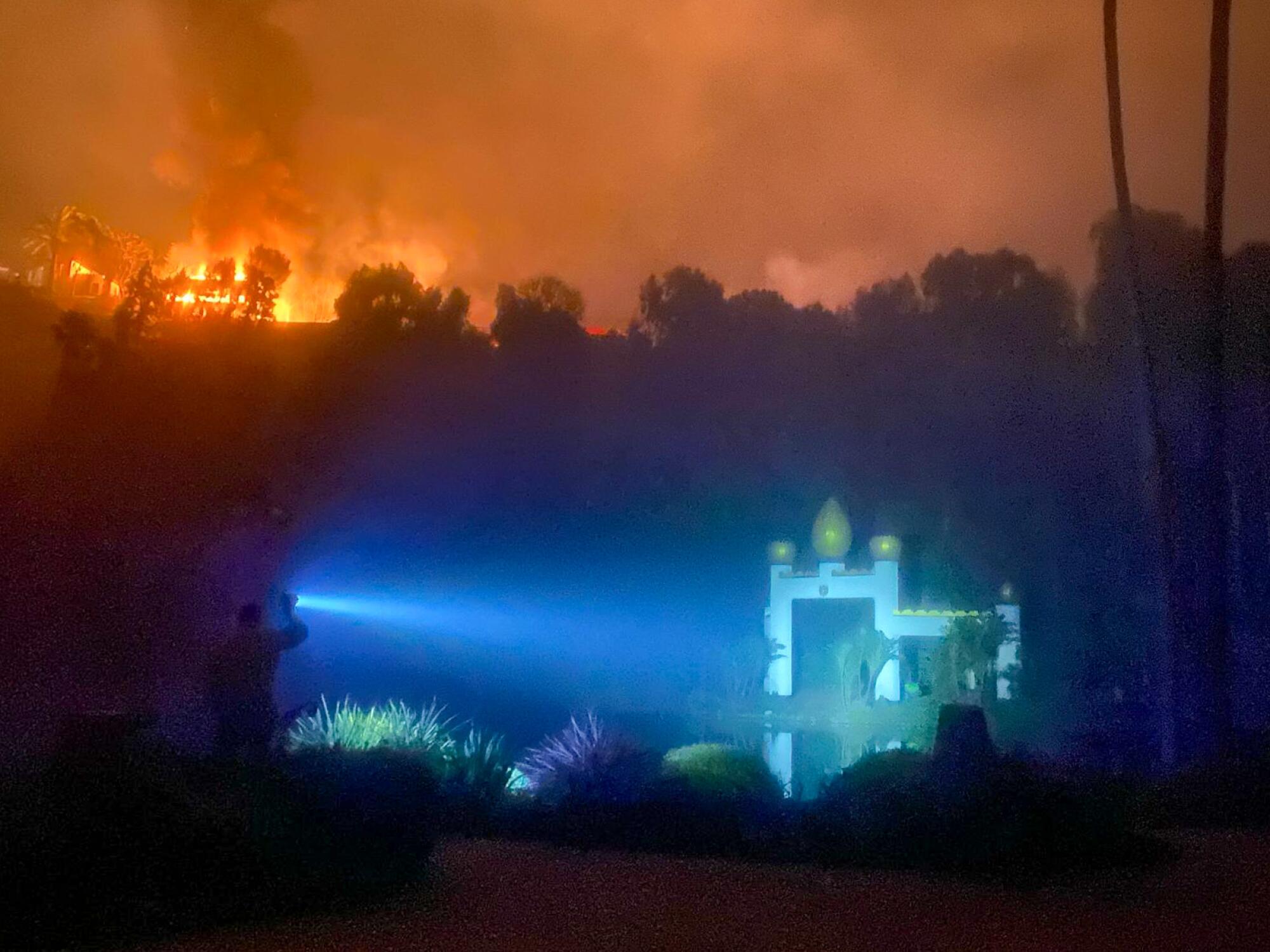
The Lake Shrine towers were at risk as the Palisades fire raged on the hillside last week.
(Nicky Asad)
For the next three days they kept returning until the fire danger had passed. Even now, as the initial fire threat has ended, they continue to patrol the grounds daily.
On Sunday in his livestream, Chidananda shared the results of the Asads’ work. The Gandhi World Peace Memorial is unharmed even as the vegetation on the hillside behind it is gone. The houseboat is safe, as is the Windmill Chapel, where weddings, christenings and memorials are held.
The Court of Religions, where small monuments to each of the world’s major faiths welcomes visitors to the grounds, is intact. The towering pillars and crossbars of the Golden Lotus Temple were hosed down by the Asads and are once again gleaming white.
There were, however, some structural losses. The visitors’ restroom near the property’s entrance, for one. Even as, just 20 feet away, the Lake Shrine museum and bookshop with artifacts from Yogananda’s life still stands.
The living quarters of the 14 monks who reside on the property also took a hit. An ashram where half of them lived sustained slight damage to one window. The Old Santa Ynez Inn, which housed the other seven monks, burned down, taking with it the office and apartment of the Lake Shrine’s spiritual director, Satyananda.
“I’m an unhoused evacuee, but I’m doing quite well,” Satyananda said. “We adapt and move forward.”

One of the few structures lost on the property was the visitors’ bathroom.
(Self-Realization Fellowship)
Witnessing what took place at the Lake Shrine was a spiritual experience, Chidananda told fellowship members in his address, but he added that he doesn’t plan to talk about it much more.
“You know why,” he said, smiling gently. “Because it’s too easy to become proud or smug, or feel that we are better than others who didn’t fare as well. Our guru would have abhorred any sense of superiority complex based on the fact that we were spared while others suffered. That’s completely opposite to the spirit of his life.”
Instead, he said, the spiritual community’s consciousness should revolve around one question: What can we do to help?
He’s already asked fellowship communities in Southern California to organize food and clothing drives, while monks and nuns at the group’s center in Mount Washington are offering spiritual counseling over the phone.
Thanks to the Asads, the Lake Shrine community will also continue to offer an open, inclusive and beautiful space for anyone seeking a quiet sanctuary for spiritual reflection, renewal or meditation — just as soon as it’s able.
“To me, the survival of this beloved shrine means so much because of what it represents,” Chidananda said. “It represents our faith that spiritual life, a higher consciousness of love and unity and harmony, will be able to endure in this world, despite all contrary forces of maya [illusion], delusion and destruction.”
The property remains closed to the public for now, but Billy said he’s already welcomed a few firefighters and police officers to take their breaks on the Lake Shrine grounds.
“They walk around the lake and take a break from the chaos,” he said. “And you’d just see it in their eyes: ‘What is this place?’ ‘We had no clue this was here.’ ‘We’re coming back.’”

The Self-Realization Fellowship Lake Shrine property remains closed to the public for now.
(Self-Realization Fellowship )
Meanwhile, Gabriella is relieved to see that the swans are back to their snow white color. The turtles have started sunning themselves again.


Students walk on the Stanford University campus on March 14, 2019, in Stanford, Calif.
Ben Margot/AP
hide caption
toggle caption
Ben Margot/AP
When Theo Baker arrived at Stanford University a few years ago, he joined the student newspaper, following the path of his journalist parents, Peter Baker, a White House correspondent for The New York Times, and Susan Glasser, a writer for The New Yorker.
Through his reporting as a student journalist, he eventually broke a story about manipulated data in Stanford President Marc Tessier-Lavigne’s neuroscience research that helped lead to the university president’s resignation.
Theo Baker’s book, How to Rule the World: An Education in Power at Stanford University was released May 19. In it, Baker describes Stanford as a place where proximity to Silicon Valley gives rise to a parallel system of influence, recruitment and money, with investors looking to identify promising students almost as soon as they arrive on campus.
He told Morning Edition host Steve Inskeep there was “a sort of Stanford inside Stanford,” where elite students are drawn into an “alternate reality” of excess and access to cut corners.
In the interview, he discusses how Stanford is not just a university but also a pipeline where status and power can matter as much as ideas.
We reached out to Stanford University for comment and have not heard back.
Listen to the interview by clicking play on the blue box above.


The scoreboard shows the results of the women’s singles final match between Iga Swiatek of Poland and Amanda Anisimova of the U.S. at the Wimbledon Tennis Championships in London, Saturday, July 12, 2025.
Kirsty Wigglesworth/AP
hide caption
toggle caption
Kirsty Wigglesworth/AP
Fifteen points in tennis? Nice. Thirty, 40 — even better. Advantage — that sounds good. “Love” — that also must be great, right? Well, not quite.
As the French Open rolls on and Serena Williams has announced her return to the sport, maybe you’ve been paying a little more attention to tennis. The sport’s scoring system is notably distinct, and can sometimes be hard to grasp for newcomers. But even tennis aficionados might not know why, or how, “love” became the unmistakable callout for zero points. For this installment of NPR’s Word of the Week, we’re exploring how a word that signifies trailing behind got such a sweet name.
“Love” comes from the heart — or an egg?
It’s hard to pinpoint when the first tennis ball went over the net. Tennis is a derivative of lots of other sports, such as “jeu de paume,” a handball game played in France, said JT Buzanga, the collections manager at the International Tennis Hall of Fame museum.

But tennis became a patented, official sport in 1874, said Steve Flink, a journalist whose tennis coverage got him inducted into the International Tennis Hall of Fame. It has retained its unique, mysterious scoring system ever since.
“By and large, the original system has held up almost entirely,” Flink said.
The use of “love” goes back to the late 18th century, said Jesse Sheidlower, a lexicographer. But it was used earlier than that in card games such as whist and bridge. Before the term made its way to tennis, the sport favored plain old “nothing,” or “nil,” he said.
Why love in the first place, though? Historians don’t really know for sure, but there are a few theories.
The French could have something to do with it. Some historians believe “love” derives from “l’oeuf,” which means “the egg” in French. Because eggs are shaped like zeros, terms such as “goose egg” and “duck’s egg” have been used in other contexts to mean zero, Sheidlower said.
It’s also possible English speakers mispronounced l’oeuf as “love.” But Sheidlower isn’t convinced that’s the answer.
“It’s the French equivalent of an English expression. But since that expression doesn’t appear in French, the French word wouldn’t have been used,” he said.
To be sure, France has had a lot of influence on tennis culture, Buzanga said. For example, “deuce” or a game tied at 40 points, comes from the French word for “two”: “deux.” But he prefers another prominent theory: that “love” comes from the idiom “for the love of the game.” Even if a player hasn’t scored, it doesn’t matter, because their heart is in it. It’s the theory Sheidlower said is the most plausible, because the idiom was used by the English before tennis was popularized.

Another variation of the “love of the game” theory is that the word could have come from the Dutch “lof,” or “honor” — or the Latin “amare,” meaning “to love,” Flink said.
But if tennis’ “love” doesn’t come from a French word, the theory at least has a French sensibility.
“I think the ‘for the love of the game’ is kind of romantic,” Buzanga said.
“Love” probably isn’t going anywhere
Tennis used to be a sport of leisure. The style of play has changed a lot over the years; players are more athletic and competitive, for instance, Flink said. But the rules of the sport are more steadfast, he said.
“There’s this incredible, enduring respect for tradition in tennis,” he said. “Changes are not made easily.”
There has been one major change in modern history: the tie-break. Matches can go on and on because players have to score two consecutive points to break a deuce, or by two games to break a tied set. But the onset of television meant matches would have to get shorter if the sport wanted to capture a larger audience, Flink said.

Change even came for “love.” An alternative sprouted up in the 1970s, and is still used today: “bagel,” named for its zero shape, Sheidlower said. Novices may say “zero,” and insiders will understand what they mean, but they “will needle them about it,” Flink said.
But “love” still prevails.
“People kind of like it,” Flink said. “It’s different. Why say zero when you can say love?”
-

 Tennessee4 minutes ago
2026 Tennessee football preview: Grady Dangerfield
-

 Texas11 minutes ago
Fort Worth police launch drone program to speed response times
-
 Utah14 minutes ago
Got cargo? Utah Highway Patrol, DPS want you to secure your load before you drive
-

 Vermont19 minutes ago
Vermont barn-building ‘legend’ still visits every job site at 83
-

 Virginia26 minutes ago
West Virginia Vs. Cal Poly Predictions & Preview: 2026 NCAA Baseball Tournament Super Regional
-

 Washington29 minutes ago
Ivey announces Alabama National Guard support for America250 events in Washington
-
 Wisconsin34 minutes ago
Wisconsin Senate leader leaves door open for another budget surplus vote
-

 West Virginia41 minutes ago
CTC Council approves presidential appointments at BridgeValley, Pierpont, and West Virginia Northern – WV MetroNews

