Maine
Maine still relies heavily on fossil fuels but calls zero-carbon goals ‘achievable’


Maine energy officials on Friday offered a sober assessment of the state’s reliance on fossil fuels as they released a plan touting advances in electric heat pumps and electric vehicles and outlined ambitious goals for offshore wind, clean energy jobs and other features of a zero-carbon environment.
More than a year in the making, the Maine Energy Plan released by the Governor’s Energy Office boasted of the state’s “nation-leading adoption” of heat pumps and heat pump water heaters, helping to reduce the state’s dependence on heating oil, a goal set in state law in 2011. A technical report in the energy plan demonstrates that Maine’s goal of 100% clean electricity by 2040 is “achievable, beneficial and results in reduced energy costs across the economy,” it said.
More than 17,500 all-electric and plug-in hybrid electric vehicles, or 1.5% of the state’s 1.2 million registered light-duty vehicles, are traveling Maine roads, the most ever, the Governor’s Energy Office said. The state’s network of charging stations has expanded to more than 1,000 ports for public use.
“While the electrification shift will increase Maine’s overall electricity use over time, total energy costs will decrease as Maine people spend significantly less on costly fossil fuels and swap traditional combustion technologies for more efficient electric options,” the report said.
The Governor’s Energy Office spent $500,000 for the analysis and outreach to various groups that participated in meetings organized by a consulting group, said a spokeswoman for the state agency. Funding was from a 2019 agreement related to the New England Clean Energy Connect transmission project.
Maine remains the most dependent on home heating fuel in the U.S., the Governor’s Energy Office said, and more than half of electricity produced in New England is generated using natural gas. Maine spends more than $4.5 billion on imported fossil fuels each year, including gasoline and heating oil, with combustion contributing to climate change that’s causing more frequent and severe extreme storms, the report said. Last year was the warmest on record, it said.
Several winter storms last year and in 2023 caused more than $90 million in damage to public infrastructure and received federal disaster declarations, the report said.
Petroleum accounted for nearly 50% of energy consumed in the state in 2021, with electricity at 22.5%, wood at 16.3% and natural gas at nearly 11%, according to the state.
Maine has made progress reducing the share of households that rely on fuel oil for home heating, to 53% in 2023 from 70% in 2010. In contrast, electricity to heat homes has climbed to 13% of households from 5% in the same period.
The state still has some distance to cover to reach other goals. For example, the state has set a goal of 275,000 heat pumps installed by 2027.
The report said 143,857 heat pumps were installed between 2019 and 2024, increasing each year, according to Efficiency Maine Trust. And 54,405 heat pump water heaters were installed in the same six years.
Officials also have set a target of 30,000 clean energy jobs by 2030. Employers would have to double the existing number in less than eight years: A study in May 2024 said Maine’s “clean energy economy” accounted for 15,000 jobs at the end of 2022.
The report cites targets for more energy storage and distributed generation, which is power produced close to consumers such as rooftop solar power, fuel cells or small wind turbines.
Among the more ambitious targets that Maine has set for itself is to generate 3,000 megawatts of offshore wind by 2040, a big goal in the next 15 years for an industry that is only now beginning to take shape.
Two energy companies in October committed nearly $22 million in an offshore wind lease sale in the Gulf of Maine. The state’s offshore wind research project, also in the Gulf of Maine, is the subject of negotiations over costs among state regulators, the project’s developers and the Maine public advocate.
In addition, the federal government has turned down Maine’s application for $456 million to build an offshore wind port at Sears Island, complicating the state’s work as it looks to enter the offshore wind industry.


A Massachusetts photographer was seriously injured when he was stabbed during a wedding reception last month in Raymond, Maine.
Donald Halsing, 26, was hospitalized for five days after the stabbing on May 23. NBC affiliate News Center Maine reported that 26-year-old Andrew Manderson was arrested and charged with elevated aggravated assault.
Still recovering, Halsing told NBC10 Boston the attack came out of nowhere — one moment, he was snapping photos on the dance floor, while the next, he was searching for help as blood spilled onto his camera.
“I was sitting there in that chair thinking, ‘There’s a real possibility I could die here,’” Halsing said. “Immediately, I put my hand on my chest here to try and stop the bleeding, get some pressure on it, and started yelling for help.”
Halsing was working at the reception at the Kingsley Pine Campgrounds. He took his last photo at 9:01 p.m., minutes before the stabbing.
“One of the wedding guests came up to me and started asking questions about our business,” he said.
Halsing said it was nothing out of the ordinary, and he tried to explain his photography business to the inquiring guest through the pulse of the DJ booth and celebrating guests.
“I thought he was going to reach in his back pocket for his phone, and instead, he didn’t pull out his phone — he pulled out a pocket knife and stabbed me,” he said.
Manderson, who faced a judge days later, is a cousin of the bride.
“There was this look in his eyes that he wasn’t quite all there,” Halsing said.
Halsing’s fiancée, Ashley Wall, was feet away as he struggled to stay awake. She has been his photography partner for eight years since they met at Framingham State University, and she was helping him work the wedding.
“People who were around me, they asked, ‘What can we do to help you? What do you need?’ And I said, ‘Please go check on Ashley. Please go check on my fiancée,’” he recalled.
Halsing spent five days in the hospital suffering from two lacerations to his liver, ultimately developing a blood clot in his left leg. But the road to recovery exceeds his physical wounds as he contemplates his mental state when he resumes photography next year.
“I’m also worried about what lingering effects there might be,” he said. “If we get out on the dance floor and I start remembering what happened, I don’t know how I’m going to react.”
Halsing still doesn’t know why he was attacked.
Manderson was released on $50,000 bail and is due back in court in October.
When BDN shines a light, policymakers act. Make a gift to help our reporters keep Maine’s leaders informed. Make a donation now.
This story will be updated.
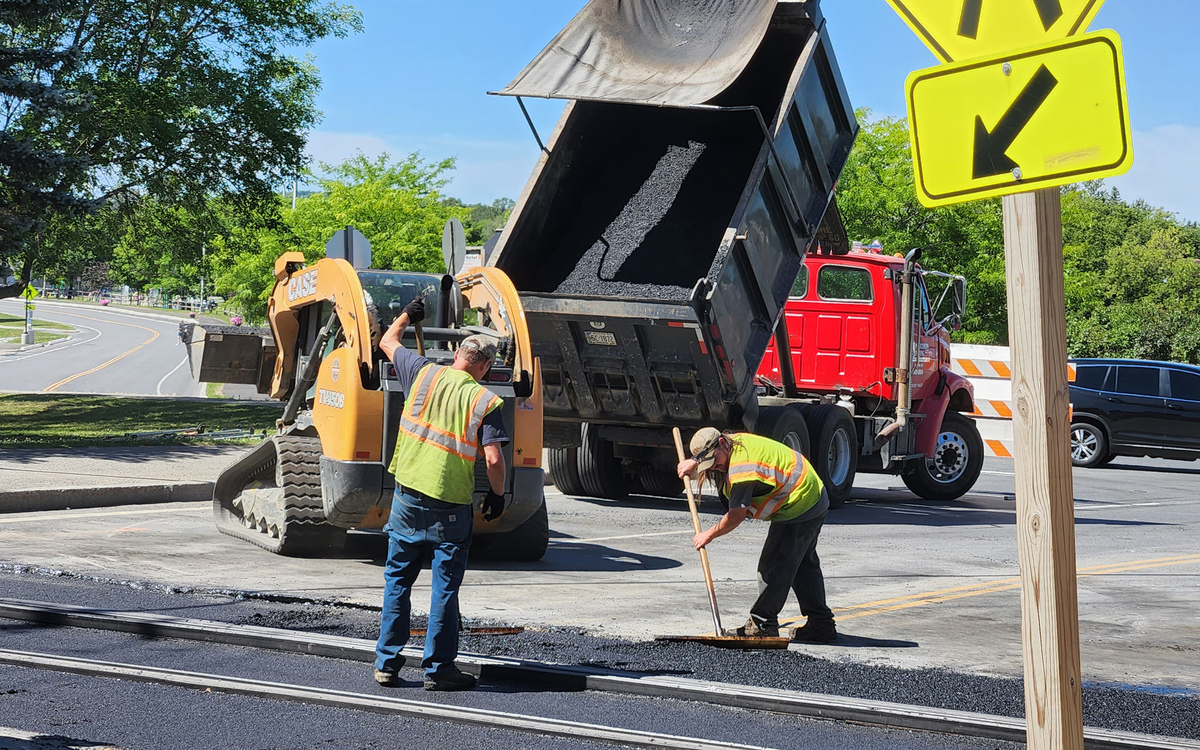
The Maine Department of Transportation is moving to slash up to $400 million in projects from its agenda, a shocking and abrupt cutback that is rattling the state’s construction industry at the start of building season.
Roughly $50 million across six pavement projects have already been delayed, according to a memo exclusively obtained by the Bangor Daily News. The agency plans to cut or delay another $150 million in bridge, highway, intersection and multimodal projects later this month. A further $200 million or more in cuts are planned in the next three-year work plan.
Those figures were outlined by Transportation Commissioner Dale Doughty in the May 18 memo to Gov. Janet Mills that has since circulated widely in the transportation sector, which has been getting drip-by-drip details on the wide scope of the cuts over the past three weeks.
It comes at the beginning of the state’s relatively narrow construction season. Companies have hired workers and ordered materials for projects they expected to begin this summer. The severity of the transportation budget problems was not raised to lawmakers during the 2026 legislative session.
Kelly Flagg, executive director of the Associated General Contractors of Maine, called the shortfall “deeply troubling” in a statement.
“We stand ready to work with policymakers, stakeholders, and industry partners to identify both immediate and long-term solutions,” Flagg said. “Maine cannot afford to fall further behind.”

Insiders saw this first.
This story was broken in Maine Politics Insider, the BDN’s daily premium newsletter for the most ardent political news followers. If you are a new BDN subscriber, you can sign up here. Current subscribers can contact our customer service team to upgrade.
The cuts stem from a structural funding gap of at least $130 million in the state’s current work plan, according to Doughty’s memo. Losses are magnified because state money from the gas tax and other revenue sources is matched by federal funds. Lawmakers have long grappled with politically difficult long-term problems with the state’s transportation budget.
A Mills spokesperson said Wednesday morning that the administration was working on a response to questions from the BDN. The department says it needs roughly $240 million more in state capital funding annually to maintain the existing system, and that anything less than $200 million will erode it over time.
Doughty’s memo the only near-term solution is a series of bonds beginning as soon as possible. Lawmakers would have to return to Augusta to authorize that if one is going to appear on the November ballot.

The BDN Opinion section operates independently and does not set news policies or contribute to reporting or editing articles elsewhere in the newspaper or on bangordailynews.com
Michael Capeci is the former chairman of the Bangor GOP.
Let’s be honest about Maine’s current state.
For many families, the cost of living has become unsustainable. Housing is out of reach for many young people. Energy bills keep rising. Many small businesses are struggling under taxes and regulations that make it harder to grow. Rural hospitals are under strain and despite years of increased state spending, the results are not showing up in people’s daily lives.
Concurrently, Maine continues to lose young workers to other states. That is not a statistic, it is a warning sign.
To me, the question in this Republican primary for governor is not about slogans. It is whether we continue with a political approach that has failed to reverse these trends, or whether we nominate someone with new ideas. I think that someone is Owen McCarthy.
Owen is not a political insider. He is an entrepreneur from Patten, a small town where opportunity is not assumed, it is built. He grew up in a working-class family, became the first in his family to graduate from college graduating from the University of Maine, and founded MedRhythms, a healthcare technology company focused on neurological treatment.
He didn’t just talk about opportunity. He built it. That distinction matters, because Maine’s problem is not a lack of debate it is a lack of results. We have seen the trajectory: higher costs, slower growth, and a steady outmigration of young workers. I believe Owen McCarthy represents a break from that pattern.
His Maine 2040 plan focuses on creating 50,000 new jobs in sectors where Maine has real advantages — maritime and defense, advanced forest products, and life sciences. These are export-driven industries tied directly to Maine’s workforce, geography, and institutions. What sets Owen apart is not only what he proposes, but how he approaches governing.
He prioritizes modernizing permitting so projects do not stall. He supports using technology to reduce costs and increase efficiency. He focuses on making it easier to build, hire, and expand in Maine.
That same practical mindset extends to healthcare. Expanding telehealth, strengthening EMS systems, improving provider flexibility, and shifting toward earlier intervention are not abstract reforms. They are system upgrades designed to improve access while controlling costs.
Maine voters consistently respond to competence. They reward candidates who understand problems and present plans to solve them. I believe they are tired of rhetoric that does not translate into results, and skeptical of politics that prioritizes messaging over execution.
Owen’s approach is grounded in solving the issues that shape daily life — affordability, healthcare access, job creation, and government efficiency. That is not just policy positioning. It is a governing model that speaks directly to voters.
Some will point to his lack of political experience. But I believe Maine’s core problems are not the result of insufficient political experience; they are the result of policies that have failed to deliver measurable improvement. Experience inside a broken system, by itself, is not a solution.
If Republicans want to win, this primary must be taken seriously. From my perspective, it is not about choosing a nominee for governor who can energize the base. It is about selecting someone who can compete in a broader electorate that is frustrated and looking for change.
That requires a candidate who can speak beyond the base, not by abandoning principles, but by demonstrating competence and a credible plan to address Maine’s challenges. I believe Owen McCarthy offers that combination. He represents a shift away from managed decline and toward economic execution.
This is not just another primary. It is a decision about whether Republicans position themselves to win Maine or whether they remain trapped in a cycle of repeating the same strategies and expecting different outcomes.
If Republicans want to compete for Maine’s future, they cannot afford to nominate a candidate who only motivates part of the electorate. They need someone who expands it.
I believe Owen McCarthy is that candidate.
And if the goal is to win Maine, then the choice should be unmistakable
-

 Dallas, TX32 seconds ago
Wings’ top pick Azzi Fudd hosts clinic as Cash App donates to Dallas nonprofit
-

 Miami, FL8 minutes ago
Patients left scrambling for care after Miami-Dade woman accused of operating an unlicensed surgery recovery center
-

 Boston, MA11 minutes ago
Clover plans to reopen some locations after sudden closure, thanks to an anonymous investor
-
 Denver, CO15 minutes ago
New report finds Denver metro home buyers and sellers experiencing ‘unattainability fatigue’
-

 Seattle, WA23 minutes ago
Seattle mayor grilled over public safety, affordability, CCTV
-

 San Diego, CA25 minutes ago
Automated license plate readers and public surveillance cameras are coming to Imperial Beach
-

 Milwaukee, WI31 minutes ago
Friends, family gather to remember gunshot victim Pepe Sikisi-Belle Jr.
-

 Atlanta, GA38 minutes ago
As FIFA World Cup nears, some MARTA riders raise safety concerns after recent attacks on transit system

