News
Elon Musk Downplays the Role of Climate in L.A. Fires, Scientists Say


Elon Musk on Thursday inserted himself into the debate over the role climate change plays in wildfires as at least five fires scorched the Los Angeles area, charring entire neighborhoods, killing at least five people and forcing tens of thousands to flee.
“Climate change risk is real, just much slower than alarmists claim,” Mr. Musk wrote to his 211 million followers on X, the social media site he owns. He said the loss of homes was “primarily due” to “nonsensical overregulation” and “bad governance at the state and local level that resulted in a shortage of water.”
But scientists are clear: A warming planet, driven largely by the burning of fossil fuels, has created the conditions for increasingly destructive wildfires, along with more damaging hurricanes and other extreme weather.
Studies have found that extreme wildfires are getting more frequent and more intense, and fires are spreading faster, too.
“Wildfires have become larger and more frequent because of climate change in the Western part of the United States,” said Michael F. Wehner, a senior scientist at Lawrence Berkeley National Laboratory. Regarding Mr. Musk’s comments, he said, “I find the whole thing pretty alarming.”
Scientists are unable to say with certainty that any single weather event was caused by global warming. But coming off the hottest year in history, the Los Angeles area has received less rainfall since the start of the rainy season in October than almost any other year since record-keeping began in 1877.
That drought turned vegetation into ready kindling, and temperatures have been above normal, further drying out grasses and scrubs. At the same time, Santa Ana winds have been unusually ferocious, blowing as fast as 100 miles per hour.
Benjamin Hatchett, a fire meteorologist at the University of Colorado, said there have been dry starts in past years but the combination of drought and high winds is fueling more destruction.
“This is probably just a bad, unfortunate, confluence of events,” Mr. Hatchett said. “I would be very hesitant to immediately say this is climate change and I don’t think that’s the right message here.
But because of climate change, he said, “this is the kind of conditions we expect to see more of going into the future.”
President-elect Donald J. Trump, Mr. Musk and other Republicans have sought to politicize the wildfires, using it as a way to attack Democratic officeholders in California. Mr. Trump in particular has seized on environmental regulations, including federal and state protections for California’s endangered delta smelt fish. He falsely claimed that those regulations led to inadequate water availability for firefighting efforts.
Peter Gleick, co-founder of the Pacific Institute, a California research organization that focuses on water, said Mr. Trump was spouting “complete nonsense.”
“There’s no link between California’s water policies and efforts to protect endangered species and water availability for firefighters,” Mr. Gleick said. “They’re completely unrelated.”
He noted that Southern California reservoir levels, including ones that feed Los Angeles, are above normal for this time of year. “There’s no water shortage,” he said. “The real issue is that urban water systems are not built or designed to fight massive, urban wildfires.”



Kim was, in her words, “starving for that fatherly love.”
She became an intern for Baer and always looked forward to being held in his arms for extended periods of time. She eventually asked him if there was anything she could do to help ease the fear that she believed was still holding her back.
There was, Baer told her. At his direction, she took off her top and bra, Kim said, and he held her but didn’t touch her breasts or privates.
“It felt very parental, and it felt very special,” she said.
In hindsight, Kim said, she cherished the experience for another reason.
“I was getting this special attention from him,” she said. “I was pretty desperate for that in my life.”
She now sees it as classic grooming behavior.
It happened one other time, Kim said, and she eventually asked him if there was anything else she could do to experience a “bigger shift.”
Baer brought her to the pool house and instructed her to remove her clothes piece by piece, Kim said. He lay in bed with her, rubbed her back and held her breasts, according to Kim.
“There was no talking me into it — I just did it,” Kim said. “In hindsight, I realized I didn’t feel free to say no to any of it. I had the belief that if I did say no, he would write me off.”
When Kim got the call from her daughter Penelope, she said it jolted her out of what she now describes as a cult mindset.
She spoke to other women in the community and said she heard more stories involving naked holding.
One of those women was Inge Jechart. A mother of two with a doctorate in physics, Inge had been an active Real Love member since a friend recommended Baer around 2005.
“At that time, I was lost and lonely,” she said, describing struggling under the weight of a faltering marriage and a strained relationship with her sons. “I learned how to become a better person and more loving and understanding.”
The first time Baer held her in his lap, Inge was overcome with emotion.
“I just cried,” Inge recalled. “It was such a relief to feel safe and loved. What else do we want in life?”
Following that experience, Inge said, she booked every retreat at his house that she could. And it was there, in 2017, that she said she twice got naked with Baer at his direction.
“We hold our own children when they’re naked to make them feel safe,” Inge said. “For me, that’s what we were doing.”
“And here’s the thing,” she added. “It made a huge difference for me.”
But Inge said Baer fondled her breasts the second time, and that didn’t feel right at all.
“I said, ‘Hey, as a 4-year-old, I wouldn’t have breasts,’” she recalled. “And he stopped.”
Inge said Baer told her he had done it with only one other woman before, and he added in a stern voice: “I don’t talk about this with anyone else.”
“I got the message,” Inge said. “Our community was important to me, and I didn’t want it to blow up, so I kept silent.”
But she said she never considered that he might be engaging in naked holding with younger, more impressionable women like Veena and Penelope.
Kim, Penelope’s mother, said the same.
“It had never crossed my mind that he would ever do this with my daughter,” Kim said. “I was completely blind to that possibility.”
The backlash
In February 2019, Kim sat down at her computer and began to type an email to Baer.
“Greg what you have done with my daughter…is wrong, hurtful, traumatic and goes against so many gospel principles,” read the email, which was reviewed by NBC News.
“Holding people without clothes on needs to stop, what you are doing is wrong,” it added. “Touching my daughter between her legs when she was naked was wrong — there is no justification for it.”
“I know of 4 women personally who have undressed completely with you, and I don’t know hardly anyone that you spend time with so I conjecture that there are many more,” Kim wrote near the end. “I beg of you…put a stop to this horribly damaging behavior.”
Baer was defiant in his response.
Kim’s daughter was “claiming events that never happened,” he wrote. “And she is supplying lots of details that never happened. And now she is sharing these details with as many people as she can find.”
Kim’s email wasn’t the only scathing message Baer received during this period.
“I am writing to perhaps appeal to your consciences and any integrity you may still have left,” wrote a woman from the U.K. in an email viewed by NBC News. “Shut Real Love down now before it’s too late.”
“Greg you have had sexual dealings with way more women than we initially thought,” the woman added. “That’s not including the naked holding.”
Baer replied with another strong denial.
“Nothing, absolutely nothing, like this is occurring, and people are healing all over the place,” he wrote to the British woman.
After receiving an email from NBC News, the woman declined to be interviewed, citing the lasting emotional toll.
“It’s honestly an incredibly traumatic part of my life, and one I don’t want to revisit,” she wrote. “It’s been 8 years and I haven’t moved on.”
The aftermath
Veena, Penelope and her mother said they all reached out to the police in Baer’s hometown of Rome but were told there was not enough evidence to pursue a sexual abuse case.
The Rome Police Department confirmed to NBC News that it conducted an investigation but said no charges were brought due to “insufficient probable cause.”
The women said they had also reported Baer to their local Mormon churches.

A spokesman for the Church of Jesus Christ of Latter-day Saints, widely known as the Mormon church, said it “initiated ecclesiastical proceedings involving this individual beginning in February 2020.”
The process could lead to a member’s excommunication, but the spokesman said he was not authorized to comment on the outcome of the proceedings.
Veena and Penelope filed lawsuits against Baer in Georgia’s Floyd County Superior Court in April 2019. They were settled five months later for $12,000 each. (The attorney who represented Baer, Robert Smalley, declined to comment.)
By then, Veena was adapting to life outside of Real Love. She had already separated from her husband and left the church. While raising her three children, she went back to college. A career in physics no longer interested her. She earned a degree in psychology from Columbia University.
“To help me understand what on earth just happened,” Veena said.
A few years ago, she decided to write what became a very different book than the one originally conceived about her experience in Real Love. She used pseudonyms for the group and for Baer himself, but the account, she said, was drawn from her recollections, emails and journal entries.
“The True Happiness Company” was published last year with the subtitle, “How a Girl Like Me Falls for a Cult Like That.”
Veena hoped that it would help her process what happened and serve as a cautionary tale for others.
“The physical violation is not what unravels me,” she says in the book. “It’s the loss of life experience, the mental and emotional violation of having my young adulthood orchestrated by someone with undue influence over me. It’s the friendships that disintegrated. The career paths unexplored. The opinions he replaced with his own.”
“The changes feel almost imperceptible as they happen,” she added later in the book, “and then suddenly appear extreme in retrospect.”
If you or someone you know is in crisis, call or text 988 or go to 988lifeline.org to reach the 988 Suicide & Crisis Lifeline, or visit SpeakingOfSuicide.com/resources.

U.S. President Donald Trump pumps his fist after touring the inside of the newest aircraft in the presidential fleet at Andrews Air Force Base on June 19, 2026 at Joint Base Andrews, Maryland.
Alex Wong
/Getty Images
hide caption
toggle caption
Alex Wong
/Getty Images
The newest Air Force One jet, gifted to President Trump from the Qatari government, arrived ahead of schedule on Friday to Joint Base Andrews in Maryland.
On Friday afternoon, Trump toured the luxury Boeing 747 plane that initially stirred controversy. The plane was one of the biggest foreign gifts ever received by the U.S. government and raised legal and ethical questions after Qatar offered to replace the presidential jet last year. Trump said last May he’d be “stupid” not to accept the offer. Industry groups originally said the plane could be worth approximately $400 million.
Trump also spoke standing in front of the plane, thanking the Emir of Qatar.

The president praised the workmanship of the plane, describing it as the “world’s most luxurious plane.” He also called it the “largest Air Force One ever built,” adding “it flies further and faster than any Air Force One.”
“This plane was transformed into a flying White House at a level of luxury that nobody’s ever seen before, probably even almost outside of an airplane,” Trump said. “Nobody’s ever seen anything like this, and in only 10 months, a timeframe no one thought possible.”

The exterior of the jet is no longer light blue, silver, and white – a fixture since the Kennedy administration. Trump unveiled the new red, white and blue color scheme.
“It was time for a change. … Everything was designed good. It was my taste,” Trump said saying that he approved the new color scheme, which reflects the American flag.
The VC-25B Bridge aircraft will now undertake its commissioning flights, what the Air Force calls a “final exam” for the plane. The plane was modified after serving the Qatari Head of State.
“Once these flights are successfully completed, the aircraft is officially ‘commissioned’ into the active executive airlift fleet and becomes available for presidential missions,” an Air Force press release said.

The aircraft from Qatar will “serve as a bridge until the [long-term] VC-25B is delivered,” according to earlier communications from the Air Force. The plane was delivered well before expectations. The Air Force originally estimated the plane would be delivered in 2028 but said by modifying requirements it could deliver the first aircraft in 2027. The modifications “were carefully crafted to prioritize mission over aesthetics, leaving much of the previous head of state interior layout minimally changed,” the Air Force said.
Air Force Chief of Staff Gen. Ken Wilsbach praised the delivery.
“Many thought it could not be done, but the United States Air Force was able to execute and provide a secure, reliable airborne command post on an accelerated timeline,” he said.

Algae turns the newly repainted Lincoln Memorial Reflecting Pool green on the National Mall on Tuesday in Washington, DC.
Chip Somodevilla/Getty Images
hide caption
toggle caption
Chip Somodevilla/Getty Images
WASHINGTON — The Lincoln Memorial reflecting pool is once again making headlines, this week for turning green.
The Washington, D.C. landmark was refilled with water earlier this month after President Trump had its neutral grey bottom repainted “American flag blue.” The multi-million dollar project produced subtle results in the eyes of many observers, even as Trump and Secretary of the Interior Doug Burgum — whose agency managed the renovation — touted its success.

In recent days, however, the pool has taken on a verdant hue — the result of algae blooms that experts say are to be expected in these conditions.
“It’s called ‘New Pond Syndrome,’” says Steve Goodale, a Canadian swimming pool specialist known online as “Swimming Pool Steve.” “It’s a known thing that happens when you take a natural, clear body of water like this that sits in an open air environment and you try to start it up, very often you end up with green water almost immediately.”
Goodale says the process took longer — a matter of days — to unfold in this case likely due to the sheer size of the pool, which measures 2,030 feet long and has a surface area of approximately 338,000 square feet.
“Excellent conditions” for algae growth
Rosalina Stancheva Christova, a professor of aquatic ecology at George Mason University in Virginia, took water samples from the pool on Tuesday. She confirmed the algae belongs to the genus Desmodesmus, which she said is “growing in excessive amounts” but is not toxic or harmful.
Christova says this kind of common green algae is found all over the region, especially this time of year. The reflecting pool in particular provides “excellent conditions” for algae growth, she said: shallow, stagnant water, strong sunlight and no shade.
“It could happen every single summer,” she added. “But it seems that the disturbance of the pond during the renovations [is] accelerating this process.”

Christova said last month’s renovations may have affected the balance of nutrients in the pool, potentially accelerating the algae blooms. Goodale similarly views the resurfacing as one of several contributing factors.
“The new, darker interior surface is going to absorb more sunlight,” Goodale says. “It is going to result in water that’s warmer, and that ultimately is going to lead to more prolific algae growth.”

A microscopic slide shows the Desmodesmus algae that quickly turned the Reflecting Pool’s water green. The new dark blue paint of the pool’s lining makes the water warmer and friendlier to the algae growth.
Rosalina Stancheva Christova, PhD.
hide caption
toggle caption
Rosalina Stancheva Christova, PhD.
The Trump administration has said the algae came from residual material in supply lines that had lain dormant for weeks. Their growth was likely exacerbated by the extreme temperatures that hit D.C. last week, bringing heat index values to 95 degrees and above.
Algae has resurfaced in the reflecting pool periodically over the years — including immediately after it reopened from its last major renovation in 2012, forcing the National Park Service to drain it, refill it and recalibrate its ozone level. And in 2019, crews had to drain four million gallons from the pool to fix a broken water line that had algae growing in it.
An Interior Department spokesperson told NPR over email that algae and other contaminants have “long plagued the Reflecting Pool since 1922,” pointing to the Obama-era renovation as an example.
“Unlike under Obama and Biden, the National Park Service is actually maintaining the beautifully completed Reflecting Pool,” they added.
Responding with tiny bubbles and big vacuums
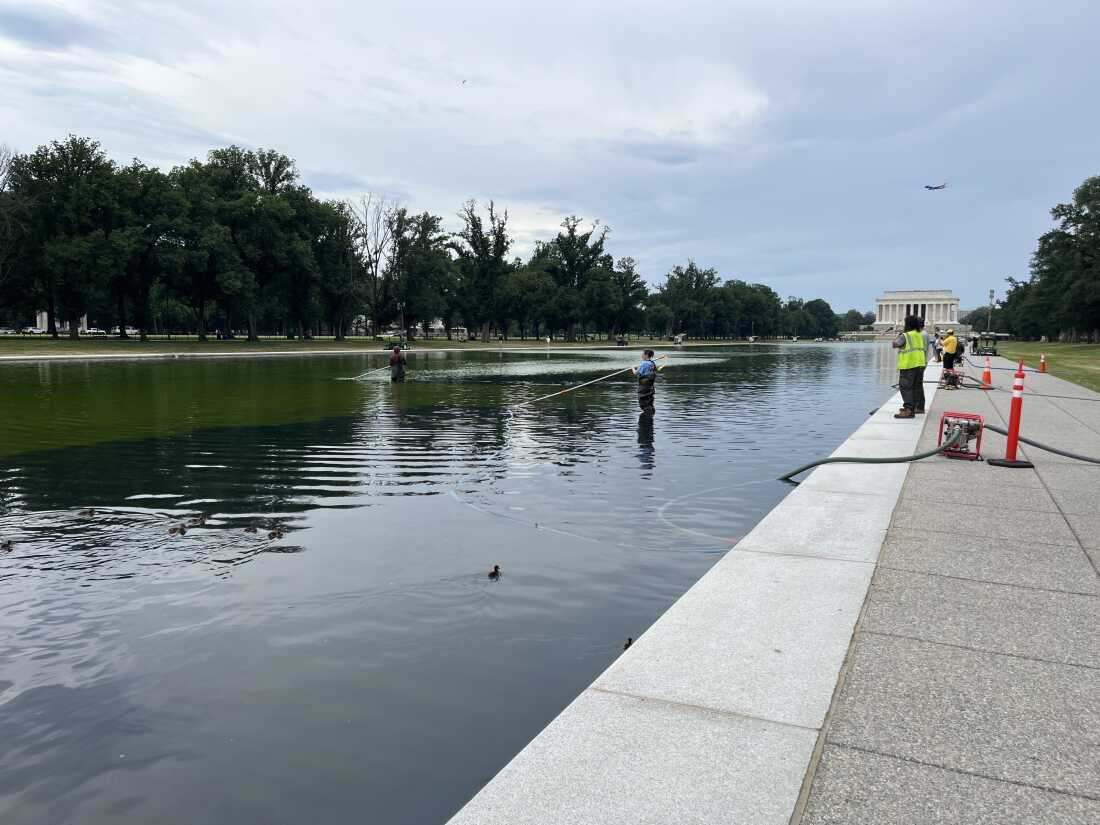
Workers battle the fast-growing common algae in the Lincoln Memorial Reflecting Pool on Thursday.
Rachel Treisman/NPR
hide caption
toggle caption
Rachel Treisman/NPR
The Trump administration is using a mix of mitigation strategies, including pouring hydrogen peroxide into the water to kill the algae.
The Interior Department says hydrogen peroxide is a “milder treatment than chlorine and is used in spas and specialty pools like natural swimming pools,” adding “there are no harmful side effects to marine life or to the environment.”
Workers are also deploying what the department calls “high-tech nanobubble ozone technology” to neutralize algae and other pathogens in the pool. The department says that approach is validated by several universities and the National Oceanic & Atmospheric Administration.
Those ozone bubbles are so tiny the human eye can’t even see them, Goodale says.
“The best way to describe it is that the bubbles are neutrally buoyant, so they won’t just rise to the surface and disappear readily,” he explains. “They can last for weeks, if not months in the water, doing their oxidizing thing and keeping the algae at bay.”
‘A monumental effort’
Goodale says it’s more complicated than treating the average backyard swimming pool, since the reflecting pool — despite its name — is actually more akin to a “manmade shallow lake.” He says it’s hard to predict just how long it will take to completely solve the algae problem, calling it “a monumental effort, literally.”
The Interior Department posted on X Wednesday that the nanobubble technology had “very effectively killed the algae,” and National Park Service crews would spend several days vacuuming up the dead algae from the bottom of the pool.
But as of Thursday morning, much of the pool — especially in the center — was still bright green.
Work continued on both ends of the pool. Nanobubble machines deposited their tubes into the water, as mobile vacuuming systems known as “trash pumps” hummed loudly from the shore. Handfuls of workers stood either in the pool or on the edge maneuvering long-handled vacuums back and forth. Their contents, including pistachio-colored water, poured out of hoses laying in the nearby grass.
The work zones were marked off by orange cones, but passersby walking the length of the pool appeared relatively unfazed. Some stopped to peer down and snap pictures of the water itself — including sections of paint that had visibly peeled off — while others were more focused on getting a photo of the Washington Monument in the background.
Loay Hidmi was walking deliberately along the edge of the pool closest to the Lincoln Memorial, hands clasped behind his back, looking over the ledge. The relatively new D.C. resident is a civil engineer who specializes in water treatment, and has been coming by the pool all week to see the progress for himself. He estimates it’s about 80% of the way there.
“I’m taking pictures of it … for the last week and I can see the gradual change,” he said. “So I’m hopeful. But we’ll have to see if it gets sustained.”
What happens next?
Hidmi worries that the algae could come back, given the favorable conditions posed by the sunny, shallow pool.
He acknowledges that’s mostly an aesthetic concern, given how much the administration has just spent on repainting the pool, but says it also raises questions about their process.
“In water systems, when you fix something, you need to look at the step before it and the step after,” he said.
Goodale agrees. He says that when a water system is taken offline, the pipes still remain full of water — “they don’t just gravity-drain away” — and need to be flushed out before any refilling. And he says eliminating algae is no substitute for dealing with underlying filtration issues.
“That’s like the equivalent of mowing the lawn when perhaps it needs to be something else that addresses the source nitrates and phosphorus, so that it’s more like pulling the weeds out by the root,” he says.

The algae doesn’t bother the ducklings swimming in the Reflecting Pool. Experts say the hydrogen peroxide used to get rid of the algae is safe for them, too.
Rachel Treisman/NPR
hide caption
toggle caption
Rachel Treisman/NPR
In the meantime, Christova, the algae expert, would like to see the water monitored weekly.
“If we don’t have any control over algal growth, we don’t know what is growing,” she said, adding that not all types of algae are as harmless as the one currently blooming in the pool.
When asked about plans for maintenance and algae prevention, White House spokesperson Taylor Rogers told NPR: “Thanks to President Trump, new lining and industrial grade materials will permanently seal the Reflecting Pool, which previously leaked 16 million gallons per year and wasted countless taxpayer dollars.”
Even after the Obama-era renovation, the reflecting pool suffered from broken pipes and water leaks requiring costly refills, according to a Department of the Interior report from fiscal year 2023. It called for new expansion joints, supply and return lines with thicker walls, saying “an improved distribution system will ensure the water can be circulated through the treatment plant, filtered, and treated with ozone.”
This latest renovation does not appear to have addressed the pipe problems, even though it did involve replacing failing expansion joints, resealing the pool, removing truckloads of garbage and “fixing the water system, drainage and so much more,” as Trump wrote on Truth Social in May.
Along the way, the cost of the project grew from Trump’s initial $2 million price tag to at least $14 million. Federal contract records show the government is paying $1.7 million to an Ohio-based company for the nanobubble technology alone.
“The scope of the Project has been greatly enlarged as we became involved because we realized how important it would be to Washington, D.C., and the record number of visitors coming to our now very safe Capital for all of the upcoming events in celebration of our 250th Anniversary,” Trump wrote.

The National Mall is hosting a number of semiquincentennial events on and around July 4, including a weekslong state fair that kicks off Wednesday evening.
-

 News12 minutes ago
The Real Love Company made her feel whole. Then ‘Daddy’ said to strip naked.
-

 Los Angeles, Ca2 hours ago
Woman, man found shot to death in Pomona, suspect leads officers on erratic chase
-

 Detroit, MI2 hours ago
Today in History: June 20, race-related rioting erupts in Detroit
-

 San Francisco, CA2 hours ago
San Francisco hotels see steady World Cup business, but fall short of Super Bowl surge
-

 Dallas, TX2 hours ago
Dallas International Piano Competition brings finalists June 23
-

 Miami, FL2 hours ago
Where to watch San Francisco Giants vs Miami Marlins: TV channel, start time, streaming for June 20
-

 Boston, MA2 hours ago
Duck parades, outdoor drinking, and Gronk in a kilt. Here’s how Friday’s World Cup festivities unfolded. – The Boston Globe
-

 Denver, CO2 hours ago
Rockies ride Kyle Freeland’s gem, Braxton Fulford’s double to 4-3 win over Pirates

