Business
Saudi Arabia May Partner With UFC Owner TKO to Create Boxing League


In the days after Donald J. Trump was re-elected president, one of his most high-profile stops was at an Ultimate Fighting Championship event at Madison Square Garden.
Mr. Trump’s appearance in the front row was notable, as was the presence of some of his closest confidants, like Elon Musk, who sat alongside him. But few in attendance for the fights would have recognized the other man sitting beside the president-elect.
Yasir al-Rumayyan, the governor of Saudi Arabia’s vast sovereign wealth vehicle, the Public Investment Fund, watched the action from ringside, and is getting even closer to being part of the action. A company owned by the fund is close to creating a boxing league with TKO, the owner of Ultimate Fighting Championship. A deal for what would be a new competition, featuring up-and-coming boxers tied exclusively to the league, could be announced within weeks, according to three people familiar with the matter.
TKO said in a statement on Wednesday that it had “nothing to announce,” but that it “would evaluate any unique and compelling opportunity that could fit well in our portfolio of businesses and create incremental value for our shareholders.”
The wealth fund did not comment.
The potential investment in TKO follows a Saudi Arabian effort in June to create a multibillion-dollar boxing league that would aim to unite the world’s best boxers, who for decades have been divided by rival promoters and fighting for titles controlled by an alphabet soup of sanctioning bodies. That effort, while not completely abandoned, had proved complicated and expensive, even for a country like Saudi Arabia, which for the past half decade has disbursed billions to become a player across some of the world’s biggest sports.
The investment in the new league will be made by Sela, a subsidiary of the Public Investment Fund. TKO — which is majority controlled by the entertainment and sports conglomerate Endeavor and embodied by Dana White, the U.F.C. empresario, a longtime friend of Mr. Trump’s — would be a managing partner. In return, TKO has been offered an equity stake and a share of the revenue, according to the people familiar with the matter, who spoke on the condition of anonymity ahead of the official announcement.
Saudi Arabia has backed some of the biggest and richest boxing bouts in history in recent years. It has played host to major title fights, most recently a face-off between Oleksandr Usyk and Tyson Fury, which ended with Mr. Usyk as the first undisputed heavyweight champion in more than a generation. Fights like that, which for years proved almost impossible to negotiate, have taken place thanks to the millions of dollars put on the table by Turki al-Sheikh, a government official with close ties to the kingdom’s crown prince, Mohammed bin Salman.
Mr. al-Sheikh, a former security guard, has become perhaps the most powerful man in boxing, seen at ringside and even inside the ring for the biggest bouts. He is also a frequent recipient of messages of thanks from some of the best-known fighters and boxing promoters, who refer to him as “His Excellency.” He pushed for a partnership with Mr. White, who over the last two decades has turned the U.F.C. from a $2 million company into one worth more than $10 billion. Talks have been taking place for more than a year in the United States, Europe and Saudi Arabia.
Mr. al-Sheikh had suggested in interviews that he was planning a new boxing venture. And he has made no secret of his frustration at the way the sport has been run, with the best fighters rarely meeting in their prime. In November, he purchased Ring Magazine — the century-old bible of the sport — and vowed to re-establish its prominence.
Mr. al-Sheikh has also teamed up with the World Boxing Council, a sanctioning organization, to create the Boxing Grand Prix, a tournament for young boxers.
For TKO, which owns both the U.F.C. and World Wrestling Entertainment, the venture has little risk, given that the Saudis are footing the bill. “If we were to get involved in boxing, we would expect to do so in an organic way, not an M&A way,” said Mark Shapiro, TKO’s president, on an earnings call in November, referring to mergers and acquisitions.
He added, “So, i.e., we’re not writing a check.”
Should the deal be completed, TKO will earn management fees of close to $30 million a year. Saudi Arabia is expected to pay significantly more in hosting fees to the league than any other country, according to details of the plan reviewed by The New York Times. Two fights there will bring in more than $40 million in fees. Other bouts are planned for the United States and Europe, where the hosting fees will be far lower.
TKO has also been talking with other parties, including other Arab nations, about the boxing league, according to one of the people familiar with the matter.
Endeavor, TKO’s parent company, has at times had a strained relationship with Saudi Arabia, and this potential partnership suggests that it has largely been repaired. In 2019, after the killing of the Saudi journalist Jamal Khashoggi, Endeavor returned $400 million that the Saudi sovereign wealth fund had invested in the company.
For the Saudis, getting a partner like Mr. White would come at an opportune time. He joined the board of Meta this week, and has spoken at the last three Republican National Conventions. Mr. Trump regularly hosted U.F.C. events at his properties in the organization’s early years, and he has attended many fights. Mr. Trump and Mr. al-Rumayyan are also close, with the Saudi-owned LIV golf championship holding several of its events at Mr. Trump’s courses, including one scheduled for April in Florida.
Saudi officials have described sports and entertainment as major pillars of a strategy, known as Vision 2030, to pivot their economy away from its reliance on oil exports, and as a part of efforts to liberalize society. Critics have described those efforts differently, positioning them as a way of using sports to distract the focus from Saudi Arabia’s human rights record, a tool known as sportswashing.
What TKO would get is a partnership with the biggest sports investor in the world. Saudi Arabia has invested in teams, talent and events across a wide range of sports, most recently securing rights to the 2034 men’s soccer World Cup, the most-watched event on the planet.
The U.F.C.’s U.S. media rights agreement with ESPN expires this year, as does the network’s deal with Top Rank, a top boxing promoter. TKO could try to bundle the rights to its new boxing league with the U.F.C. rights to help shore up the fledgling boxing league.
But applying the U.F.C. playbook to boxing will be extremely difficult. Boxing is a much more heavily regulated sport than mixed martial arts, with the federal Muhammad Ali Act mandating a separation in boxing between the role of manager and promoter, and the public listing of purse figures.
Unlike U.F.C., the league would not include the most prominent boxers. And they may not think there is an upside to joining it. While the fractured nature of boxing means its earning potential isn’t maximized for promoters and managers, top boxers earn far more than top M.M.A. fighters.
In October, the U.F.C. settled an antitrust lawsuit filed by former fighters — who claimed that the company illegally suppressed fighters’ pay — for $375 million. Documents submitted as evidence in that suit showed that the U.F.C. paid less than 20 percent of its revenue to its fighters.
In boxing, those figures are reversed, with fighters combining to earn well over 50 percent of the revenue from any fight.



WASHINGTON — In congressional races across the country, a new crop of super PACs is taking to the air with millions of dollars worth of advertisements to sway voters.
“President Trump said it best, ‘Celeste Maloy will never let you down,’” says one advertisement supporting the Utah Republican representative in her upcoming primary election.
“Standing up to big pharma, fighting for local jobs, Val Hoyle doesn’t back down,” says an ad backing the Oregon Democratic representative ahead of her primary victory last month.
The super PACs have nondescript names — such as Jobs and Democracy PAC and American Mission — and the text is so generic that it almost seems to have been created by artificial intelligence.
That isn’t so far off the mark. The AI industry has funded the ads.
One network of super PACs is linked to Anthropic, maker of the popular AI tool Claude, and the other to Open AI, maker of ChatGPT.
They have been among the most prolific political spenders so far in the 2026 midterm elections, splashing out more than $37 million to date to influence races across the country and making the groups among the biggest outside spenders so far in congressional races. That number could grow exponentially as campaign season heats up closer to the November election — and as the Silicon Valley giants prepare initial pubic offerings that are poised to raise billions of dollars for the companies and their executives.
The AI political spending boom comes as emerging technology companies have become increasingly “comfortable with using their power to achieve a political goal,” said Adam Kovacevich, a former Google public policy executive and founder of Chamber of Progress, a technology trade group with a progressive orientation.
The leading AI companies have a history.
Anthropic was formed by former OpenAI employees who were concerned that the company was less focused on its original mission to safely harness the power of AI.
The companies are now the leading drivers of the burgeoning AI industry, and their competing views about how the technology should be regulated are playing out in a wide-ranging political ad spending war that has targeted congressional races in big cities and rural areas alike.
OpenAI thinks AI should be regulated solely at the federal level.
Anthropic calls for more stringent regulation and supports efforts by states such as New York and California that have passed more aggressive AI laws.
The groups spending in these races are super PACs, which are able to raise and spend unlimited amounts of money in federal races thanks to the 2010 Citizens United Supreme Court decision.
In some races, the AI-backed political groups have spent more than the candidates they are backing.
“There was no way as a grassroots person that I could compete with that kind of money,” said Al Olszewski, whose opponent in a Montana Republican congressional primary beat him by 30 points after getting a boost from $877,000 in ads from a super PAC backed by OpenAI’s co-founder. “I got crushed.”
The AI behemoths have emphasized that they are independent from the political groups.
One group counts $25 million in support from OpenAI co-founder Greg Brockman and his wife, Anna, alongside $100 million tied to one of Silicon Valley’s biggest venture capital firms, which holds a large stake in OpenAI. The global policy chief for OpenAI was reportedly involved in conceiving the group.
The other side has gotten $20 million from Anthropic and millions more from donors whose identities are not public.
This anonymous political cash is commonly known as dark money, and its prevalence is growing.

(Los Angeles Times photo illustration; source photos courtesy of the Tech Oversight Project)
“This has become very normalized now,” said Brendan Glavin, director of insights at OpenSecrets, which tracks campaign spending. “In 2024, we tracked over $1 billion in dark money.”
That total was $350 million higher than the previous presidential election.
The crypto playbook
The political activity of these AI companies and executives reflects a dramatic shift from how emerging technology companies have historically engaged with politics.
Google, for example, didn’t hire its first in-house Washington lobbyist until after the company had gone public in 2005.
“I think that for a long time, the tech industry lobbying strategy was just ‘leave us alone,’” Kovacevich said.
He sees the spending by these AI-linked super PACs as following the recent playbook developed by the cryptocurrency industry, which has funded the only network of political groups that has spent more on congressional races this year than those linked to OpenAI.
“I think what the crypto industry realized was that there’s no substitute for building up political power,” Kovacevich said.
The political stakes for these technology companies are significant.
“AI policy is far from settled,” said Asad Ramzanali, the former deputy director for strategy in the White House Office of Science and Technology Policy during the Biden administration and the director of artificial intelligence and technology policy at the Vanderbilt Policy Accelerator.
Earlier this month, the Trump administration banned foreign nationals from using the most powerful AI model developed by Anthropic — and even banned the company’s own employees from it — which forced the company to restrict access for all users.
Manhattan matchup
The two super PAC networks have largely shied away from producing ads that mention AI and have mostly chosen to avoid competing against each other in the same races.
There’s one big exception.
In the marquee Manhattan Democratic congressional primary to replace retiring Rep. Jerry Nadler (D-N.Y.), each side has spent millions of dollars.
While the field includes Kennedy scion and social media star Jake Schlossberg and former Republican turned Trump critic George Conway, the target of all the AI-backed spending has been Alex Bores, a former Palantir data scientist who now serves in the New York state Assembly.

New York congressional candidate sponsored a state measure Bores requiring major AI companies to be transparent about their safety protocols and promptly report safety incidents.
(Yuki Iwamura / Associated Press)
That’s because Bores sponsored a state bill, known as the RAISE Act, that requires major AI companies to be transparent about their safety protocols and promptly report safety incidents. The bill was signed into law in December 2025.
The ads sponsored by the group tied to OpenAI, which has spent more than $7.5 million in the race, paint Bores as someone who can’t be trusted.

They cite his support from other tech billionaires, including former crypto mogul and convicted financial fraudster Sam Bankman-Fried, whose super PAC spent $100,000 to support Bores in 2022 when he first ran for New York Assembly.
“Is that really who should be shaping AI safety for our kids?” one ad asks.
An ad sponsored by the Anthropic-backed network, which has also spent more than $7.5 million supporting Bores, makes the case that the bill he sponsored is exactly why he should be elected.
“As a computer engineer, Alex Bores saw how dangerous unregulated AI could be and he wrote New York’s RAISE Act to put real safeguards on A.I. and hold big tech accountable,” the ad says.
The AI ad barrage in New York has even included what might be considered a kumbaya moment in the ad wars — another super PAC created to support Bores is most heavily backed by both an employee of Anthropic and an employee of OpenAI, who both focus on AI safety.
The group, Dream NYC, has spent more than $1.7 million supporting Bores.
Bores and fellow New York State Assemblymember Micah Lasher have been atop the most recent polls in the race ahead of the June 23 primary.

A general view of businesses in St. George, Utah, on Wednesday.
(Ian Maule / For The Times)
Rural Republicans
For voters in many parts of the country, the debate over AI policy has played out locally as a debate over the massive data centers required to power the technology.
In Utah, a proposed data center in Box Elder County, backed by “Shark Tank” television personality Kevin O’Leary, has generated controversy because of questions about its impact on resources in the drought-prone state and its environmental effect on the nearby Great Salt Lake.
In the state’s most competitive Republican congressional primary — the vast, newly drawn 3rd Congressional District — both candidates expressed concerns about how the project has been developed and called for greater transparency in this plan and for future data centers in the state.

Utah congressional candidates Phil Lyman and Celeste Maloy in a debate on June 1. A super PAC backed by Anthropic has spent more than $920,000 to support Maloy.
(Rick Egan / Pool / The Salt Lake Tribune Via Associated Press)
Despite their similar position on the project, a super PAC backed by Anthropic has spent more than $950,000 to support Maloy, who is running in the new district after the boundaries of her old district changed.
“It’s a lot of money to throw at a race,” said her opponent, Phil Lyman, a former conservative Republican state Representative who ran to the right of Utah Republican Gov. Spencer Cox in an unsuccessful primary challenge in 2024.
Lyman insists he is no AI skeptic.
“I’m not anti data centers, I’m pro-transparency,” he said. “I think the future is bright with AI.”
The group said it is backing Maloy because it sees her as “someone who’s worked the issue” of AI regulation and who “has demonstrated leadership” with Republicans in Congress.
Maloy’s campaign didn’t respond to request for comment.
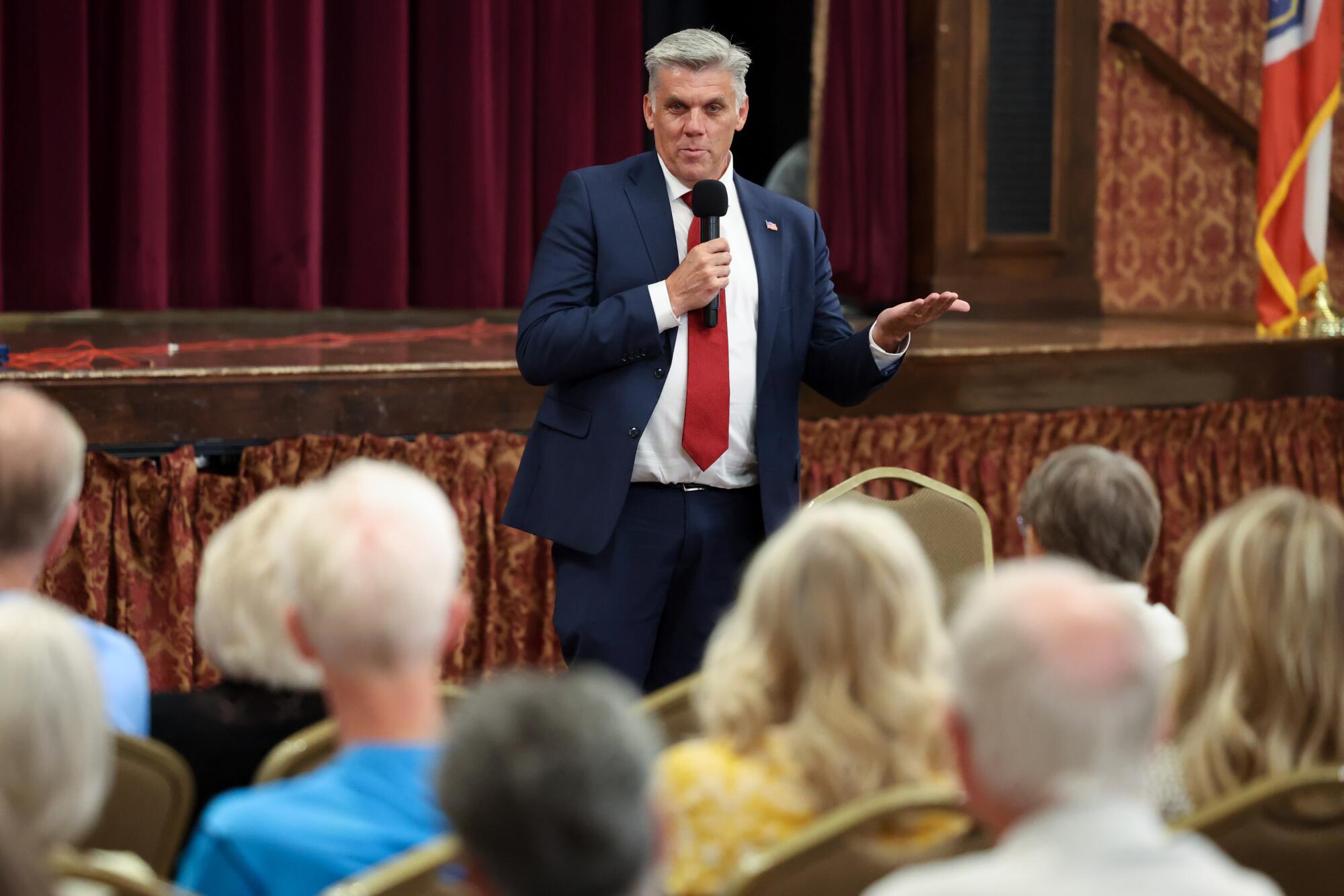
Utah congressional candidate Phil Lyman speaks during a Cottage Meeting at the SunRiver Community Center Ballroom in St. George, Utah, on Wednesday.
(Ian Maule / For The Times)
But Lyman suspects the group’s support for Maloy ahead of their June 23 primary has more to do with old-fashioned politics than any emerging technology.
One of the two co-founders of the political group is Chris Stewart, Maloy’s predecessor in Congress.
“Everything that they’re doing feels very coordinated,” Lyman said. “It makes you wonder if he’s still really controlling that seat.”
A big rig crossed the center divider on the 210 Freeway in Irwindale on Saturday morning, killing one and injuring 30, authorities said.
The mass accident took place before 9 a.m. west of Irwindale Avenue, where emergency personnel arrived to find the truck had collided with several vehicles, the Los Angeles County Fire Department said in a social media post.
One person was pronounced dead at the scene and two were critically injured. Eight minors were taken to the hospital and 22 other crash victims declined treatment, the department said.
The California Highway Patrol temporarily shut down all westbound lanes of the freeway, diverting traffic onto Irwindale Avenue, before opening up one lane.
The CHP issued a SigAlert warning of traffic delays on the westbound lanes, with two lanes on the eastbound side of the freeway also temporarily closed.
The cause of the crash is under investigation.

Ford Motor Co. is suing a prominent Los Angeles lemon law firm for allegedly inflating their fees by as much as 7,000%, the company’s latest attempt to crack down on California attorneys who it says are exploiting the state’s unique law to protect consumers from defective cars.
Quill & Arrow, a personal injury firm that represents drivers suing over so-called “lemons” — vehicles with significant, unfixable manufacturing flaws — has long been a thorn in the side of Ford. Since 2021, Ford said its has paid them more than $100 million, roughly half in attorney fees.
That profit, Ford alleges in a federal lawsuit filed Thursday, came from billing records that were “utter fabrications.”
Quill & Arrow used an overseas “army” of low-paid, non-lawyers to help file thousands of lemon lawsuits and then pretended the work was done by California attorneys, who billed as much as $950 per hour, Ford alleged in its complaint.
Ford claims that the bulk of the work was actually done by non-lawyers in countries such as Mexico and the Philippines, who got paid as little as $13 per hour.
Quill & Arrow was founded in 2019 by attorneys Kevin Jacobson and Jonathan Shirian, according to the firm’s website, which touts recovering $500 million in lemon law payouts. The partners called Ford’s lawsuit “nothing more than an attempt to silence firms who would dare to hold them responsible and seek justice for consumers.”
“It grossly mischaracterizes the facts and the claim that Quill & Arrow created fabricated attorney billing records is absurd,” the firm said in a statement.
California’s lemon law, considered one of the strongest consumer protections in the nation, allows drivers to get a refund or replacement of a broken car if the manufacturer can’t fix it. If the driver is not satisfied, they can sue.
If the driver wins, the law allows attorneys to collect their fees from the car maker — rather than take a percentage of the client’s winnings, as is common in personal injury cases. This fee structure, Ford argues, has turned the law into a bonanza for plaintiff attorneys. The longer the case drags on, the company argues, the more the law firm can reap in profit.
Ford alleges the firm intentionally slowed down its clients’ cases to drive up their billable hours, instructing drivers not to communicate with Ford and pushing them toward filing a lawsuit.
“California’s Lemon Laws are in need of reform and the courts need to exercise more oversight, given the fraud we continue to expose,” said Doug Lampe, counsel at Ford, in a statement. The law is “being blatantly abused by the lemon law plaintiffs lawyers, the bar is not policing its own and the courts need to monitor fee awards with far more skepticism and scrutiny.”
The cases, he said, “have become about the lawyers for the lawyers.”
Lemon law cases have exploded in California in the last decade from about 4,500 cases in 2015 to roughly 30,000 in 2024, according to an analysis from the Assembly Judiciary. These cases, officials warned, “are poised to cripple the entirety of California’s civil justice system.”
In 2024, the legislature tightened the state’s lemon law, requiring additional steps before a driver could sue. The bill seems to have put little dent in the caseload: Lemon lawsuits surged to record levels the following year.
Ford’s lawsuit marks the second attempt by one of America’s largest car manufacturers to go on the offense against lemon law attorneys in Southern California.
Ford sued a cohort of local lemon law firms in May 2025, accusing attorneys of collecting at least $100 million in “phantom legal fees” by billing for hours they never worked. The case, which was brought under the Racketeer Influenced and Corrupt Organizations Act, or RICO, alleged lawyers worked together to file a flurry of fraudulent cases with billable hours that defied logic.
A partner at Knight Law Group, an L.A.-based lemon law firm, once billed an “ostensibly heroic but physically impossible” 57.5-hour workday, Ford alleged.
Knight Law Group denied inflating their billing, calling the suit a “thinly veiled attempt to silence firms who would dare to hold them responsible and seek justice for consumers.”
A judge threw out the suit in March on the grounds that lawyers were protected under the 1st Amendment from being sued for the content of their lawsuits unless the case was proved fraudulent. Ford says it plans to appeal.
After Quill found about the Knight Law Group case, Ford alleged, Quill dedicated a team to “scrubbing” their own timesheets of “impossible time entries.”
-
Maryland3 minutes ago
Piper PA-28 crashes in Maryland, killing all three Israeli occupants | The Jerusalem Post
-

 Michigan6 minutes ago
Remembering soccer matches at Michigan Stadium
-

 Massachusetts11 minutes ago
Howie Carr: Meet another Massachusetts ‘resident’ lugged by the feds
-

 Minnesota18 minutes ago
Minnesota bans crypto ATMs after scam surge
-

 Mississippi21 minutes ago
Iconic Mississippi foods and top US foodie states
-

 Missouri26 minutes ago
Man shot, killed after argument spills out of south Kansas City home
-

 Montana33 minutes ago
Photos: Montana East-West Shrine Game
-

 Nebraska36 minutes ago
Deadline looms for filing Nebraska Homestead Exemption applications


