Entertainment
'It's a little holiday gift': Inside the Weeknd's free Santa Monica show for his biggest fans


In the digital streaming era, one of the biggest flexes an artist can have is being a member of Spotify’s Billions Club, a playlist that highlights every song that has been streamed more than 1 billion times on the platform. Among the nearly 500 artists who have graced the glorified list are Mariah Carey (“All I Want for Christmas Is You”), Rihanna (“Needed Me”), Fleetwood Mac (“Dreams”), Kendrick Lamar (“All the Stars” featuring SZA), Billie Eilish (“Ocean Eyes”), but the distinction of having the most tracks — 24 to be exact — to hit 1 billion streams on Spotify belongs to the Weeknd.
To commemorate this milestone, the Toronto pop star teamed up with Spotify to host an intimate, invite-only concert with nearly 2,000 of his biggest fans — his top 10% listeners on the platform — on Tuesday night at the Barker Hangar in Santa Monica.
“It’s a little holiday gift for the OG XO fans supporting me [since] Day 1,” the Weeknd said during his 70-minute set. “2024 is almost done, but 2025, we got some new s— coming out. New album. New tour. New movie. New everything. We’re shutting this s— down.” His upcoming album “Hurry Up Tomorrow,” which is the third and final installment of his “After Hours” / “Dawn FM” trilogy,” will be supported by a psychological thriller starring the singer born Abel Tesfaye, alongside Jenna Ortega and Barry Keoghan.
With the support of his longtime collaborator Mike Dean (on the keys) and guitarist Patrick Greenaway, the Weeknd performed 20 of the 24 songs that landed him on the Billions Club playlist including “Blinding Lights” (the most streamed song on Spotify), “The Hills,” “Can’t Feel My Face,” and “After Hours.” He also performed three additional songs for the energetic crowd, who knew every word, including “São Paulo,” “Timeless,” and “Wicked Games.”
“I know that song didn’t hit a billion, but I felt like I had to do it,” he said about “Wicked Games.” “It’s necessary, at least one ‘House of Balloons’ song.”
Fans started lining up overnight at 4 a.m. for the highly anticipated show and a few folks traveled from Newark, N.J., for the chance to get inside even though they didn’t have tickets to the event. (Unfortunately, the aforementioned Jersey fans didn’t make it inside because they didn’t have a ticket.) The special night featured food trucks including L.A.’s beloved Kogi Korean BBQ, an open bar (for attendees 21 and up) and the Weeknd merchandise — all of which was free to attendees.
Fans take photos at the Weeknd’s show with Spotify on Tuesday at the Barker Hangar in Santa Monica.
(Jason Armond/Los Angeles Times)
For an international superstar like the Weeknd, who regularly sells out arenas and stadiums around the globe, the event was a chance for fans to experience his music in a personal setting. In fact, it was likely the first time since his early days that he’s performed for an audience of fewer than 2,000 people. “It feels like back in the ‘Kiss Land’ tour,” he said. “Maybe after the stadium tour, we’ll go back to smaller venues. I like this.”
Ashley Graver, who leads artist partnerships and is head of pop, dance and indie at Spotify, says the Weeknd and his team were involved throughout the entire process of putting together the show, including on the merch design, stage and sound design.
“This milestone really shows how massive the Weeknd’s impact is around the world,” she said. “His success is a testament to his artistry and his constant drive to push creative boundaries. Right now, ‘Blinding Lights’ is the most-streamed song on Spotify, even four years after it came out, which just goes to show how much staying power he has and how loyal his fans are.”
Before the show, we caught up with attendees to ask them about their fandom and what it means to be invited to such an exclusive event.
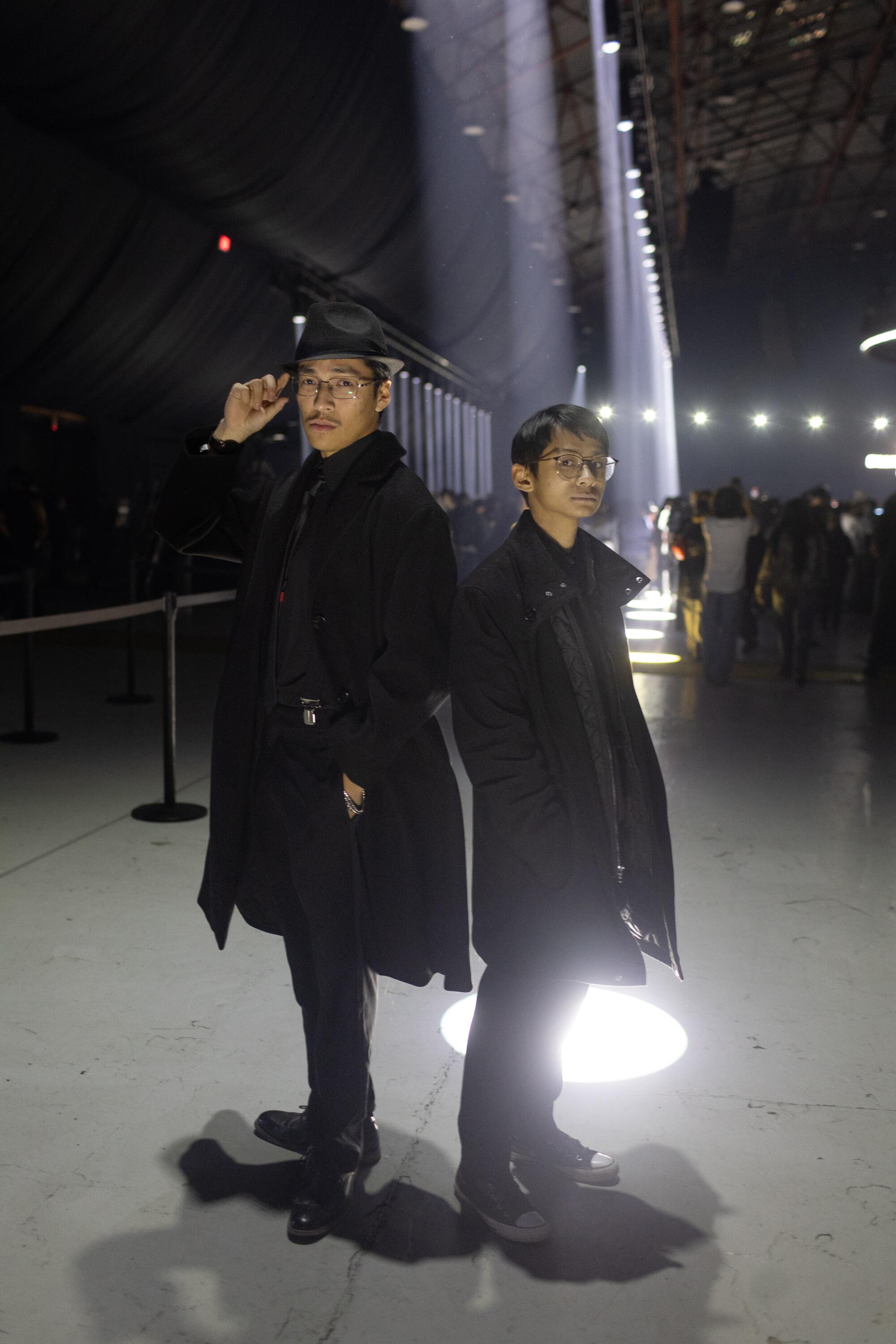
Elijah Shen Muralles, 21, left, and Cole Dizon, 20, attend the Weeknd’s show with Spotify on Tuesday in Santa Monica.
(Jason Armond/Los Angeles Times)
Cole Dizon and Elijah Shen Muralles
Age:
Dizon: 20
Shen Muralles: 21
Neighborhood:
Dizon: Lancaster
Shen Muralles: South Gate
How long have you been a fan of the Weeknd?
Dizon: About two years ago, one of my friends showed me a few songs — some of the mainstream ones like “Die For You” and “Blinding Lights.” I knew he was a household name, but once I started getting into the groove of it, I was like “OK, he’s pretty good.” Eventually, I went to his Spotify profile and started listening to more of his songs. I was like, “Hold on. I can see why he’s so popular. The trend has motion to it.” So I started listening to him more and more.
Shen Muralles: I would hear him here and there and he was always one of the big celebrities, but I didn’t really get deep into it until maybe like a year or two ago. My friend was just blasting his music all the time and I was like, “You know what, I’m going to hear this artist out.” After a few songs, I realized, “Oh my gosh. He’s one of the best sounding artists I’ve ever heard. I should’ve hopped onto the bandwagon sooner.”
What’s your favorite song by the Weeknd?
Dizon: “I Feel It Coming.” Daft Punk is a classic. When the song dropped, I wasn’t on the bandwagon yet but listening to it recently I was like, first off, I remember this song. [Secondly], I’ve been sleeping on this because this is straight heat.
Shen Muralles: “House of Balloons.” I’m a big fan of the first half. The second half is still really good. However, I think the first half, it’s just the beat, the lyrics, it really just gets me in the mood. Also, “Stargirl Interlude.” I’m a bit of a Lana Del Rey fan. Her voice just hard carries that song.
How does it feel to be at this exclusive show?
Dizon: It’s super surreal. When I got the email [invite] from Spotify, I didn’t believe it was real… We got here and saw the line and I was like, “Holy smokes! This is actually legitimate.” We were stressing in line cause we thought we weren’t going to get in… I’m going to see him in like four weeks from now [at his tour], so to me this is not only a wonderful surprise, but it’s a great love letter to his fans.
Shen Muralles: I’m not one to drop a whole lot of money to go to concerts, so to get to come to something like this with Spotify is like, “Wow, this is crazy.” I’m just so grateful to be here because this is like a once in a lifetime opportunity for me… This is a Christmas gift right here.

Friends America Maldonado, left, Maya Garcia and Kessai Suksanguan were among the first people in line at the Weeknd’s Spotify show in Santa Monica.
(Jason Armond/Los Angeles Times)
America Maldonado, Maya Garcia and Kessai Suksanguan
Age:
Maldonado: 21
Garcia: 21
Suksanguan: 19
Neighborhood:
Maldonado: Downtown L.A.
Garcia: Bellflower
Suksanguan: Long Beach
How long have you been a fan of the Weeknd?
Maldonado: Since I was 13. I would listen to his mixtapes.
Garcia: Probably since middle school.
Suksanguan: Around middle school. I would hear him a lot on the radio.
What’s your favorite song by the Weeknd?
Maldonado: “Adaptation.” It’s just a beautiful story. If you listen to [the album] “Kiss Land,” every song ends and it just continues on with the story.
Garcia: I know it’s basic, but I’m going to say “Earned It.” It’s super catchy and it highlights his voice, which I love.
Suksanguan: “After Hours.” I really like the style of that whole album and that time period for him.
How does it feel to be at this exclusive show?
Maldonado: It feels amazing. Unfortunately, I’ve only seen him perform live twice. I’ve been listening to him for so long, but to be a part of this free event where I feel comfortable, is great.
Garcia: I’m honestly so glad that he’s doing this show in L.A. I just love being here in L.A.
Suksanguan: I think it’s just really special that it was free and invite only, so it makes us feel really wanted and really special. And the fact that it’s close to us too, it’s really convenient.
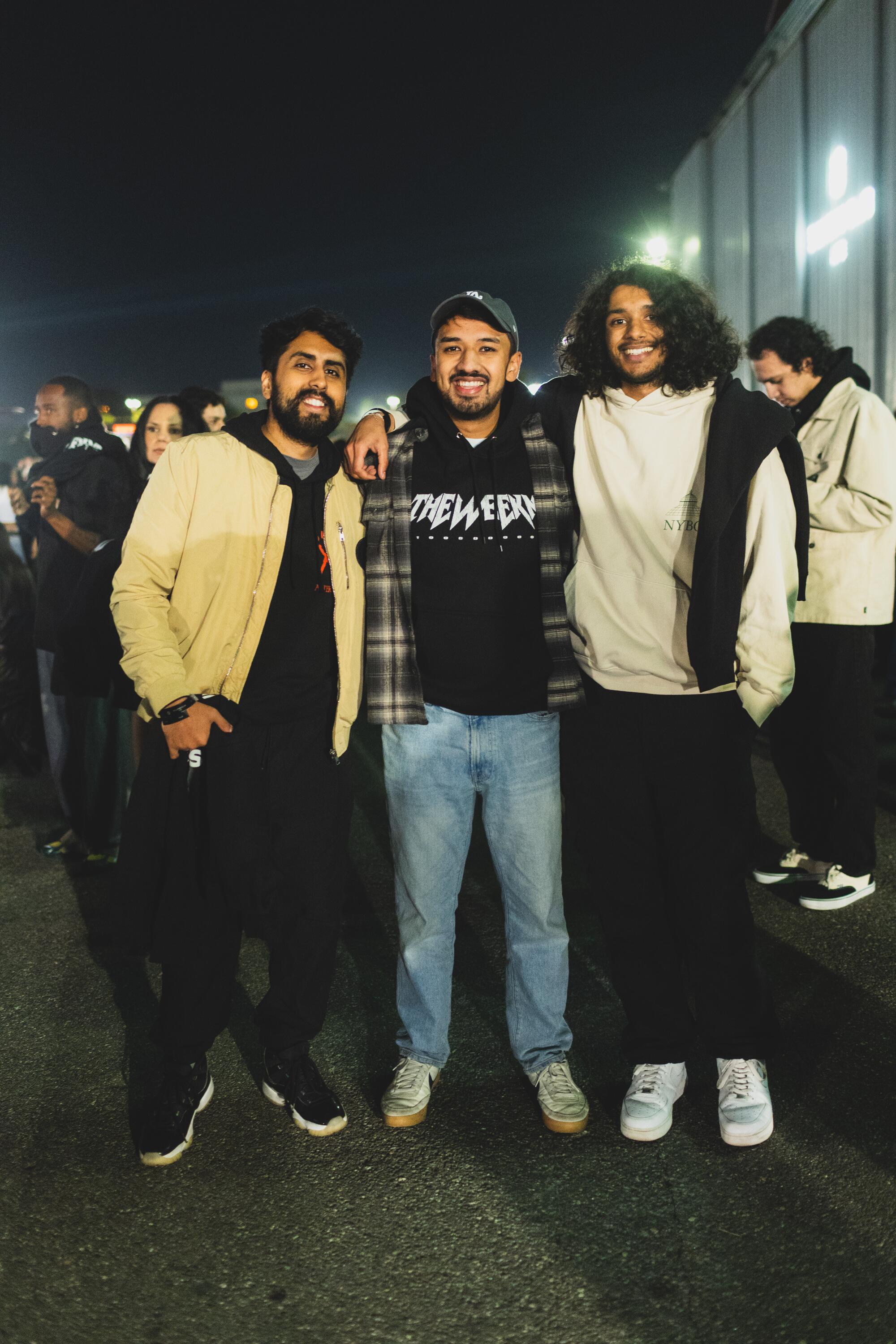
Hamza Akmal, left, Adeeb Ali and Ameer Ali attend the Weeknd’s Billions Club show in collaboration with Spotify on Tuesday at the Barker Hangar in Santa Monica.
(Jason Armond/Los Angeles Times)
Hamza Akmal, Adeeb Ali and Ameer Ali
Age:
Ameer: 25
Adeeb: 28
Akmal: 29
Neighborhood:
Ameer: Whittier
Adeeb: West Covina
Akmal: Culver City
How long have you been a fan of the Weeknd?
Ameer: The Drake collabs made me a fan. The songs were very unique. I’d never heard anything like that at the time.
Adeeb: I became a fan when I heard him on “Crew Love” with Drake. I was like, “This guy is good.”
Akmal: I became a fan around high school [around] like 2011. A couple of my friends liked to explore a lot of new music and they told me to check him out, so I’ve been listening since then.
What’s your favorite song by the Weeknd?
Ameer: I’m a big Michael Jackson fan. I love how the Weeknd did “Dirty Diana” [with his song] “D.D.”
Adeeb: “Out of Time.” It’s just so pretty. He sampled some Japanese city pop and it sounded really nice.
Akmal: Probably “The Hills.” It’s just too catchy for me. I just love the beat of it and everything.
How does it feel to be at this exclusive show?
Ameer: It’s exciting.
Adeeb: It seemed a little too good to be true. I was like, “Are we being set up right now?” And like, no, it’s just super cool.
Akmal: Coming to this, I didn’t really know what to expect, but based on what I’m seeing, it’s really cool to be here.
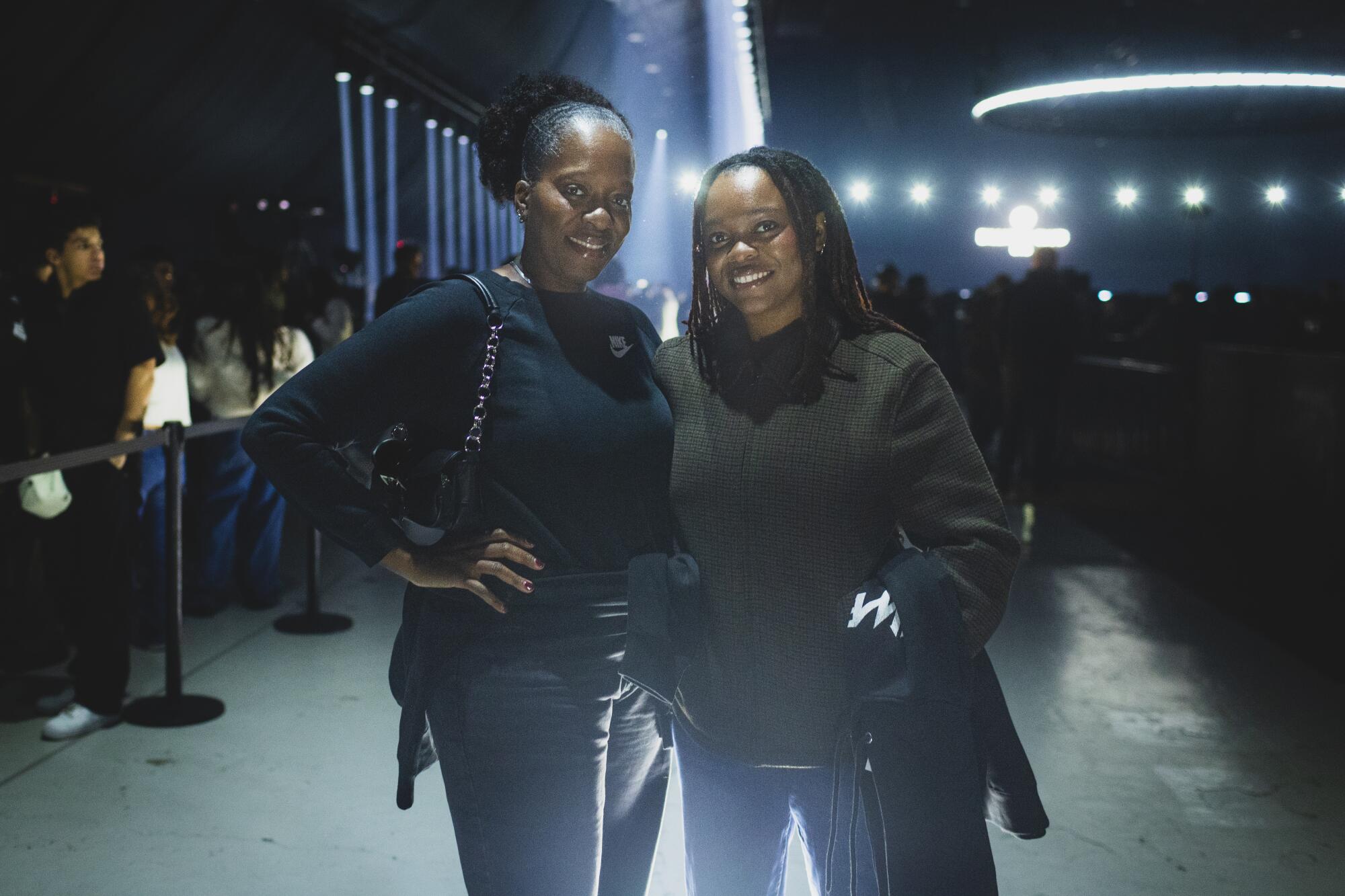
Mother and daughter, Kenyah Moore, 18, and Shenita Moore, 48, attend a show put on by Spotify to celebrate the Weeknd on Tuesday.
(Jason Armond/Los Angeles Times)
Shenita and Kenyah Moore
Age:
Kenyah: 18
Shenita: 48
Neighborhood:
Kenyah: Santa Monica
Shenita: Santa Monica
How long have you been a fan of the Weeknd?
Kenyah: He’s just always been there. Growing up, he’s one of the most popular artists of my generation.
Shenita: I’m just here supporting her, but I am familiar with his music.
What’s your favorite song by the Weeknd?
Kenyah: “In the Night.” I like the story that it tells.
How does it feel to be at this exclusive show?
Kenyah: I’m glad I saw the email. It’s a pretty cool thing that he achieved — to get that many songs over 1 billion [streams].
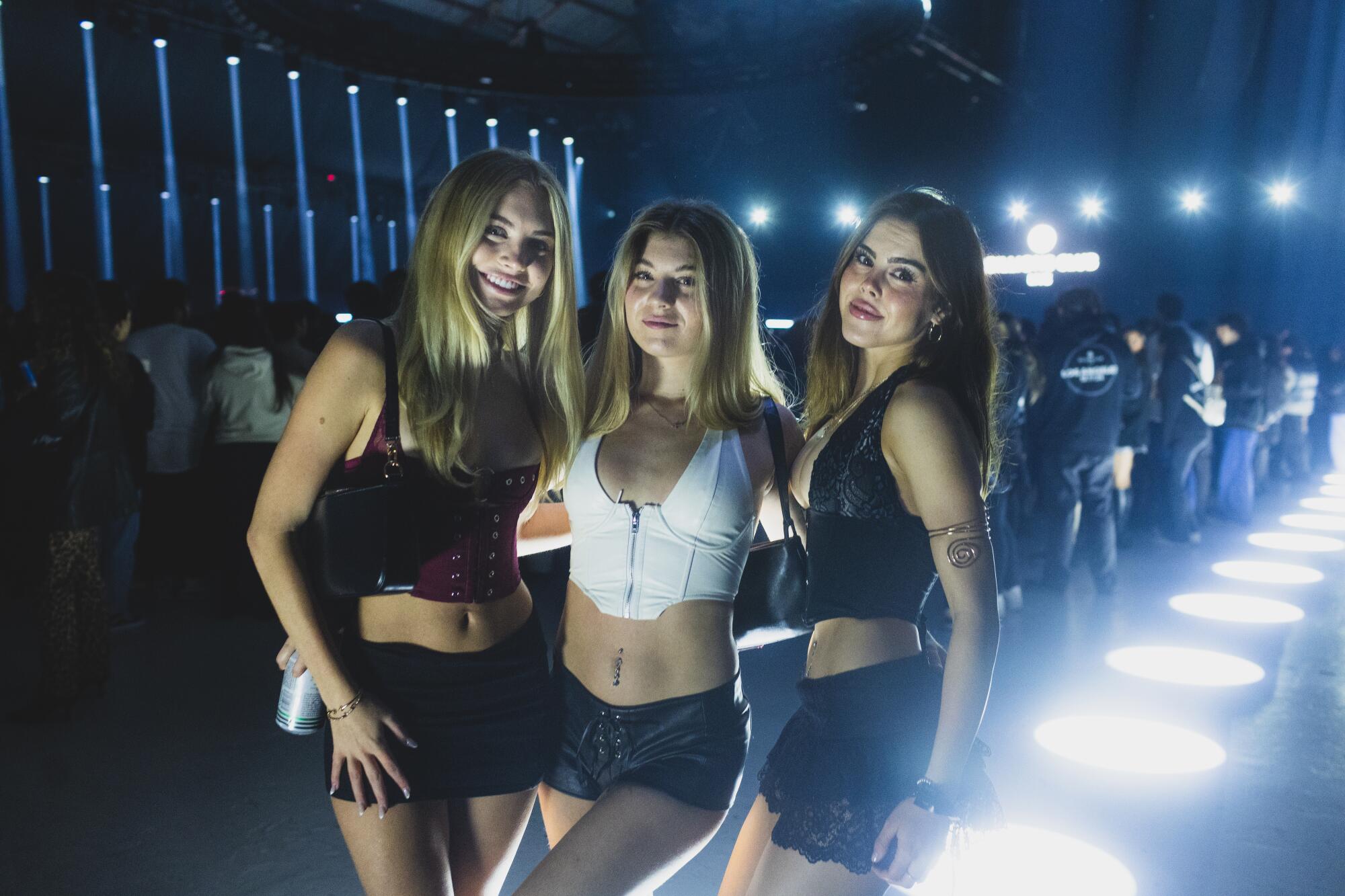
Grace Chandler, left, Jessie Sheridan and Isabella Elsesser were among the nearly 2,000 fans who were invited to attend the Weeknd’s Spotify show.
(Jason Armond/Los Angeles Times)
Grace Chandler, Jessie Sheridan and Isabella Elsesser
Age:
Chandler: 20
Sheridan: 20
Elsesser: 19
Neighborhood:
Chandler: Long Beach
Sheridan: San Luis Obispo
Elsesser: Long Beach
How long have you been a fan of the Weeknd?
Chandler: It had to have been when I was in the fifth grade when “The Hills” came out. Everyone was singing that song and I would play it 24/7 with my mom and my sister. Respectfully. It was just the beat. It just started from there.
Sheridan: Since the third grade. My sister put me on. I have no idea what album it was, but that was my life. I’ve been singing his music since the third grade. He will always and forever be my guy.
Elsesser: I heard about him from “The Hills” but it was the Echos Remix. There’s a woman who sings it in a house, dubstep kind of way and I was always into dubstep. I was like, “Yes. Yes. I love this.”
What’s your favorite song by the Weeknd?
Chandler: “Stargirl Interlude” and “Save Your Tears.”
Sheridan: “Stargirl Interlude.”
Elsesser: “The Morning” [starts singing song]. It’s empowering. I feel like I’m the girl. I’m like “Yeah, I’m the money. I’m the motive.” I also love “São Paulo” with Anitta. It’s so fire.
How does it feel to be at this exclusive show?
Chandler: Unreal!
Sheridan: So exciting.
Elsesser: I’m excited to dance.

Zachary Cutting, 37, of Belmont, Calif., wears an exclusive hoodie from the Weeknd’s Spotify Billions Club performance on Tuesday.
(Jason Armond/Los Angeles Times)
Zachary Cutting
Age: 37
Neighborhood: Belmont, Calif.
How long have you been a fan of the Weeknd?
I was doing security at the Fonda Theatre, but he wasn’t popular yet. I heard him performing. He did the “Dirty Diana” song and I liked that, so from then on, I followed his career and I’ve been a fan ever since.
What’s your favorite song by the Weeknd?
“Is There Someone Else?” Sometimes I be wondering… with the person I’m talking to, like, “Is there someone else?” [laughs]
How does it feel to be at this exclusive show?
I’ve only seen him perform that one time, so I’m excited.

Carmen Flores, 25, and Marco De La Cruz, 26, of Maywood arrived at the Barker Hangar early so they could attend the Weeknd’s Billions Club show with Spotify.
(Jason Armond/Los Angeles Times)
Carmen Flores and Marco De La Cruz
Age:
Flores: 25
De La Cruz: 26
Neighborhood: Maywood
How long have you been a fan of the Weeknd?
Flores: I think I was in middle school. My sister asked if I ever heard of his music.
De La Cruz: Around 2015-2016, probably during the “Trilogy” era.
What’s your favorite song by the Weeknd?
Flores: “Faith.” First of all, I think it’s a very fun song. Just meaning of faith and how it transitions into [the next song, “Blinding Lights”]. It’s very underrated.
De La Cruz: “After Hours.” Just the whole production on that song and his vocals.
How does it feel to be at this exclusive show?
Flores: It means everything. But I will be seeing him again next month and I also saw him with Mike Dean on March 1 at the Wiltern when he came out with Travis Scott and it was the best thing ever.

David Reyes, 19, of Riverside became a fan of the Weeknd after his sister put him onto the pop star’s “Starboy” album.
(Jason Armond/Los Angeles Times)
David Reyes
Age: 19
Neighborhood: Riverside
How long have you been a fan of the Weeknd? My sister put me on when “Starboy” came out. She always played it.
What’s your favorite song by the Weeknd?
“Die For You” for sure. It’s just a classic. 10/10.
How does it feel to be at this exclusive show?
It’s very unique how Spotify and Abel are doing this for his fans. It’s just cool how artists actually care for their fans.
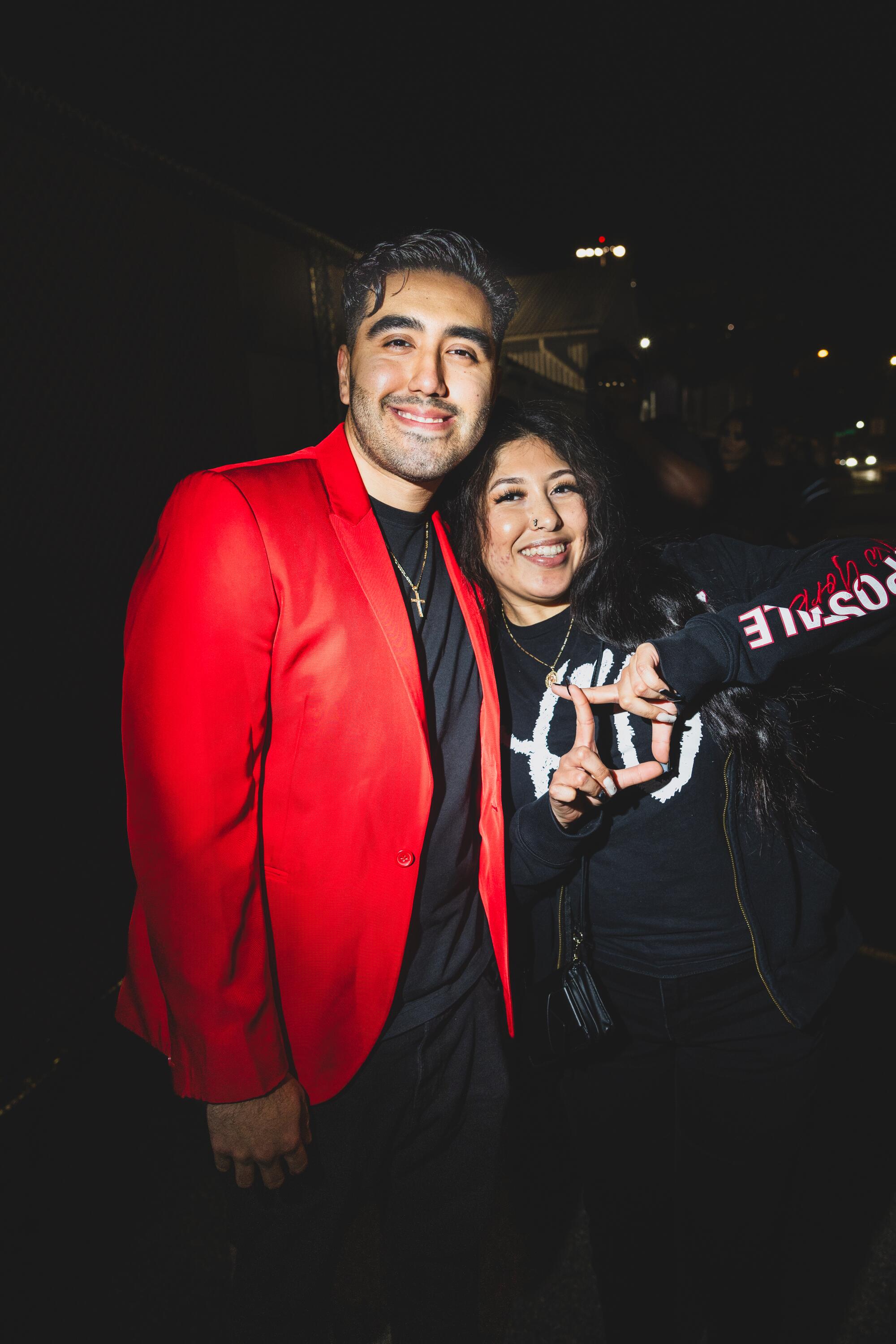
Catherine Carrasco, 25, and Jonathan Serna, 26, were among the first fans in line at the Weeknd’s exclusive Billions Club show put on by Spotify.
(Jason Armond/Los Angeles Times)
Jonathan Serna and Catherine Carrasco
Age:
Carrasco: 25
Serna: 26
Neighborhood:
Carrasco: Santa Ana
Serna: Santa Ana
How long have you been a fan of the Weeknd?
Carrasco: In 2015. I was a sophomore in high school. I think the first song that I listened to by him was “The Morning” and I got introduced to his music by an ex-boyfriend. [laughs] I got this hoodie a while ago and then his first concert I went to was the “Starboy” [tour].
Serna: When “Starboy” released, I kept listening to it on repeat like crazy. After that, I listened to everything he’s made and I became a fan. I wasn’t a big fan until “After Hours” [though].
What’s your favorite song by the Weeknd?
Carrasco: That’s such a hard question. I think “The Birds Pt. 1” and Pt. 2. I love every song by him, but I have those on repeat. He’s No. 1 on my Spotify Wrapped every year.
Serna: “After Hours.” He was No. 1 on my Wrapped.
How does it feel to be at this exclusive show?
Carrasco: I’m like shaking. I’m excited. I’ve seen him a couple of times, but this is a free event.
Serna: It’s amazing. I didn’t think I was going to get it. When I got the [email], I just went on break at my job. They gave you like 20 minutes to respond and I know she would’ve killed me if I didn’t.
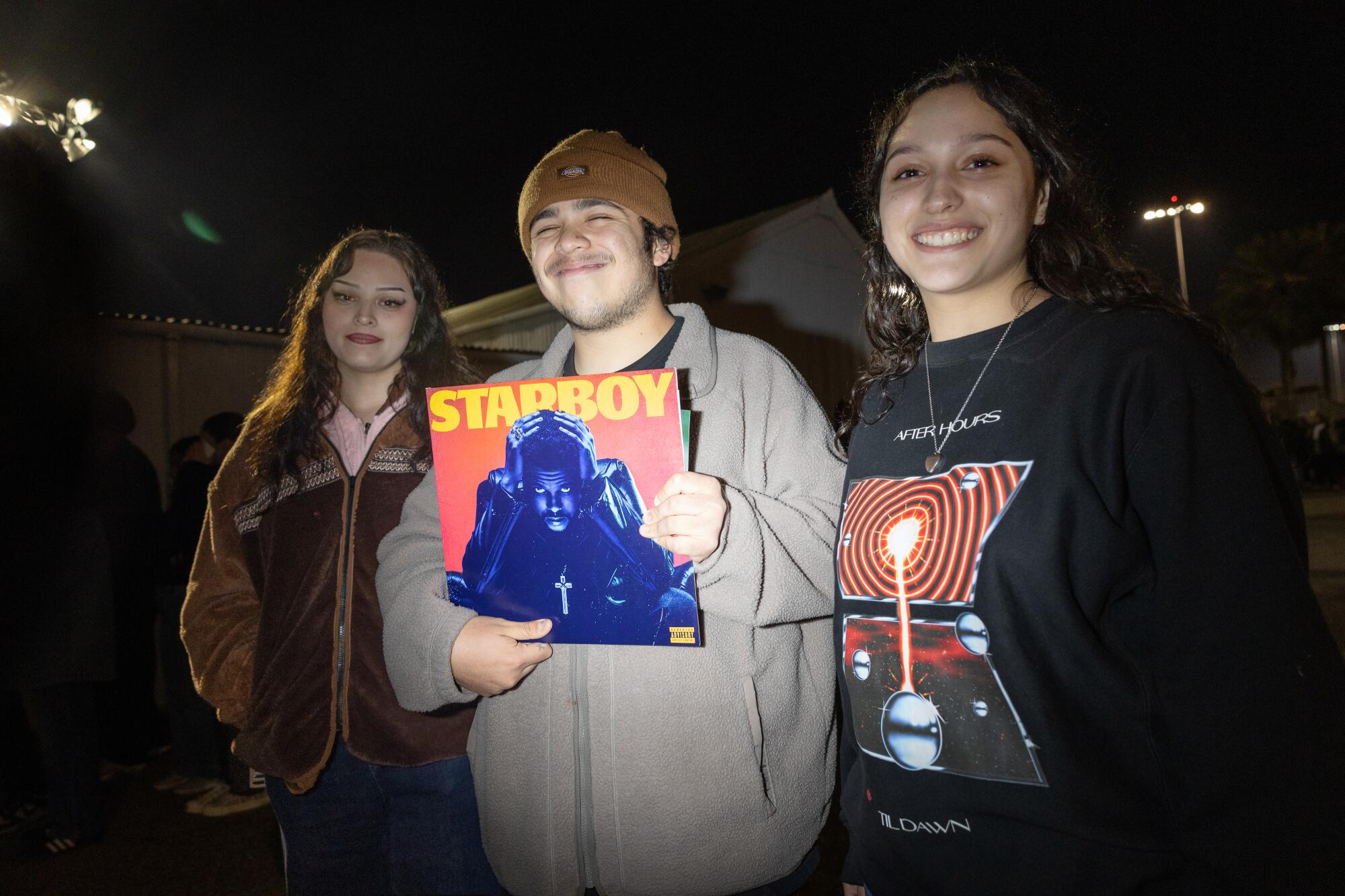
Katherine Martinez, left, Jorge Martinez and Angelina Bomar flew to L.A. from New Jersey for the chance to attend the Weeknd’s Spotify show.
(Jason Armond/Los Angeles Times)
Jorge Martinez
Age: 20
Neighborhood: We live in Newark, N.J. I saw a couple of TikToks like two days ago about the Spotify event. Unfortunately, we’re on Apple Music so we didn’t get the invite, but I was like maybe Abel might stop and sign our vinyl. She has on her “After Hours” hoodie. We came here for the SoFi show in November for the three-year anniversary. [Then we came back for this], so we traveled a long way.
How long have you been a fan of the Weeknd? I’ve been a big fan since “After Hours” came out. It was really good. It was a dream seeing him in concert [at his recent show]. The next dream is hopefully meeting him.
What’s your favorite song by the Weeknd?
“After Hours.” The way it slowly transitions to the beat drop — I like the 808s.
You flew out to L.A. just for the chance to see the show even though you don’t have tickets. Why was it important to you?
It would mean a lot for us to make it inside of the show or even to meet him, that would be amazing too. We’re planning to maybe fly out to the Rose Bowl show. But we got to try it out.
[Unfortunately, Jorge, his girlfriend and sister didn’t make it inside of the show because they didn’t have tickets.]

Movie Reviews
Bandar Movie Review: Bobby Deol roars in Anurag Kashyap’s unsettling legal thriller that refuses to spoon-feed

Name: Bandar
Director: Anurag Kashyap
Cast: Bobby Deol, Sanya Malhotra, Sapna Pabbi, Saba Azad, Jitendra Joshi, Raj B Shetty
Writer: Sudip Sharma, Abhishek Banerjee
Rating: 3.5/5
Plot:
Bandar follows Sameer Mehra’s character, essayed by Bobby Deol, a fading star who is desperately clinging to his past glory. Just as he attempts to rebuild his life and finds solace in a new relationship, his world comes crashing down. A former girlfriend files a heinous allegation against him, dragging him into a vicious, high-profile legal battle. Written by Sudip Sharma and Abhishek Banerjee, the film moves away from standard Bollywood courtroom setups. Instead, it dives straight into the murky waters of social media trials, public perception, and a sluggish judicial system where the truth gets buried under layers of gray.
What works:
Known for his chaotic energy, Anurag Kashyap takes a remarkably mature and controlled approach here. He avoids sensationalizing a highly sensitive topic, choosing instead to focus on the psychological claustrophobia of the protagonist. The prison sequences are exceptionally well-shot. They create a suffocating, raw atmosphere that makes you feel the weight of the character’s confinement. The script successfully avoids preachy, black-and-white monologues. It bravely forces the audience to confront their own biases regarding modern-day public trials and the digital judge-and-jury culture.
What doesn’t:
Clocking in at nearly two hours and twenty minutes, Bandar feels heavily weighed down in the second half. The narrative stretches thin, and a few subplots demand too much patience, making you wish for a tighter edit. The film stubbornly refuses to take a definitive moral stance or offer a neat resolution. While film enthusiasts might appreciate the complexity, mainstream viewers looking for a clear-cut ending or emotional payoff might walk away feeling detached and frustrated.
Performances:
- Bobby Deol is the beating heart of this film. Stripping away the massive macho swagger and menacing villainy of his recent hits, he delivers a deeply vulnerable, understated performance. He plays Samar with a mix of arrogance, confusion, and raw helplessness, proving his immense range.
- Sanya Malhotra anchors her screen time with her trademark reliability, turning in a grounded and impactful performance.
- Saba Azad and Sapna Pabbi excel in their respective roles, bringing genuine nuance to characters that could have easily been sidelined.
- Jitendra Joshi is an absolute scene-stealer, commanding your attention every single time he steps into the frame.
- Indrajith Sukumaran and Raj B Shetty are absolute show stealers with their raw acting.
Final Verdict:
Bandar is an unsettling, morally complex thriller that refuses to spoon-feed its audience. It isn’t a comfortable watch, nor does it try to be. While the sluggish pacing in the second half prevents it from being an absolute masterpiece, it is worth a watch for Bobby Deol’s spectacular acting reinvention and Anurag Kashyap’s gritty, thought-provoking storytelling.
Disclaimer: The views and opinions expressed in this article are solely those of the author and do not reflect the official policy or position of Pinkvilla. No statement in this article is intended to defame, harm, or malign any individual or entity.
ALSO READ: Maa Behen Movie Review: Madhuri Dixit, Triptii Dimri, and Dharna Durga save a slow-burning mystery
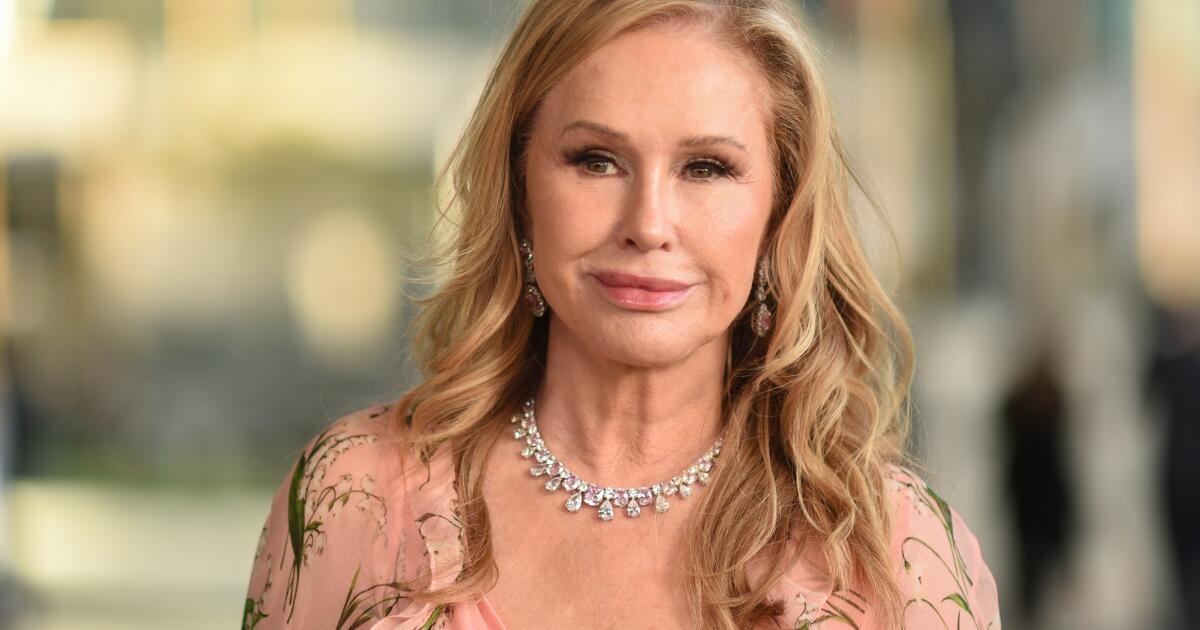
Kathy Hilton will no longer be the grand marshal of West Hollywood’s pride parade.
The city and WeHo Pride on Wednesday released a joint statement, announcing that “The Real Housewives of Beverly Hills” star would no longer serve as the Grand Marshal Icon for the 2026 WeHo Pride Parade. The event is scheduled for Sunday.
“After thoughtful discussions, the City of West Hollywood, the WeHo Pride production team, and Kathy Hilton have determined that the 2026 WeHo Pride Parade will not designate a Grand Marshal Icon honoree,” read the statement.
The decision comes less than a week after Hilton was announced. That May 28 announcement was met with swift backlash from the LGBTQ+ community and allies, who called out Hilton’s ties to President Trump and alleged MAGA-leaning politics. Critics also cited accusations that the socialite had used a homophobic slur while on a trip with other cast members of “The Real Housewives of Beverly Hills,” an action she has previously denied.
In their joint statement, West Hollywood and the WeHo Pride team expressed their appreciation for “the respectful and sincere dialogue” around both the event and the “role and significance” of Pride honorees.
“The City of West Hollywood has always believed that Pride belongs to the community,” the joint statement said. “Since its earliest days, Pride has served as both a celebration and a platform for activism, visibility, resilience, and the ongoing pursuit of equality, dignity, and justice for LGBTQ+ people. … These conversations reflect the passion people have for WeHo Pride and underscore the importance of ensuring that WeHo Pride continues to honor the history, values, and diverse voices of the LGBTQ+ community.”
In a statement, Hilton expressed gratitude for being considered for grand marshal and reaffirmed her commitment to the LGBTQ+ community and causes.
“My reason for wanting to be involved in this year’s WeHo Pride weekend was simple: to celebrate, support, and share in the joy of a community that means a great deal to so many people,” Hilton said. “Pride is, and always will be, about celebrating and uplifting LGBTQ+ voices, experiences, and achievements. … My support for the community and WeHo Pride is unwavering.”
She also mentioned several queer advocacy organizations and events she has supported over the years, including GLAAD, the Elton John AIDS Foundation, the Elizabeth Taylor AIDS Foundation, Dr. Mathilde Krim, God’s Love We Deliver and Project Angel Food.
The latest Pride-related dust-up follows the abrupt cancellation of the Long Beach Pride Festival in May. The city’s Pride Parade took place as planned.
Both snafus have occurred as conservative politicians and advocates continue to attack LGBTQ+ rights and visibility nationwide. Some Republican governors have even pushed for conservative alternatives to Pride month festivities. A recent Gallup poll has found that after years of steady gains, support for marriage equality and same-sex relationships has slipped, particularly among Republicans.
Movie Reviews
Movie Review: Travolta’s “Propeller: One-Way Night Coach” is One for the Ages — All Ages

Back in the good ol’days — the ’90s — John Travolta would love to get off the topic of “Michael,” “Pulp Fiction” or “Get Shorty” in interviews with film journalists like me and regale us with how utterly besotted he had been with his first flying experience, how that drove his passion for piloting and buying planes and airfield-adjacent luxury houses.
He didn’t even seem to mind having to move house when this or that development balked at him flying his Boeing 707 out of there on the way to locations.
Travolta would tell any journalist who asked that he was writing a kid-friendly book, “Propeller: One Way Night Coach,” based on his first flights as a child in old propeller driven airliners — cheap red-eye overnight treks with too many connections for your average jet age traveller to tolerate.
I remember picking up the book when it came out later in the ’90s — at an airport gift shop — and thinking “Well, that’s as cute as I figured.”
And now, decades later and trapped in the B-movie hell of his post “Gotti” career, Travolta’s turned that cute book into the most delightful, fanciful and colorful bon bon of a movie.
“One Way Night Coach” is a child’s fantasy of flight and flying the way it used to be — with pristine, uncrowded, futuristic airports, an early ’60s era of jets and prop planes with over-uniformed stewardesses in white gloves, the days “Back before every Joe Sweatsock could wedge himself behind a lunch tray and jet off to Raleigh-Durham,” as Sideshow Bob memorably sneered on “The Simpsons’.”
It’s a fictionalized account of Travolta’s childhood about an only child (at least two Travolta siblings have bit parts in this movie) of a never-made-it/never-will actress/single-mom (Kelly Eviston-Quinnett) who indulges her aviation-obsessed eight-year-old with a cheap cross-country overnight flight.
Little Jeff (Clark Shotwell) will revel in almost every Idlewild to Pittsburgh to Dayton to Chicago to Kansas City to Denver and Los Angeles minute. He strolls into the cockpit to meet pilots, charms the stewardesses and checks out the sleeping bunks on the TWA Lockheed Super Constellation, loving even the delays if not the Chicken Cordon Bleu he’s offered on legs of the journey that offer a meal.
And as he’s an observant child, he comments (Travolta narrates) on his 50ish mother’s vamping and posing, her choice of cigarettes (Newports) and drinks, the solo traveling men whose attention she pursues and earns.
“I was her best audience,” adult Jeff remembers of the mother who’d read him plays as bedtime stories and delusionally hopes that this trip to Los Angeles might be her “big break” even though she’s pushing 50.
“Hollywood called,” she’d explain about their overnight cheap flight arrangements to ticket agents and crew. “They told me to take the next flight!”
At every turn, Jeff meets or sees kindness — stewardesses who indulge his many questions and bump them up to first class on the mostly-empty planes, a captain who fixes his toy model of a Constellation, a mentally ill flyer who flips out but is calmed by a flight attendant who isn’t overworked and frazzled in jet-powered tin-can jammed with Joe and Jane Sweatsocks who think nothing of traveling in their pajamas.
Normally, I cringe at pictures this reliant on voice-over narration. I recoil from stars who populate their picture with Sandler etc. offspring. But “Propeller” is unfailingly sweet and never cloying.
Sure, it’s fictionalized. But if you’ve followed Travolta’s life and career, a lot of him is in this — his raptoruous engagement with flying, an indulged child who developed a taste for fine food and creature comforts, a mother who was his guiding star as an actor.
I get why there are less adoring reviews than mine floating around “Propeller.” It’s unfailingly sweet. Mom’s man-hunting is seriously dated. This TWA tale is decorated with Gershwin’s majestic “Rhapsody in Blue” — United Airlines’ signature tune. And Travolta’s been around long enough for recent generations to come up and not feel a connection to the “Saturday Night Fever/Get Shorty” star whose career has fallen off and life has been visited by too much tragedy.
But I’d hate to be seated next to anybody who doesn’t appreciate this adorable, pristine and nearly perfect aviation fantasy on any flight, much less an overnight one.
Rating: TV-PG
Cast: Clark Shotwell, Kelly Eviston-Quinnett, Ellen Travolta, Ella Beau Travolta, Olga Hoffmann and John Travolta.
Credits: Scripted and directed by John Travolta, based on his book. An Apple TV+ release.
Running time: 1:01

-

 New Jersey3 minutes ago
New details on plane collision on New Jersey Turnpike
-

 New Mexico6 minutes ago
New Mexico sues Kalshi over allegedly allowing unlawful sports betting
-

 North Carolina11 minutes ago
Mom driving 111 mph crashes car with 3 kids inside, 2 killed, one in critically injured, NCSHP says
-

 North Dakota18 minutes ago
Armstrong applauds federal funding for upgrading coal infrastructure, including Antelope Valley Station
-

 Ohio21 minutes ago
Ohio freezes new behavioral health provider applications amid fraud concerns
-

 Oklahoma26 minutes ago
Oklahoma House Democratic leader reflects on final session, calls for focus on cost of living
-

 Oregon33 minutes ago
Oregon resumes SNAP renewal interviews as advocates warn more could lose benefits
-

 Pennsylvania36 minutes ago
Pennsylvania hunting licenses to soon go on sale

