Montana
Montana Supreme Court affirms decision in landmark youth climate case


What’s New
The Montana Supreme Court on Wednesday affirmed a landmark climate decision that declared the state was violating residents’ constitutional right to a clean environment by allowing oil, gas and coal projects without regard for global warming.
Why It Matters
The decision reinforces an August 2023 ruling by District Court Judge Kathy Seeley, who found that Montana’s practices violated its residents’ constitutional right to a “clean and healthful environment.”
This pivotal case, spearheaded by a group of young plaintiffs aged 6 to 23, represented a milestone for climate advocates seeking judicial intervention to compel governmental action on climate change.
What To Know
On Wednesday in a 6-1 ruling, the Montana Supreme Court upheld the August 2023 decision.
The court’s decision strikes down a state policy that prohibited the consideration of greenhouse gas emissions in granting permits for fossil fuel development.
The state had previously appealed the ruling by Seeley, and arguments were heard in July, in which the state argued that greenhouse gases released from Montana fossil fuel projects are minuscule on a global scale and reducing them would have no effect on climate change.
Thom Bridge/Independent Record/ AP
Chief Justice Mike McGrath dismissed the state’s argument that Montana’s emissions are insignificant on a global scale, likening the defense to an “everyone else is doing it” excuse.
McGrath wrote, “The right to a clean and healthful environment is meaningless if the State abdicates its responsibility to protect it.”
What Are People Saying
Melissa Hornbein, an attorney with the Western Environmental Law Center and attorney for the plaintiffs said, “With the ruling now in place, the Montana Supreme Court’s decision compels the state to carefully assess the greenhouse gas emissions and climate impacts of all future fossil fuel permits.”
Chief Justice Mike McGrath wrote for the majority: “Plaintiffs may enforce their constitutional right to a clean and healthful environment against the State, which owes them that affirmative duty, without requiring everyone else to stop jumping off bridges or adding fuel to the fire. Otherwise the right to a clean and healthful environment is meaningless.”
Republican Governor Greg Gianforte said in a statement that the state was still reviewing the decision, but said it will lead to “perpetual lawsuits that will waste taxpayer dollars and drive up energy bills for hardworking Montanans.
Pushback From State Leadership
The ruling has sparked a backlash from Gianforte, who criticized the court for what he described as judicial overreach. He warned the decision could invite an onslaught of lawsuits, increase energy costs for Montanans and hinder the state’s “all-of-the-above” energy strategy.
“This Court continues to step outside of its lane to tread on the right of the Legislature, the elected representatives of the people, to make policy,” he said in a statement. “This decision does nothing more than declare open season on Montana’s all-of-the-above approach to energy, which is key to providing affordable and reliable energy to homes, schools, and businesses across our state.”
Gianforte also convened energy stakeholders earlier this week to discuss boosting production to meet rising demand, emphasizing the need for “unleashing American energy” to maintain grid stability.
The Plaintiffs’ Perspective
For the 16 young plaintiffs, the court’s decision validates their personal struggles with the tangible effects of climate change. In a Wednesday statement, lead plaintiff Rikki Held called the ruling “a victory not just for us, but for every young person whose future is threatened by climate change.”
During the trial, the plaintiffs described how worsening wildfires, droughts and diminishing snowpack have disrupted their lives, polluted the air and depleted vital natural resources. They argued that the state’s failure to address these challenges imperils their future and violates their constitutional rights.
What Happens Next
The ruling has positioned Montana as a flashpoint in the national debate over climate accountability, potentially inspiring similar legal challenges across the United States.
This article includes reporting from The Associated Press.



Montana
Montana Supreme Court Decides International Child Custody Case – Transnational Litigation Blog

Image by Clker-Free-Vector-Images from Pixabay
The Uniform Child Custody Jurisdiction Enforcement Act discourages forum shopping in child custody disputes by assigning subject-matter jurisdiction to the court located in the “home state” of the child. In Allen v. Allen, decided on April 21, 2026, the Montana Supreme Court had to determine whether the child’s “home state” was Montana or the Netherlands. This case shines an important spotlight on the importance of timing in international child custody disputes. The left-behind parent’s likelihood of success is strongly correlated with how quickly he or she acts to vindicate their legal rights.
Facts
Jonathan Edward Allen (Father) and Petronella Gerline (Van Oosterom) Allen (Mother) were married in Colorado in 2009. Father is a United States citizen. Mother is a dual citizen of the United States and the Netherlands. Their child (R.A.A.) was born in 2015. In 2020, the family moved from Colorado to Montana.
In August 2023, after Father and Mother began having marital difficulties, Mother and R.A.A. relocated to the Netherlands. In February 2024, Mother filed a petition for divorce and custody with the District Court of Central Netherlands (Netherlands District Court).
In January 2025, Father filed a petition with the District Court of The Hague seeking the return of R.A.A. pursuant to the Hague Convention on the Civil Aspects of International Child Abduction. This petition was denied. Although the court held that R.A.A. had been wrongfully removed from the United States, the court reasoned that the one-year automatic return period had passed and that R.A.A. had become settled in her new environment in the Netherlands. This decision was affirmed on appeal.
In September 2025, Father filed an Emergency Motion for Temporary Custody and Petition for Permanent Parenting Plan in Montana state court. That court dismissed the petition on the grounds that it lacked subject-matter jurisdiction. Specifically, it held that it lacked the power to adjudicate the dispute because Montana was no longer the “home state” of R.A.A. Father, acting pro se, appealed to the Montana Supreme Court.
Analysis
The Uniform Child Custody Jurisdiction and Enforcement Act (UCCJEA) assigns exclusive subject-matter jurisdiction to courts located in the child’s “home state” when it comes to matters relating to child custody. The “home state” is “the state in which a child lived with a parent or a person acting as parent for at least 6 consecutive months immediately before the commencement of a child custody proceeding.” The UCCJEA specifically provides that courts “shall treat a foreign country as if it were a state of the United States” for purposes of resolving these disputes.
On the facts presented in Allen v. Allen, the Montana Supreme Court correctly held that it lacked subject-matter jurisdiction to consider Father’s emergency motion. Mother and R.A.A. relocated to the Netherlands in August 2023. Six months later—in February 2024—R.A.A.’s home state shifted to the Netherlands. The Dutch courts—rather than the Montana courts—now had exclusive subject-matter jurisdiction to resolve custody disputes involving R.A.A. Father did not file his motion in Montana until September 2025, which was nineteen months too late.
Conclusion
If Father had filed his suit in Montana before February 2024, he could have shown that Montana was R.A.A.’s “home state” because the child had not yet resided in the Netherlands for six months. The suit was, however, not filed until September 2025.
If Father had filed suit in the Netherlands before August 2024, he could have argued that R.A.A. should be returned to the United States pursuant to the Hague Convention on the Civil Aspects of International Child Abduction because the child had not yet resided in the Netherlands for a year. The suit was, however, not filed until January 2025.
The key takeaway of Allen v. Allen is the need for speed in international child custody cases. The timelines baked into the relevant laws and treaties mandate that the left-behind parent move quickly to assert their rights. If they are slow off the mark, they be forced to litigate in foreign courts under less favorable legal rules.

MISSOULA, Mont. — The Clark Fork River has long been a defining feature of Missoula, shaping the city’s culture, economy and outdoor lifestyle.
The river is so closely tied to the area that it helped inspire the well-known book and film “A River Runs Through It.” But local conservation advocates say its importance goes far beyond scenery.
“Without the Clark Fork River, Missoula would just be another town,” said Lisa Ronald, Northern Rockies associate conservation director for American Rivers. “We wouldn’t be the River City. I think we’re known in Montana as Missoula the River City, and it’s really because of the Clark Fork River and its central role in business, in economics, in recreation, that really makes Missoula the town that it is.”
Carmen Murill, a field organizer with Wild Montana, said the river is deeply woven into daily life for people who live in Missoula.
“A lot of us would wonder what to do on a beautiful or a rainy summer day,” Murill said. “I mean, it’s really a lifeforce of town. And I think it’s pretty unique that Missoula, as a community is living and breathing on both sides of the river. It’s really like two downtowns but connected by the Clark Fork.”
Conservation groups say protecting the river begins with community involvement.
Advocates encourage residents and visitors to spend time outdoors, whether on a trail, in the woods or along the river, and to learn how they can become better stewards of the environment.

MISSOULA — Sam Forstag edged out Ryan Busse to secure the Democratic nomination in Montana’s 1st Congressional District.
Busse conceded the race to Forstag on Wednesday morning. Forstag had trailed behind Busse Tuesday evening, but he made up ground as the votes were counted into the early hours of Wednesday morning. The other two candidates in the race, Russl Cleveland and Matt Rains, are sitting at third and fourth, respectively.
Forstag leads in close race for Montana’s 1st Congressional District
Forstag spent eight years as a wildland firefighter, including four as a smokejumper, and he’s been vice president of the local National Federation of Federal Employees union. Last week, U.S. House of Representative Alexandria Ocasio-Cortez, D-New York, held a rally in Missoula to support Forstag’s campaign.
He told MTN on Tuesday that his campaign has been for the working class.
“We got a whole lot of people here that have been working their tail off to finally get some working-class representation in Washington,” Forstag noted. “So proud of everything we’ve done and so grateful.”
Forstag further noted he wants Montanans to be able to afford groceries, have universal free childcare and restore and expand Affordable Health Care Act subsidies.
“Hearing people’s stories and struggles and commonalities in the ways that we’re all fighting in the system that does not serve us so often, and the government serves corporations and the richest people in this country more than working people. It has been frustrating and saddening, but it has also inspired so much hope in me, like the fixes we can actually make,” he told MTN.
The 1st Congressional District covers much of western Montana, including Kalispell, Missoula, Butte and Bozeman. It is currently held by Rep. Ryan Zinke, R-Montana, who chose not to seek reelection.
By securing the nomination, Forstag is slated tol face off against Libertarian candidate Nick Sheedy and Republican candidate Aaron Flint in November.
-

 Los Angeles, Ca36 minutes ago
Overnight military training brings loud flash bangs, simulated gunfire to quiet Pasadena neighborhood
-

 Detroit, MI58 minutes ago
Detroit Lions add UDFA rookie WR during OTAs
-

 San Francisco, CA1 hour ago
How to watch San Francisco Giants vs. Milwaukee Brewers
-

 Dallas, TX1 hour ago
3 different Cowboys 53-man roster projections pinpoint contested roster spots
-

 Miami, FL1 hour ago
Jeff Hafley suggests Miami Dolphins entertain Malik Willis Tush Push
-

 Boston, MA1 hour ago
Karen Read sues the police agencies that investigated her Boston police boyfriend’s death
-
 Denver, CO1 hour ago
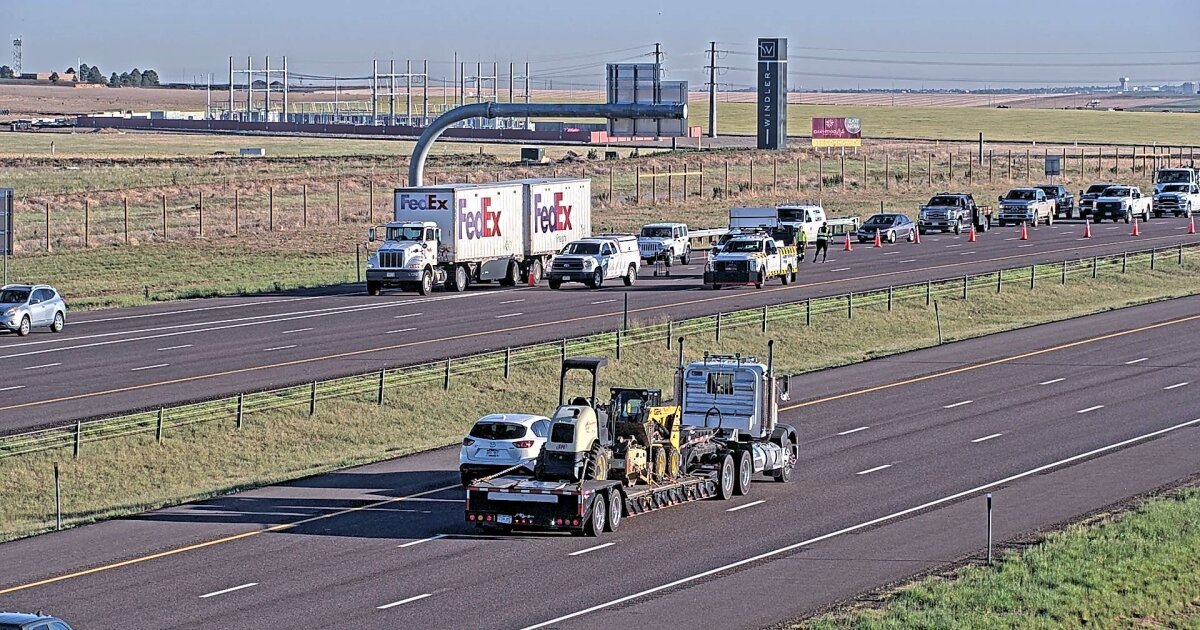
Pedestrian dies after hit by car on southbound E-470, Aurora police say
-

 Seattle, WA2 hours ago
Seattle paying $2.6M to settle sexual harassment lawsuit filed by four female SPD officers – MyNorthwest.com

