Utah
Can Utah football end its season on a positive note at UCF?


This article was first published in the Ute Insiders newsletter. Sign up to receive the newsletter in your inbox each Wednesday night.
The final game of the 2024 regular season is here.
For the University of Utah, there’s almost a sigh of relief that this year will soon be behind them.
Utah started the year with hopes of the College Football Playoff, but will end the season in Orlando with a losing record — just the third of the Kyle Whittingham era.
There was never an answer at the quarterback position after Cam Rising suffered a finger injury in Week 2 that kept him out for three games, then suffered a season-ending leg injury in Week 6.
Isaac Wilson, a true freshman, was placed in an unfortunate position by having to start the majority of the games, and he just wasn’t ready yet. After suffering an injury against Iowa State that will keep him out for the finale, Wilson finished his first collegiate season with 167.8 passing yards per game (No. 98 in the nation), a 56.4% completion percentage (102), 10 passing touchdowns (103), and 11 interceptions.
Brandon Rose provided a spark against BYU, but suffered a Lisfranc injury. Sam Huard, who was QB4 and never saw the field, also suffered a season-ending injury.
Another year of below-par quarterback play and a run game that stagnated near the end of the season, partly because opponents were able to key in on the run due to the ineffective passing game, doomed Utah to one of its most disappointing seasons in program history.
Losers of seven straight, the only thing left to play for in Orlando is the chance to break a lengthy losing streak and head into the 2025 season on a somewhat positive note.
“Super important. I think even it carries momentum going forward with the boys in the spring ball and winter conditioning. I think ending on a good note is huge for momentum moving forward,” senior linebacker Karene Reid said.
Due to the aforementioned quarterback injuries, Utah is down to QB5, Luke Bottari, for the Black Friday matchup at UCF (6 p.m. MST, Fox).
In a quarter-and-a-half of action last week, Bottari surprised Iowa State with his legs, rushing for 56 total yards on a 10-play, 91-yard drive that gave the Utes a 28-24 lead with 5:51 remaining. He drove Utah to the Iowa State 36-yard line, but couldn’t advance the offense further, setting up a 54-yard field goal that Cole Becker missed.
“For a guy that started the season as the fifth-string guy and really didn’t have a whole lot of chance to play, just continued to keep himself ready every single week in case,” Whittingham said. “And last week was the week that he got his opportunity and really did some good things. He came in and really provided the spark for us. And so that was good to see Luke do that.”
There’s a lot of similarities between Utah and UCF this season, starting with the identical records — 4-7. The Utes won’t be going bowling for the first time since 2013, while the Knights are missing a bowl for the first time since 2015. Both schools have suffered lengthy losing streaks — Utah losing seven in a row and UCF losing five in a row, beating Arizona, and losing its last two — are are desperate to end the season on a positive.
Both programs have had their fair share of quarterback difficulties — Utah’s have been well-documented, while UCF has used three quarterbacks this season.
The Knights started the year with KJ Jefferson, who played in five games before being benched in favor of Jacurri Brown. During UCF’s 37-24 loss to BYU, Brown was sent to the pine and redshirt freshman Dylan Rizk finished out the contest.
Since then, it’s been Rizk as the starter. He’s thrown for 797 yards, five touchdowns and an interception on 68% accuracy.
The star of UCF’s productive offense is running back RJ Harvey, who has rushed for 1,458 yards — fourth-best in the country — and 21 touchdowns. He will be a handful for Utah’s defense to try and contain.
UCF leads the Big 12 in yards per game with 454 and is scoring 31.9 points per game.
“It’ll be a challenge for our defense this week to face that, particularly that rushing attack,” Whittingham said.
Defensively, UCF is in the middle of the Big 12 pack statistically in terms of total yards allowed per game (352), but have generally been stout against the run, allowing just 123.5 rushing yards, though BYU and West Virginia were recently able to eclipse 200 yards on the ground against the Knights.
While Bottari was 5 for 9 for 55 yards through the air against Iowa State, the game plan for the Utes is going to try and find success on the ground first — something they haven’t done consistently in their last two games.
It’s the final game in running back Micah Bernard’s college career, and aside from contributing to a win, he’s trying to rush for 78 more yards, which would put him at 1,000 on the year.
“Man, I’m trying to check it off. I’m trying so hard to check it off. Lack of production lately, but 78 yards to go, I believe. I mean, I need to do it. I got to,” Bernard said.
Before the season, a cross-country trip on a short week — the Utes will fly to Orlando on Thanksgiving — was always going to be a challenging contest. Even though UCF’s season hasn’t gone the way the Knights imagined it would, this is still going to be a tough one for the Utes, who are currently 10-point underdogs, to win if they want to break the seven-game losing streak.
In case you missed it
Kyle Whittingham has a decision to make at the end of his 20th season as Utah’s coach. Whittingham will assess his future with the program following the season finale at UCF on Friday, but says he will do what’s best for the program, not what’s best for him.
From the archives
Extra points
- A new era, a thrilling finish: How Utah won Gavin Petersen’s unforgettable head coaching debut (Deseret News)
- Utah’s pick-six streak extends to an NCAA-record 21 consecutive years, but is little more than a footnote for team embroiled in seven-game losing streak (Deseret News)
- Mark Harlan’s $40,000 fine was not paid out of university funds (Deseret News)



The Utah Jazz won their final summer league game against the Portland Trail Blazers 83-79. It was a fun game that came down to the wire, with a few Jazz players showing promise that could help the team.
The player who surprisingly didn’t help as much as you’d hope was Blake Hinson, who shot just 1/9 from three. Hinson was a sharpshooter for the Jazz last season, and it’s too bad that he couldn’t show that shooting stroke in the summer league. It’s likely not a big deal, but it would have been nice to see that shooting continue in the summer league. It does make you wonder why all the players who played for Utah last season, or will be getting regular minutes next year, didn’t shoot well in Las Vegas. Is that a trend? Or is it just a coincidence? It makes you wonder if the Jazz have been running hard practices, or if the players are tired from enjoying their time in Las Vegas? There’s no way to really know, but it’s interesting.
Utah’s strongest performer, in terms of plus-minus, was Bez Mbeng. He was a team-leading +14 and, even though he didn’t shoot the ball well either, his defense and intensity really shows on the floor. In this one, Mbeng had 4 steals and handled the ball for a lot of the game. He was also one of the top players in minutes with 20 in this one. I personally really like Mbeng and I’m rooting for him to make the team. I do think he can be a defensive-focused do-it-all player who could really contribute if he keeps improving.
Justin Harmon scored the ball well, leading the team in scoring with a team-leading 21 points. He had 6 free throws in this one and was a positive contributor overall. Harmon could be a nice addition to the training camp roster and, if he can show out, maybe he can earn himself a roster spot. He’s worth watching going forward at the very least.
And with that, the summer league is now over, and we now enter a long summer that will lead into one of the most exciting eras of Jazz basketball I can remember. It will be led by the best prospect in Jazz history to actually suit up for the Utah Jazz, and I can’t wait to see him develop into a superstar wearing the purple and blue.

Jon Anderson will be charged with moving the Orem school forward following the death of conservative commentator Charlie Kirk on campus last year.
(Bethany Baker | The Salt Lake Tribune) Incoming UVU President Jon Anderson poses for a photo with his family after an event announcing his selection at Utah Valley University in Orem on Friday, July 17, 2026.

BEAVER COUNTY, Utah — A massive community effort is underway as volunteers and Beaver County crews distribute thousands of sandbags to protect homes from the potential path of floodwaters.
After the Cottonwood Fires, residents have been waiting for weeks for relief to come in the form of rain, though officials now warn it may come all at once with an increased risk of flooding and debris flow.
Emergency Service Director Les Whitney believes that the fire has left plenty of debris to bring trouble for residents.
“We got a lot of water. We’re bringing debris with it, so tree branches, tree limbs, logs, lots of different size firewood, and that’s all in the creeks. We’re worried about that plugging up our bridges and stuff, so we have heavy equipment and excavators located in strategic places so that we can keep those bridges open,” said Whitney.
An estimated 140 homes and condominiums were spared from the flames, but remain in the paths of floodwaters.
Residents can also pick up sandbags at the Beaver County Sheriff’s Office or at the Beaver County Rodeo Fairgrounds.
-

 Kentucky7 seconds ago
Two-vehicle crash injures one in Pike County, Kentucky, troopers say
-
 Louisiana6 minutes ago
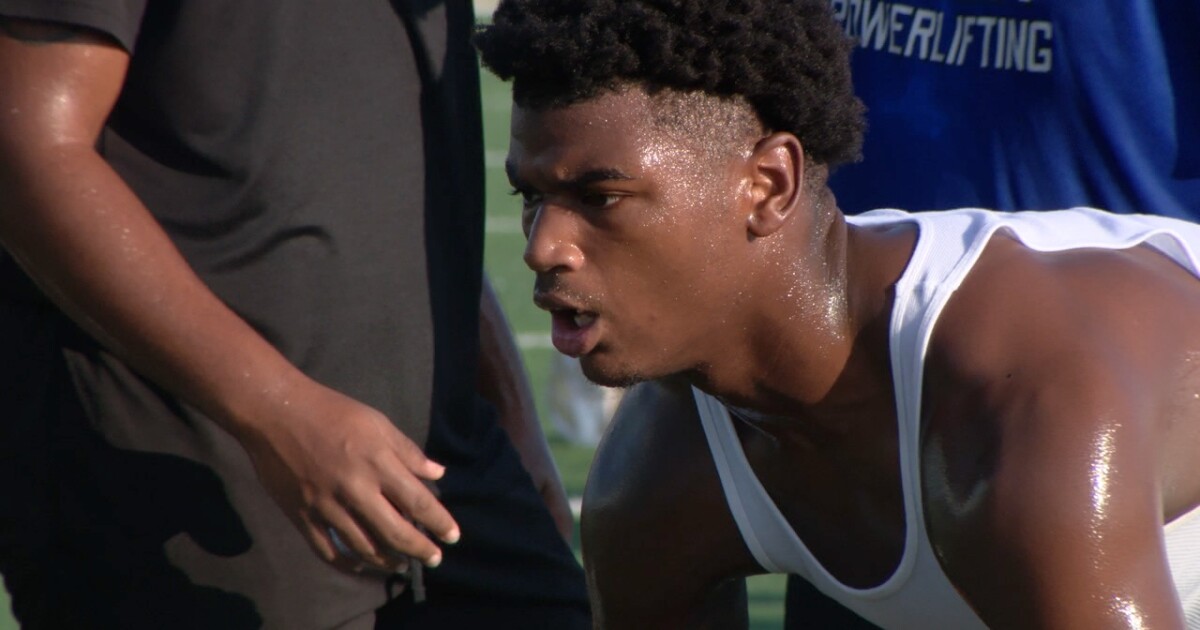
Lafayette Renaissance edge rusher Ansinneo Charles commits to Louisiana
-

 Maine12 minutes ago
Maine Trust announces 2 hires in Augusta, Waterville
-

 Maryland18 minutes ago
What Doesn’t Change in Chevy Chase, Maryland
-

 Michigan24 minutes ago
Huntington Bank to close 13 Michigan branches by the end of August — see full list here
-

 Massachusetts30 minutes ago
Massachusetts RMV under fire after illegal immigrant trucker kills state trooper
-

 Minnesota36 minutes ago
Thousands expected to attend Minnesota Yacht Club festival in St. Paul
-

 Mississippi42 minutes ago
Mississippi Lottery Mississippi Match 5, Cash 3 results for July 17, 2026

