South
Hurricane Helene forces North Carolina residents to sleep in tents where homes once stood

SWANNANOA, N.C. – Nearly a month after Hurricane Helene devastated areas of the Southeast and killed more than 250 people, North Carolina residents are sleeping in tents where their homes once stood, even as temperatures drop to the 30s at night.
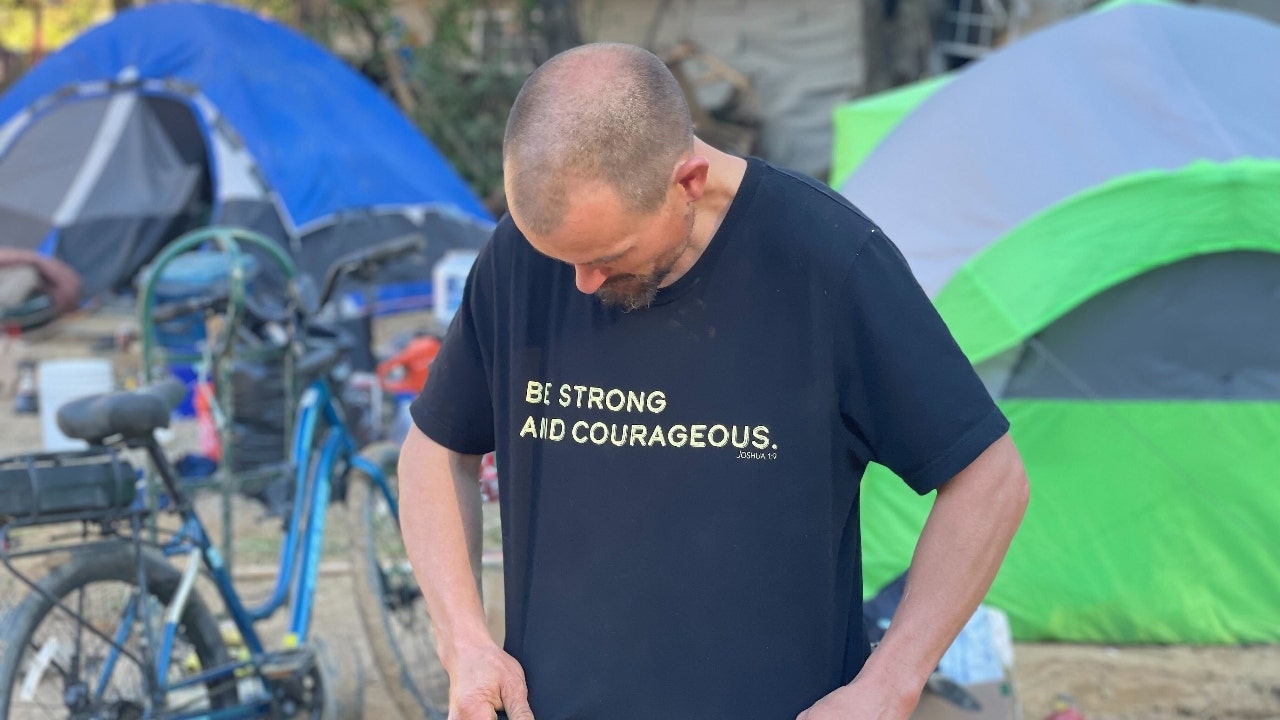
Kris Weil is one of several people in hard-hit Swannanoa sleeping in a tent with his dog outside his home, which was destroyed by intense flooding and winds on Sept. 27. Weil’s story is nothing short of a miracle.
Less than 24 hours before the storm struck the Appalachian Mountains, Weil’s 8-month-pregnant girlfriend was transported to the hospital because she was experiencing chest pain. Weil stayed home to prepare for the baby, at which point he started getting flood warnings on his phone, not knowing he’d soon be left with nothing.
Weil watched as water rapidly flooded his neighborhood and then made its way inside his home.
NC FAMILY THAT LOST 11 IN HURRICANE HELENE MUDSLIDES SAYS COMMUNITY SACRIFICED ‘LIFE AND LIMB’ TO SAVE EACH OTHER
Kris Weil is sleeping in a tent outside his home that was destroyed during Hurricane Helene. (Fox News Digital)
“The house completely got washed off its foundation, and we got sucked out the back window — with me and my friend and three dogs — and managed to survive long enough for a swift water rescue boat to come get us, just by chance, they had just showed up in town from Chicago, Illinois,” Weil told Fox News Digital. “They came and got us out of the tree with a rescue boat. And we’ve been staying in tents.”
The water that flooded Weil’s home forced him out a back window that had broken open. He was able to latch onto a vine attached to a tree in his backyard with one hand and hold onto one of his dogs with the other hand as water rushed through the area.
It wasn’t until nearly six hours later that a rescue boat from Cook County, Illinois, arrived and transported Weil and his friend to safety.
HURRICANE HELENE: ‘BACKBONE OF AMERICA’ HELPING FARMERS ACROSS SOUTHEAST WHO LOST BILLIONS IN CROPS, LAND
The water that flooded Weil’s home forced him out a window that had broken open. He was able to latch onto a vine attached to a tree in his backyard with one hand and hold onto one of his dogs with the other hand as water rushed through the area. (Fox News Digital)
“She would have been in that tree with me,” Weil said of his girlfriend had she not gone to the hospital before the storm hit.
For days, there was no cellphone service or Wi-Fi for Weil to contact his girlfriend, but when he eventually found a way to contact her, he learned she had been transported to UNC Medical Center in Chapel Hill where she delivered a healthy baby several weeks before her due date on Oct. 20.
RETIRED NORTH CAROLINA POLICE OFFICER DELIVERS THOUSANDS OF DOLLARS IN SUPPLIES, FOOD TO HELENE SURVIVORS
The couple named their baby Sage Nevaeh — her middle name being “Heaven” spelled backwards. (Kris Weil)
The couple named their baby Sage Nevaeh — her middle name being “Heaven” spelled backwards. Sage is expected to be released from the NICU soon, Weil said. His girlfriend qualified for a program offering her temporary free housing, and she and the baby are both doing well.
“There’s been some miracles.”
“The churches, the community, more than anything, have been some of the people who have helped the most. And it’s been inspiring to know that we’re not forgotten. The people are amazing,” Weil said. “Their willpower and their love for other people is amazing. … They come in here in force and brought us everything we need. And they weren’t going to leave until they knew we were all right.”
Kris Weil and his dog survived flooding during Hurricane Helene by holding onto a vine attached to a tree in his backyard. (Fox News Digital)
Volunteers donated several tents to Weil and his dog, as well as a bike, food, a camping stove and propane. Emerge Ministries was able to find someone to donate a car to Weil so he can visit his girlfriend and newborn.
Less than a mile from Weil, Dara Cody and her neighbor are sleeping in tents where their homes once stood in picturesque yards on the banks of the Swannanoa River.
“For whatever reason, I just couldn’t sleep that night,” Cody said of the night Hurricane Helene came through, adding that she kept “checking and checking” the water level of the river behind her home that she had lived in since 2010.
Less than a mile from Weil, Dara Cody and her neighbor are sleeping in tents where their homes once stood in picturesque yards on the banks of the Swannanoa River. (Fox News Digital)
“Something wouldn’t let me rest. I almost fell asleep several times, but something brought me back awake,” she explained. “But then at about 5 in the morning, I just couldn’t rest till I got up and went and looked. … It had jumped up about 12 feet in 30 minutes … and it was way higher up in my yard and way deeper.”
At that point, Cody woke her partner and told him, “You have to get up right now. We’re not going to make it if you don’t.”
HURRICANE HELENE: MORE THAN 90 REPORTED DEAD IN NORTH CAROLINA, 26 STILL MISSING
Volunteers with Emerge Ministries of North Carolina have been helping Dara Cody sort through debris after Helene. (Emerge Ministries)
They grabbed what personal items they could and fled their home, which is now a patch of dirt beside the river that came far up over its banks that morning, destroying homes, cars and land. The couple found shelter while Helene passed through the area, but when they returned to where their home once stood the next day, it was “completely gone.”
“Like, is this a dream? What is happening here? I just didn’t know how to feel,” Cody recalled.
PUPPIES RESCUED FROM HURRICANE HELENE TO BE REHOMED WITH MILITARY MEMBERS, FIRST RESPONDERS
What Dara Cody’s property looked like before Hurricane Helene. (Dara Cody)
“Our home, my car, everything was just completely gone. And the devastation — not just in my home — of the entire town was just absolutely heartbreaking and just beyond … there are no words,” she said. “It was shock. It was pain. It was hurt. It was just, my heart was broken for my whole town. I’ve lived here my entire life since I was born.”
“It was shock. It was pain. It was hurt. It was just, my heart was broken for my whole town.”
In the weeks since, Cody has been working to gather what remnants of her home she can. Volunteers from Emerge Ministries have been helping her clean and sort through debris. At night, Cody, her partner and their neighbor sleep in tents alongside the now-destroyed edges of the Swannanoa.
She added that she is a candidate for a tiny home “if the county will allow it.”
Volunteers from Emerge Ministries have been helping her clean and sort through debris. (Emerge Ministries)
“All the volunteers that have come here have just been beyond what we could ever imagine and have been more generous than we could ever imagine,” Cody said. “They have all done more for us than we ever imagined any people, especially strangers, would ever do for us. The outpouring of love and compassion and generosity and people giving … has just blown our minds. It’s unbelievable.”
“They have all done more for us than we ever imagined any people, especially strangers, would ever do for us.”
Shannon Martin Easley of Louisiana and Judy Norris of North Carolina are two volunteers with Emerge Ministries who have been helping Cody and others in the aftermath of Helene. The ministry has anywhere from 50 to 150 volunteers in the western North Carolina region “from all over the country” offering help “every day,” Easley said.
A car crushed between a house and a tree has a yellow “X” spray-painted on it, meaning authorities did not find anyone inside. (Fox News Digital)
“My uncle cleared a driveway for a man a few days ago, and he had not seen a human in 20 days,” Easley said. “How many more are just like him?”
Volunteers from Ohio and Maryland also spoke with Fox News Digital in Swannanoa.
Martha Hershberger and her husband, Roy, of Shekinah Christian Fellowship in Ohio, have been serving hot meals under a tent in a parking lot off the main road in Swannanoa. She estimates that she and other volunteers have been serving between 1,500 and 2,000 meals per day.
Martha Hershberger of Abba’s Heart Ministries International in Ohio has been serving hot meals under a tent in a parking lot off the main road in Swannanoa. She estimates that she and other volunteers have been serving between 1,500 and 2,000 meals per day. (Fox News Digital)
“We’ve dealt with several people who’ve lost their homes, and we’ve talked to some who have watched their neighbors drown and everything washed away,” Hershberger said. “We’ve talked to some who have their home. They lost power for a bit, but they’re all impacted with the trauma of it.”
HURRICANE EFFECTS POSE ‘TREMENDOUS’ HEALTH HAZARDS FOR AMERICANS, DOCTOR WARNS
Hershberger added that the people of western North Carolina will need “help for the long haul.”
Several volunteers from Maryland echoed that sentiment. Barbara Kaufman of A Lady and A Hop Maryland LLC, David Hawkins of Hawkins Landscaping and Michele Payton of Pulling for Veterans all came to Swannanoa from Frederick to deliver supplies and services to those in need. Kaufman said she traveled to the area to help people clean their damaged homes.
WATCH: Volunteers help Hurricane Helene survivors in North Carolina
“We need boots on the ground, hands to the plow,” Kaufman said. “These people here need help.”
CLICK HERE TO GET THE FOX NEWS APP
“Yeah, they shouldn’t be sleeping in tents,” Payton added.
A total of 26 North Carolinians remain missing in the wake of Helene. The storm caused widespread damage across seven states that will take years for some towns to recover from. Locals and volunteers compared Helene’s devastation to a war zone.

Maryland
Most Maryland sheriffs drop arrest agreements with ICE despite vows to fight a new state law – WTOP News

At least seven of the nine counties that had the so-called 287(g) agreements with Immigration and Customs Enforcement have pulled out of those plans.
Maryland sheriffs vowed to fight legislation, passed early in this year’s legislative session, prohibiting formal agreements between local police agencies and federal immigration officials, and giving sheriff’s departments 90 days to get out of any deal they were in.
But as the 90-day clock expires Monday, it turns out that at least seven of the nine counties that had the so-called 287(g) agreements with Immigration and Customs Enforcement have pulled out of those plans and an eighth said the agreement will not be enforced, even though it’s still on the books.
Most of the local departments dropped the 287(G) agreements either the same day or the day after Gov. Wes Moore (D) signed Senate Bill 245 and House Bill 444 into law Feb. 17. The emergency legislation took effect immediately upon his signature.
While they appear to have given up the 287(g) fight, however, sheriffs are still assessing a challenge to another immigration bill that passed during the waning hours on the last day of this year’s session: the Community Trust Act. It is one of several immigration enforcement bills the governor has yet to sign, with just one more bill signing scheduled for May 26.
The majority Democratic legislature and the supporters of the 287(g) ban argue it eliminates and distrust of police in communities where aggressive immigration tactics have been conducted and enforced by President Donald Trump (R) and his administration.
As of Sunday, according to ICE, the agency had 1,832 law enforcement agencies in 39 states and two U.S. territories signed on to participate in the 287(g) program. Seven of the nine Maryland counties – Allegany, Carroll, Cecil, Frederick, Harford, St. Mary’s and Wicomico – already informed the agency they had to terminate their partnerships due to the passage of the law.
“I thank you for your partnership since 2019 and your efforts to help me keep our communities safer,” wrote Cecil County Sheriff Scott Adams in a Feb. 17 letter addressed to Vernon Liggins, acting field office director in the Baltimore ICE office.
But the agency’s website lists two Maryland counties still participating: Garrett and Washington.
A representative from the Garrett County Sheriff Office didn’t respond to requests for comment Friday.
Washington County Sheriff Brian Albert said that because the 287(g) ban took effect immediately, the agreement “is pretty much null and void. We’re not participating in the 287(g) program. We just don’t have a lot of people with detainers on them that are processing through the jail. There’s not a large immigrant community here in Washington County.”
But Albert and some other sheriffs are assessing legal advice about the Community Trust Act.
Senate Bill 791, sponsored by Sen. Clarence Lam (D-Anne Arundel and Howard), which was made an emergency measure, would prohibit local or state police from holding a person for ICE, except in limited scenarios: If a person was convicted of a felony in the United States; is a registered sex offender; served between 12 to 18 months in a state prison; or committed an offense in another state and served at least five years in prison.
A major part of the bill requires federal officials to present a judicial warrant to hold someone, not just an administrative warrant.
One of the main complaints from Republican lawmakers and some sheriffs is the act will not only decrease cooperation with federal officials, but also force law enforcement agencies to follow both federal and state law they say conflict with each other.
“We’re sworn to uphold the constitution of the United States and the state of Maryland. The Community Trust Act puts us in a very tough predicament,” Albert said.
‘Have some standing’
Harford County Sheriff Jeffrey Gahler posted a video April 15 on social media urging the governor to veto the Community Trust Act.
“This legislation is a direct assault on public safety. It officially bans our law enforcement and correctional officers from communicating with our federal partners at the Department of Homeland Security,” Gahler said in video.
He reiterated that point said in an interview Thursday.
“The governor hasn’t signed it. We’re waiting on [whether] if he vetoes it, or allows it to become law after 30 days if he doesn’t veto it or sign it,” Gahler said. “We have talked with attorneys. We think we might have some standing. I hope we don’t get there. I hope he does the right thing and vetoes this terrible bill.”
But supporters have said the Community Trust Act closes a loophole that lets local law enforcement agencies and jails detain individuals based on their immigration status and administrative requests from ICE. It complements the passage of the 287(g) ban, they argue.
Another immigration-related bill awaiting the governor’s signature is the Data Privacy Act, which seeks to close loopholes in the state’s Public Information Act and prohibit a business from selling personal data of an individual “for the purpose of immigration enforcement.”
“The signing of these bills are going to be career defining for our governor and going to mark his legacy on immigration at a time when our communities are under attack,” said Cathryn Jackson, policy director for We Are CASA.
As for the 287(g) legislation advocates pushed for more than a decade to get, Del. Nicole Williams (D-Prince George’s) said “it’s a big deal.”
“It’s just really unfortunate we are in this political climate we are in today with a federal administration in trying to prevent people from obtaining the American dream,” said Williams, who sponsored the House version of the 287(g) legislation.
“It’s about people who are searching for a better life for their family. When we talk about American exceptionalism, our immigration system is a part of that,” she said.
Maryland Matters is part of States Newsroom, a nonprofit news network supported by grants and a coalition of donors as a 501c(3) public charity. Maryland Matters maintains editorial independence. Contact Editor Steve Crane for questions: editor@marylandmatters.org.

With North Carolina’s activity in the transfer portal and recruiting pool coming to a close, although there are a couple of players to keep tabs on in the coming days, it is time to start evaluating how next season could look in Chapel Hill.
Big picture, 2026 is about head coach Michael Malone establishing a foundational culture for multiple years. Tar Heel fans are going to expect nothing less than a deep tournament run, but North Carolina needs to take the required baby steps. Coming off a second consecutive first-round exit, the Tar Heels need to at least win one game in the NCAA Tournament, but even then, their fans will not be satisfied if they fail to advance past the first weekend.
If North Carolina wants to be in the best position possible in the revamped 76-team field, winning as many games in conference play and orchestrating a formidable run in the ACC tournament will go a long way in setting itself up nicely for a potential run in March. With that being said, here are the Tar Heels’ ceiling and floor in the ACC next season.
Ceiling: Third Place
It is tough to imagine North Carolina cracking the top-two threshold in the conference, with Duke and Louisville as the clear top ACC teams. While the Blue Devils retained four key rotational players and compiled the No. 1 overall 2026 class, the Cardinals went all in on the transfer portal, signing Flory Bidunga, Jackson Sheldstad, Karter Knox, and Alvaro Folgueiras. Not to mention, Louisville landed five-star center Obinna Ekezie Jr., who reclassified from 2027 and will be part of the 2026 rotation.
Quite frankly, there is too much firepower on those two teams for North Carolina to keep pace with. That being said, Malone’s coaching should elevate the Tar Heels and at least surpass their fourth-place finish last season.
Floor: Fifth Place
This would be a major disappointment, and there would be salt in the wound when assessing that this would be a worse finish than last season. North Carolina has the coaching and talent to finish inside the top three, but a couple of under-the-radar teams could emerge as legitimate threats in the ACC.
Virginia and Miami each finished above the Tar Heels in 2025, and the Cavaliers are returning the majority of their roster. Meanwhile, Miami has signed a couple of underrated players from the transfer portal who should help offset losses across the roster. Nevertheless, North Carolina cannot afford to miss out on a double-bye in the conference tournament, which is awarded to the top four teams at the end of the regular season.
 Add us as a preferred source on Google
Follow

It was their dream home, a newly built, 2,500-square-foot modern farmhouse with a playroom that Mitch and Kara Meredith had saved for 12 years to buy for their growing family. During construction, family members had written their favorite Bible verses on studs throughout the house. For four idyllic years on Darlene Lane, the couple hosted birthday parties for their two young daughters, who became fast friends with the other children in the recently built subdivision in Fort Gibson.
Then one evening last summer, five weeks after the couple’s third child was born, their bathroom flooded.
When their 7-year-old ran into the garage to report that water was all over the floor, Mitch assumed a pipe had burst, or perhaps the toilet was backed up.
Then he entered the bathroom. A thick, black fluid with an oily sheen covered the floor. Kara yelled from their bedroom for him to come quickly; the same substance was flowing out of the floor next to their bed.
Mitch, along with several family members, fought the flood all night, vacuuming up the sludge and emptying buckets out the window. Black goo covered their arms. Shiny rainbow patterns covered their shoes. After pulling the bathtub away from the wall, Mitch saw that the substance was gushing through the house’s foundation. It was clear this wasn’t a plumbing problem.
Around 5 a.m., Mitch’s uncle turned to him. “I think this is oil,” he said. The family called the fire department, and Kara rushed their three children, including their infant, to her grandmother’s house.
“And that’s the last time we got to be in our home,” Mitch said.


The Frontier and ProPublica’s reporting on oil and gas pollution in Oklahoma over the last year has shown how old oil wells abandoned by the industry pose severe public and environmental health risks. Officially, the state lists 19,000 orphan wells that state regulators are responsible for cleaning up, but the true figure is likely over 300,000, according to federal researchers.
State records suggest that the Merediths’ house may have been built on top of an improperly plugged oil well drilled in the 1940s. And on that fateful Saturday last August, something woke it up.
Mitch drilled a hole into his home’s concrete foundation in hopes of diverting the sludge out of the house and into the yard. It worked: The foul-smelling water began to pour out of the cavity, filling a deep trench they had dug.
Many of their possessions were ruined. A strong smell of gas hung throughout the house, permeating clothes, sheets and mattresses.
After leaving Darlene Lane, the family moved four times in four months — at times paying their mortgage and rent simultaneously.
At the outset of the crisis, the family had pinned most of their hopes on the Oklahoma Corporation Commission, the regulatory agency responsible for overseeing oil and gas — including pollution from the industry and plugging old wells. They wanted the agency to figure out what happened — and help them clean it up.
It did not take long for their hopes to transform into anger.
State regulators, according to the family, have done little to help them.
“They wanted to act like it would go away,” Mitch said.
In October, more than a month after the flooding began, Jeremy Hodges, the director of the commission’s oil and gas division, met with Mitch and Kara at the house.
He told them that when his team stuck a gas reader into the hole in their bathroom floor, where the oily water continued to flow, it showed gas concentrations at explosive levels, according to a recording that the Merediths provided to The Frontier and ProPublica.
The local public works authority had also brought out a gas reader. It found gas levels that constituted a “serious and immediate hazard,” according to a report.
Old, unplugged wells — like the one that state records indicate is near or possibly under the Merediths’ house — are known to leak gas and toxic fluids.
Hodges also told the couple that the agency would likely have to tear down the house to look for the well and plug it. Subsequent sampling conducted by the commission showed salt readings that suggested the presence of wastewater resulting from the production of oil and gas. Other testing by the state’s environmental quality department found elevated levels of heavy metals commonly found in oil field wastewater including barium and bromide. Mitch took his own samples and paid an environmental lab to test them. The results also pointed to oil and gas pollution.
But as the months wore on, the agency never stated explicitly that the mysterious substance contaminating the Merediths’ home was the byproduct of oil and gas production. It simply referred to the pollution as “water” in public statements.
In a packed town hall in March convened after the family began criticizing the agency on social media, community members grilled Hodges and several other high-ranking agency representatives about the Merediths’ situation for two hours, pressing them about the environmental risks and demanding action. About half of Oklahomans live within 1 mile of oil and gas wells.
“Would you live there?” a woman in the audience asked Hodges.
“I’m not going to answer that,” he responded, prompting jeers from the crowd.
“So you’re saying that you don’t want to answer the question of whether you would actually live in that house?” asked Mitch’s brother, Matt Meredith.
“That’s a hypothetical,” Hodges said. “I’m not going to answer that.”
Homeowners facing such an event should file damages with their insurance companies, Jim Marshall, an administrator with the Oklahoma Corporation Commission, said from the front of the community center conference room. But the family’s insurance company had denied their claim last fall — citing exclusions for pollution and water damage — without ever inspecting the damage, according to the Merediths’ attorney. The Merediths have sued American Mercury, their insurance company, which did not answer questions about the case because of pending litigation, as well as their developers, who did not respond to requests for comment.
At the public meeting, Marshall suggested underground water sources could be pushing fluid into the home, noting that the Merediths’ neighborhood once contained several ponds. If the culprit is not oil and gas, that would shift the responsibility for cleanup to other state agencies. Marshall, Hodges and an agency attorney repeatedly told the crowd that with the house likely blocking access to the well, the agency had reached the end of its legal ability to help the Merediths.
Jack Damrill, a spokesperson for the Oklahoma Corporation Commission, did not answer questions about what the agency thinks is causing the pollution but said it “recognizes the seriousness of the concerns raised regarding the Meredith family matter, as well as the broader public interest.” The agency, he said in a statement, has “devoted significant investigative time, technical expertise, and regulatory resources to reviewing the situation and will continue to evaluate any new, relevant information as it becomes available.”
Last week, Oklahoma lawmakers passed a bill introduced by the Merediths’ state senator, Avery Frix, that would create a fund to compensate homeowners whose houses have been damaged by oil and gas pollution. While hopeful that the legislation will help them, Mitch noted that it requires the commission to confirm the presence of an old well, something the agency has yet to do at the Merediths’ home.
On Darlene Lane, the flow of contamination increased in late April and continues to seep into their neighbor’s yard.
“What I’ve begged for from the beginning is for them to help me contain it,” Mitch said. “They have refused to do anything.”
Nine months after they were forced to flee their dream home, the family of five is crammed into a 900-square-foot, two-bedroom bungalow on Mitch’s parents’ farm where the couple had lived as newlyweds. The girls share a bunk bed. The baby sleeps in Mitch and Kara’s room.
The girls often ask to play with the neighbors they had to leave behind, along with many of their possessions. Their toys still line the shelves of their bedrooms in the house on Darlene Lane, awaiting their return. Wet clothes sat in the washer for months. Half-packed boxes are scattered around the floor, evidence of the family’s panicked retreat last August.
The house is stuck in time, like a museum of the Merediths’ old life.


Toxic wastewater from oil fields keeps pouring out of the ground in Oklahoma. For years, residents have filed complaints and struggled to find solutions. We need your help to understand the full scale of the problem.
-

 Maryland2 minutes ago
Most Maryland sheriffs drop arrest agreements with ICE despite vows to fight a new state law – WTOP News
-

 Michigan8 minutes ago
Severe storm threat targets Southeast Michigan through Tuesday — What to know
-

 Massachusetts14 minutes ago
Trial of accused Boston serial rapist Alvin Campbell Jr. begins today
-

 Minnesota20 minutes ago
Gas Prices In Minnesota Rise 25.5 Cents, Now Averaging $4.42 Per Gallon
-
Montana38 minutes ago
Montana Lottery Big Sky Bonus, Millionaire for Life results for May 17, 2026
-

 Nebraska44 minutes ago
The Nine Biggest Reasons Nebraska Football Has Been Mired in Mediocrity the Last 10 Years
-

 Nevada50 minutes ago
Fatal crash on US-95 in Nye County
-

 New Hampshire56 minutes ago
Wrong-way driver hits state trooper’s cruiser head-on in New Hampshire

