Entertainment
What's fact vs. fiction in Netflix's 'Dating Game' killer film 'Woman of the Hour'

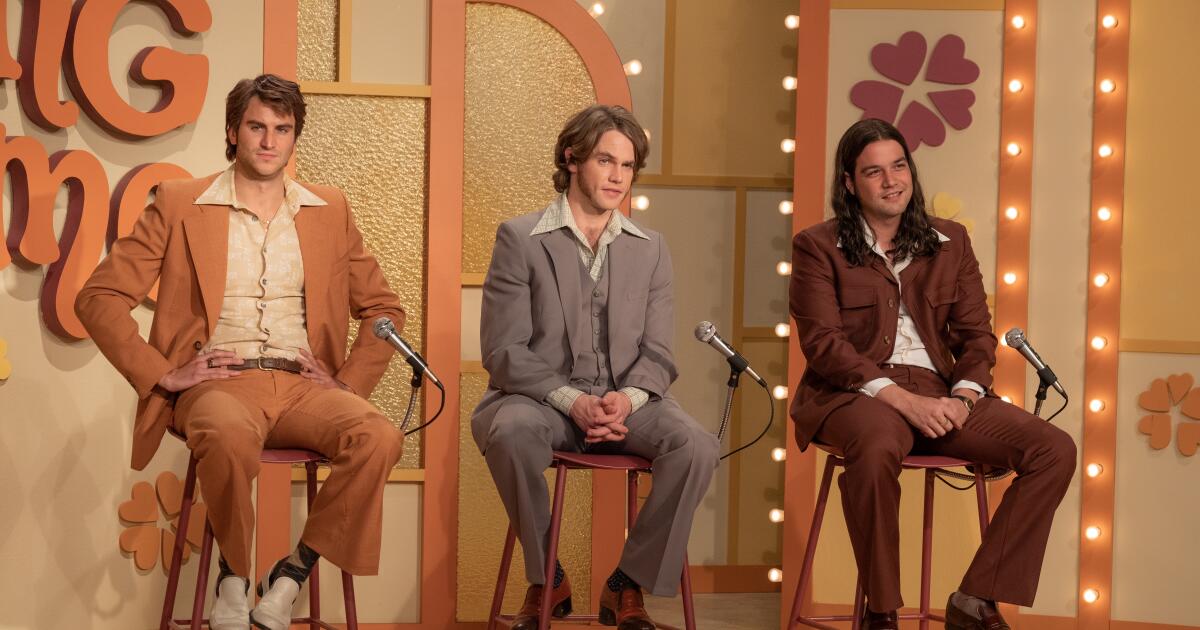
It’s one of the strangest moments in television history: A notorious serial killer went on ABC’s “The Dating Game” and won a date with Cheryl Bradshaw. Now streaming, Netflix’s new film “Woman of the Hour,” directed, produced by and starring Anna Kendrick, explores that bizarre moment in history through the eyes of Kendrick’s character, named Sheryl, who survives her interaction with murderer Rodney Alcala (Daniel Zovatto) as the real-life Cheryl Bradshaw did.
In the telling of any true story in cinema, though, creative liberties are bound to be taken. So we compared the real-life case of Rodney Alcala with “Woman of the Hour” to determine what’s fact and what’s fiction in the film.
Did Alcala work at the Los Angeles Times?
One scene in “Woman of the Hour” depicts Alcala working at The Times in 1977, a year before his 1978 appearance on “The Dating Game.” It’s unclear what his position at the newspaper is, but his colleagues seem impressed by him as he weaves tall tales of knowing Warren Beatty and shows off his photography. (Many of the images are of nude women.) The scene suggests that Alcala exaggerated his role at the newspaper to gain access to his subjects.
Despite not using an alias and having prior convictions, Alcala was hired by The Times as a typesetter in September 1977. According to a “20/20” episode on “The Dating Game Killer,” Alcala did indeed bring photos of nude women into the office, though they were seen by his colleagues as artistic in nature and not a warning sign about his state of mind. He likely used his job to ensnare at least one of his victims: Pamela Jean Lambson met Alcala in October 1977, and former Marin County Det. Richard Keaton recalled that Lambson was excited about the opportunity Alcala offered her, showing off the photographer’s business card to her stylist. Her body was found the next day. It’s not entirely clear when Alcala left the paper, quitting sometime before he killed Robin Christine Samsoe in 1979.
How accurate are “The Dating Game” scenes?
“Woman of the Hour” takes significant creative liberties when exploring the pivotal “Dating Game.” Some of these are minor adjustments for dramatic effect; making Alcala Bachelor No. 3, when he was actually No. 1, helps the film build to the reveal of Alcala’s face on the panel. The change of prize also ups the stakes: Sheryl and Rodney win an all-expenses-paid trip to Carmel when the real prize was tennis lessons and tickets to Magic Mountain theme park. One accurate aspect of the episode’s depiction? According to fellow contestant Jed Mills, Alcala really did tell him “I always get my girl.”
As for Sheryl going on “The Dating Game” to bolster her profile as an actor, what may seem absurd today was not uncommon then. Her agent points out that it worked for Sally Field, who appeared in a 1966 episode of the show (alongside bachelor Robert Vaughn of “The Man From U.N.C.L.E.” fame); many other stars went on the show before they found superstardom as well, including Farrah Fawcett, Steve Martin, Suzanne Somers, Burt Reynolds and Arnold Schwarzenegger.
The largest change in “The Dating Game” is in Sheryl herself. In “Woman of the Hour,” she rewrites the script and asks her own questions, including a tricky one about special relativity and “What are girls for?” At least as seen in the surviving clips of the original episode, the real Cheryl appears to lean into the show’s conventions, flirtatiously playing along with the game. Knowing the context of Alcala’s actions, this is even more chilling than the film: At one point, Cheryl asks Rodney to act like a dirty old man, resulting in a moment that would likely be dismissed as too outrageous if it were re-created for the film.
Anna Kendrick as Sheryl in “Woman of the Hour.”
(Leah Gallo / Netflix)
Did a woman recognize Rodney in “The Dating Game”?
Much of the dramatic heft of “The Dating Game” sequence comes not from the game itself, but from an audience member named Laura (Nicolette Robinson) who is horrified to discover that one of the bachelors is the man who killed her friend. She leaves the studio audience and heads into the studio and asks a security guard for help. In turn, the guard offers to have her speak to a producer, but it’s a cruel prank — refusing to take her concerns seriously, he gives her the name of a janitor instead.
Kendrick has said that Laura represents those affected by such crimes, as well as those who tried and failed to draw authorities’ attention to Alcala over the years. (Laura’s friend whom Alcala killed was, however, based on a real person.) Numerous people reported Alcala in relation to assaults and killings over the course of more than a decade before he was finally put away for good in July 1979.
In fact, Alcala had a criminal record even before he appeared on “The Dating Game,” serving stints in prison for assaults on two girls and becoming a registered sex offender. (In both cases he was paroled.)
Did Alcala and Bradshaw go for a drink?
Though Alcala won “The Dating Game” and secured a date with the real-life Bradshaw, that date never materialized. The day after the episode was filmed, contestant coordinator Ellen Metzger said, Bradshaw called her and told her, “I can’t go out with this guy. There’s weird vibes that are coming off of him, he’s very strange. I’m not comfortable going out with him. Is that going to be a problem?” Ellen told Bradshaw she did not have to have that date.
It’s unclear what exactly happened between Bradshaw and Alcala. In clips from their episode, Bradshaw looks considerably less excited when she comes face to face with Alcala. It’s unlikely the pair went for a drink after the show, as depicted in “Woman of the Hour.” Regardless, it’s an intense and frightening scene that smartly highlights the pair’s size difference and the physical power advantage he has. The moment when Alcala nearly attacks Sheryl at her car, only to be saved by a last-second stage door opening is also likely a narrative contrivance.
How did Alcala get caught?
Amy, the teenage runaway seen at the end of “Woman of the Hour,” is based on the real-life Monique Hoyt, who did in fact escape Alcala and report him to the police — leading to his arrest in February 1979. But as the post-film text reveals, that wasn’t the end of his crimes. While awaiting trial, Alcala was released on bail and proceeded to kill again. On July 24, 1979, he was arrested for a final time for the murder of 12-year-old Robin Samsoe. Police discovered a storage unit in Seattle that belonged to Alcala, filled with damning evidence and trophies of his kills. Alcala received the death sentence at trial, but a series of appeals, reversals and subsequent trials left Alcala in prison until 2019, when California placed a moratorium on capital punishment. Alcala ultimately died in prison of natural causes in 2021.
In the end, Alcala was found guilty of seven murders, though it’s believed the real number of people he killed is significantly higher. One day the mystery may be solved: the Huntington Beach Police Department released Alcala’s photographs in 2010 in hopes that people who recognized them would come forward and identify some of the victims.
“Woman of the Hour” states that some authorities estimate up to 130 people were killed by Alcala.

Movie Reviews
Bandar Movie Review: Bobby Deol roars in Anurag Kashyap’s unsettling legal thriller that refuses to spoon-feed

Name: Bandar
Director: Anurag Kashyap
Cast: Bobby Deol, Sanya Malhotra, Sapna Pabbi, Saba Azad, Jitendra Joshi, Raj B Shetty
Writer: Sudip Sharma, Abhishek Banerjee
Rating: 3.5/5
Plot:
Bandar follows Sameer Mehra’s character, essayed by Bobby Deol, a fading star who is desperately clinging to his past glory. Just as he attempts to rebuild his life and finds solace in a new relationship, his world comes crashing down. A former girlfriend files a heinous allegation against him, dragging him into a vicious, high-profile legal battle. Written by Sudip Sharma and Abhishek Banerjee, the film moves away from standard Bollywood courtroom setups. Instead, it dives straight into the murky waters of social media trials, public perception, and a sluggish judicial system where the truth gets buried under layers of gray.
What works:
Known for his chaotic energy, Anurag Kashyap takes a remarkably mature and controlled approach here. He avoids sensationalizing a highly sensitive topic, choosing instead to focus on the psychological claustrophobia of the protagonist. The prison sequences are exceptionally well-shot. They create a suffocating, raw atmosphere that makes you feel the weight of the character’s confinement. The script successfully avoids preachy, black-and-white monologues. It bravely forces the audience to confront their own biases regarding modern-day public trials and the digital judge-and-jury culture.
What doesn’t:
Clocking in at nearly two hours and twenty minutes, Bandar feels heavily weighed down in the second half. The narrative stretches thin, and a few subplots demand too much patience, making you wish for a tighter edit. The film stubbornly refuses to take a definitive moral stance or offer a neat resolution. While film enthusiasts might appreciate the complexity, mainstream viewers looking for a clear-cut ending or emotional payoff might walk away feeling detached and frustrated.
Performances:
- Bobby Deol is the beating heart of this film. Stripping away the massive macho swagger and menacing villainy of his recent hits, he delivers a deeply vulnerable, understated performance. He plays Samar with a mix of arrogance, confusion, and raw helplessness, proving his immense range.
- Sanya Malhotra anchors her screen time with her trademark reliability, turning in a grounded and impactful performance.
- Saba Azad and Sapna Pabbi excel in their respective roles, bringing genuine nuance to characters that could have easily been sidelined.
- Jitendra Joshi is an absolute scene-stealer, commanding your attention every single time he steps into the frame.
- Indrajith Sukumaran and Raj B Shetty are absolute show stealers with their raw acting.
Final Verdict:
Bandar is an unsettling, morally complex thriller that refuses to spoon-feed its audience. It isn’t a comfortable watch, nor does it try to be. While the sluggish pacing in the second half prevents it from being an absolute masterpiece, it is worth a watch for Bobby Deol’s spectacular acting reinvention and Anurag Kashyap’s gritty, thought-provoking storytelling.
Disclaimer: The views and opinions expressed in this article are solely those of the author and do not reflect the official policy or position of Pinkvilla. No statement in this article is intended to defame, harm, or malign any individual or entity.
ALSO READ: Maa Behen Movie Review: Madhuri Dixit, Triptii Dimri, and Dharna Durga save a slow-burning mystery

Kathy Hilton will no longer be the grand marshal of West Hollywood’s pride parade.
The city and WeHo Pride on Wednesday released a joint statement, announcing that “The Real Housewives of Beverly Hills” star would no longer serve as the Grand Marshal Icon for the 2026 WeHo Pride Parade. The event is scheduled for Sunday.
“After thoughtful discussions, the City of West Hollywood, the WeHo Pride production team, and Kathy Hilton have determined that the 2026 WeHo Pride Parade will not designate a Grand Marshal Icon honoree,” read the statement.
The decision comes less than a week after Hilton was announced. That May 28 announcement was met with swift backlash from the LGBTQ+ community and allies, who called out Hilton’s ties to President Trump and alleged MAGA-leaning politics. Critics also cited accusations that the socialite had used a homophobic slur while on a trip with other cast members of “The Real Housewives of Beverly Hills,” an action she has previously denied.
In their joint statement, West Hollywood and the WeHo Pride team expressed their appreciation for “the respectful and sincere dialogue” around both the event and the “role and significance” of Pride honorees.
“The City of West Hollywood has always believed that Pride belongs to the community,” the joint statement said. “Since its earliest days, Pride has served as both a celebration and a platform for activism, visibility, resilience, and the ongoing pursuit of equality, dignity, and justice for LGBTQ+ people. … These conversations reflect the passion people have for WeHo Pride and underscore the importance of ensuring that WeHo Pride continues to honor the history, values, and diverse voices of the LGBTQ+ community.”
In a statement, Hilton expressed gratitude for being considered for grand marshal and reaffirmed her commitment to the LGBTQ+ community and causes.
“My reason for wanting to be involved in this year’s WeHo Pride weekend was simple: to celebrate, support, and share in the joy of a community that means a great deal to so many people,” Hilton said. “Pride is, and always will be, about celebrating and uplifting LGBTQ+ voices, experiences, and achievements. … My support for the community and WeHo Pride is unwavering.”
She also mentioned several queer advocacy organizations and events she has supported over the years, including GLAAD, the Elton John AIDS Foundation, the Elizabeth Taylor AIDS Foundation, Dr. Mathilde Krim, God’s Love We Deliver and Project Angel Food.
The latest Pride-related dust-up follows the abrupt cancellation of the Long Beach Pride Festival in May. The city’s Pride Parade took place as planned.
Both snafus have occurred as conservative politicians and advocates continue to attack LGBTQ+ rights and visibility nationwide. Some Republican governors have even pushed for conservative alternatives to Pride month festivities. A recent Gallup poll has found that after years of steady gains, support for marriage equality and same-sex relationships has slipped, particularly among Republicans.
Movie Reviews
Movie Review: Travolta’s “Propeller: One-Way Night Coach” is One for the Ages — All Ages

Back in the good ol’days — the ’90s — John Travolta would love to get off the topic of “Michael,” “Pulp Fiction” or “Get Shorty” in interviews with film journalists like me and regale us with how utterly besotted he had been with his first flying experience, how that drove his passion for piloting and buying planes and airfield-adjacent luxury houses.
He didn’t even seem to mind having to move house when this or that development balked at him flying his Boeing 707 out of there on the way to locations.
Travolta would tell any journalist who asked that he was writing a kid-friendly book, “Propeller: One Way Night Coach,” based on his first flights as a child in old propeller driven airliners — cheap red-eye overnight treks with too many connections for your average jet age traveller to tolerate.
I remember picking up the book when it came out later in the ’90s — at an airport gift shop — and thinking “Well, that’s as cute as I figured.”
And now, decades later and trapped in the B-movie hell of his post “Gotti” career, Travolta’s turned that cute book into the most delightful, fanciful and colorful bon bon of a movie.
“One Way Night Coach” is a child’s fantasy of flight and flying the way it used to be — with pristine, uncrowded, futuristic airports, an early ’60s era of jets and prop planes with over-uniformed stewardesses in white gloves, the days “Back before every Joe Sweatsock could wedge himself behind a lunch tray and jet off to Raleigh-Durham,” as Sideshow Bob memorably sneered on “The Simpsons’.”
It’s a fictionalized account of Travolta’s childhood about an only child (at least two Travolta siblings have bit parts in this movie) of a never-made-it/never-will actress/single-mom (Kelly Eviston-Quinnett) who indulges her aviation-obsessed eight-year-old with a cheap cross-country overnight flight.
Little Jeff (Clark Shotwell) will revel in almost every Idlewild to Pittsburgh to Dayton to Chicago to Kansas City to Denver and Los Angeles minute. He strolls into the cockpit to meet pilots, charms the stewardesses and checks out the sleeping bunks on the TWA Lockheed Super Constellation, loving even the delays if not the Chicken Cordon Bleu he’s offered on legs of the journey that offer a meal.
And as he’s an observant child, he comments (Travolta narrates) on his 50ish mother’s vamping and posing, her choice of cigarettes (Newports) and drinks, the solo traveling men whose attention she pursues and earns.
“I was her best audience,” adult Jeff remembers of the mother who’d read him plays as bedtime stories and delusionally hopes that this trip to Los Angeles might be her “big break” even though she’s pushing 50.
“Hollywood called,” she’d explain about their overnight cheap flight arrangements to ticket agents and crew. “They told me to take the next flight!”
At every turn, Jeff meets or sees kindness — stewardesses who indulge his many questions and bump them up to first class on the mostly-empty planes, a captain who fixes his toy model of a Constellation, a mentally ill flyer who flips out but is calmed by a flight attendant who isn’t overworked and frazzled in jet-powered tin-can jammed with Joe and Jane Sweatsocks who think nothing of traveling in their pajamas.
Normally, I cringe at pictures this reliant on voice-over narration. I recoil from stars who populate their picture with Sandler etc. offspring. But “Propeller” is unfailingly sweet and never cloying.
Sure, it’s fictionalized. But if you’ve followed Travolta’s life and career, a lot of him is in this — his raptoruous engagement with flying, an indulged child who developed a taste for fine food and creature comforts, a mother who was his guiding star as an actor.
I get why there are less adoring reviews than mine floating around “Propeller.” It’s unfailingly sweet. Mom’s man-hunting is seriously dated. This TWA tale is decorated with Gershwin’s majestic “Rhapsody in Blue” — United Airlines’ signature tune. And Travolta’s been around long enough for recent generations to come up and not feel a connection to the “Saturday Night Fever/Get Shorty” star whose career has fallen off and life has been visited by too much tragedy.
But I’d hate to be seated next to anybody who doesn’t appreciate this adorable, pristine and nearly perfect aviation fantasy on any flight, much less an overnight one.
Rating: TV-PG
Cast: Clark Shotwell, Kelly Eviston-Quinnett, Ellen Travolta, Ella Beau Travolta, Olga Hoffmann and John Travolta.
Credits: Scripted and directed by John Travolta, based on his book. An Apple TV+ release.
Running time: 1:01

-
 Sports12 minutes ago
High school baseball and softball: Regional scores and schedule
-
World20 minutes ago
Europe Today: Costa speaks exclusively to Euronews as EU-Western Balkans summit underway
-
 News45 minutes ago
Trump, Netanyahu at odds / Elusive Iran deal : Sources & Methods
-

 Los Angeles, Ca2 hours ago
'Top Gun: Maverick' actor identified as victim stabbed to death in Tarzana
-

 Detroit, MI2 hours ago
Storm chances return, which could impact Motor City Pride, graduations this weekend across Metro Detroit
-

 San Francisco, CA3 hours ago
Hilton campaigns in San Francisco as California primary votes still being counted
-

 Dallas, TX3 hours ago
Crews cover up AT&T branding as stadium becomes
-

 Miami, FL3 hours ago
Miami leaders gather for FIFA World Cup Host Committee Gala

