Connect with us

News

Moldova’s wineries shift away from Russian gas

Published

on

Moldova’s wineries shift away from Russian gas

Unlock the Editor’s Digest for free

Wineries in the small eastern European country of Moldova are increasingly turning to renewable energy as part of the nation’s westward shift and efforts to curb its reliance on Russian gas.

Cricova, founded in 1952 by a Soviet decree that bears the signature of Joseph Stalin, is one of the vineyards that reduced its energy costs by 25 per cent after building solar parks and improving its insulation.

“All of the wine production process has been modernised . . . as we are adapting to today’s consumers and global trends”, said Cricova director Sorin Maslo.

Advertisement

After Russia’s full-scale invasion of neighbouring Ukraine, Moldova accelerated its westward shift, applying for EU membership and looking for alternative energy sources to the Russian state-owned giant Gazprom.

Winemakers — a significant sector of the country’s economy — followed suit and started installing solar panels and insulating their facilities to reduce energy consumption. Cricova also pulled from public display Vladimir Putin’s wine collection of 607 bottles which the Moldovan government gave the Russian leader when he visited in 2008.

Moldova’s energy ministry estimates that last year households and businesses tripled their renewable energy sources, particularly photovoltaics.

Smaller businesses such as the new vinery Luca have also benefited from state subsidies to go green.

The owner Ion Luca told the Financial Times he avoided gas from the outset, when construction started in 2018, by investing in insulation and an electricity-powered heat pump at his winery in the town of Cricova, near the eponymous state company.

Advertisement

“We were Gazprom’s hostages and I did not want to depend on them,” Luca said.

Luca, who is part of the fourth generation of winemakers in his family, said that when the Soviets annexed Moldova in 1944, his grandparents lost their house, their vineyards and all other properties. They were labelled “enemies of the people” and sent to Siberia in 1949 as part of one of Stalin’s mass deportations.

After Stalin’s death, his family returned to Moldova, and his father helped set up the wine production at the Soviet winery in Cricova the dictator had ordered, but the Lucas never got their land back. In 2018, Ion Luca purchased his new vineyard which aims to be “the most sustainable winery” in Moldova.

Winemakers, which are a significant sector of Moldova’s economy, started installing solar panels and insulating their facilities to reduce energy consumption after Russia invaded its neighbour Ukraine © Purcari winery/Dreamstime

Purcari, a Moldovan brand that has a strong presence on western markets after turning its back on Russia, is also going green.

Vasile Tofan, chair of the board of Purcari, said the shift was prompted by Russia’s repeated wine embargoes in the 2010s when Moscow sought to squeeze Moldova into cheaper deals.

Advertisement

“Fool me once, shame on thee, fool me twice, shame on me,” said Tofan. The Russian bans initially put Purcari “on our knees” but eventually proved “a blessing in disguise” as it accelerated the westward pivot.

In 2014, when Russia annexed Crimea, Purcari produced “a liquid manifesto”, Freedom Blend, a wine made from Crimean, Georgian and Moldovan grape varieties. Purcari has since become a staple at festivals in neighbouring Romania and is available in the UK, Germany, Poland, as well as online.

Since 2021, Purcari has managed to cover a third of its energy consumption using solar panels. Tofan told the FT that the shift was bound to happen because Russia had been throttling Moldova’s gas supply and imposing price rises long before invading Ukraine, with the war just the latest catalyst for this transition.

Cricova, Luca and Purcari are also trying to make their business more sustainable by investing in lighter bottles, given that the biggest share of the industry’s carbon footprint is generated by producing and transporting heavy glass bottles. Luca also exports bag-in-box wines to Scandinavian markets.

A focus on wine quality and the revival of local varieties, which were lost in the Soviet era, can also boost exports, said Diana Lazăr, senior wine director at the international development company Chemonics.

Advertisement

Russia’s squeeze on the Moldovan economy “galvanised the transition to a more sustainable business model which does not just use cheap resources and can become a competitive advantage in the long run”, said Lazăr. “This way, the Moldovan winemakers are aligning themselves to the global trend.”

News

How a Beer Hall Keeps Up With a World Cup Crowd

Published

on

The fans see the games, the crowds, the food and the beer. But behind every World Cup watch party is a team working long before kickoff and well after the final whistle. We go behind the scenes at a beer hall in Brooklyn to see what it takes to serve a room full of soccer fans on game day.

Continue Reading

News

With the white nationalist group Patriot Front, what you see is not what you get

Published

on

With the white nationalist group Patriot Front, what you see is not what you get

Members of the group Patriot Front ride the subway as a commuter looks on, in Washington, D.C., on July 4.

Cheney Orr/Reuters


hide caption


toggle caption

Advertisement

Cheney Orr/Reuters

The sight of hundreds of masked men roaming the streets of Washington, D.C., on July Fourth weekend, wearing khakis, blue shirts and uniform patches, was chilling to some of the city’s residents.

For many Americans, it was the first they heard about Patriot Front, a white nationalist organization that was born out of the deadly 2017 Unite the Right rally in Charlottesville, Va. A now-viral Reuters photo prompted reflections on the experience of a lone African American woman who was photographed in a Metro subway car, surrounded by white supremacists.

The planned demonstration of force was timed to bring a fringe group of extremists into public view as the nation marked 250 years of its independence. Indeed, the stunt succeeded in earning the group media coverage across mainstream outlets, amplifying its brand and potential to reach new recruits. On this occasion, the members refrained from engaging in violence and property damage, projecting an image of law-abiding, orderly activism.

Advertisement

But those who are closely familiar with Patriot Front’s history and operations warn: Don’t believe what you see.

“That is not who they are in private,” said Len Kamdang, director of the Criminal Justice Project at the Lawyers’ Committee for Civil Rights Under Law. “Although they were on their best behavior [last] weekend, this is a dangerous group that commits acts of violence all over the country.”

Patriot Front’s history of violence and property damage

Kamdang’s organization sued members of Patriot Front for vandalizing a public mural dedicated to the tennis legend and Black activist Arthur Ashe in Richmond, Va., in 2021. Ashe, who was inducted into the International Tennis Hall of Fame in 1985, was born in Richmond and his legacy is a continuing source of pride to members of that community.

“A couple of Patriot Front members showed up under cover of night and vandalized the mural,” Kamdang said. “They painted white stencils all over. … They literally tried to whitewash him and they put their symbols of hate all over — their stencils, their slogans. And all the while they were caught on video. And that video leaked using some of the most horrible language that you can imagine.”

In many jurisdictions, law enforcement can seek additional hate crime charges or sentencing enhancements in cases where illegal acts appear to have been motivated by racial bias. But in this case, Kamdang said, Patriot Front members faced no criminal charges and their identities were only revealed when online activists later infiltrated the group and leaked internal records.

Advertisement
Continue Reading

News

Graham Platner makes it official in Maine, submitting paperwork to leave Senate race

Published

on

Graham Platner makes it official in Maine, submitting paperwork to leave Senate race

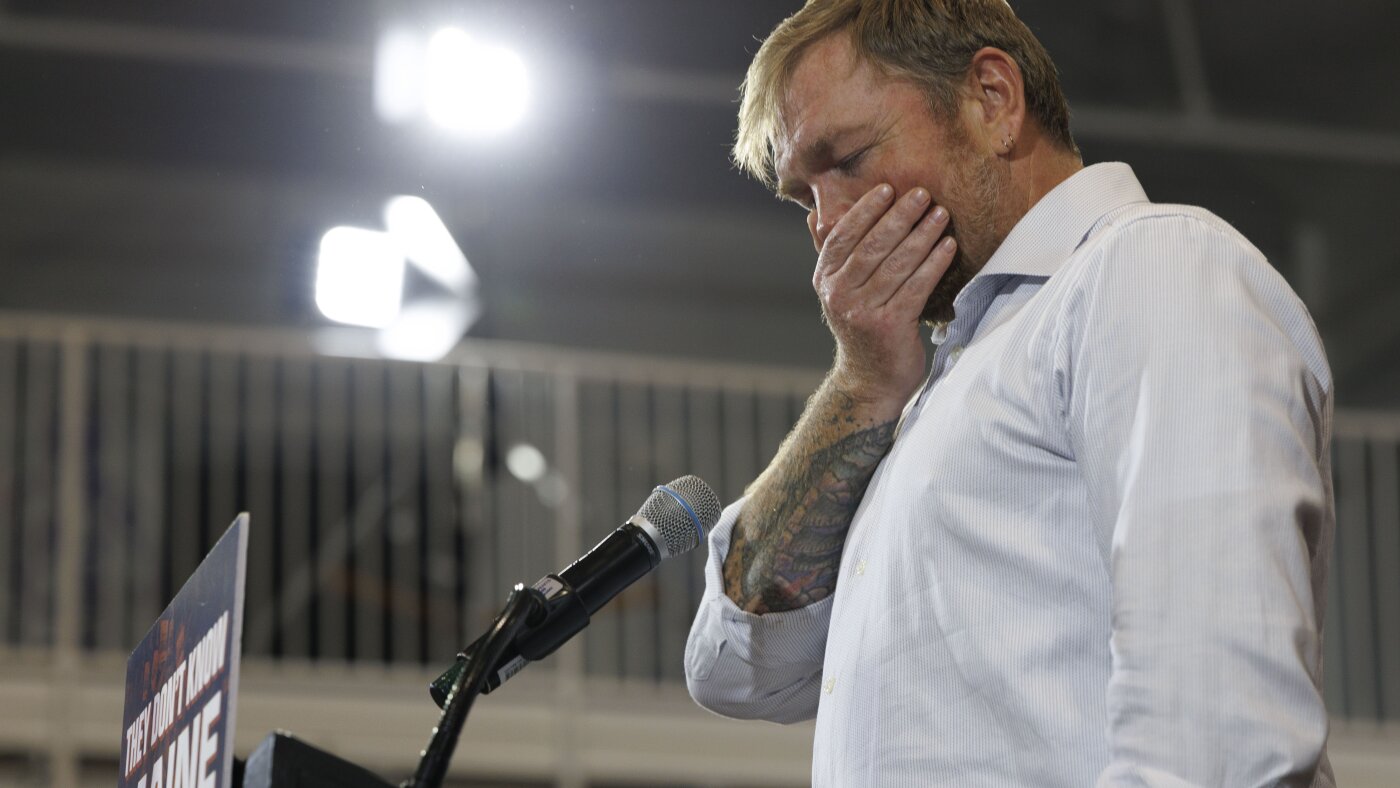
Now-former Democratic Senate candidate Graham Platner speaks at his primary election night event on June 9 in Blue Hill, Maine. Platner officially dropped out of the race July 10 following rape allegations from a former romantic partner that he denies.

CJ Gunther/Getty Images


hide caption


toggle caption

Advertisement

CJ Gunther/Getty Images

Graham Platner, Maine’s Democratic nominee for Senate, is officially out of the race.

The Maine Secretary of State said Platner filed the necessary paperwork to withdraw his candidacy two days after he announced he planned to do so following an accusation of rape by a former romantic partner. Platner denies the allegation.

The Maine Democratic Party has until July 27 to pick Platner’s replacement.

Advertisement

In his withdrawal notice, Platner said “people are desperate for change” and that’s why they voted “for a new kind of politics” by making him the Democratic nominee. He expressed gratitude for those who supported his campaign and said that he will continue to fight for “the movement we have built together and the future we believe in.”

He ended his notice with a strong statement aligned with the progressive platform.

“F*ck ICE. Free Palestine. Up the Hearts.”

Platner announced his plan to withdraw from the race in an 11-minute video he posted to social media on July 8. He said he had no choice but to suspend his campaign, citing it was no longer viable financially.

Advertisement

“We are going to lose our ability to fundraise. We are going to lose our ability to access voter data. We are going to lose all of the things that any campaign needs on the basic level simply to function,” he said.

Platner added that dropping out was not an admission of guilt. Rather, the decision, he said, is to keep the progressive movement in Maine alive to defeat Republican Sen. Susan Collins in November. Platner blamed the “political establishment” for his downfall and argued the goal was to force him out of the race.

“We built a campaign. We engaged in electoral politics. We motivated people. We banded together. We did it the way that we were told we are supposed to make change and we won. And now they are not going to let us have it. Not if it’s me,” he said.

Continue Reading
Advertisement

Trending