Northeast
Florida sheriff issues warning for authorities enforcing homeless crackdown

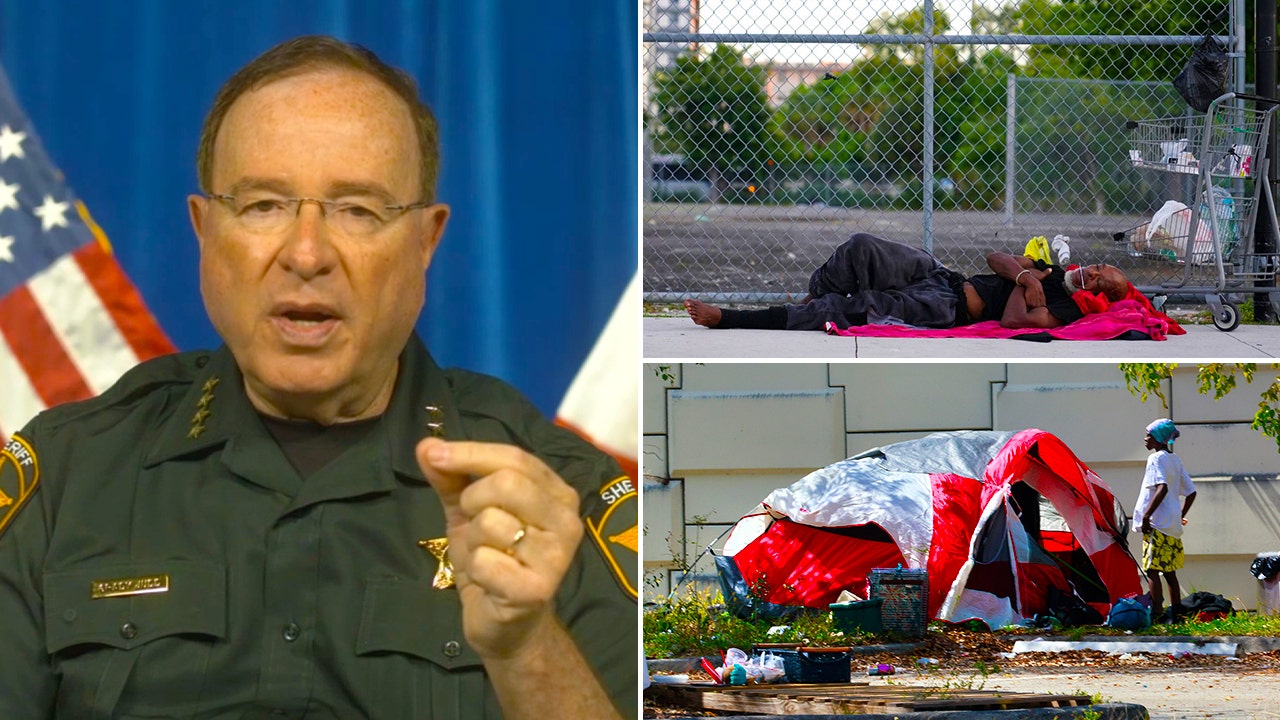
Tough-on-crime Polk County Sheriff Grady Judd tells Fox News Digital that a new Florida law prohibiting homeless people from sleeping outside will increase the quality of life for regular people by clearing sidewalks and public places of homeless people who clog up these areas and make them unsavory.
However, homeless advocates say the law may put unhoused people in danger by driving them away from urban areas with critical services and potentially making them “vulnerable to predators.”
The new law, one of the strictest anti-homelessness measures in the nation, came into effect last week and bans camping on streets, sidewalks and in parks. Local governments are required to offer temporary housing to the homeless, where individuals will be prohibited from using drugs. They must also be offered substance abuse and mental health treatment.
NEWSOM VETOES BIPARTISAN ACCOUNTABILITY LEGISLATION AIMED AT STATE SPENDING ON HOMELESSNESS CRISIS
A person sleeps on a sidewalk in Fort Lauderdale, Fla., last week. Proponents of a new state law prohibiting the homeless from sleeping outside say it will increase the quality of life by clearing sidewalks and public places of homeless people in those areas. (AP Photo/Lynne Sladky)
Judd said the law needs to strike the right balance between providing safety for residents walking the streets while at the same time helping those in need. He said that while he’s empathetic to the circumstances of homeless people, it doesn’t give some of them the right to block sidewalks.
“And that’s important because our family, our children, our wife, our husband, our significant other has the right to walk down a sidewalk without having to step over or walk around a homeless person that’s decided to set up camp in the middle of the sidewalk,” Judd said.
“That’s a quality-of-life issue for everyone, and because you don’t want to live in housing and because you don’t want to work and live like the rest of America, it doesn’t give you the right to lay around in the public parks, lay on the benches, set up your nasty little camps. So that’s what we’re cleaning up. But we’ve always done that here, and at the end of the day my heart breaks for them, and we’re going to help them, but they’ve got to help themselves.”
The new law gives municipalities the power to arrest those not complying, but Judd said his department does regular outreach to the homeless to help them and that he wants to avoid a situation where homeless people are arrested, taken to jail and end up in the prison system.
“What we’re working toward is what we’ve always done, [which] is not letting the jail be a de facto homeless camp, and that’s not going to happen,” Judd said. “We’ve got to be careful when we implement this. It’s designed so that government really doesn’t set up housing camps because that part of it is very onerous.”
“What I hear overwhelmingly is, ‘We want food, clothing and shelter, but we don’t want to go into homes. We don’t want to go into organized places. We just want to be left alone.’ So our challenge is: Where do they go?
Polk County Sheriff Grady Judd says the law needs to strike the right balance between providing safety for residents walking the streets while at the same time helping those in need. (Fox News Digital)
Martha Are, the CEO of the Homeless Services Network of Central Florida, told Fox News Digital that the new law will push homeless people out of built-up areas, which could prove the difference between life and death. The group works to provide stable long-term housing for people experiencing homelessness in Central Florida.
“If you think about the horrendous storm that just tore up the Southeast. If people had been experiencing homelessness and had been more isolated further into the woods, farther away from other people, harder to find, they may not have even known that the storm was coming,” Are said.
“They’d have been afraid to believe it, to listen, so if they had seen a police officer coming out to try and encourage them to get to safety before the storm, they may have avoided that officer, never gotten the message and then been completely overwhelmed in a storm. Those are the kind of real-life consequences with this type of legislation.”
BLUE STATE COUNTY BUCKS TRENDS ON HANDOUTS – AND HOMELESS POPULATION CRATERS
Are said the legislation does little to tackle homelessness, which she said is driven largely by the lack of affordable housing.
She said the No. 1 demographic of homeless people in Florida is the elderly, who oftentimes are on fixed incomes and then get priced out of housing, forcing them to take to the streets. For example, the population of Orange County grew by 25% between 2010 and 2020, whereas the housing stock grew by 15%, she said.
“When you’ve got many more people moving here than you’re developing housing and transportation, then you end up with this mismatch,” Are said. “And so there are certain people that are more vulnerable in that type of market.”
The belongings of a homeless person are piled on the sidewalk on the first day the law took effect. (AP Photo/Lynne Sladky)
Under the new law, local governments can offer county-owned land for people to sleep on as long as they keep it clean and free of crime, and as long as the people staying there are provided access to showers and mental health services. For approval, the county must prove there are not enough beds in homeless shelters to keep up with the local homeless population and that the camp would not hurt the property value or safety and security of other homes or businesses in the county.
The legislation provides $30 million to help municipalities enact the law, and it provides the homeless with mental health and substance abuse treatment, but Are said only $10 million of new money is being provided since the remainder of the funds are already annually allocated.
If counties don’t have enough shelter beds, the law allows them to erect outdoor encampments where the homeless could live for up to a year, with the biggest counties required to equip them with sanitation and 24-hour security.
Are said it would be difficult for local governments to meet those standards, and that if a type of homeless encampment was to be set up it would pose serious safety concerns, for children in particular.
“The people experiencing unsheltered homelessness are extremely diverse … then you’re talking about putting young children, youth and families with lots of human trafficking, violence, people who are mentally ill and substance users. And unfortunately, that would become like a playground for predators.
A dog is shown as a homeless person sleeps in the backyard of an abandoned house in Fort Lauderdale, Fla. (AP Photo/Lynne Sladky)
Are said the solution to solving the homeless crisis is to invest in adequate housing and transportation and make sure there are enough shelters for people to go to.
“Short of that, we are going to continue to see more people experiencing homelessness, and then when we criminalize it, we essentially say that you’re a criminal because you’re having this experience that in many cases was absolutely beyond someone’s control.
“And then it becomes quite dangerous, and it would say an unfortunate thing about our communities and our state if we continue to pursue that strategy.”
Fox News’ Landon Mion and the Associated Press contributed to this report.
Read the full article from Here


new video loaded: The Democracy of The Dive Bar
By Anna Kodé, Gabriel Blanco, Haimy Assefa and Laura Salaberry
June 19, 2026

Boston is allowing outdoor drinking in two neighborhoods this summer while the city welcomes a wave of international visitors during the World Cup, Mayor Michelle Wu announced.
The social districts opened Friday and will run through July 31.
Boston public drinking zones
Patrons will be allowed to consume alcoholic beverages outdoors within designated areas at Union and Marshall streets in Downtown Boston’s Block Historic District, as well as on Temple Place in Downtown Crossing.
According to the city, the initiative along with the decision to extend last call until 3 a.m. for the World Cup “is creating vibrancy for patrons and expanding opportunities for Boston businesses during one of the region’s busiest summers in recent years.”
“As Boston welcomes people from around the world to gather and enjoy our city this summer, these new social districts will create even more opportunities to build community and have fun responsibly,” Wu said in a statement. “These districts help us open our streets in a safe environment for residents and visitors to enjoy themselves, ‘sip and stroll,’ and make lasting memories in our beautiful city.”
Last week, Gov. Maura Healey signed a new law that allowed for cities and towns to create designated areas for public drinking.
How drinking zones work
In order to participate, businesses within the designated zones must file a one-day amendment application with the Boston Licensing Board that states they wish to be included in the districts.
Businesses cannot sell alcohol for public consumption until they receive approval from the Licensing Board.
Hours for the Union-Marshall Street Social District will be 9 a.m. to midnight Monday through Saturday and 10 a.m. to 9 p.m. on Sunday. The Temple Place Social District will be open from 9 a.m. to 11 p.m. Monday through Saturday and 10 a.m. to 9 p.m. on Sunday.
Drinks sold for public consumption will be in clear plastic containers with a sticker or other label that shows where they were sold. Businesses cannot sell more than one 16-ounce alcoholic beverage for public consumption per customer in a single transaction.
Outside alcohol cannot be brought into businesses.
“We are grateful for this opportunity to activate our downtown, support businesses, and create a welcoming, relaxed atmosphere in two of Boston’s entertainment districts,” Corean Reynolds, director of nightlife economy, said in a statement. “Both residents and tourists can benefit from these Social Districts. After the summer, we look forward to continuing our work creating a nightlife infrastructure that works for everyone.”

The decision to trade catcher Joey Bart to the Braves gives the Pirates a solution to a problem that soon needed to be made.
Bart had been on a rehab assignment with Triple-A Indianapolis, working his way back from a left foot infection that kept him out of action for over a month.
With Bart nearing a return, the Pirates were going to have to figure out what to do at catcher with Henry Davis and Endy Rodríguez splitting time behind the plate in his absence.
Given how Rodríguez has been swinging the bat since he was recalled from Indianapolis to replace Bart on the active roster, there was no way the Pirates could’ve sent him down. In 23 games, the 26-year-old has a .267/.413/.467 batting line with three doubles, three home runs, eight RBI, two steals and a robust 19.7% walk rate.
Davis, meanwhile, has struggled to an anemic .138/.242/.285 batting line with four doubles, five home runs and 17 RBI in 47 games. While he hasn’t offered much with the bat, he’s been responsible for two defensive runs saved and leads MLB with a 55% caught stealing rate.
Now that Bart has been traded, Rodríguez and Davis will remain the catching tandem at the big-league level with Rafael Flores Jr. as the top backup option with Indianapolis. Flores is considered Pittsburgh’s eighth-best prospect on MLB Pipeline.
For the first time in the big leagues, Rodríguez is realizing the potential that once made him one of the top 100 prospects in baseball. Because of that, he should get the majority of the playing time with Davis continuing to catch Paul Skenes’ starts and filling in when needed.
As for the return, the Pirates known what to expect from Hunter Stratton, who spent nine seasons in the organization and made 47 appearances with the team from 2023-25.
The bullpen has been an obvious weak spot for the team this season, and while it was somewhat surprising to see the Pirates assign Stratton to Indianapolis, he improves the pitching depth and will almost surely be called upon at some point this year.
In 60 career big-league appearances between the Pirates and Braves, Stratton is 3-2 with a 3.75 ERA and two saves. The right-hander spent most of the 2026 season with Triple-A Gwinnett and went 2-4 with a 4.38 ERA and 24 strikeouts in 24.2 innings across 21 appearances.
One more important note about the trade is that the Pirates saved some money in the deal, which could be used later in additional trades to add to an already record-setting payroll. Stratton is a pre-arbitration player, while Bart is making $2.53 million this season.
More about:Pirates
-

 Politics3 minutes ago
Video: Demining the Strait of Hormuz
-

 Health18 minutes ago
Video: Wii Bowling Takes Over Tulsa Retirement Homes
-
Lifestyle33 minutes ago
This Pride month, teen flicks are recasting familiar tropes with a queer sensibility
-

 Technology41 minutes ago
NASA selects Eric Schmidt’s rocket company for a 2028 mission to Mars
-

 World49 minutes ago
British Prime Minister Keir Starmer faces potential leadership challenge from newly-elected Andy Burnham
-

 Politics51 minutes ago
Reporter’s Notebook: How Trump’s surprise move on DNI confirmation upended key Senate deal on FISA
-

 Health1 hour ago
Weight-loss drugs linked to ‘Ozempic ears’ and other cosmetic complaints, surgeons say
-

 Sports1 hour ago
Florida AG launches civil rights investigation into MLB’s warning to Christian pitchers over Pride Night caps


