Movie Reviews
Joker 2 Is So Bad It’s Almost Laughable


In 2019, a year now separated from us by enough catastrophic global events to feel like a remote archaeological era, the movie Joker, like it or not (I certainly didn’t), was a big deal. It won the Golden Lion at the Venice Film Festival and later garnered a leading 11 Oscar nominations, including Best Picture, with star Joaquin Phoenix eventually winning Best Actor for his performance as a mentally ill would-be stand-up comic turned murderous clown. The movie also became the subject of heated discussion and not a little hand-wringing. Would its portrait of the comic-book villain as the lonely, misunderstood victim of mistreatment by a vaguely defined “society” inspire copycat acts of mayhem? Joker may have teetered uneasily in the balance between critiquing incel violence and being a commercial for it, but thankfully its many admirers kept their enthusiasm contained to the box office, where the film raked in over a billion dollars worldwide, shattering the all-time record for an R-rated movie.
Five years later, Joker’s director and co-writer Todd Phillips has returned with a sequel that swerves in an unseen—and on paper, intriguing—new direction: Our miserable antihero has become, of all things, the singing, dancing protagonist in his own private musical. A lot of things could be said about Phillips’ execution of that idea, most of them deservedly negative. By any reasonable measure this is a terrible movie, too long and too self-serious and way too dramatically inert, a regrettable waste of its lead actors’ boundless commitment to even their most thinly written roles. But no one could accuse Joker: Folie à Deux of being a mere cash grab, lazily recycling its predecessor’s mood, themes, or plot structure.
There’s an admirable boldness to Phillips’ decision to cast a pop supernova like Lady Gaga opposite the darkly charismatic Phoenix, then ask them both to sing, live-to-film, a jukebox-musical soundtrack of more than a dozen well-known songs that range from 1940s Broadway standards (“Bewitched, Bothered and Bewildered,” from Pal Joey) to 1970s easy-listening pop (the Carpenters’ “Close to You”). Granted, the director fails to clear the bar he sets for himself—fails hard enough, at times, to scrape the skin off his legs from knee to ankle—but it’s fair to say that this movie’s problems have little if anything to do with the attempted magic trick of its premise. It’s mainly the weirdness of that trick, and the stars’ doomed dedication to pulling it off, that renders Joker: Folie à Deux even minimally watchable.
Joker ended with Phoenix’s Arthur Fleck locked up in a mental institution but seemingly on the verge of escaping to start his career as Batman’s archnemesis. Instead, Folie à Deux finds Arthur still locked up in Gotham City’s inhumane Arkham State Hospital. Having been judged competent in a sanity hearing, Arthur is about to go on trial for the murders of five people, one of them on live television. (As he confesses to more people than he probably should, the number is really six if you include his mother.) Outside the institution’s grimy walls, he has become a folk hero to a certain set of clown-mask-sporting nihilists and a tabloid bogeyman to the public at large. But inside the hospital, Arthur remains a pitiable loser, mocked by his fellow inmates and singled out for alternately friendly and cruel treatment by an Irish prison guard (Brendan Gleeson).
Phillips’ desire to mess with the audience’s genre expectations is evident from the jump. The first thing the audience sees, after a vintage WB logo, is a cartoon short entitled “Me and My Shadow,” animated by the Triplets of Belleville filmmaker Sylvain Chomet in a style reminiscent of classic Looney Tunes. In it, Arthur’s shadow self emerges from his body to commit crimes that the real man is then blamed for. The plot of the cartoon is a literalization of the defense that his sympathetic lawyer (Catherine Keener) will later use in court: Arthur, she believes, is the victim of dissociative identity disorder, a former abused child who’s made up the Joker character as a way to vent his otherwise inaccessible rage. It’s not clear whether the movie wants us to agree with her assessment or with that of Gotham assistant district attorney Harvey Dent (Industry’s Harry Lawtey), who thinks Arthur is merely a sociopath faking mental illness in order to escape the consequences he deserves.
Meanwhile, Lee Quinzel (Gaga), an arsonist serving time in Arkham’s minimum-security wing, has a very different vision of the Joker: She’s a groupie, having followed his crime spree in the news and obsessively rewatched a TV biopic about him. (Even fans who haven’t consumed the aggressive marketing won’t take long to recognize her as the future Harley Quinn.) When they’re put in the same music-therapy group—a place where cheery sing-alongs are touted as a wholesome counterpoint to the grimness of asylum life—Lee and Arthur bond instantly and soon develop their own more twisted motives for bursting into song. When they’re together, or apart and thinking of each other, their internal monologues bubble to the surface as ready-made classics of the American songbook. This despite the fact that Lee, for her part, seems not to be a big fan of the musical genre. When the asylum shows the MGM classic The Band Wagon on movie night, Lee gets so bored she sets fire to the rec-room piano. Not liking The Band Wagon should surely serve as a red flag for any prospective suitor, but Lee redeems her taste later on, when the by-then-besotted couple belts out a cover of that musical’s most enduring number, “That’s Entertainment.”
Joker: Folie à Deux is hardly the first musical to posit the idea of its song-and-dance sequences as the emanations of a delusional mind, but it must be among the ones that hammer hardest on that conceit. In scene after scene, often with hardly a break for dialogue in between, either Lee, Arthur, or both in unison will channel the intensity of an emotional moment by delivering a breathy version of some beloved pop hit or other. Invisible string orchestras may swoop in to accompany these flights of fancy, just as they would in a Hollywood musical, but the secondary characters never join in and seldom seem to notice that a serenade is taking place. With rare exceptions (like the rock-’em-sock-’em Gaga cover of “That’s Life” that plays under the closing credits), most of the vocal performances in Folie à Deux are purposely underwhelming in terms of virtuosity: They’re husky, scratchy, and in Phoenix’s case often half-spoken, suited more for a tipsy karaoke night than for the Broadway stage.
Gaga has pointed out in interviews that neither her nor Phoenix’s character is a professional entertainer, so why should they sing like one? It’s a reasonable point, as is a less polite one she doesn’t make: that if she sang full-out instead of curbing her usual vocal splendor, the contrast would place Phoenix’s adequate but limited baritone in unflattering relief. But what makes the songs, irresistible toe-tappers all, start to blur into a drab wall of sound has less to do with the performance quality than with the nonstop onslaught of musical numbers and the sluggishness of the story in between. Other than the building of internal emotion to the point that it must express itself in song—over and over and over—precious little happens in Folie à Deux. Arthur is declared fit to stand trial, goes to court, and is marched back by the cruel guards each night to the bleakness of his cell. A few familiar characters from the first Joker, including Zazie Beetz as Arthur’s former neighbor, show up to take the stand, and at one point a horrific act of violence interrupts the proceedings. But the forward motion of the story is so minimal, and so broken up by long stretches of musical stasis, that the result barely feels like a movie. It’s more like a work of Joker fanfic, created not just by the credited screenwriters (Phillips and Scott Silver, who also co-wrote the 2019 film) but by Phoenix and Gaga themselves in what was apparently a collaborative project to revise the script in real time during the shoot.
The fact that Folie à Deux has the self-referential quality of fanfic does not necessarily mean it will go down well with actual Joker fans, who seem likely to come out scratching their heads over a sequel about a comic-book supervillain that contains virtually no fight scenes, a single car chase that ends roughly a minute after it begins, and scarcely a moment that could be classified as suspenseful. The main question to be answered by the viewer is not “What will happen next?” but “Is all this taking place in the real world, or just inside their heads?”—an epistemological puzzle that is not enough in itself to sustain our energy for nearly two hours and 20 minutes. Even more confoundingly, all this time spent locked in the psyches of two deeply disturbed characters gives us little insight into their motivations. The pathetic Arthur Fleck remains, as I called him in my review of the 2019 movie, a “poor little clownsie-wownsie,” while Gaga’s Lee is so underwritten we remain unsure to the end whether she is a vulnerable fangirl or a heartless femme fatale. If he is, as the lyric from “That’s Entertainment” goes, “the clown with his pants falling down,” does that make her simply “the skirt who is doing him dirt”? To make Gaga’s character little more than a mirror that reflects the Joker back to himself (in alternately flattering and unflattering ways) is a real squandering of this powerhouse performer, whose life experience as a stadium-filling superstar has given her no shortage of insight into the psychology of fame monsters.
Without spoiling the ending, it’s safe to say that with it, Phillips seems to foreclose the likelihood that anyone will be begging for more. That’s probably a blessing for both the filmmaker and us, since this somber, muddled, maudlin film seems to have been made by someone who holds his characters and his audience in contempt.



Movie Reviews
Movie Review: ‘Leviticus’ makes a demon out of desire in an auspicious debut for Adrian Chiarella – Sentinel Colorado

What if the object of your desire was also the thing that’s trying to kill you? Not slowly irritating you to death for leaving the toilet seat up again. We mean actively trying to strangle you.
That’s the intriguing premise behind the horror-satire “Leviticus,” an auspicious feature film debut for writer-director Adrian Chiarella that’s both deeply scary and a queer revolt.
Named for the book of the Old Testament often used to justify homophobia, the movie explores the burgeoning relationship between two young men that is shattered when so-called “conversion therapy” — a scientifically discredited practice — unleashes a demon that stalks them. Some have called the movie “It Follows” meets “Heated Rivalry,” but that’s a disservice to Chiarella’s ambition.
The film centers on Naim (Joe Bird, the breakout star of A24’s “Talk to Me” )and Ryan (newcomer Stacy Clausen), who we watch fitfully, awkwardly fall for each other, slowly exploring their sexuality and stutter-stepping into their true selves. Wrestling turns to flirtation, which becomes longing and tenderness.
That doesn’t go over well in the small Australian town where the movie is set, a blue-collar community with belching smoke stacks, low-slung houses, barking dogs and a Christian pastor — with a “deliverance healer” — who prefers his flock much more heterosexual.
Chiarella is leaning not only into the notion that sexual desire makes you vulnerable, but also the harm that repressing who you are can do. In this case, the demon takes the form of your crush. It has weaponized lust.
“You shouldn’t be near me. I shouldn’t be near you, either,” one of the would-be lovers says to the other.
Chiarella starts his movie with a nod to Alfred Hitchcock — a shower scene worthy of “Psycho” — and nods to others in the genre, like “A Nightmare on Elm Street.” He can be a bit clunky with his images — a frog being eaten by a snake — but his pacing is flawless and his ramping up of terror is sure. “Leviticus” might be an indie film, but it’s got the blessing of Frank Ocean, who gave the filmmakers the right to use his song “Self Control.”
The monsters — in addition to the nasty one only the boys can see, of course — are the adults: the parents and caregivers and friends who turn on vulnerable, scared young men and make them scared of each other. Mom might kindly take some disliked olives off her son’s pizza, but she won’t accept him kissing another boy.
Chiarella’s pro-queer filmmaking extends to his ability to perfectly capture the fumbling ecstasy of new love, the fierce longing of stolen kisses and how scary it is to submit to a new partner. Kudos to Bird and Clausen for capturing that universal feeling.
With his film, Chiarella forms a triumvirate of young filmmakers making horror brilliant in summer 2026, alongside Curry Barker with “Obsession” and Kane Parsons’ “Backrooms.” The future of movies is in good hands.
“Leviticus,” a Neon release that’s in theaters Friday, is rated R by the Motion Picture Association for “bloody violent content, language, some sexual content and teen drug use.” Running time: 88 minutes. Three and a half stars out of four.
Related
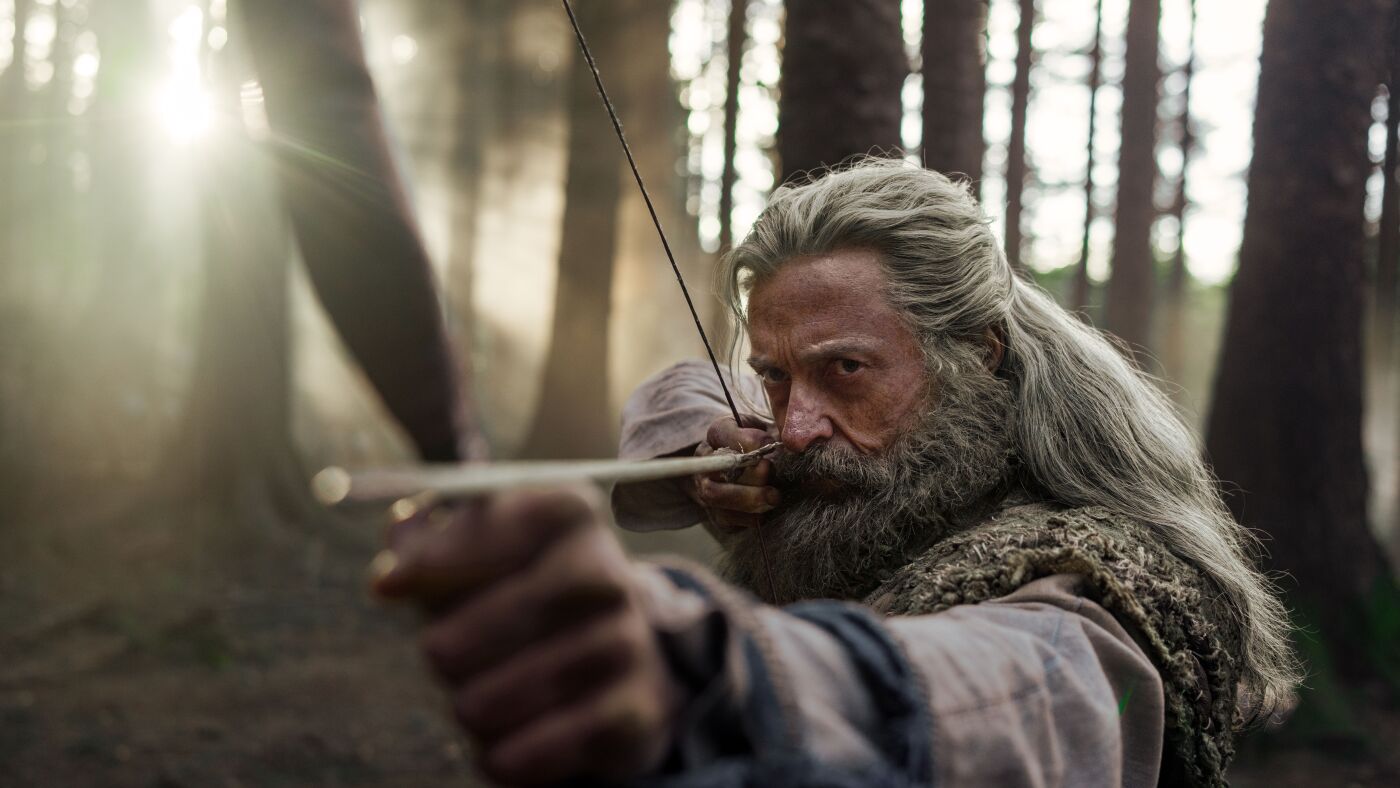
Hugh Jackman as Robin Hood.
A24
hide caption
toggle caption
A24
Gunmetal gray sky, barren muddy terrain, a half-starved child begging a wizened title character for a scrap of food moments before he slashes her throat. It’s hardly the opening you imagine for a film about a folk hero — especially one who robs the rich and gives to the poor. But then, The Death of Robin Hood is the brainchild of Michael Sarnoski (Pig, A Quiet Place: Day One), so maybe leave expectations in the lobby.
Sarnoski gives us Hugh Jackman’s battle-scarred, gray-bearded Robin as a tormented wretch, not the brash strapping outlaw of legend — alone, wracked by regret over the countless lives he’s ended or ruined. When we meet Robin in 1247 A.D., he seems pursued as much by his own guilt as by avenging relatives of the innocents he murdered in younger days (say, that half-starved but surreptitiously knife-clutching little girl).
So he tries to beg off when Little John (Bill Skarsgård, unrecognizable) approaches him with the promise of one more “adventure” — to rescue the wife John’s claimed after killing her husband, from the neighbors who then rescued her from John. Robin notes correctly that she’s not really John’s wife, yet he reluctantly brings his quiver, and an arm that can still shoot an arrow through a skull and out an eye socket at 50 paces.

He proves formidable, but not immortal. This “adventure” leaves him gravely wounded, dragged across forbidding terrain to a remote, cliff-top convent, where a prioress (Jodie Comer) with a curative touch and a marginally gentler way with a knife will attempt to bleed him back to health.
Sarnoski’s indie-realist approach to blood-letting — whether Pitt-ishly clinical, or Game of Thrones-esque in its brutality — is never less than arresting, and Jackman’s certainly up for the gore, extinguishing his torch in one opponent’s mouth and burying a hatchet in another’s back.
But it’s in the film’s later stages, where the character grapples with what his youthful righting of wrongs has cost both him and bystanders, that the actor and this medieval thriller find their emotional footing. Sarnoski is exploring the way we edit and augment the tales we tell about ourselves as we pass through the world, noting that hedges and embellishments will ultimately be laid bare.
If we live long enough, we’ll face a reckoning, a lesson Jackman’s delivered before as Logan, another troubled figure of legend. This film’s latter moments have a similarly eulogistic quality, augmented by Comer’s affecting turn as an accepting if anguished guardian at the hour when life ends, and myth takes flight.
Movie Reviews
‘Dreams of Violets’ Review: What Does a Film Made Entirely with AI Look Like? Ash Koosha’s Iranian Protest Drama Is Dramatically Numbing, but It’s Still a Startling Portent of the Future

“Dreams of Violets,” which premiered last week at the Tribeca Festival, is the first movie generated entirely by AI to be programmed at a major film festival — and it’s also the first movie generated entirely by AI that I’ve seen. As such, those of us at the premiere were really watching — and evaluating — two films at once. The first is a drama, set in Tehran, written and directed by the expatriate Iranian Ash Koosha (who is now a London-based tech entrepreneur), that depicts the days of protest and crackdown and state-sanctioned killing that took place five months ago, in January, as waves of Iranian citizens poured into the streets to register their anger at the country’s theocratic regime. I didn’t find that movie to be particularly effective. In fact, after a while I thought it was stultifying.
But the other movie, which is far more interesting and significant, is the one that demonstrates, simply by virtue of its existence, what some of the possibilities might be for the use of AI within the world of feature filmmaking. This is a delicate and dicey subject to even bring up, since the industry right now is in the grip of multiple perceptions and anxieties about what AI portends for the future of entertainment. And all of this is changing by the week. Just look at how quickly we went from Steven Soderbergh, in April, ruffling feathers for admitting that he used AI to craft fantasy sequences for his documentary “John Lennon: The Last Interview” to Martin Scorsese — as moral and respected a voice as there is in the industry — signing on, at the beginning of June, to partner with the German generative-AI firm Black Forest Labs in order to speed up the storyboarding process. Darren Aronofsky has now crossed the AI barrier as well, using it to make a series of web videos about the Revolutionary War.
These, of course, are all baby steps. But the baby is going to grow up. And what will it look like when it does? “Dreams of Violets” offers indications of at least a few of the places that AI, as its symbiosis with the industry grows and gathers force (which it surely will), might go.
But first, an aesthetic question: Is “Dreams of Violets” a weirdly distant and unsatisfying movie because it was made with AI? The strange answer to that is yes, but not really. It’s actually the form of the movie that’s odd and off-putting: a barely scripted series of anecdotes, or mere moments, with little in the way of dramatic development. Ash Koosha based the film on journalistic reports, photographs, and eyewitness accounts, and it’s clear that he wanted it to feel like we were watching scenes from a documentary, which sounds like a valid impulse. (Plenty of movies, including last year’s combat docudrama “Warfare,” have been staged that way.) But though the characters in “Dreams of Violets” look and talk like real people, and the rubble-strewn urban streets look and feel like real rubble-strewn urban streets, we’re barely given a context for what we’re seeing: soldiers killing civilians with random cruelty, which is the heart of the movie — at least, for the first half, after which it becomes less severe and even less interesting.
If you see a soldier killing a civilian in a documentary, it’s horrifying, but the effect is 100 times less powerful in a film that simply looks like a documentary, since we know, in our gut, that we’re not watching reality. That’s why the quality that draws us into a movie, even if it is a documentary, is the connection we feel to the people we’re watching. But Ash Koosha hasn’t scripted “Dreams of Violets” that way. He has made a movie with an uncanny-valley problem, an “existential” drama that’s all “authentic” but abstract moments: the vérité political-war-movie equivalent of calendar art. It’s like synthetic prize-winning photojournalism that moves.
At the time of the January protests, some observers thought the Iranian regime would topple (the Iran War has now made it clear what a naïve belief that was). But “Dreams of Violets” is not a days-of-rage tale of inspiration. It’s set after the protests have already been contained (the country’s police are doing a clean-up operation), and what it offers, mostly, is raw snapshots of state-sanctioned murder and political oppression. Yes, we “get to know” half a dozen characters — a boy in a wheelchair, his physician older brother, a reminiscing old woman, a music student, and several others. But Koosha doesn’t create fully realized scenes.
When “Dreams of Violets” played at Tribeca, the justification for the film — the reason given by Koosha to make it entirely with AI — is that it couldn’t have existed otherwise, and that the figures we’re seeing onscreen are all based on real people. Maybe that’s true, but effective art needs no justification. If you wanted to be cynical about it, you could say that Ash Koosha is exploiting the tragedy of his homeland to have the best possible excuse to craft an AI showreel. His company builds AI-based characters and has also played with using AI to generate pop music. In “Dreams of Violets,” he’s like the creator of Tilly Norwood pretending to be the director of a movie like “No Other Land.”
But if “Dreams of Violets,” as a movie, is mostly a bust, as an AI showreel it’s something more. Several critics have nitpicked visual flaws in the film’s design, but from moment to moment what I saw in “Dreams of Violence” looked plenty textured and realistic. Does this mean that AI can “make a movie”? No. But it does mean that AI can give you scenes of roiling tumultuous Civil War set in the hurly-burly of Tehran at sunset, with soldiers roaming the streets and forcing citizens into vans as others scurry out of the way, and it can make you believe your eyes. And here’s the buried lead: The film’s entire budget was $2,000. I don’t want to be the bearer of bad news, but the most powerful message to emerge from
“Dreams of Violets” isn’t that the Iranian regime is a ruthless pack of totalitarian oppressors. It’s that $2,000 can now buy a hell of a lot of motion picture.
-

 Kansas1 minute ago
Mixed results for Kansas City World Cup start as some businesses struggle
-

 Iowa3 minutes ago
Iowa High School Baseball Stats: Leaders On The Diamond This Summer
-

 Kentucky11 minutes ago
Kentucky MBB players were dishing out smiles at the Kentucky Children’s Hospital this week
-

 Louisiana18 minutes ago
Gov. Landry declares state of emergency after flooding, severe weather across Louisiana
-

 Maine21 minutes ago
Important things to know about the Maine boys lacrosse state finals
-

 Maryland26 minutes ago
University of Maryland football player arrested for harassment
-

 Michigan33 minutes ago
Michigan Department of Corrections to launch L.E.A.D. Academy program this fall
-

 Massachusetts36 minutes ago
Two men indicted for Hinsdale robbery after ‘cigarette trail’ leads through Vermont, Massachusetts

