Science
'More serious than we had hoped': Bird flu deaths mount among California dairy cows

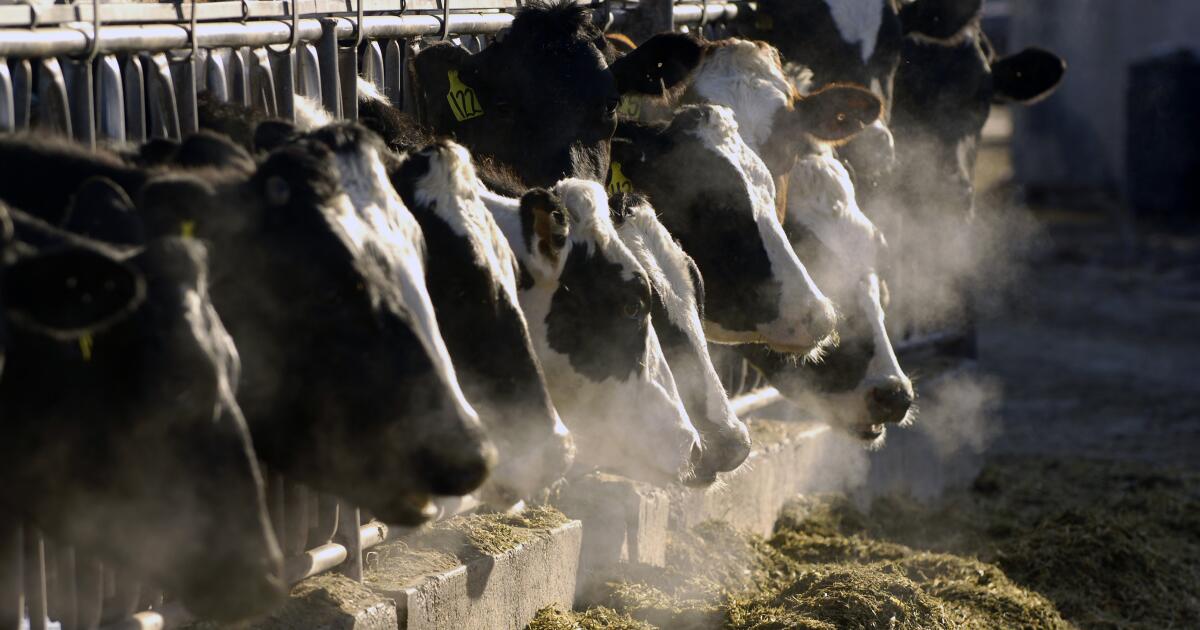
As California struggles to contain an increasing number of H5N1 bird flu outbreaks at Central Valley dairy farms, veterinary experts and industry observers are voicing concern that the number of cattle deaths is far higher than anticipated.
Although dairy operators had been told to expect a mortality rate of less than 2%, preliminary reports suggest that between 10% and 15% of infected cattle are dying, according to veterinarians and dairy farmers.
“I was shocked the first time I encountered it in one of my herds,” said Maxwell Beal, a Central Valley-based veterinarian who has been treating infected herds in California since late August. “It was just like, wow. Production-wise, this is a lot more serious than than we had hoped. And health-wise, it’s a lot more serious than we had been led to believe.”
A total of 56 California dairy farms have reported bird flu outbreaks. At the same time, state health officials have reported two suspected cases of H5N1 infections among dairy workers in Tulare County, the largest dairy-producing county in the nation. With more than 600,000 dairy cows, the county accounts for roughly 30% of the state’s milk production.
Beal’s observations were confirmed by others during a Sept. 26 webinar for dairy farmers that was hosted by the California Dairy Quality Assurance Program — an arm of the industry-funded California Dairy Research Foundation. A summary of the findings and observations was reported in a newsletter published earlier this week by the program.
Beal, along with Murray Minnema, another Central Valley veterinarian, and Jason Lombard, a Colorado State University veterinarian, described their observations and data to dairy farmers to help them anticipate the signs of, and treatments for, the virus.
The webcast was not made available to The Times.
“The animals really don’t do well,” Beal told The Times.
He said the infected cows he has seen are not dissimilar to people who are suffering from a typical flu: “They don’t look so hot.”
He and others think the recent heat may be a factor.
Since the end of August, the Central Valley has suffered multiple heat waves, with daytime temperatures exceeding 100 degrees.
“Heat stress is always a problem in dairy cattle here in California,” he said. “So you take that, you add in this virus, which does have some affinity for the respiratory tract … we always see a little bit of snotty noses and heavy breathing in animals that are affected … and for some of them, just the stress takes them.”
Indeed, most of the deaths are not directly the result of the virus, he said, but are “virus adjacent.” For instance, he has seen a lot of bacterial pneumonia, which is likely the result of the cow’s depressed immune system, as well as bloat.
He said that when the cows aren’t feeling well, they often don’t eat.
“The digestive tract, or rumen, basically requires movement. There has to be things moving out of that rumen constantly in order for the pH balance and microbiome to stay where it should be,” he said. So, when they’re not eating, things in the digestive tract stagnate.
That, in turn, causes them to “asphyxiate because their diaphragm has too much pressure on it.”
In addition, he and others are seeing a lot of variation in the duration of illness.
While early reports had suggested the virus seemed mild and lasted only about a week or two, others are seeing it last several weeks. According to the industry newsletter, at one dairy, cows were shedding virus 14 days before they showed clinical signs of illness. It then took another three weeks for the cows to get rid of the virus.
They’re also noticing the virus is affecting larger percentages of herds — in some cases 50%-60% of the animals. This is much more than the 10% that had been previously reported.
Some say the actual rate may be even higher.
“I would speculate infection is even higher; 50-60% are showing clinical signs due to heat stress or better herd monitoring earlier in infection. Unfortunately, few or no herds have been assessed retrospectively through serology testing to determine actual infection rates,” said John Korslund, a retired U.S. Department of Agriculture veterinarian epidemiologist.
Cows are also not returning to 100% production after they’ve cleared the virus, said Beal. Instead, he and others say it’s closer to 60%-70%.
“There’s going to be some animals that are removed from the herd, because they never seem to come back,” he said.
Beal said his firsthand observations have really challenged his notions about the disease, which has so often been described as mild and insignificant.
“Once I saw it myself, I said, this is something I need to communicate with my clients about … this is not something that is just a joke at the dinner table,” he said. “I didn’t want people to not take it seriously, because I see what it is doing to the animals, and it is rough to see — as an animal caretaker, as a veterinarian like myself — it’s just not something that’s enjoyable. It’s more serious than we had been led to believe.”
He said he is working hard with Central Valley farmers to treat the animals — largely by making sure the cattle are adequately hydrated. He also treats sick cows with a medication similar to aspirin, to reduce fever, pain and discomfort.
He said the treatment is pretty effective, and seems to be helping.
Others are not surprised H5N1 is becoming more severe in cows.
“As I’ve said since we first learned of the outbreak in dairy cows, nothing we’ve learned about this virus is new or unexpected,” said Rick Bright, a virologist and former head of the U.S. Biomedical Advanced Research and Development Authority. “It’s behaving exactly as we’ve come to know of this virus over the past 25 years. It’s spreading very efficiently now among mammals, and it’s mutating and adapting to mammals as it does.”
He credited state health officials and veterinarian for “being more forthcoming and transparent with their data” than other states, and said this may be the reason the virus seems to be hitting California cows so hard.
“This virus is out of control. It is time for urgent and serious leadership and action to halt further transmission and mutation,” Bright said. “The concept of letting it burn out through food animals, with unmonitored voluntary testing, has failed. There are pandemic playbooks that we need to dust off and begin to implement.”
In the meantime, officials continue to reassure the public about the safety of the nation’s dairy supply. They say pasteurization inactivates the virus. They also warn people to stay away from raw milk.
Beal noted one of the sentinel signs that a farm has been infected is dead barn cats that have drunk the infected, raw milk.
“It’s weird, actually, how consistently that seems to be happening everywhere,” he said. “It’s pretty sad and shocking. But that’s one of the first things that people see sometimes.”
There is also some suggestion that some cows that have recovered from the virus have been reinfected, although this has not been confirmed.
“We don’t have any data to support this yet, but there have been anecdotal reports of reinfections in herds,” said Kay Russo, a dairy-poultry vet with RSM Consulting, an international consulting firm.
She said it could just be a persistent infection that is being observed, but also speculated that the virus could be mutating rapidly — and evolving “enough to reinfect an animal.”
And Jason Lombard, one of the speakers at the dairy webinar, said in an email that he had been told by veterinarians that they are observing clinical signs of disease in animals that had been infected, “but I don’t believe any of them have been confirmed via testing.”
As of Oct. 4, California officials have reported 56 infected herds. Although state officials will not disclose the location of these herds, the Valley Veterinarians Inc. website — a veterinary clinic run by large-animal vets in the Central Valley — said the infections are in Tulare and Fresno counties.
Steve Lyle, a California Department of Food and Agriculture spokesman, would not confirm the counties.
There are more than 200 herds in Tulare County and more than 100 in Fresno County. The state’s largest raw milk dairy is also in Fresno County.
Requests by The Times to observe infected farms or speak with the owners of infected dairies went unanswered by the state and declined by industry insiders.
“We are not recommending farmers engage on this due to farm security issues we’ve had,” said Anja Raudabaugh, chief executive officer of Western United Dairies, an industry trade group for California dairy farmers. “It is very unwise to consider viewing a dairy under quarantine … this is just not the time.”
She said her organization doesn’t want anyone “doxing” farmers or increasing traffic at or near a farm, “both of which have happened.”
In the last week, the H5N1 virus has been detected in wastewater samples collected in Turlock, San Francisco, Sunnyvale and Palo Alto.
State epidemiologist Erica Pan said it was hard to know where the virus is coming from. While Turlock is a dairy center, the hits in the Bay Area cities could potentially be from wild birds, she said, but the source is not known.


new video loaded: NASA Announces Artemis III Crew
transcript
transcript
NASA Announces Artemis III Crew
NASA announced the crew of Artemis III mission, which will fly to low-Earth orbit to test rendezvous and docking maneuvers with one or two lunar landers.
-
“I am excited to welcome you as the next crew in the Artemis journey to successfully return to the moon — this time to stay.” “I’m honored by the role that I’ve been given. I’m also very humbled by the task in front of us. But first and foremost, I’m grateful.” “So with that, the Artemis II crew, comrade, hands you the baton. You got the controls.” “As you know, we had a significant anomaly at our Launch Complex 36A on May 28. We’ve redoubled our efforts and are moving forward.”
By Alisa Shodiyev Kaff
June 9, 2026
Science
Santa Monica Mountains’ last steelhead trout survived the Palisades fire — and even had babies

Scientists feared the Santa Monica Mountains’ last remaining steelhead trout were dead, smothered by debris flows unleashed by the Palisades fire.
But the endangered fish surprised them: A team of biologists recently spotted 30 of the rare trout — and 21 babies — in Topanga Creek.
“There was a lot of happy dancing in the creek,” said Rosi Dagit, principal conservation biologist for the Resource Conservation District of the Santa Monica Mountains, which works with public and private landowners to conserve natural resources.
That’s because the steelhead here are endangered, at both the state and federal levels. Once, they swam in most streams of the Santa Monicas, but their numbers plummeted amid overfishing and coastal development. Increasingly frequent wildfire has further stressed their habitat. Topanga Creek, a biodiversity hot spot, is home to their last known population in the mountains that stretch from the Hollywood Hills to Point Mugu in Ventura County.
The trout that were spotted, including this one, are part of a distinct Southern California population that’s listed as endangered at the state and federal levels.
(RCDSMM Stream Team)
The California Department of Fish and Wildlife spearheaded a complex mission to rescue trout threatened by the Palisades fire that sparked in January 2025.
Time was of the essence. The fire hadn’t yet been fully contained. But rain was on the way, which would sweep massive amounts of sediment from the denuded hillsides into the water. Fish are often killed this way.
Crews stunned the fish with electricity, scooped them up in buckets, trucked them to a hatchery and ultimately moved them to Arroyo Hondo Creek in Santa Barbara County.
Within days, Topanga Creek was choked with mud. Some assumed the fish left behind were goners.
But in March, the conservation district’s team found four. The following month, when water conditions were clearer, they saw more.
“These fish continue to amaze me,” said Kyle Evans, environmental program manager for the state Department of Fish and Wildlife, who had seen the damage to the creek. “I had seen populations get wiped out in similar situations. So when I heard, I was thrilled.”
Evans surmises the fish that survived were in an area of the creek where less charred material and sediment were swept in.
“These fish likely hunkered down, were hiding under some rocks or places to try to get away from the main concentration of flow,” he said. “And luckily they weren’t buried.”
The ones that were spotted were fairly small, around 6 to 14 inches. Rainbow trout and steelhead trout are the same species, but with different lifestyles. If the fish remain in freshwater, they’ll be considered rainbows. However, they can migrate to the ocean and become steelhead, where they typically grow larger before returning to their natal waters to spawn.
Topanga Creek hasn’t fully recovered from the damage it sustained, but scientists say it’s looking better. Surveys last year were “so depressing,” Dagit said, with very few animals, and stretches that were essentially transformed into flat roads from all the sediment buildup. Some of the riparian canopy burned right down to the creek.
Then came 32 inches of rain over the last nine months, scouring out and moving sediment, creating deeper pools. Dagit said they recently found newt egg masses for the first time in years, as well as a few adult newts and many frogs. Plants that provide cover are starting to recover.
She provided photos comparing certain pools last year and this year, some dramatically transformed. In September 2025, the Shrine Pool could have been an overgrown hiking trail. This April, it was filled with shallow water.

The Shrine Pool in September 2025, left, and the same location in April 2026, right, with RCDSMM’s Isaac Yelchin donning a wetsuit.
(RCDSMM Stream Team)
Topanga Creek is home to another endangered fish, the small but hardy northern tidewater goby, often described as cute. Not long before the trout operation, Dagit led a rescue of hundreds of these fish too. Many were repatriated to the lagoon at the mouth of the creek in a moving ceremony last June.
There’s still the matter of what to do with the trout that were moved to Santa Barbara County last year. Evans would like to bring them home to the Santa Monicas at some point, but isn’t sure if it will happen. On one hand, they could bolster the small, genetically isolated surviving population. On the other, they might inadvertently bring in a disease or bacteria. There is some time to decide. Evans estimates the creek still needs to recover for two to three more years.
For now, the fish are functioning fine in their adopted creek. Experts worried the trauma wrought by the move would disrupt their spawning process, but they had babies that spring. This year, they spawned again.

The Pacifica Municipal Pier was shut down and taped off Thursday after city workers noticed cracks running through the landmark structure and concrete chunks falling into the ocean.
It’s just one of many coastal California structures that have recently crumbled under pressure from a rising and relentless ocean.
Officials from the small, beach city south of San Francisco said the pier was closed due to “cracking, separation, and displacement of the concrete walkway and structural elements.”
It will stay closed while structural engineers asses its safety.
Photos taken by city employees show a wide crack that runs from top to bottom and across the structure as well. Other photos show a large horizontal crack under the foundation of a small restaurant on the pier, the Chit Chat Cafe.
The cafe was also shut down.
This is not the first time the 53-year-old pier has shown signs of stress. In 2021, part of it was shut down after handrails along the edge collapsed. And in 2023, after a series of storms pummeled the Central California coast, damaging parts of the pier, the structure was partially closed for more than year.
Those same storms caused extensive damage in Aptos and Capitola, 70 miles south, where piers and waterfront infrastructure were swept away or damaged.
In 2024, a 150- to 180- foot section of the Santa Cruz wharf was ripped off by powerful waves.
At least 10 of the state’s dozens of coastal public piers were closed for part or all of 2024 due to structural damage sustained in winter storms since 2022. At least five others have longer-term upgrades planned to address structural issues.
“These things are costly to maintain,” said Zach Plopper, senior environmental director at Surfrider. “They are a part of our California coastal culture in many ways, but we’re going to need to reckon with, one, the state that they’re in, and two, the continuous and worsening threats they’re going to experience,”
He said most of the piers were constructed in the early 1900s, and they weren’t built to withstand decades of rough seas, storms and rising sea level.
“With this incoming El Niño, which is forecasted to be significant, and this marine heat wave we’re in the midst of, we’re kind of in uncharted waters as far as what this winter could bring in terms of storms and swells to the California coast, and we’re likely going to see a lot more damage,” he said. “Not just piers, but roads and other coastal infrastructure up and down the state.”
There was no storm in Pacifica earlier this week, so no single event could be blamed for the destruction.
However, a 2025 report from an outside engineering firm, GHD, found that several sections of the pier were in “poor” or “serious” condition, and they recommended closure before anticipated storms or events that could “subject the piles to high winds, swells and large waves.”
The firm found several areas of the pier where concrete was missing and rebar was exposed and corroding.
“The pier has continued to experience high winds and large waves in a harsh marine environment,” the engineers wrote in the report, noting that continuous exposure to seawater or marine spray was “detrimental” to the structure.
A 2023 city report estimated it would cost $19 million to repair.
That same year, a state law was enacted to require local governments along the California coast to plan for sea level rise in the coming decades.
Sea level has risen some 8 inches, on average, along the coast in the past 150 years, Plopper said, and researchers anticipate another foot in the next 25 years.
“We’re going to see profound shifts on our coastline, none that we have ever experienced before, and building static structures on the coast just doesn’t work all that well,” he said. “We’re going to have to make some really hard decisions.”
-

 Arizona20 seconds ago
Texas-based Buc-ee’s reveals opening date for first Arizona store
-

 Arkansas3 minutes ago
Arkansas lands grant to battle deadly cattle tick disease
-

 California8 minutes ago
Operation Hands Down disrupts Central California gangs – Inside CDCR
-

 Colorado15 minutes ago
$25.7M Colorado private ski mountain property heads to auction
-

 Connecticut18 minutes ago
Connecticut driver spots snake in car while driving, police say
-

 Delaware23 minutes ago
Delaware Bay’s new oil spill response boat officially christened
-

 Florida30 minutes ago
Sheriff’s Office investigating fatal shooting of child in Florida City
-

 Georgia33 minutes ago
Northwest Georgia Congressman pushes for impeachment of federal judge for misconduct

