Pennsylvania
Need a new hunting spot? Pennsylvania boasts abundant public options.


Pennsylvania has one of the richest hunting heritages in the nation, so it makes sense that it would have one of the largest hunting populations in the country. But, in a state where the vast majority of the land is privately owned, there’s also a surprising amount of publicly accessible land to pursue deer, turkeys, black bear and other game species.
Within its borders, the Keystone State has about 28.8 million acres of land. Of that total, according to information from the Pennsylvania Game Commission (PGC), at least 6 million acres are open to public hunting. That equates to more than 20% of the total land in the state, pretty impressive for a heavily populated East Coast state.
The most well-known of the state’s public hunting-land options is the PGC’s State Game Lands (SGL) system, which started in 1920 with a 6,288-acre parcel in Elk County. PGC spokesman Travis Lau said today, there are roughly 1,535,000 acres across 312 game lands, with game lands in every county except Delaware County. Even Philadelphia has an SGL now, with a small, 17-acre parcel opened to bowhunting just this year.
Locally, the Lehigh Valley is home to all or part of three State Game Lands — the 1,314-acre SGL 205 off Route 100 in Lehigh County; the 7,805-acre SGL 168 on the Blue Mountain in Northampton, Carbon and Monroe counties; and the 8,613-acre SGL 217 on the Blue in Lehigh, Carbon and Schuylkill counties.
“Approximately 1,174 acres have been added so far this year, though there are additional acquisitions pending that have been approved but not yet finalized,” Lau said. “We prioritize certain types of properties and acquisitions, including those that fill in indentures to, adjoin or improve access to existing game lands; those where some unique or otherwise important habitat feature or wildlife species exists; and those near population centers or acquired through donation or partnership.
“These are just a few examples, but some of the more common priorities exhibited in properties we acquire.”
In addition to its SGLs, the PGC also partners with private landowners who are willing to open their land to public hunting through a program called the Hunter Access Program. Currently, there are approximately 1.65 million farmland and forest acres open to hunting through this program.
State Game Lands 205 off Route 100 in Lehigh County is one of 312 SGLs owned by the Pennsylvania Game Commission, providing more than 1,535,000 acres of land open to public hunting.Mark Demko | For lehighvalleylive.com
Other public hunting opportunities include about 2.2 million acres of state forest and more than 240,000 acres of state parks managed under the Pennsylvania Department of Conservation and Natural Resources (DCNR), as well as the 70,000-acre Delaware Water Gap National Recreation Area and 500,000-plus acres in the Allegheny National Forest in the western part of the state.
DCNR spokesman Wesley Robinson said 100 of the 124 state parks are open to public hunting during established hunting seasons. Locally, these include the 1,164-acre Jacobsburg Environmental Education Center near Belfast off Route 33.
It’s important to note that some state parks, especially those in the southeastern part of the state, have special regulations or restrictions when it comes to hunting, so interested individuals need to do their homework before showing up to hunt.
“Hunters should use extreme caution with firearms at all times,” Robinson said. “Other visitors use the parks during hunting seasons. Firearms and archery equipment used for hunting may be uncased and ready for use only in authorized hunting areas during hunting seasons.”
In addition to the above-mentioned programs, there are also other hunting opportunities through township and county parks, as well as land preservation organizations such as The Nature Conservancy. Just one example is Trexler Nature Preserve in the Schnecksville area. Part of Lehigh County parks system, the 1,495-acre preserve provides bowhunting opportunities on some of its land. Other Lehigh County-owned properties like Leaser Lake are also open for hunting, as are a number of parks owned by Northampton County.
While public-land hunting opportunities are plentiful in the state, the number of hunters using public land may surprise some. Every couple of years, the PGC conducts a Hunter Survey that surveys hunters on a variety of topics, one of which is whether they hunt public land, private land or both.
In the 2024 survey, which covered the 2023-24 hunting-license year, some 9,300 hunters were surveyed, with 47% responding. Of those, 56% said they hunted only private land, while 23 percent hunted both public and private. Only 21% of respondents said they hunted public land exclusively.
Statistically, that’s similar to the 2021-22 hunting-license year survey of 6,000 hunters, in which 55% of respondents said they only hunted private land and 16% only hunted public land. For that year, 29% said they hunted both.
If you’re interested in exploring a new piece of public ground this year, it’s easier than ever to get started since there are now so many online resources and apps to assist you. Hunting apps like onX, HuntStand and Spartan Forge are excellent tools since they highlight public- and private-land boundaries, plus provide 2- and 3-D maps and a host of other resources to help with planning your next big- or small-game outing.
The PGC also offers an excellent Mapping Center through pgc.pa.gov that individuals can use to explore its Game Lands system and identify the private properties enrolled in the Hunter Access Program, while the DCNR offers the same for its state forests and parks at dcnr.pa.gov.
If you need a new place to hunt, or your old spot is no longer producing like you’d hoped, don’t forget to explore Pennsylvania’s public-land options. There are more publicly accessible acres out there than you think, and one of these parcels just might lead you to your next trophy or meal for the dinner table.
Our journalism needs your support. Please subscribe today to lehighvalleylive.com.



The boat dock at the entrance of Penn’s Cave.
HUNTER SMITH / THE EXPRESS

HUNTER SMITH / THE EXPRESS
The colored light room in Penn’s Cave.
BELLEFONTE — After four generations of family stewardship, the owners of Penn’s Cave and Wildlife Park are asking the state to take over one of Centre County’s most iconic attractions in an effort to preserve it from future development.
Following remarks from CEO Russ Schleiden and his daughter, Jeanine Watson, the Centre County Commissioners on Tuesday endorsed the plan to make the natural wonder Pennsylvania’s 126th state park.
“This has been a very difficult decision for us,” said Schleiden. “But we feel that it’s a very important part of, not only Centre County, but the Commonwealth of Pennsylvania, and that it should be preserved in perpetuity.”
The Schleiden family has spent decades as custodians of America’s only all-water, limestone cavern, working to expand and conserve Penn’s Cave, which contains the headwaters of Penn’s Creek. To ensure the 1,400 acres of land and its waters are around for generations to come, the family is petitioning the Pennsylvania Department of Conservation and Natural Resources (DCNR) to designate the Penn’s Cave estate a state park and take over its stewardship.
The proposed transfer includes the cavern, Cave House, surrounding land and waterways, five homes and several barns. Watson said the family has been working toward the proposal for three years.
“I know the state, DCNR, has wonderful plans and visions for enhancing it and taking it to that next level beyond what we could do,” she said.
Penn’s Creek, which starts in the cavern, flows 34 miles to Selinsgrove where it joins the Susquehanna River Basin before emptying into the Chesapeake. The state has made significant investments in protecting those waters, and the proposed transition would expand that work.
“The tributaries also support the native brook trout,” said Schleiden, naming specifically Little Poe and Big Poe creeks, which are known for their fishing.
Penn’s Cave, he said, has always been supportive of “wildlife for everyone.”
With the commissioners’ help, Penn’s Cave and Wildlife Park has invested $2 million into the local wetlands, protecting local fauna while improving the area’s accessibility. Schleiden said transferring ownership to the state would ensure that mission remains central to the property.
“We strongly desire this to go to the state to protect and continue to conserve, and have it available to the public,” Watson said.
The property also carries historical significance. Penn’s Cave and Hotel was listed on the National Register of Historic Places in April 1978 for its local importance.
The Cave House, or hotel, was built in 1885 by the Long family, who first commercialized the cavern. At the time, visitors traversed the cave by boat using lanterns. That changed in 1927, when the Campbell family, who emigrated from Scotland to the land, electrified the cave.
“It probably had electricity before more than most of the local residents,” Schleiden said.
State Rep. Kerry Benninghoff, who helped coordinate with the state on the proposed transition, also joined the commissioners for the discussion.
Benninghoff said the move would require the endorsement of the governor and both chambers of the General Assembly. The governor is aware of the plan and visited the site last year, and Benninghoff said he has drafted legislation outlining the mechanics of the transition.
“I can’t think of a better time in our country and our county’s history, at the semiquincentennial, to make this a reality,” he said. “If you want to look at Americana in its best, the park I think exemplifies that.”
“In the long run, I think this is a tremendous investment for the commonwealth,” Benninghoff said, noting the transition would not be easy but the commissioners’ endorsement could help move the project forward during this budget cycle.
The proposal also carries potential economic benefits for the region.
Penn’s Cave and Wildlife Park already attracts visitors from all 50 states and several countries. During its peak season, the park employs dozens of local community members. The attraction is a multigenerational employer in Gregg Township, providing jobs for members of the Schleiden family and their employees, many of whom are young adults and teens.
Transferring ownership to DCNR and becoming Pennsylvania’s 126th state park could increase tourism and economic engagement in the area, the owners said. State parks in rural communities often bring tourism dollars and expand employment opportunities as operations grow.
Benninghoff said he could envision additional public amenities, including a campground, while emphasizing the property would remain accessible.
“This is not going to be an exclusive property that no one can access,” she said. “It’s actually one we want more people to enjoy.”
The commissioners each praised the work Schleiden and Watson have done and expressed support for the state park designation, citing the conservation, education, historical, tourism and recreational benefits of the proposal.
“Penn’s Cave is a premier tourist attraction in Centre County,” said Commissioner Mark Higgins, who noted it is one of only a few caves accessible by boat worldwide. “With the trout in the water and the wild animals surrounding it in the wildlife park, it’s a really, really fun half-day attraction to visit.”
“It’s just irreplaceable,” he said.
Commissioner Amber Concepcion called the property “an outstanding area of natural beauty” and added that it provides an opportunity for education and recreation.
“It’s a great place for kids to learn and for adults and people of all ages to spend a summer afternoon,” she said. “It would make a fantastic state park.”
Dershem called the opportunity “once in a lifetime” and said it would be a “crying shame” if the property were developed instead.
“This is an amazing opportunity for the Commonwealth of Pennsylvania to invest in a property that is literally irreplaceable, iconic to our region and unique. I don’t know that you’ll find anything quite like it,” Dershem said. “It’s an amazing place.”
Penn’s Cave, he added, “represents who we are in Centre County” and is “natural splendor at its best.”
Benninghoff said their support will emphasize the urgency of completing the transition to state legislators.
“This endorsement by the county, visitors bureau and other people helps to emphasize that we’d really like to get this done, and time is of the essence,” he said. “People have been knocking on their door, wanting to purchase this land and break it all apart, and a lot of it would go into development.”

STATE COLLEGE, Pa. (WJAC) — It was a strong opening day in State College for the 60th anniversary of the Central Pennsylvania Festival of the Arts.
The festival kicked off with the traditional children’s day festivities.
Kids lined South Allen Street, displaying and selling their latest creations.
6 News spoke with one of the young businessmen there — Trevor Winterich — who was busy with his 3D toys.
On Thursday, the festival’s sidewalk sales open, featuring artists and performers from across the country.
BE THE FIRST TO COMMENT
The festival will then wrap up on Sunday.
Pennsylvania
Pennsylvania state trooper to be laid to rest after being fatally struck in Schuylkill County

BUTLER TWP., Pa. (WPVI) — A Pennsylvania State Trooper who was killed in a crash on Interstate 81 will be laid to rest Wednesday.
A public viewing for Trooper Michael Pahira, Jr., is scheduled from 8 a.m. to 10 a.m. at North Schuylkill High School in Butler Township.
A funeral will follow at 11 a.m.
Trooper Pahira was fatally struck on I-81 last week by a tractor-trailer while conducting a safety inspection on another truck in Cass Township, Schuylkill County.
According to state police, a passing commercial vehicle hit Pahira while he was conducting the inspection with his emergency lights activated.
The alleged driver, 33-year-old Michael Bon, is facing homicide charges. He is being held on $700,000 bail.
Pahira, 44, was assigned to Troop L, Frackville and had been with the state police for 20 years.
Copyright © 2026 WPVI-TV. All Rights Reserved.
-
 Entertainment1 minute ago
Lucas Museum to give free annual passes to South L.A. neighbors, host community preview day
-
 Lifestyle7 minutes ago
Meow Wolf taps famed L.A. animation house for its new Los Angeles venue
-
Politics14 minutes ago
Column: Trump decries ‘communism’ while his government takes ownership of companies
-
 Science17 minutes ago
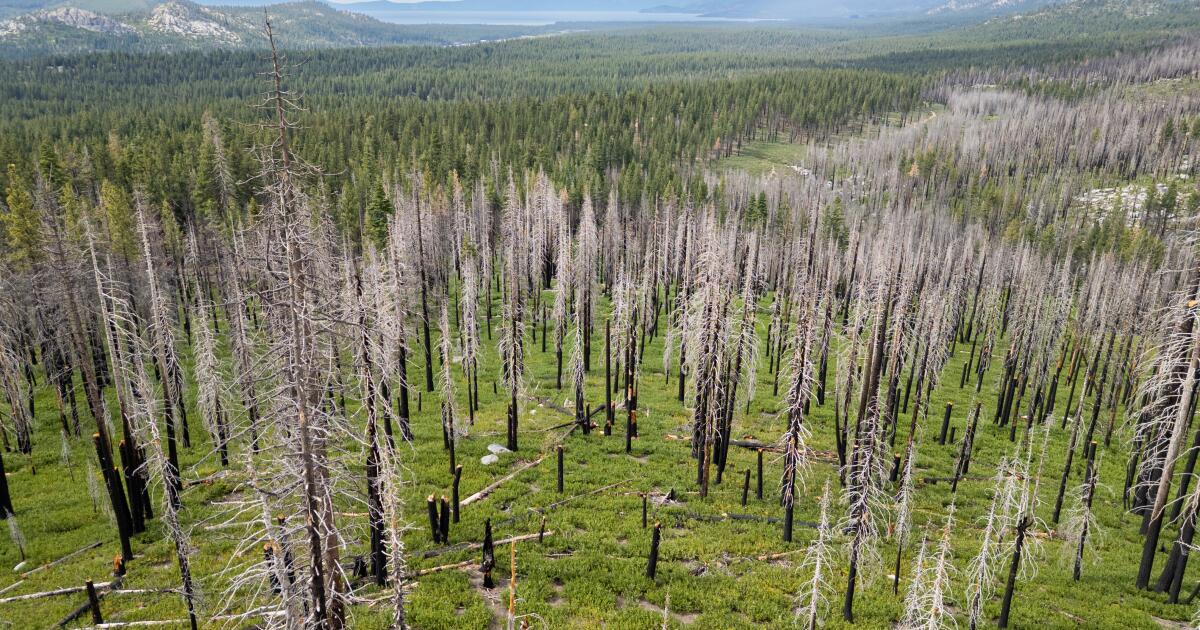
‘I’d rather my house burn down than get cancer’: Herbicide use upends California’s fight to save forests
-
 Sports22 minutes ago
Dodgers scheduled to visit White House in late July to celebrate 2025 World Series win
-

 World32 minutes ago
Former US Olympian pleads not guilty in DC reflecting pool vandalism case
-
 News59 minutes ago
Former Olympian pleads not guilty in reflecting pool vandalism charges
-

 Los Angeles, Ca2 hours ago
Heat advisory, beach hazards in effect as Southern California sizzles


