Ohio
Shot through the heart: fast draw is alive and well in Ohio


Many of the traditions of the American West are lost to us now. Most will never know what it’s like to ride a wagon train, move a herd of cattle out of state or die of consumption.
But there’s still one great cowboy pastime that can be enjoyed, and Ohio is at the heart of it.
Ygal Kaufman
/
Ideastream Public Media
The sport of fast draw is thriving, and Ohio has the oldest still-running organization that specializes in this unique activity that is as much art and performance as it is sport.
Drag racing with a firearm
The Ohio Fast Draw Association (OFDA) holds events in cities across the state, often renting out spaces that are suited to their specific needs.
At a recent event in Bellefontaine, Ohio, a small city north of Dayton, they rented out the Logan County Fish & Game hall, a remote one-story building off Route 68.
The room was harshly lit by fluorescents, the smell of sulfur, from the gunfire, hung in the air and conversation was regularly punctuated by the sound of two shots.

Ygal Kaufman
/
Ideastream Public Media
Brian “Doc” Hric is Vice President of the Buckeye Rangers, a fast draw club out of Willoughby, as well as secretary for the Ohio Fast Draw Association.
“Well, the sport of fast draw – because we say fast draw, people think, ‘Oh, you must be some kind of an artist.’ Well, technically we are, but we don’t draw anything,” said Hric.
Western fast draw as a sport isn’t nearly as old as the activity it recreates. In the 1800s, fast draw was a life or death situation with two people facing each other and the faster draw shooting, and often killing, the other person first.
The sport of fast draw started in the late 1950s at a well-known California tourist attraction, Knott’s Berry Farm, according to Hric.
“That’s where it originally was created by a couple of workers there … and it kind of grew and went on from there. In the ’60s and ’70s, there was fast draw clubs all over the United States. They used to put contests on at casinos in Las Vegas, where some of the actors would go, like Clint Eastwood and Glenn Ford and people like that, and actually participate in those,” said Hric.
Ohio Fast Draw Association, which started in 1960, is the nation’s oldest sanctioning body in the sport. They set up events every month in cities all over the state and clubs like Buckeye Rangers and others come to compete.
The sport, of course, has lower stakes than the historical version of gunfighting; nobody is shooting at anything but a target. In the sport of fast draw, competitors line up side by side and on an activated signal, they both draw their six shooters and fire, with the target reading their speeds. A really quick speed can be between three tenths and four tenths of a second, while the elite can go even faster.
“What I like to refer to this as: this is like drag racing. But instead of a car you’re using a firearm,” said Hric.
3 ways to fast draw with Brian “Doc” Hric
Showdown in Bellefontaine
One of the fastest shooters of the day in Bellefontaine was Laura Campbell, of Quincy, Ohio. She’s been shooting since 2007, when she and her husband picked up the hobby.
There used to be a women’s division, but a lack of participants led the association to fold the divisions together, so now Campbell goes up against her husband and all the other men.
“This is, this is like the second contest that I’ve competed with the men and the contest we had the beginning of the morning. I won that contest, so, yeah … I beat him. I beat them all,” Campbell said with a laugh.
Campbell relished the opportunity to go back home to Quincy with a victory under her belt.
“I have a group of ladies that I go out to lunch with once a month, and that’s the first thing they say, ‘Hey, Quickdraw, how you go? Have you got a contest? Did you win? Did you win? Because if you didn’t win, we won’t make fun of you, you know?’” Said Campbell.
Campbell said she and her husband were never into guns before discovering the sport, which was inspired by their abiding love for Western film and TV.

Ygal Kaufman
/
Ideastream Public Media
Respecting the iron
Like many sports that include an element of danger, the sport of fast draw is highly focused on safety. In their case, gun safety is the name of the game, and one of their guiding principles.
“We do not shoot live ammunition. There is no live ammunition shot in the sport of fast draw. We use what is called as a wax bullet,” said Hric.
Competitors assemble their own shells with wax loads and a shot shell primer, that uses no gunpowder, to propel them. It’s important that the wax mixture is just right; too soft and the load won’t make it to the target in one piece, too hard and it will bounce off and possibly fly back at the shooter.

Ygal Kaufman
/
Ideastream Public Media
Tony Wisen is the chairman of the Ohio Fast Draw Association.
“So we we have race guns and we have stock guns. So stock guns can still shoot live ammunition, which you don’t do in competition. And you’re not allowed to have live ammunition anywhere near a competition,” said Wisen.
Race guns are modified with lighter barrels and other parts made out of aluminum for a faster draw time. Those guns can’t shoot real bullets.
Ygal Kaufman
/
Ideastream Public Media
A western tradition
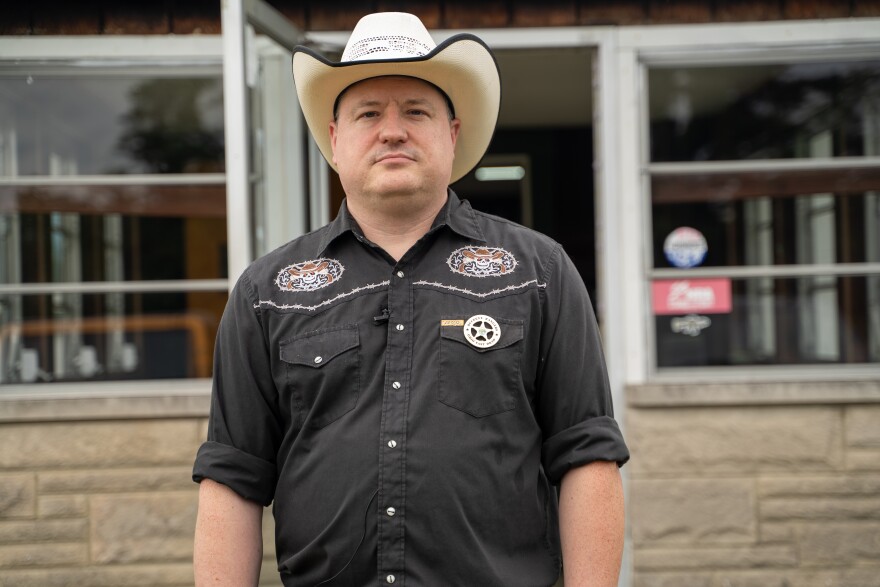
Perhaps the most important part of the sport is its reverence of the American western tradition. The act of fast drawing revolvers is itself an homage to the Wild West, but beyond that, competitors don’t just show up to competition in the same garb — or persona — that they’d wear into work at an office on Monday.
“Western wear is mandatory. Now to what degree you want to take that Western wear, that’s up to the individual. We’ve had people dress in all buckskin fringes,” said Hric.
It doesn’t stop at the clothes. Most of the competitors at these events are old enough to have grandchildren. And much like their kids and grandkids do at comic-cons and cosplay gatherings, many fast draw competitors show up to events in character.
“In Ohio fast draw, you do not have to have a character or take a handle. There are other organizations that do, and that’s what they go by. People don’t know what a shooter’s real name is. They know them by their handle, or their character, which is kind of neat,” said Hric.
Though OFDA does not require one, many choose to still come to events in character. For Hric, a retired fire department paramedic with a touch of asthma who already went by the nickname “Doc,” an immediate parallel presented itself in the form of one of the most famous figures of the Wild West era.
“Okay, I chose Doc Newberry, who is an offshoot of Doc Holliday,” said Hric, referencing the famed ally of Wyatt Earp. Holliday fought with Earp in the gunfight at the OK Corral, perhaps the most famous gunfight in American history, suffered from tuberculosis and notably was also in the medical profession.
As Doc Newberry, Hric competes and also shares his love of history and the American west with other competitors and spectators.

Ygal Kaufman
/
Ideastream Public Media
“I didn’t feel like dressing up as Star Wars and shooting lasers, so I decided to do this instead,” said Hric.
A deep abiding love for cowboy culture is the bolo tie that binds all the spectators and competitors at fast draw events, even more than shooting or competition. And one cowboy figure towers above the rest in terms of influence.
“John Wayne is my absolute hero. I love my John Wayne,” said Laura Campbell.
“I’m a big John Wayne fan … I grew up with Westerns, the Don Knotts comedy westerns. Yeah, the John Wayne, Clint Eastwoods. So I was really into Westerns,” said Wisen.
“I wanted a large loop lever put on my rifle like John Wayne. Because John Wayne was my hero. That’s the guy that I love watching his Westerns,” said Hric.

Ygal Kaufman
/
Ideastream Public Media
The shadows of figures like Wayne, Eastwood, and other cowboy movie legends, like Glenn Ford (who was notable for being the fastest draw in real life, not just his films) loom large over the sport and all the gatherings.
As much as fast draw is a competition, it’s also a performance, an oral history session and a chance to gather with friends.
At the end of a loud day of shooting and living out their childhood—and sometimes adulthood—dreams, the cowboys and cowgirls of Ohio Fast Draw always seem to have a blast reliving history in their own unique way.


Ohio is shaping up to be a top battleground state this year, and MS NOW’s election team now characterizes its Senate race as a Toss Up.
We are updating the race based primarily on multiple high-quality polls showing a very tight contest, as well as the candidates running and the broader political environment.
The contest is technically a special election to fill out the remainder of Vice President JD Vance’s term. Republican Jon Husted, who was appointed to the seat after Vance took office in 2025, is running to defend it for the first time.
The candidates and structural forces
While Ohio is still often thought of as a bellwether state, it has voted reliably Republican in recent presidential elections. The state has shifted to the right during President Donald Trump’s political rise, backing him in all three of his presidential campaigns.
Ohio’s last few Senate races, however, have been more competitive. Vance won by six points in 2022, while Republican Bernie Moreno beat Democrat Sherrod Brown by less than four points in 2024, narrowly ousting Brown from office after he served three terms in the Senate.
Brown’s showing two years ago is more impressive than it might seem at first blush. A relatively well-liked senator with working-class appeal, he was likely dragged down by his party’s brand. He came close to hanging onto his seat in an unfavorable environment for Democrats. That four-point loss meant he ran ahead of Kamala Harris, who lost to Trump by 11 points.
And 2026 looks to be a much better environment for Democrats.
Trump’s approval rating and the GOP’s favorability ratings are underwater amid an unpopular war and widespread economic dissatisfaction. Brown is running again, and polls indicate he has a real shot at flipping the seat.
The polls
No single poll should be viewed as definitive, but a clear pattern has emerged in recent weeks. A Fox News poll made waves four weeks ago, showing Brown with a lead outside the poll’s margin of sampling error. Since then, two more high-quality polls have shown a very competitive race: one commissioned by AARP and fielded by a bipartisan team of pollsters, and the other released this week by the New York Times and Siena College. Both show a three-point race, which is well within the margin of error, and they differ on which candidate is ahead. This is what polling in a true toss-up race looks like.

HAMDEN, Ohio (AP) — The 16 children found living in “deplorable” conditions inside a small, dilapidated rural Ohio home are part of the same family, officials said Wednesday.
Authorities arrested four adults Tuesday on felony child endangerment charges after finding the children in the home. Some were in dire need of medical treatment, authorities said.
Vinton County prosecuting attorney William Archer said the four adults were charged with second-degree felony child endangering because it involves “serious physical harm.”
Gary Siders Jr., Gary Siders Sr., Christina Siders and Elizabeth Siders appeared in court Wednesday where a judge entered not guilty pleas on their behalf.. They have not yet been assigned lawyers.
Ohio Attorney General Andy Wilson said Wednesday that the conditions inside the house in the tiny village of Hamden were almost indescribable, saying it “really looked third world.”
“It’s just almost beyond comprehension,” he said without providing details about what was inside.
It appeared that the children spent most of their time in just one room for much of the four years they lived there, Wilson said.
The house sits on a road tucked away alongside a steep railroad embankment, where tracks carry rumbling trains through Hamden. On Wednesday, its doors and windows stood open to the 94-degree Fahrenheit (34-degree Celsius) heat. A tangle of discarded children’s items — two busted bicycles, a plastic play table, a beach pail and two infant carriers — stood in a pile in the yard.
The Ohio Bureau of Investigation and local sheriff’s department searched the home on Tuesday.
The children ranged in age from 1 1/2 years to 18 years old and included both boys and girls, officials said. Seven were transported to hospitals in Columbus and two were flown by helicopters.
Hamden has a population of less than 1,000 people and is about 60 miles (97 kilometers) southeast of Columbus.
___
Seewer reported from Toledo, Ohio.

Authorities arrested four adults on felony child endangerment charges after discovering 16 children in dire need of medical treatment Tuesday in a rural southern Ohio home.
The Ohio Bureau of Investigation and local sheriff’s department searched a home in the small village of Hamden, where they found the kids in what officials called “deplorable” conditions.”
“Conditions you cannot even imagine people being in, let alone children being in,” Ohio Attorney General Andy Wilson said at a news conference.
Law enforcement arrested Gary Siders Jr., Gary Siders Sr., Christina Siders and Elizabeth Siders. They have not yet been arraigned and assigned public defenders.
Vinton County prosecuting attorney William Archer said they were being charged with second-degree felony child endangering because it involves “serious physical harm.”
Officials did not confirm if the children were related but said it was not a human trafficking situation. They said the adults were not locals and appeared to have been traveling.
Hamden has a population of less than 1,000 people and is about 60 miles southeast of Columbus.
The children ranged from ages 1.5 to 18 and included both boys and girls, officials said. Several were in serious conditions when found, and two had to be flown to level one trauma centers because of their injuries.
Wilson said it was the worst scene he had ever encountered in his entire career, describing what he saw as “pure evil.”
Law enforcement were also executing a secondary search warrant at the home Tuesday, and the investigation is ongoing. The four adults will appear in court Wednesday morning.
“Justice will be served for these children,” Wilson said.
-
World8 minutes ago
How the Entry-Exit System is becoming a nightmare for Europe's summer travellers
-

 News33 minutes ago
Newsom’s office responds to SCOTUS ruling on women’s sports as California faces ongoing trans athlete wave
-

 Los Angeles, Ca2 hours ago
Family of boy, 8, killed by falling tree branch at Calabasas park to get $14.6M
-

 Detroit, MI2 hours ago
The worst Detroit sports uniform from every pro team
-

 San Francisco, CA2 hours ago
Discovery Bay driver arrested for San Francisco fatal vehicle collision | Contra Costa Herald
-

 Dallas, TX2 hours ago
Erling Haaland’s Dallas Western wear purchase goes viral
-

 Miami, FL3 hours ago
Miami’s FIFA Fan Fest draws thousands to Bayfront Park to watch Team USA win World Cup match against Bosnia
-

 Boston, MA3 hours ago
2026 Yukon Denali Ultimate gets pricey, but tops the charts

