Florida
Feds should call off their turf-war bid to control Florida Trump-assassination case


In the second attempted assassination of former President Donald Trump this summer, the Biden-Harris Justice Department has rushed to charge Ryan Wesley Routh in a two-count criminal complaint alleging federal firearms offenses.
These are obviously not the main crimes here: This appears to be a case of attempted murder of a major-party presidential candidate.
Naturally, we have the makings of a prosecutorial turf war.
Attempted murder is a state crime — a very serious one in the state of Florida, where murder is a capital offense. From a public-interest perspective, the case should be charged as attempted murder.
But it appears that the feds have rushed to lodge federal charges against Routh in hopes of getting the upper hand over their state counterparts.
Assassination attempts are rare; ambitious prosecutors are not. And ambitious federal prosecutors always want to control the criminal cases of great national consequence.
Yet that is not always the best thing for the case.
There is little doubt that both federal and state authorities have charges they can and should bring against the would-be assailant.
In the first instance, prosecution should proceed in the system in which the most straightforward, appropriately severe charges can be brought.
In this instance, that is the state of Florida.
Moreover, in 2022, Biden-Harris Attorney General Merrick Garland speciously claimed that Trump’s status as a Republican candidate running against the Biden-Harris ticket required appointment of a special counsel — because it was supposedly inappropriate for the DOJ to become embroiled in prosecutions involving the likely Republican nominee.
This was a political calculation. There was no need for a special counsel in DOJ’s investigation of Trump, which had been going on for nearly two years with no special counsel appointment — two years during which Garland failed to appoint a special counsel to investigate Hunter Biden and the Biden family influence-peddling scheme, as to which there was a patent conflict of interest.
Nevertheless, having made this decision, the Biden-Harris administration and its Justice Department should be stuck with it.
Garland claimed DOJ should stay out of Trump-related cases, and that a special counsel was necessary to insulate it from claims of politicized prosecution.
In light of those representations, then, the department should defer to Florida prosecutors.
More to the point, Florida should have primacy for legal reasons.
Attempted murder is a very straightforward charge in the state, carrying a maximum penalty of life imprisonment.
By contrast, the Justice Department may only charge murder or attempted murder if Congress has provided some jurisdictional basis for doing so.
As I’ve elsewhere elaborated, federal law clearly makes it a crime to attempt to assassinate a president, a president-elect or a presidential candidate who has apparently prevailed in the election (i.e., one who appears to have won the majority of state electoral votes but whose victory has not yet been ratified by Congress).
But the relevant statute does not cover major party candidates for president prior to the election.
Similarly, federal law provides for murder and attempted murder charges to be brought when the victim is a federal officer or employee, a visiting foreign dignitary, or a member of their families.
But again, those statutes don’t cover candidates for the presidency.
I suspect this is why the feds rushed to charge firearms offenses.
These, undoubtedly, are crimes over which the federal government has jurisdiction, provided that there is evidence that the gun in question has traveled in interstate commerce.
The feds were quick to point out that the gun allegedly recovered from Routh is not manufactured in Florida, creating the inference of interstate shipment.
That is fine as far as it goes. Criminals who attempt to influence elections by violent means should be hit hard with the full array of federal and state crimes.
But that said, this is an attempted murder case. Florida has the simplest criminal laws for that, and thus the best chance of prevailing at trial on the most fitting charges.
And with the Biden-Harris DOJ’s record of claiming it should not participate directly in cases involving Trump that could influence the election, federal prosecutors should make way for their state counterparts to bring the first case against the would-be assassin.
Andrew C. McCarthy is a former federal prosecutor.



Florida Chief Financial Officer Blaise Ingoglia had a message for south Florida voters Wednesday.
Don’t believe the hype from “big government apologists” who claim cities and counties won’t be able to afford core government services if Gov. Ron DeSantis’ revamped property tax package is approved by 60% of the voters in November.
Ingoglia, appointed CFO by DeSantis, has been making the case for months that local governments have engaged in wasteful spending for the last five years, creating the premise that cities and counties can absorb the financial hit that would come their way if the package passes.
Appearing at the Miami-Dade Fire Rescue’s Urban Search and Rescue Training Facility, Ingoglia focused his remarks on the property tax package the Legislature passed Tuesday and its effects on funding public safety.
“Scare tactics”
“The first thing I would say is, you’re going to hear a lot of scare tactics and misinformation coming out from a lot of different places in this fight,” he told reporters in Miami.
The ballot summary language in HJR 1F reads, “Save Our Homes from Excessive Property Taxes.”
The ballot summary continues: “This amendment benefits Florida taxpayers by exempting homestead properties from taxation.” It goes on to advise voters that the proposal would exempt the first $250,000 of a homestead’s value from taxation and would require, through general law, “a schedule for full elimination.”
Ingoglia said that government’s first role is to protect the public, which is why the “first thing” that every local government should do if the proposal passes is to fund the police, firefighters, and other first responders.
“So, when I hear the misinformation and the talking points coming out from the big government apologists that say that they have to cut fire and they have to cut police, what they are saying is that that’s the last thing that they’re thinking about in the hierarchy of how they build their budgets,” he said.
Photo by Mitch Perry
/
Florida Phoenix
Tampa City Councilmember Luis Viera, a Democrat, is running for the state House of Representatives, hoping to fill the Hillsborough County seat now held by House Democratic Leader Fentrice Driskell.
In his time on the council, Viera has been a strong advocate for pay increases for the Tampa Police Department and for securing funding for new fire stations.
He says that if the constitutional amendment is passed in November, “We’re going to see significant change in revenue for police and fire with this.”
Tampa Mayor Jane Castor said last year that “every dollar of Tampa’s $380 million in property tax revenue is allocated to police and fire services,” and that the city’s total expenditures on public safety exceeded $455 million — well more than all of the revenue collected from property taxes.
No “trust fund” for public safety or schools
During the regular 2026 legislative session, the Florida House of Representatives passed its own property tax reduction plan (HJR 203). That proposal would have banned local governments from reducing funding for law enforcement below what had been appropriated for the services over the past two years. However, the Senate never considered the measure, or any other property tax relief bill, and it died.
DeSantis’ original tax proposal unveiled last week would have created in the Florida Constitution a local government trust fund so the state could help some municipalities pay for essential core services, including public safety and schools. But there was no dedicated source of revenue to finance the trust fund and the Republican-led Legislature eliminated it from the property tax plan.
Ingoglia didn’t mention the deleted trust fund during his South Florida press conference, ostensibly called to discuss hurricane preparedness. Instead, the CFO accused local government officials who claim public safety will need to be cut of bad governing.
“When I hear the misinformation and the talking points coming out from the big government apologists that say that they have to cut fire and they have to cut police, what they’re saying is, that that’s the last thing that they’re thinking about,” Ingoglia said. “That is the exact opposite of what they should be doing.”
The silence is deafening
Although Florida firefighters and emergency services responders spoke against the tax proposal in House and Senate committee this week, the Florida Sheriffs Association (FSA) and the Florida Police Chiefs Association have remained quiet. The Florida Police Chiefs Association did not immediately respond to a request for comment on Wednesday.
Meanwhile, the Sheriff’s Association affirmed to the Phoenix that it still had not taken a position on the proposal.
The Florida Chamber of Commerce said in a written statement last week that it would review the proposal with its members.
Another major representative of the business community, Associated Industries of Florida, did not immediately respond to a request for comment.
NFIB of Florida, representing small businesses, said in a statement on its website that it had not taken a position but had called for protections that would prohibit local governments from increasing taxes on commercial property to accommodate for lost revenues. Those protections were included in what was passed.
“NFIB has NOT taken a position on the overall proposal, but we will be balloting our membership on the amendment if it is passed by the Legislature,” the website notes.
Although DeSantis and Ingoglia have been talking about reducing property taxes for more than a year, the framework for DeSantis’ plan wasn’t shared with legislators until last week. It was approved in Special Session F after just two days of debate this week.
To say the proposal was rushed through the Legislature and not sufficiently vetted is “quite the understatement,” Viera said.
“The biggest issue that I think is going to worry people is public safety and first responders,” he said.
“As you know, in my nine-and-a-half years on city council, I’ve always been a big champion of police and fire, and that includes on a lot of hard votes with cops and with fire, where I stand by them on a lot of different issues, and I think that, for me, supporting cops and firefighters is about more than showing up and giving them donuts on Christmas. It’s about taking hard votes and asking voters to fund those services that are tax dollars. If we pass this, this is going to be a major, major burden on basic police and fire services in Tampa.”
Florida Phoenix is part of States Newsroom, a nonprofit news network supported by grants and a coalition of donors as a 501c(3) public charity. Florida Phoenix maintains editorial independence. Contact Editor Michael Moline for questions: info@floridaphoenix.com.


South Florida is experiencing a prolonged stretch of wet weather as deep tropical moisture combines with a stalled frontal boundary across the region.
The result has been frequent showers, thunderstorms, periods of heavy rainfall, and localized flooding concerns from Broward to Miami-Dade and throughout the Keys.
The atmosphere is loaded with moisture, allowing storms to produce intense downpours in a short amount of time.
Some neighborhoods have already seen several inches of rain, with additional rounds of showers and thunderstorms expected through the end of the week.
Flood-prone streets and poor drainage areas remain especially vulnerable during the heaviest rainfall.
While the rain is helping ease drought conditions, it is also increasing the risk of flash flooding and travel delays.
South Florida is two weeks into its rainy season, when abundant heat and humidity combine to generate daily rounds of showers and thunderstorms.
Heavy rainfall, frequent lightning, and gusty winds are common features of this time of year.
The good news? Drier air will gradually filter into parts of the region heading into the weekend, allowing rain chances to slightly decrease. Until then, keep the umbrella handy and be prepared for sudden tropical downpours.
-

 Health6 minutes ago
Popular weight-loss diet shows surprising impact on serious mental health condition
-

 Sports9 minutes ago
NBA bans two fans for life after court invasion during Knicks-Spurs Game 1
-

 Technology14 minutes ago
Charter breach warning: What customers should know
-
 Business22 minutes ago
Trump announces new coal export terminal in Oakland
-
 Entertainment24 minutes ago
Kathy Hilton won’t be WeHo Pride’s grand marshal after backlash from community
-

 Lifestyle29 minutes ago
OTB Takes Full Control of Viktor & Rolf
-
 Politics36 minutes ago
Senate rejects an initial attempt to ban Trump’s $1.8-billion ‘anti-weaponization’ fund
-
 Science39 minutes ago
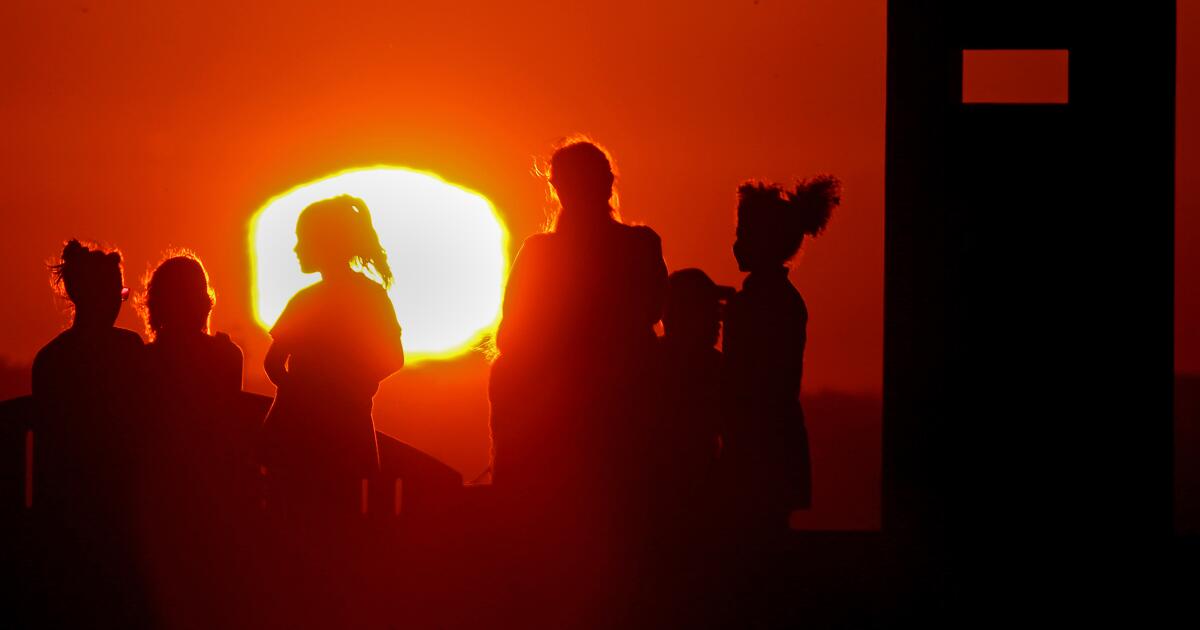
Emergency room visits during heat waves available to the public in ‘near-real time’ in L.A. County

