Maine
Birding: The long and short of migrations from Maine


An American robin provides an ideal example of how not all migrations are the same the American robin. Some leave Maine and may only go as far as Massachusetts. Carlos Osorio/Associated Press
Humans have a propensity to organize, to put things into boxes. People who try to pigeon-hole nature often do not fare well with their efforts. I still remember the admonition of one of my biology professors who said that nature has not stake in being classified.
As this fall migration proceeds, we can see how our attempts to sort out different migration strategies may lead us astray. One dichotomy that is often used for migratory birds is to contrast long-distance with short-distance migrants. Usually, a North American long-distance migrant describes a species that moves south out of the continent to Central America, South America or the Caribbean islands. A host of our nesting birds fall into this category: ruby-throated hummingbirds migrating to Central America, red knots to Argentina and scarlet tanagers broadly across South America.
In contrast, short-distance migrants typically move south to areas with more clement winter weather but do not leave the continent. Some of our breeding birds, like the American robin, travel only short distances. Some may only go as far as Massachusetts. Other short-distance migrants like our yellow-rumped warblers may go as far as the coastal regions of the mid-Atlantic states. American tree sparrows nest on the taiga and high altitudes and migrate to Maine for our “mild” winters.
We can see the messiness of this system by comparing a short-distance migrant like Lincoln’s sparrow, which may winter in the Rio Grande Valley (that’s where I saw the species for the first time) with a long-distance migrant like the rose-breasted grosbeak that spends its winter in Mexico. Hardly a difference there in distance traveled.
Let’s compare that same grosbeak to another long-distance migrant, the arctic tern, some of which migrate from pole to pole every spring and fall. The differences in migration length are huge, but both are classified as long-distance migrants.
Another contribution to the inadequacy of our classification is the phenomenon of partial migration. Our field sparrows nesting in southern Maine head south to the Carolinas or beyond for the winter. The field sparrows that nest in North Carolina do not migrate so there is a mix of resident and migrant sparrows in the winter. It turns out that the resident sparrows outcompete the migrants and have a higher survivorship over the winter.
Blue jays are a local example showing partial migration. In some years, some but not all our blue jays migrate south in the fall. In years where oaks have high acorn production, the jays stick around to enjoy their favored food. In years where acorn production is meager, many jays move south.
American goldfinches, purple finches, red-breasted nuthatches and black-capped chickadees may show partial migration as well.
As surely as temperatures decrease as you travel toward higher latitudes, so does temperature fall as you climb a mountain. Altitudinal migration is an underappreciated yet common type of migration.
One can find information on most aspects of a bird species by consulting The Birds of North America. This work is a series of species accounts, each written by an expert or experts on that species, reviewing all that is known about a particular species. In a 2017 paper, Alice Boyle scoured the 603 species accounts for North American breeders in search of evidence for altitudinal migration. She found that altitudinal migration was reported for 163 species (27%).
As you might imagine, most of these species occur in the western part of North America where many of the Rocky Mountains, Cascade Mountains and Sierra Nevadas are over twice as high as the tallest mountains we have.
Nevertheless, we do have altitudinal migrants in Maine. Here is a partial list: hairy woodpecker, pileated woodpecker, northern flicker, Canada jay, brown creeper, house wren, dark-eyed junco, purple finch and evening grosbeak. These birds may only migrate a few miles as measured along the surface of the earth.
Just to add to the complexity, some species show partial altitudinal migration with some species sticking out the winter at high altitude and others descending where temperatures are more moderate.
What about really tall mountains? Using eBird records, researchers found that 70% of the 302 species that breed at high altitude in the Himalayas engaged in altitudinal migration. Who’s surprised?
Herb Wilson taught ornithology and other biology courses at Colby College. He welcomes reader comments and questions at whwilson@colby.edu


A Massachusetts photographer was seriously injured when he was stabbed during a wedding reception last month in Raymond, Maine.
Donald Halsing, 26, was hospitalized for five days after the stabbing on May 23. NBC affiliate News Center Maine reported that 26-year-old Andrew Manderson was arrested and charged with elevated aggravated assault.
Still recovering, Halsing told NBC10 Boston the attack came out of nowhere — one moment, he was snapping photos on the dance floor, while the next, he was searching for help as blood spilled onto his camera.
“I was sitting there in that chair thinking, ‘There’s a real possibility I could die here,’” Halsing said. “Immediately, I put my hand on my chest here to try and stop the bleeding, get some pressure on it, and started yelling for help.”
Halsing was working at the reception at the Kingsley Pine Campgrounds. He took his last photo at 9:01 p.m., minutes before the stabbing.
“One of the wedding guests came up to me and started asking questions about our business,” he said.
Halsing said it was nothing out of the ordinary, and he tried to explain his photography business to the inquiring guest through the pulse of the DJ booth and celebrating guests.
“I thought he was going to reach in his back pocket for his phone, and instead, he didn’t pull out his phone — he pulled out a pocket knife and stabbed me,” he said.
Manderson, who faced a judge days later, is a cousin of the bride.
“There was this look in his eyes that he wasn’t quite all there,” Halsing said.
Halsing’s fiancée, Ashley Wall, was feet away as he struggled to stay awake. She has been his photography partner for eight years since they met at Framingham State University, and she was helping him work the wedding.
“People who were around me, they asked, ‘What can we do to help you? What do you need?’ And I said, ‘Please go check on Ashley. Please go check on my fiancée,’” he recalled.
Halsing spent five days in the hospital suffering from two lacerations to his liver, ultimately developing a blood clot in his left leg. But the road to recovery exceeds his physical wounds as he contemplates his mental state when he resumes photography next year.
“I’m also worried about what lingering effects there might be,” he said. “If we get out on the dance floor and I start remembering what happened, I don’t know how I’m going to react.”
Halsing still doesn’t know why he was attacked.
Manderson was released on $50,000 bail and is due back in court in October.
When BDN shines a light, policymakers act. Make a gift to help our reporters keep Maine’s leaders informed. Make a donation now.
This story will be updated.
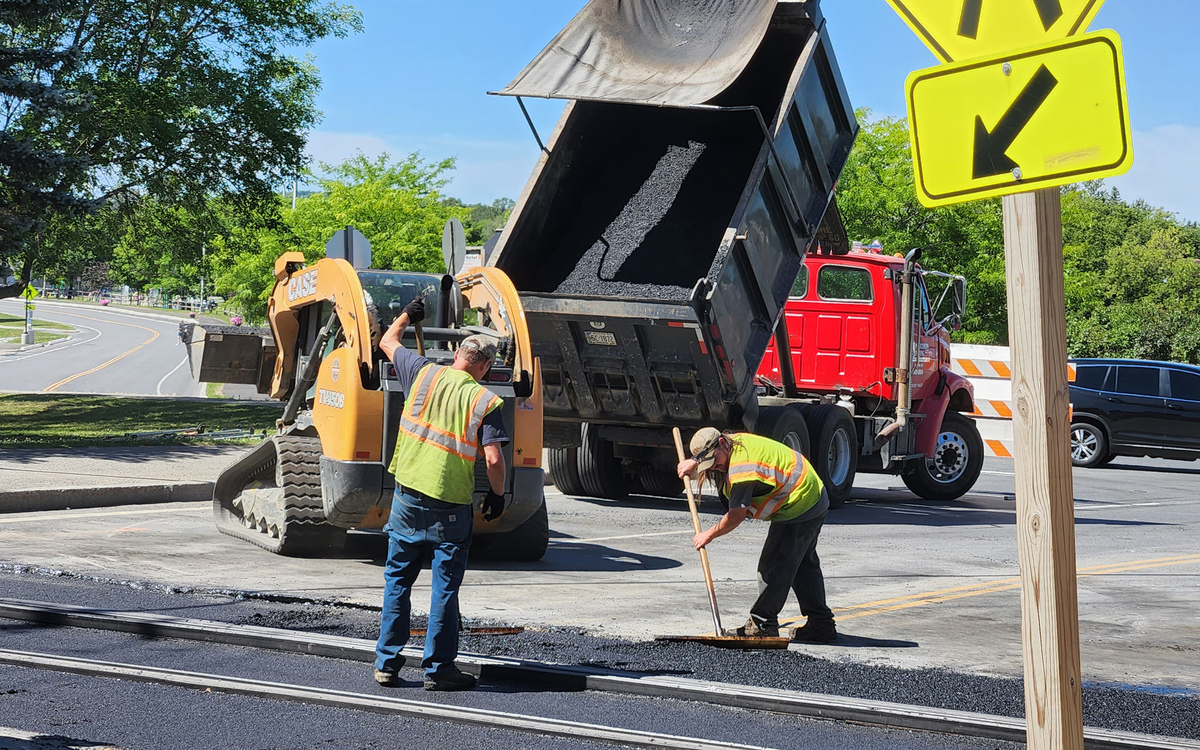
The Maine Department of Transportation is moving to slash up to $400 million in projects from its agenda, a shocking and abrupt cutback that is rattling the state’s construction industry at the start of building season.
Roughly $50 million across six pavement projects have already been delayed, according to a memo exclusively obtained by the Bangor Daily News. The agency plans to cut or delay another $150 million in bridge, highway, intersection and multimodal projects later this month. A further $200 million or more in cuts are planned in the next three-year work plan.
Those figures were outlined by Transportation Commissioner Dale Doughty in the May 18 memo to Gov. Janet Mills that has since circulated widely in the transportation sector, which has been getting drip-by-drip details on the wide scope of the cuts over the past three weeks.
It comes at the beginning of the state’s relatively narrow construction season. Companies have hired workers and ordered materials for projects they expected to begin this summer. The severity of the transportation budget problems was not raised to lawmakers during the 2026 legislative session.
Kelly Flagg, executive director of the Associated General Contractors of Maine, called the shortfall “deeply troubling” in a statement.
“We stand ready to work with policymakers, stakeholders, and industry partners to identify both immediate and long-term solutions,” Flagg said. “Maine cannot afford to fall further behind.”

Insiders saw this first.
This story was broken in Maine Politics Insider, the BDN’s daily premium newsletter for the most ardent political news followers. If you are a new BDN subscriber, you can sign up here. Current subscribers can contact our customer service team to upgrade.
The cuts stem from a structural funding gap of at least $130 million in the state’s current work plan, according to Doughty’s memo. Losses are magnified because state money from the gas tax and other revenue sources is matched by federal funds. Lawmakers have long grappled with politically difficult long-term problems with the state’s transportation budget.
A Mills spokesperson said Wednesday morning that the administration was working on a response to questions from the BDN. The department says it needs roughly $240 million more in state capital funding annually to maintain the existing system, and that anything less than $200 million will erode it over time.
Doughty’s memo the only near-term solution is a series of bonds beginning as soon as possible. Lawmakers would have to return to Augusta to authorize that if one is going to appear on the November ballot.

The BDN Opinion section operates independently and does not set news policies or contribute to reporting or editing articles elsewhere in the newspaper or on bangordailynews.com
Michael Capeci is the former chairman of the Bangor GOP.
Let’s be honest about Maine’s current state.
For many families, the cost of living has become unsustainable. Housing is out of reach for many young people. Energy bills keep rising. Many small businesses are struggling under taxes and regulations that make it harder to grow. Rural hospitals are under strain and despite years of increased state spending, the results are not showing up in people’s daily lives.
Concurrently, Maine continues to lose young workers to other states. That is not a statistic, it is a warning sign.
To me, the question in this Republican primary for governor is not about slogans. It is whether we continue with a political approach that has failed to reverse these trends, or whether we nominate someone with new ideas. I think that someone is Owen McCarthy.
Owen is not a political insider. He is an entrepreneur from Patten, a small town where opportunity is not assumed, it is built. He grew up in a working-class family, became the first in his family to graduate from college graduating from the University of Maine, and founded MedRhythms, a healthcare technology company focused on neurological treatment.
He didn’t just talk about opportunity. He built it. That distinction matters, because Maine’s problem is not a lack of debate it is a lack of results. We have seen the trajectory: higher costs, slower growth, and a steady outmigration of young workers. I believe Owen McCarthy represents a break from that pattern.
His Maine 2040 plan focuses on creating 50,000 new jobs in sectors where Maine has real advantages — maritime and defense, advanced forest products, and life sciences. These are export-driven industries tied directly to Maine’s workforce, geography, and institutions. What sets Owen apart is not only what he proposes, but how he approaches governing.
He prioritizes modernizing permitting so projects do not stall. He supports using technology to reduce costs and increase efficiency. He focuses on making it easier to build, hire, and expand in Maine.
That same practical mindset extends to healthcare. Expanding telehealth, strengthening EMS systems, improving provider flexibility, and shifting toward earlier intervention are not abstract reforms. They are system upgrades designed to improve access while controlling costs.
Maine voters consistently respond to competence. They reward candidates who understand problems and present plans to solve them. I believe they are tired of rhetoric that does not translate into results, and skeptical of politics that prioritizes messaging over execution.
Owen’s approach is grounded in solving the issues that shape daily life — affordability, healthcare access, job creation, and government efficiency. That is not just policy positioning. It is a governing model that speaks directly to voters.
Some will point to his lack of political experience. But I believe Maine’s core problems are not the result of insufficient political experience; they are the result of policies that have failed to deliver measurable improvement. Experience inside a broken system, by itself, is not a solution.
If Republicans want to win, this primary must be taken seriously. From my perspective, it is not about choosing a nominee for governor who can energize the base. It is about selecting someone who can compete in a broader electorate that is frustrated and looking for change.
That requires a candidate who can speak beyond the base, not by abandoning principles, but by demonstrating competence and a credible plan to address Maine’s challenges. I believe Owen McCarthy offers that combination. He represents a shift away from managed decline and toward economic execution.
This is not just another primary. It is a decision about whether Republicans position themselves to win Maine or whether they remain trapped in a cycle of repeating the same strategies and expecting different outcomes.
If Republicans want to compete for Maine’s future, they cannot afford to nominate a candidate who only motivates part of the electorate. They need someone who expands it.
I believe Owen McCarthy is that candidate.
And if the goal is to win Maine, then the choice should be unmistakable
-
 Lifestyle27 minutes ago
How having zero points in tennis — or ‘love’ — came to sound so sweet
-

 Technology39 minutes ago
Amazon develops a warehouse robot workers can speak to
-

 World42 minutes ago
Albino buffalo nicknamed ‘Donald Trump’ becomes sensation at Bangladesh’s national zoo for its blond hair
-

 Politics47 minutes ago
The growing list of controversies threatening Democrat Graham Platner’s Maine Senate bid
-

 Health54 minutes ago
New cancer vaccine delivers stunning result against one of the deadliest skin cancers
-

 Sports57 minutes ago
Fan disrupts NBA Finals Game 1 while trying to take selfie with Spurs’ Victor Wembanyama
-
 Business1 hour ago
How Google’s 32-million mosquito project could change California’s battle against dengue
-
 Entertainment1 hour ago
After ‘Barbie’ success, Mattel looks to He-Man for another box-office lift

