Maine
Meet the new Maine high school football head coaches


New Cheverus football coach Skip Capone works with players during a Sept. 4 practice in Portland. Ben McCanna/Staff Photographer
Being a high school varsity football coach is a multi-faceted job. Head coaches oversee players and assistant coaches. They are the final disciplinarian. They will coach a position group and usually call the offensive or defensive signals. Interacting with parents, school administrators, booster groups, grounds and maintenance crews, athletic training staff, and media are part of the job. It requires passion, planning and precision to be successful.
Several Maine teams have new leaders at the top. Here’s a look at first-year head coaches.
NATE DANFORTH, Oxford Hills: Danforth is no stranger to the Vikings’ program. He’s been on the coaching staff since 1999 and was the team’s head coach from 2008-10. He was a key assistant under Mark Soehren (2012-23) and the team’s defensive coordinator as Oxford Hills rose to the top of the Class A ranks, winning the state championship in 2022. Soehren retired in May, and Danforth was chosen as the new coach in early August.
SKIP CAPONE, Cheverus: There aren’t many coaches in Maine with more experience – or sheer enthusiasm – than the 69-year-old Capone. A native of Portsmouth, New Hampshire, Capone is in his 47th year as a football coach, including a 14-year stint as Lewiston’s head coach and 22 years as an assistant at Bates College. Capone replaces Mike Vance, who led the Stags for eight years after replacing John Wolfgram. Cheverus moves from Class C to Class B, and Capone, hired in January, said he wants to guide the program back to Class A.
MARK BOISSONNEAULT, Sanford: Another long-time assistant taking over for an established coach, Boissonneault has been at Sanford for 32 years, the last five as the Spartans’ offensive coordinator. He replaces Mike Fallon, who resigned after accepting an assistant principal’s position at Sanford.
Skip Capone is in his 47th season coaching football, but his first as the head coach at Cheverus. Ben McCanna/Staff Photographer
SPENCER EMERSON, Falmouth: The 2011 graduate of Edward Little takes over for John Fitzsimmons, Falmouth’s coach since 2007, who resigned under pressure from parents, and ultimately players. Emerson has significant coaching experience. He was the head coach at Poland in 2018-19 and has since been a college assistant at Bates, Georgetown and the University of Chicago.
SETH JOHNSON, Poland: Johnson replaces Gus Leblanc, a longtime and respected educator and administrator who died in February. He was the coach at Sacopee Valley last year, which plays in the eight-man ranks. Johnson said he enjoyed coaching at Sacopee but is excited to be back in the 11-player ranks. He is also the varsity baseball coach at Gray-New Gloucester.
NICK ORSI, Yarmouth: A relative newcomer to Maine football circles, Orsi takes over for Jim Hartman. An investment advisor and former high school quarterback outside Chicago, Orsi has been a high school assistant for three seasons, all in the eight-player ranks. He was on Hartman’s Yarmouth staff in 2021 and 2022, and last year was the offensive coordinator at Brunswick.
JOEL STONETON, Winthrop/Monmouth/Hall-Dale: Stoneton, the former Winthrop athletic director, takes over for Dave St. Hilaire, who went 55-32 in nine seasons. Stoneton, a 1993 graduate of Winthrop, was the Ramblers’ head coach prior to St. Hilaire, going 61-35 in 10 seasons. His 2008 team went 11-1, losing in the Class C state final. Stoneton had been the team’s defensive coordinator under St. Hilaire.
Nate Danforth is serving as head coach at Oxford Hills for a second time. He has been on the Vikings’ coaching staff since 1999, including three seasons as the head coach from 2008-10. Brewster Burns photo
FRED LOWER, Brewer: The former athletic director at Hampden Academy and current assistant principal at Brewer, Lower returns to the sidelines. Lower previously was a head coach at Hampden Academy, had two stints as an assistant coach at Husson University, and was on the Bangor staff for more than 10 years.
ERIC SCHROEDER, Sacopee Valley: Schroeder takes over from Seth Johnson, who left to become head coach at Poland. A longtime assistant, this is Schroeder’s 10th season coaching at his alma mater. He was a member of Sacopee Valley’s inaugural football team.
GERALD HARTLEY, Mount View: Hartley was an assistant coach with the Mustangs under his predecessor, Rick Leary, who coached for seven seasons. Hartley takes over a young team that went 2-17 over the last three seasons. A longtime coach at youth levels, Hartley is a head coach for the first time.
JOHN EDWARDS, Valley: A former high school football coach in Montana, Edwards takes over the state’s northernmost team. Playing in its third varsity season, Valley is a co-op of players from Fort Kent, Madawaska and Wisdom. The program is still looking for its first varsity win.


A Massachusetts photographer was seriously injured when he was stabbed during a wedding reception last month in Raymond, Maine.
Donald Halsing, 26, was hospitalized for five days after the stabbing on May 23. NBC affiliate News Center Maine reported that 26-year-old Andrew Manderson was arrested and charged with elevated aggravated assault.
Still recovering, Halsing told NBC10 Boston the attack came out of nowhere — one moment, he was snapping photos on the dance floor, while the next, he was searching for help as blood spilled onto his camera.
“I was sitting there in that chair thinking, ‘There’s a real possibility I could die here,’” Halsing said. “Immediately, I put my hand on my chest here to try and stop the bleeding, get some pressure on it, and started yelling for help.”
Halsing was working at the reception at the Kingsley Pine Campgrounds. He took his last photo at 9:01 p.m., minutes before the stabbing.
“One of the wedding guests came up to me and started asking questions about our business,” he said.
Halsing said it was nothing out of the ordinary, and he tried to explain his photography business to the inquiring guest through the pulse of the DJ booth and celebrating guests.
“I thought he was going to reach in his back pocket for his phone, and instead, he didn’t pull out his phone — he pulled out a pocket knife and stabbed me,” he said.
Manderson, who faced a judge days later, is a cousin of the bride.
“There was this look in his eyes that he wasn’t quite all there,” Halsing said.
Halsing’s fiancée, Ashley Wall, was feet away as he struggled to stay awake. She has been his photography partner for eight years since they met at Framingham State University, and she was helping him work the wedding.
“People who were around me, they asked, ‘What can we do to help you? What do you need?’ And I said, ‘Please go check on Ashley. Please go check on my fiancée,’” he recalled.
Halsing spent five days in the hospital suffering from two lacerations to his liver, ultimately developing a blood clot in his left leg. But the road to recovery exceeds his physical wounds as he contemplates his mental state when he resumes photography next year.
“I’m also worried about what lingering effects there might be,” he said. “If we get out on the dance floor and I start remembering what happened, I don’t know how I’m going to react.”
Halsing still doesn’t know why he was attacked.
Manderson was released on $50,000 bail and is due back in court in October.
When BDN shines a light, policymakers act. Make a gift to help our reporters keep Maine’s leaders informed. Make a donation now.
This story will be updated.
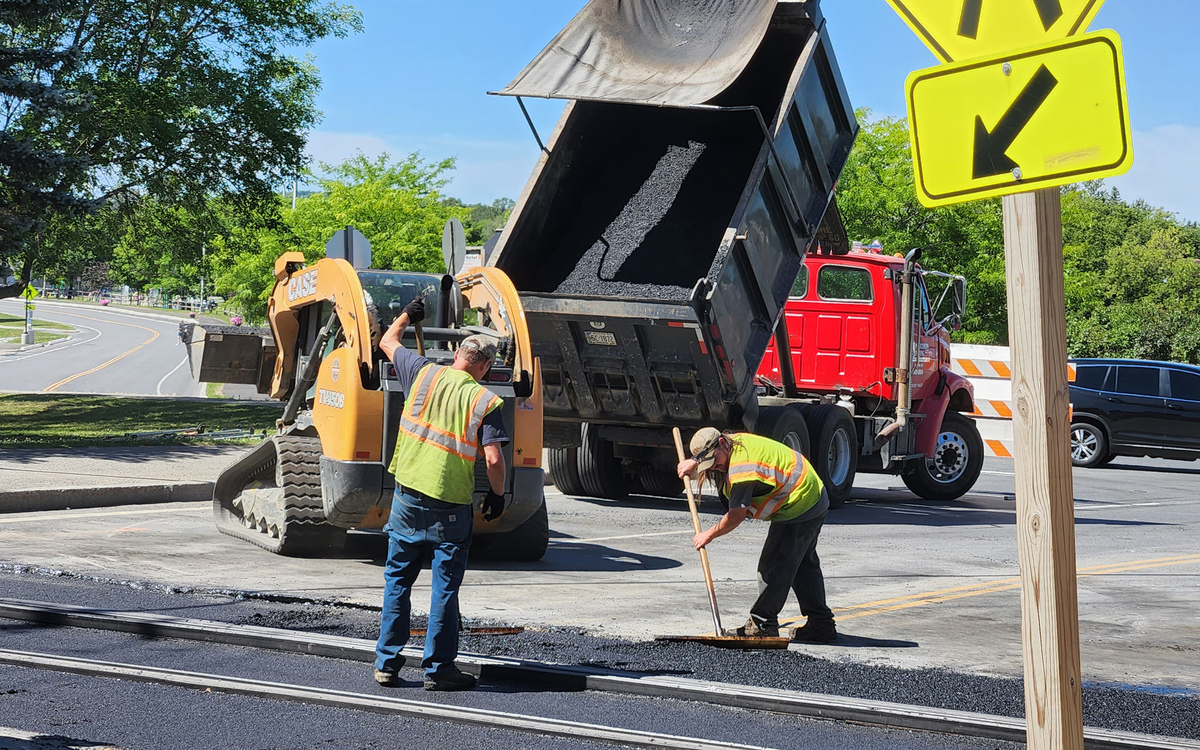
The Maine Department of Transportation is moving to slash up to $400 million in projects from its agenda, a shocking and abrupt cutback that is rattling the state’s construction industry at the start of building season.
Roughly $50 million across six pavement projects have already been delayed, according to a memo exclusively obtained by the Bangor Daily News. The agency plans to cut or delay another $150 million in bridge, highway, intersection and multimodal projects later this month. A further $200 million or more in cuts are planned in the next three-year work plan.
Those figures were outlined by Transportation Commissioner Dale Doughty in the May 18 memo to Gov. Janet Mills that has since circulated widely in the transportation sector, which has been getting drip-by-drip details on the wide scope of the cuts over the past three weeks.
It comes at the beginning of the state’s relatively narrow construction season. Companies have hired workers and ordered materials for projects they expected to begin this summer. The severity of the transportation budget problems was not raised to lawmakers during the 2026 legislative session.
Kelly Flagg, executive director of the Associated General Contractors of Maine, called the shortfall “deeply troubling” in a statement.
“We stand ready to work with policymakers, stakeholders, and industry partners to identify both immediate and long-term solutions,” Flagg said. “Maine cannot afford to fall further behind.”

Insiders saw this first.
This story was broken in Maine Politics Insider, the BDN’s daily premium newsletter for the most ardent political news followers. If you are a new BDN subscriber, you can sign up here. Current subscribers can contact our customer service team to upgrade.
The cuts stem from a structural funding gap of at least $130 million in the state’s current work plan, according to Doughty’s memo. Losses are magnified because state money from the gas tax and other revenue sources is matched by federal funds. Lawmakers have long grappled with politically difficult long-term problems with the state’s transportation budget.
A Mills spokesperson said Wednesday morning that the administration was working on a response to questions from the BDN. The department says it needs roughly $240 million more in state capital funding annually to maintain the existing system, and that anything less than $200 million will erode it over time.
Doughty’s memo the only near-term solution is a series of bonds beginning as soon as possible. Lawmakers would have to return to Augusta to authorize that if one is going to appear on the November ballot.

The BDN Opinion section operates independently and does not set news policies or contribute to reporting or editing articles elsewhere in the newspaper or on bangordailynews.com
Michael Capeci is the former chairman of the Bangor GOP.
Let’s be honest about Maine’s current state.
For many families, the cost of living has become unsustainable. Housing is out of reach for many young people. Energy bills keep rising. Many small businesses are struggling under taxes and regulations that make it harder to grow. Rural hospitals are under strain and despite years of increased state spending, the results are not showing up in people’s daily lives.
Concurrently, Maine continues to lose young workers to other states. That is not a statistic, it is a warning sign.
To me, the question in this Republican primary for governor is not about slogans. It is whether we continue with a political approach that has failed to reverse these trends, or whether we nominate someone with new ideas. I think that someone is Owen McCarthy.
Owen is not a political insider. He is an entrepreneur from Patten, a small town where opportunity is not assumed, it is built. He grew up in a working-class family, became the first in his family to graduate from college graduating from the University of Maine, and founded MedRhythms, a healthcare technology company focused on neurological treatment.
He didn’t just talk about opportunity. He built it. That distinction matters, because Maine’s problem is not a lack of debate it is a lack of results. We have seen the trajectory: higher costs, slower growth, and a steady outmigration of young workers. I believe Owen McCarthy represents a break from that pattern.
His Maine 2040 plan focuses on creating 50,000 new jobs in sectors where Maine has real advantages — maritime and defense, advanced forest products, and life sciences. These are export-driven industries tied directly to Maine’s workforce, geography, and institutions. What sets Owen apart is not only what he proposes, but how he approaches governing.
He prioritizes modernizing permitting so projects do not stall. He supports using technology to reduce costs and increase efficiency. He focuses on making it easier to build, hire, and expand in Maine.
That same practical mindset extends to healthcare. Expanding telehealth, strengthening EMS systems, improving provider flexibility, and shifting toward earlier intervention are not abstract reforms. They are system upgrades designed to improve access while controlling costs.
Maine voters consistently respond to competence. They reward candidates who understand problems and present plans to solve them. I believe they are tired of rhetoric that does not translate into results, and skeptical of politics that prioritizes messaging over execution.
Owen’s approach is grounded in solving the issues that shape daily life — affordability, healthcare access, job creation, and government efficiency. That is not just policy positioning. It is a governing model that speaks directly to voters.
Some will point to his lack of political experience. But I believe Maine’s core problems are not the result of insufficient political experience; they are the result of policies that have failed to deliver measurable improvement. Experience inside a broken system, by itself, is not a solution.
If Republicans want to win, this primary must be taken seriously. From my perspective, it is not about choosing a nominee for governor who can energize the base. It is about selecting someone who can compete in a broader electorate that is frustrated and looking for change.
That requires a candidate who can speak beyond the base, not by abandoning principles, but by demonstrating competence and a credible plan to address Maine’s challenges. I believe Owen McCarthy offers that combination. He represents a shift away from managed decline and toward economic execution.
This is not just another primary. It is a decision about whether Republicans position themselves to win Maine or whether they remain trapped in a cycle of repeating the same strategies and expecting different outcomes.
If Republicans want to compete for Maine’s future, they cannot afford to nominate a candidate who only motivates part of the electorate. They need someone who expands it.
I believe Owen McCarthy is that candidate.
And if the goal is to win Maine, then the choice should be unmistakable
-

 Detroit, MI13 minutes ago
Fired Detroit TV anchor Taryn Asher files sex discrimination lawsuit against old station, claims new GM protected men
-

 San Francisco, CA23 minutes ago
San Francisco family devastated as they face nearly 90% rent increase
-

 Dallas, TX28 minutes ago
Wings’ top pick Azzi Fudd hosts clinic as Cash App donates to Dallas nonprofit
-

 Miami, FL35 minutes ago
Patients left scrambling for care after Miami-Dade woman accused of operating an unlicensed surgery recovery center
-

 Boston, MA38 minutes ago
Clover plans to reopen some locations after sudden closure, thanks to an anonymous investor
-
 Denver, CO43 minutes ago
New report finds Denver metro home buyers and sellers experiencing ‘unattainability fatigue’
-

 Seattle, WA50 minutes ago
Seattle mayor grilled over public safety, affordability, CCTV
-

 San Diego, CA53 minutes ago
Automated license plate readers and public surveillance cameras are coming to Imperial Beach

