Northeast
$380M from DHS to be given to states, NGOs in support of migrants

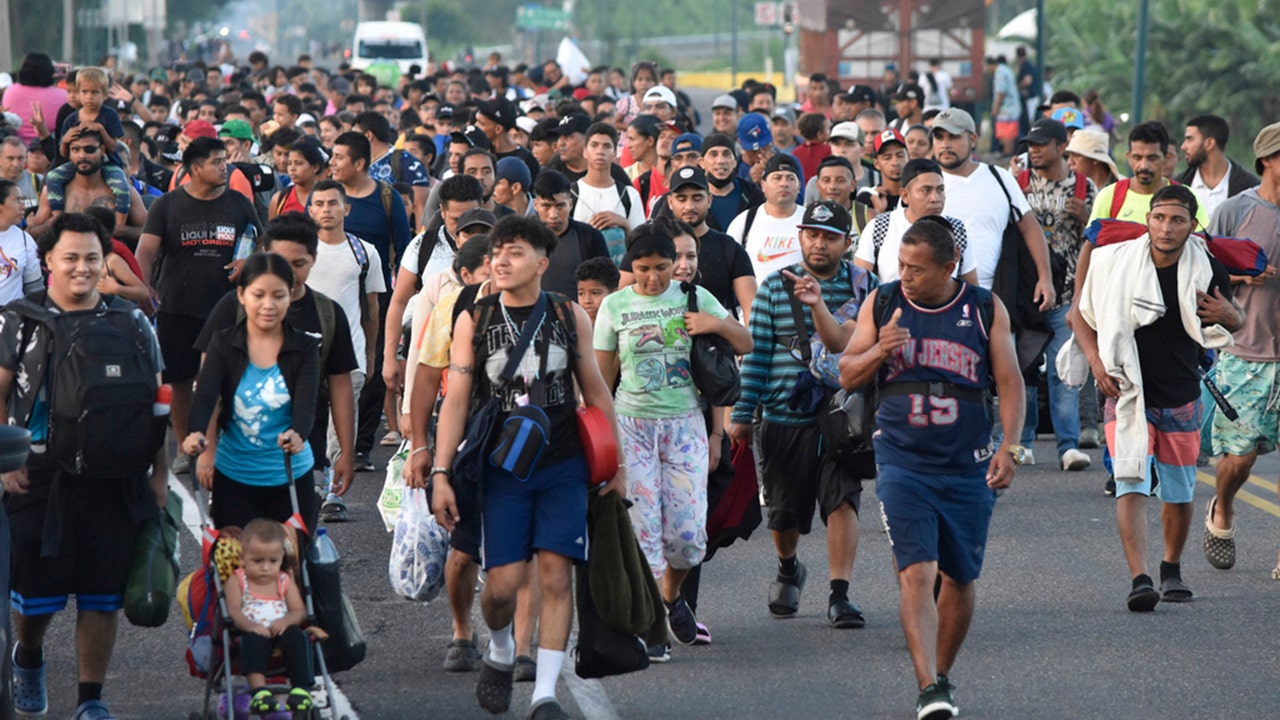
The Biden administration announced last week that it’s providing $380 million to nonprofits and local governments to cover some of the costs associated with taking care of migrants once they’ve been released by the Department of Homeland Security (DHS) at the southern border.
The huge sum is being awarded by DHS via its Shelter and Services Program (SSP), which aims to provide “critical support” for migrants by way of offering them food, shelter, clothing, acute medical care, and transportation while they await their immigration court proceedings.
DHS says the money helps prevent overcrowding at short-term Customs and Border Protection (CBP) holding facilities and enables non-federal entities to “off-set allowable costs incurred for services associated with noncitizen migrant arrivals in their communities.”
MAYORKAS FORCED TO ADMIT MORE MIGRANTS HAVE CROSSED US BORDER UNDER BIDEN THAN TRUMP: ‘SEVERAL MILLION PEOPLE’
Migrants walk along the highway through Suchiate, Chiapas state, in southern Mexico, on Sunday, July 21, 2024, during their journey north toward the U.S. border. ( AP Photo/Edgar H. Clemente)
The $380 million grant comes just four months after the agency disseminated a tranche of $259.13 million in SSP grants, bringing the total this year to nearly $640 million.
In fiscal year 2023, more than $780 million was awarded to organizations and cities across the country which are inundated with migrants who have nowhere to live and are unable to work.
The influx has overwhelmed social and health services across many big cities, and local governments have used taxpayer money to put migrants up in hotels or shelters. Under the Biden administration there were more than 2.4 million migrant encounters in fiscal year 2023, and that mark could be broken by the end of fiscal year 2024, although DHS says monthly numbers have decreased.
The $380 million grant is being divided between a total of 50 nonprofits, municipalities and government entities.
The biggest beneficiary of the allotment is New York City, a sanctuary city, which is being given nearly $22.17 million via its Office of Management, while Los Angeles is taking $21.84 million and Arizona is in line for $19.25 million.
Maricopa County and Pima County, both in Arizona, are splitting nearly $38 million in funds.
FOX NEWS POLL: VOTERS SAY THE US-MEXICO BORDER IS A BIG PROBLEM
Migrants are seen at the southern border on May 23, 2024. (Bill Melugin/Fox News)
In terms of nonprofit organizations, Jewish Family Service San Diego is being awarded $22.1 million, the Catholic Charities Diocese of San Diego is set to get $21.6 million, while Catholic Charities Archdiocese of San Antonio in Texas is getting $19.26 million.
Massachusetts Gov. Maura Healey lauded the fact that her state is securing $15.4 million in competitive funding and $4.9 million in reserve funding.
“Massachusetts ‘wins’ $20 million in federal funding to support family shelter costs,” an Aug. 28 press release from Healey reads.
“This is the largest award Massachusetts has won from this program to date, as the state and city previously won a total of $9 million.”
Healey says the money will help Boston manage costs for sheltering migrants and praised the Biden-Harris administration for reducing illegal border crossings.
“The Biden-Harris administration has taken important steps to address this federal problem in light of Congress’s failure to act, and they are seeing results with illegal border crossings down significantly,” Healey said in the statement. “But more needs to be done. Congress needs to step up and pass the bipartisan border security agreement.”
Massachusetts Gov. Maura Healey pauses to look at the Army cots set up on the gym floor as state and local officials toured the Melnea A. Cass Recreational Complex, which was used as a temporary migrant shelter in May 2024. (Getty Images)
DHS says that Border Patrol encounters in July dropped 32% compared to June, the lowest monthly total along the southwest border since September 2020. July’s total numbers between ports of entry are also lower than July 2019, and lower than the monthly average for all of 2019, the last comparable year prior to the pandemic, DHS says.
The agency says the dip follows a June 4 Presidential Proclamation by President Biden, which temporarily suspended the entry of certain noncitizens at the southern border once the number of average border encounters exceeds 2,500 a day over seven days.
But the DHS funding will not plug the massive hole in city coffers decimated by illegal migration.
In Massachusetts, Republicans say the state has spent $1 billion “in secret migrant crisis spending” and have called Healey to provide a detailed cost breakdown of the toll that the migrant crisis has caused for the state’s residents.
In New York, the comptroller estimated that the migrant crisis will cost state taxpayers $4.3 billion through 2025, and New York City taxpayers $3 billion in fiscal year 2024 alone, according to the New York Post.
It also doesn’t account for the $4 billion the Biden administration announced it was sending to Central America in March to “address the root causes” of illegal immigration.
Meanwhile, a study by the Federation for American Immigration Reform (FAIR) estimated the net cost of illegal immigration for the United States – at the federal, state, and local levels – was at least $150.7 billion at the start of 2023.
FAIR arrived at the figure by subtracting the tax revenue paid by illegal immigrants – just under $32 billion – from the gross negative economic impact of illegal immigration, $182 billion.
Read the full article from Here


A man who confessed to a 46-year-old Back Bay murder has pleaded guilty to the horrific cold case.
John Irmer, 71, entered a guilty plea for first-degree murder, which comes with a mandatory life sentence, according to the Suffolk District Attorney’s Office.
Irmer walked into an FBI office in Portland, Oregon, in 2023 to confess to killing a red-haired woman he’d met around Halloween in 1979 at a skating rink in Boston.
According to the DA’s office, Irmer told the FBI that after the meeting he’d walked into an apartment on Beacon Street that was under renovation with the victim, who turned out to be 24-year-old Susan Rose. Once inside, he said picked up a hammer, hit Rose on the head with it, killing her, then raped her. The next day, Oct. 30, Irmer said he left the state the next day for New York, while a construction crew found Rose’s body and a lot of blood.
Rose had been planning on dressing as “Dracula’s helper” for Halloween, borrowing a cape from a friend that she was wearing at the time of her death, according to a Herald article published the day after she was found.
A Boston Police detective described the killing as one of the most “vicious” he’d ever seen, telling Herald reporters whoever did it was a “real psycho.”
Another man had been tried for Rose’s murder a few months after the crime took place and was acquitted. In 2005, police reexamined evidence in the case and made a DNA profile from sperm found on a broom at the crime scene. Investigators found the DNA could not have been from the defendant in the first trial, the DA’s office said.
The FBI in Oregon reached out to Boston Police, who flew detectives across the country to interview Irmer. He told them that after becoming sober and finding religion during a prison stint in California for another killing, he felt he needed to confess to Rose’s murder.
During the interview, Irmer told police detailed information about Rose’s killing and confessed to another murder that took place in the South. According to the DA, investigators are also investigating that case.
In court Monday, Rose’s sister gave what the DA called an “emotional” impact statement, holding a photo of Rose when she was a first-grader.
Rose’s sister said she went by the nickname “Susie,” and was “caring, intelligent, adventuresome, and curious.”
“Now we know that my sister’s life was taken by John Irmer, but he also ruined the lives of my parents and me,” she said.
“The answers for Susan Rose’s sister and friends finally came today, though after a very long and sad period of time,” Suffolk DA Kevin Hayden said in a statement. “I hope other families affected by John Irmer’s murderous behavior find similar answers.”
Incident Summary
BPD responded to 247 incidents in the 24-hour period ending at 10 a.m. Wednesday, according to the department’s incident log. Those included six robberies, four aggravated assaults, two residential burglaries, two larcenies from a vehicle, 16 miscellaneous larcenies, and three auto thefts.
Arrests
All of the below-named defendants are presumed innocent until proven guilty.
— Jonathan Price, 120 Capen St., Dorchester. Assault.
— Alfred Velazquez, 68 Alexander St., Boston. Disorderly conduct.
— Nyasha Callistro, 342 Blue Ledge Dr., Roslindale. Operating under the influence of liquor.
— Vincent Evan, 122 Blue Hill Ave., Milton. Shoplifting more than $100 by asportation.
— Zane Frias, 41 Brush Hill Rd., Yarmouth. Shoplifting more than $100 by asportation.
— Darrell Seeley, no address listed. Larceny over $1,200.
— Tamerat Edelstein-Rosenberg, 31 Athelwold St., Dorchester. Possession of a firearm without an FID card.
— Anthony Isemond, 562 Walk Hill St., Mattapan. Carrying a firearm without a license.
— Pablo Pesantes, 110-112 Southampton St., Roxbury. Trespassing.
— Abosi Bond, 63 Putnam St., Somerville. Resisting arrest.
Pittsburg, PA
A year after Pittsburgh’s deadly derecho, structural damage and personal trauma linger


In April, two babies were relinquished at Connecticut hospitals under the state’s Safe Havens Act, according to the state Department of Children and Families. The babies were surrendered to Yale New Haven Hospital and Connecticut Children’s at the University of Connecticut Health Center, DCF said.
The Safe Havens Act, which was enacted 25 years ago, allows a parent to give up their infant to hospital emergency room staff anonymously and without the threat of prosecution. DCF then places the baby in a preapproved adoptive home.
At a Wednesday press conference, Lt. Gov. Susan Bysiewicz said the Safe Havens Act has had “an incredible impact” and called it “life-saving.”
“Those women who find themselves in a situation where they deliver a baby and they cannot or they do not want to raise that baby, they may feel incredibly isolated and challenged and judged, and they may feel they have nowhere to turn,” Bysiewicz said.
Under the law, a baby may be surrendered at a designated location by a parent, relative or advocate for the child, and the parent has 30 days to change their mind and begin working with DCF to see if reunification is possible. There are 37 medical centers in Connecticut — 25 of them hospitals — that allow babies to be surrendered 24 hours a day.
Pam Sawyer, a former state representative who spearheaded the law’s passage, said she intended it to be “so simple it could be shared in the school bus.”
But two babies relinquished in the same month — though these are the only two babies relinquished so far this year — marks a spike from the usual trend. Since the law went into effect, a total of 60 babies have been relinquished. And in 2025, just one baby was surrendered the whole year.
Co-chair of the General Assembly’s Committee on Children, Sen. Ceci Maher, D-Wilton, outlined a number of issues that could lead a parent to give up their baby, such as inadequate housing or financial instability.
The Committee on Children advanced a bill this session that would establish a task force to study the voluntary surrender of infants — including considerations for the best way to provide such a program without perpetuating “racial, ethnic, health, economic and socioeconomic disparities” among parents looking to surrender.
The bill passed the state Senate on April 15 and awaits a vote in the House.
Some lawmakers and advocates have suggested adding another option for parents considering giving up a baby — temperature-controlled chambers known as “baby boxes” that are installed within the exterior walls of a surrender location to allow parents to relinquish the infant anonymously.
Once a baby is left in the box device, alerts are sent to staff and to 911 dispatch centers. The boxes are designed with bassinets, and equipped with electricity, air conditioning and heating, but they’re not federally regulated. Lori Bruce, a researcher and bioethicist at Yale University, pointed this out during her testimony at a public hearing on the legislation Feb. 17.
“Even our hairdryers, even tongue depressors, all sorts of much more basic tools require regulation,” Bruce said.
The boxes are intended to be anonymous, but that’s not always possible when they are installed at places like firehouses, which have cameras all around the building.
Bruce said the boxes also remove the opportunity for any face-to-face interaction between the parent and a public service worker who might offer access to resources like crisis counseling — or simply ask if they are okay.
Baby boxes have been installed in 20 states so far, according to Safe Haven Baby Boxes.
Sawyer said she is in favor of the baby boxes, but only after more research.
“I love the idea, but I don’t know that they’re quite there yet,” she said. “My view still is that it’s advocacy and teaching” that will help those who need the Safe Havens Act the most.
-

 Detroit, MI19 minutes ago
Detroit Pistons fans nervous but excited ahead of Game 5
-

 San Francisco, CA31 minutes ago
San Francisco thieves targeting seniors who wear jewelry, police say
-

 Dallas, TX37 minutes ago
Before The Boys, Chace Crawford Starred In A Dallas-Esque Drama With Don Johnson – TVLine
-

 Miami, FL43 minutes ago
Braxton Berrios, Bethenny Frankel and more stars hit Gaia Miami’s opening
-

 Boston, MA49 minutes ago
Boston Police Blotter: Man pleads guilty to ‘vicious’ 1979 murder of Susie Rose
-

 Denver, CO55 minutes ago
Recruit dies during Denver Sheriff Department academy training
-

 Seattle, WA1 hour ago
Concerned Alki Beach neighbors seek safety measures seen in other Seattle neighborhoods
-

 San Diego, CA1 hour ago
Man sentenced to prison in Hillcrest sexual assault