Lifestyle
Leonard Riggio, who built Barnes & Noble into a bookselling empire, dies at 83

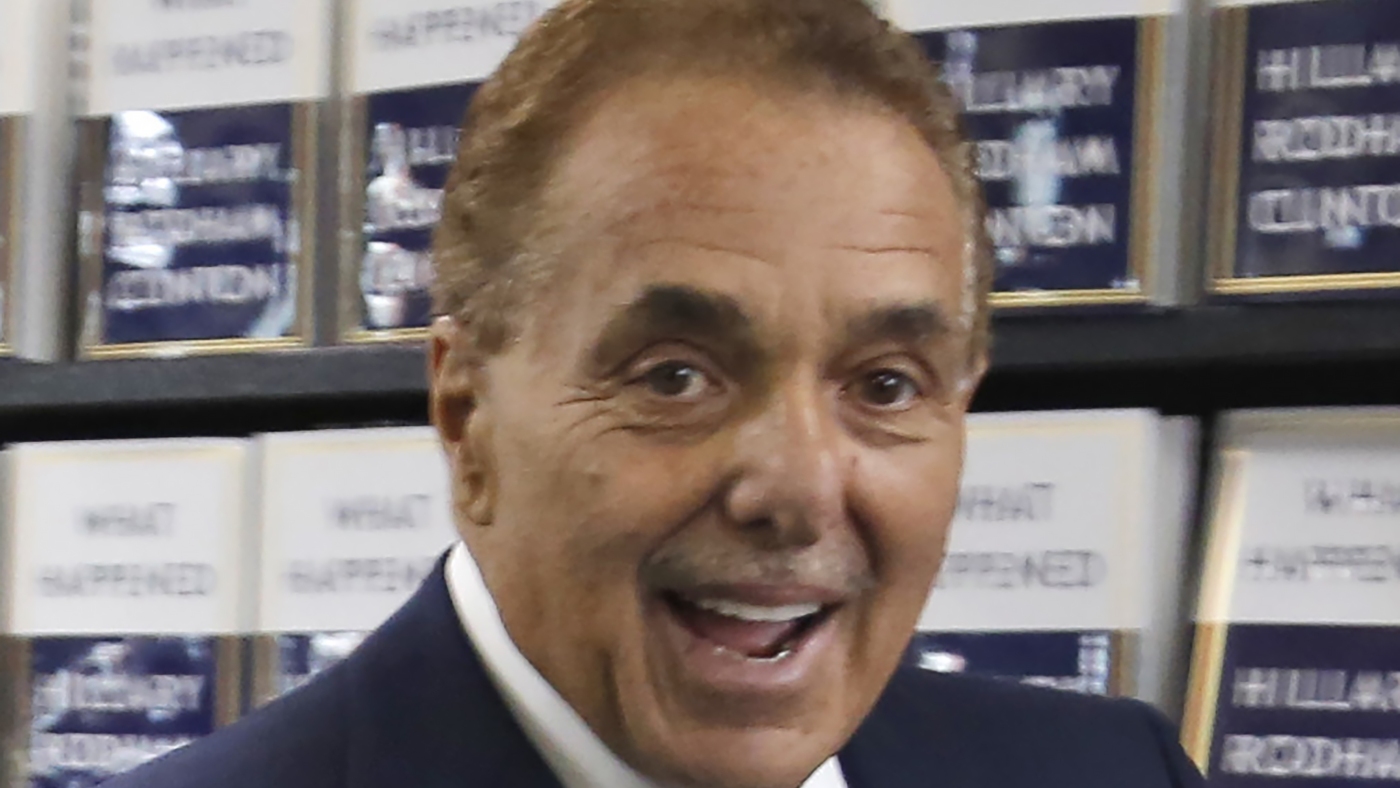
Leonard Riggio, then chairman of Barnes & Noble, arrives at a bookstore in New York on Sept. 12, 2017. Riggio died on Tuesday.
Seth Wenig/AP
hide caption
toggle caption
Seth Wenig/AP
NEW YORK — Leonard Riggio, a brash, self-styled underdog who transformed the publishing industry by building Barnes & Noble into the country’s most powerful bookseller before his company was overtaken by the rise of Amazon.com, has died at age 83.
Riggio died Tuesday “following a valiant battle with Alzheimer’s disease,” according to a statement issued by his family. He had stepped down as chairman in 2019 after the chain was sold to the hedge fund Elliott Advisors.
“His leadership spanned decades, during which he not only grew the company but also nurtured a culture of innovation and a love for reading,” reads a statement from Barnes & Noble.
Riggio’s near-half century reign began in 1971 when he used a $1.2 million loan to purchase Barnes & Noble’s name and the flagship store on lower Fifth Avenue in Manhattan. He acquired hundreds of new stores over the next 20 years and, in the 1990s, launched what became a nationwide empire of “superstores” that combined a chain’s discount prices and massive capacity with the cozy appeal of couches, reading chairs and cafes.

“Our bookstores were designed to be welcoming as opposed to intimidating,” Riggio told The New York Times in 2016. “These weren’t elitist places. You could go in, get a cup of coffee, sit down and read a book for as long as you like, use the restroom. These were innovations that we had that no one thought was possible.”
He grew up working class in New York City, liked to say he preferred socializing with childhood pals over fellow business leaders and was informal enough among associates to be known as “Lenny.” But in his time no one in the book world was more feared. With the power to make any given book a best seller, or a flop, to alter the market on an idle whim, Riggio could terrify publishers simply by suggesting prices were too high or that he might sign up such top sellers as Stephen King and John Grisham and publish them himself. He even tried to buy the country’s biggest book wholesaler, Ingram, in 1999, but backed off after facing government resistance.
By the end of the 1990s, an estimated one of every eight books sold in the U.S. were purchased through the chain, where front table displays were so valuable that publishers paid thousands of dollars to have their books included. Thousands of independent sellers went out of business even as Riggio insisted that he was expanding the market by opening up in neighborhoods without an existing store. Instead, independent owners spoke of being overwhelmed by competition from both Barnes & Noble and Borders Book Group, the rival chains sometimes setting up stores in close proximity to each other and to the locally owned business.
Barnes & Noble became so identified as an overdog that one of the 1990s’ most popular romantic comedies, “You’ve Got Mail,” starred Tom Hanks as an executive for the “Fox Books” chain and Meg Ryan as the owner of an endangered independent store in Manhattan.
“We are going to seduce them with our square footage, and our discounts, and our deep arm chairs, and our cappuccino,” Hanks’ character confidently declares. “They’re going to hate us at the beginning, but we’ll get ’em in the end.”
Acrimony from independent booksellers
For a time, it seemed industry conversation was an ongoing response to Barnes & Noble. Publishers were known to change the cover or title of a book simply because a Barnes & Noble official had objected. “Angela’s Ashes” author Frank McCourt found himself condemned by the American Booksellers Association, the trade organization for independents, after agreeing to appear in a Barnes & Noble commercial. On the floor of the industry’s annual national trade show, long hosted by the ABA, independent store employees would hiss at attendees wearing Barnes & Noble badges.
When novelist Russell Banks, addressing Barnes & Noble’s annual shareholder meeting in 1995, declared that he was both a stock holder and a happy B&N customer, some independent sellers stopped offering his books.
“You must know that I’ll never read, buy or sell another word you write,” Richard Howorth, owner of Square Books in Oxford, Mississippi, wrote to him. ”These are the kindest things I can think of to say to you.”
Tensions led to legal action when the ABA — on the eve of the 1994 convention — announced it was suing Barnes & Noble and five leading publishers for unfair trade practices. Some of the publishers were so angered they boycotted the gathering the following year and only returned after the ABA sold the show to Reed Exhibitions. In 1998, the ABA sued Barnes & Noble and Borders for unfair business practices (both cases were settled out of court).
The internet shifts bookselling
Riggio began the 2000s at the height of power, with more than 700 superstores and hundreds of others outlets. But internet commerce was growing quickly and Barnes & Noble, with its roots in physical retail, lacked the imagination and flexibility of the startup from Seattle that called itself “Earth’s Biggest Bookstore,” Amazon.com. The online giant launched in 1995 by Jeff Bezos gained business throughout the 2000s and by the early 2010s had displaced Barnes & Noble through such innovations as the Kindle e-book reader and the Amazon Prime subscription service.
Bezos would liken himself to David taking down Goliath, although the contrast between the leaders also had the feel of an Aesop’s fable: The muscular, mustachioed Riggio, a boxer’s son, upended by the quick and clever Bezos.
“We’re great booksellers; we know how to do that,’’ Riggio acknowledged to the Times in 2016. “We weren’t constituted to be a technology company.”
Barnes & Noble started its own online site in the late 1990s, but such initiatives as the Nook e-book reader and a self-publishing platform failed to stop Amazon. Not even the collapse of Borders after the 2008-2009 economic crisis mattered for Barnes & Noble, which after decades of expansion closed more than 100 stores between 2009 and 2019.
An unlikely ally of independent booksellers
By the time of Riggio’s retirement, independent sellers regarded the chain not as a threat, but as an ally in the fight against Amazon to keep physical stores alive. At the 2018 booksellers convention, Riggio and ABA CEO Oren Teicher, once enemies in business and in court, praised each other during a joint appearance.
“My standing here, doing what I’m about to do (introduce Riggio) would have been impossible to imagine several years ago,” Teicher said at the time. “The simple fact is that our business is stronger and American readers benefit when there is a vibrant and healthy network of brick-and-mortar bookshops all across the country.”
During the 2010s, Barnes & Noble seemed unleadable and unwanted. The board announced in 2010 that the company was for sale, but no one offered to buy it. Four CEOs left in five years and Barnes & Noble’s stock dropped 60% between 2015 and 2018. New rumors of a sale lasted for months before Elliott Advisors, which had previously purchased the British chain Waterstones, bought Barnes & Noble for $638 million and hired Waterstones chief executive James Daunt to lead B&N.
“I don’t miss being a business person, I had enough of that. But I do miss the bookselling part, helping to find books to recommend to customers,” Riggio told Publishers Weekly in 2021.
Riggio’s roots and early bookselling ventures
Bookselling and family often overlapped for Riggio. His brother Steve Riggio served for years as vice chairman of Barnes & Noble and another brother, Thomas Riggio, helped run a trucking company that shipped the store’s books. After being interviewed in 1974 by the trade publication College Store Executive, Leonard Riggio met for coffee with the editor, Louise Altavilla, who seven years later became his second wife (Riggio had three children, two with his first wife, one with his second).
Leonard S. Riggio was the eldest son of a prize fighter (who twice defeated Rocky Graziano) turned cab driver and a dress maker. Even in childhood, he advanced quickly, skipping two grades and attending one of the city’s top high schools, Brooklyn Tech. He studied metallurgical engineering at New York University’s night school before focusing on commerce, and by day absorbed the bookselling world and the rising cultural rebellion of the 1960s.
Working as a floor manager at the campus book store, he learned enough to drop out of school and start a rival shop in 1965 — SBX (Student Book Exchange), where he allowed student activists to use the copying machine to print copies of anti-war leaflets. SBX was so successful he bought several other campus stores and was in position by 1971 to buy Barnes & Noble and its single Manhattan store. A few years later, he became the rare bookseller to run television commercials, with the catchphrase “Barnes & Noble! Of Course! Of Course!”
Riggio and the independent community may have seemed to hold opposing values, but they shared a love of reading and the arts and a liberal political outlook. He was a generous philanthropist and a prominent supporter of Democratic politicians. He was even friendly with the consumer activist and presidential candidate Ralph Nader, who featured Riggio, Ted Turner and Yoko Ono among others in his 2009 novel “Only the Super-Rich Can Save Us!”, in which Nader imagines a progressive revolution from above.
“Ever since he was a boy from Brooklyn, he’d had a visceral reaction to the way workings stiffs and the poor were treated on a day-to-day basis,” Nader wrote of Riggio, who did at times stand apart from his management peers. When some 200 business leaders were questioned by Fortune magazine in the 1990s about their political ideas, only Riggio supported the raising of worker pay.
“Money can become a burden, like something you carry on your shoulders,” he told New York magazine in 1999. “My nature is to be a ball-buster, but my role is to help people.”


In central London’s Waterloo Place, a life-size statue that emerged overnight in late April has been creating a stir. When I visited a few weeks after it was erected, local authorities had already set up protective barriers around it.
The installation — signed by the famed street artist Banksy — depicts a man in a suit hoisting a flag as he strides over a precipice. As he marches on, the flag blows backward to cover his face, leaving him unaware he’s only a step away from a perilous fall.
Set among grand monuments celebrating Britain’s past, the “flag man” takes on a particular visual irony at a time when the country — and much of the world — is debating its path forward.
Like many viewers there, I found myself wondering whether this statue is Banksy’s warning about the consequences of uncritical nationalism, or simply a reflection on human shortsightedness. Or, perhaps, it is just prompting us to ponder a broader question: What happens when devotion to a symbol prevents us from seeing what lies ahead?
Whatever the message, the work feels remarkably attuned to the current moment.
For more Far-Flung Postcards, click here.
Lifestyle
Wait, it’s a candle? Her beeswax fruit and veggie ones look so real, you’ll want to take a bite
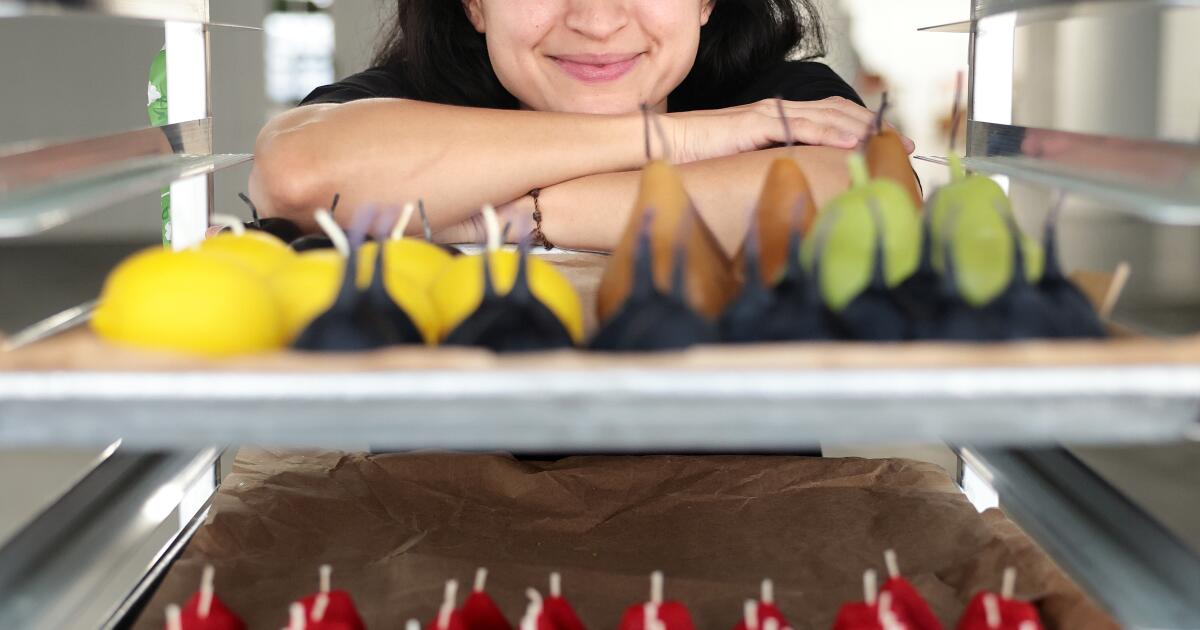
Jessica Gonzalez hustles behind her booth at the recent Renegade Craft Fair, frantically ringing up sales, answering questions and packaging her beeswax candles.
It’s hot on the grounds of the Los Angeles State Historic Park in April, but 35-year-old Gonzalez and her fiancé, Jordan Colindres, keep their cool as a crowd gathers to admire her Happy Organics candle collection, a homage to her family’s produce company in the Central Valley that looks like real fruits and vegetables.
“I love doing in-person events because it’s so fun to see people’s reactions,” she said a few months later. “It makes me feel good to see other people finding joy in my candles. They often say, ‘Oh, that’s really funny.’ And it is funny to have a cherry candle on top of your birthday cake.”

3

1. A staff member pulls a beeswax corn candle, $26, out of its mold at Happy Organics’ studio in downtown Los Angeles. 2. Each Beeswax Mixed Berry Birthday Candles set is cast from real mixed berries — strawberries, raspberries, blackberries, blueberries and cherries. A set of 10 is $30. 3. Bartlett green pears and heirloom tomatoes, $24 to $40.
Judging by the smiles and charmed looks on shoppers’ faces, her produce-inspired candles are less about illuminating rooms and more about sharing the joy she sought when she first started the company in 2018.
In this series, we highlight independent makers and artists, from glassblowers to fiber artists, who are creating original products in and around Los Angeles.
But then, it’s hard not to smile at the playfully elegant Bosc pears, puckered mandarins and green-and-purple asparagus taper candles which range in price from $12 to $40. Some are molded into corn on the cob, celery and rhubarb shapes. Others are made to look like mushrooms, figs, tomatoes and snap peas. The most popular are the small birthday candles shaped like raspberries, cherries and blackberries, packed in molded-pulp baskets just like you’d find at the grocery store or farmers market.

-
Share via
Gonzalez didn’t start out as a designer. The youngest of nine children, she was born in 1991 in Salinas and later moved to Merced, where she grew up on a 10-acre farm. She studied computer science at Mills College, then worked in tech consulting in the Bay Area and eventually became the CTO of an ag-tech company. When her mother, Angela, became ill in 2016, she returned to Merced to be with her family.
When her mom died suddenly soon after she moved home, Gonzalez left the tech industry. “I wasn’t connected with what I was doing,” she said. “I wanted to find something more meaningful; something I loved. I didn’t want my ego to keep me stuck in what I studied in college. I decided to let myself try new hobbies and passions and look for joy again.”
After her mother’s death, she began working with her father, Salvador, and her uncles at the family’s apiary, where they managed more than 30 hives. (Her grandfather was also a beekeeper in Michoacán, Mexico.) Soon, she began selling their raw honey at local farmers markets. In a heartbreaking turn, her father was diagnosed with cancer a year later, so she started making cannabis-infused honey, balms and chocolates to help ease his pain.
When she saw that the beeswax candles, which last significantly longer than paraffin candles, were selling faster than the honey, she decided to focus on making candles from the leftovers from her uncles’ hives.
She was only 25, but it was a turning point. “It was one of those moments where I felt like I needed to change my path,” she said. “I needed to change everything in my life.”

Jessica Gonzalez and her father Salvador on their family farm in Merced. (Gonzalez family)

Gonzalez at Happy Organics’ studio in downtown Los Angeles. (Christina House / Los Angeles Times)
When her father died in 2018, she inherited his bees and started Happy Organics, although she hadn’t planned on starting a business. After experiencing so much loss, making candles became a kind of therapy. “It felt great to work with my hands again, something I thought I’d never have time for,” she said.
Her oldest sister, Sonia Gonzalez, said Gonzalez reminds her a lot of their father, who reinvented himself many times over the years.


The nopal cactus is cast from a real nopal and hand-poured in 100% pure beeswax in the Los Angeles studio.
“He grew up as a village boy in the rural mountains of Michoacán, Mexico, and went on to work in restaurants, cut down Christmas trees and pick strawberries and broccoli in the fields of Salinas,” she wrote in an email. “From there, he started selling produce door-to-door, then at flea markets and eventually built his own produce distribution business from the ground up. As the youngest of nine kids from a working-class family, Jessica’s always been incredibly resourceful, responsible, and amazing at reinventing herself.”
Like a lot of millennials, Gonzalez taught herself how to make candles by watching YouTube videos. She started with hand-dipped tapers, working in the garage on the farm that helped her feel safe and connected to her parents. “It was a really nice environment to try something new and creative,” she said.
Inspired by her family’s produce, she cast real corn, strawberries and cherries in plaster, then made a silicone mold to create copies. Even when using the same mold, color can vary from batch to batch, and how it cools also affects the result. “That’s just how handmade things are,” she said. “There’s always some variation.”

Cherry molds make cherry candles at Happy Organics’ studio in downtown Los Angeles.

A variety of fruit and veggie candles.
When she moved to Los Angeles in 2023 to be with Colindres, her business took off. “L.A. is a great place to grow,” she said. “There’s so much opportunity here. When I go to a farmers market, I never know who I’ll meet.”
She sold her candles in person at craft shows, the Hollywood Farmers’ Market and most recently, during a residency at the P.F. Candle Co. showroom in Echo Park.

2

3

1. A staff member trims the wicks on a pair of carrot birthday candles, $22. 2. Gonzalez passes by shelves of candles at Happy Organics’ studio in downtown Los Angeles. 3. Asparagus taper candles, $30.
“I have a lot of respect for her as a fellow candle maker (making molds is not easy), but getting to know her story more and how her choice of foods and wax is reflective of her family’s history gave it so much meaning,” P.F. Candle Co. founder and creative director Kristen Pumphrey said in an email. “It’s been a tough couple of years for L.A. businesses, so we gotta stick together — there’s this wonderful sense of community hosting a local brand that’s so passionate about their work.”
As her business has expanded, her products are now available at Terrain, Joan’s on Third and the MoMA Design Store in addition to her website. She has also had to source beeswax from other vendors across the country to keep up with demand.
Kimberly Curtis, owner of Hide & Seek Vintage in Studio City, said Gonzalez’s strawberry and cherry birthday candles “flew off the shelves last year” during the holidays. “Our customers love them,” she added.

Gonzalez holds a cabbage candle.
Still, Gonzalez stays connected to her Central Valley roots. Everything she and her small team make in downtown Los Angeles is handmade and “takes time,” she said, describing the steps involved in crafting quality candles. Right now, her favorite is the Nopal Cactus candle, which she made using a clipping from an employee’s yard. While others help her with production, wholesale management and packaging, she focuses on sales, content and all-new product development.
When asked if she has advice for others who want to start their own business, Gonzalez admits she sometimes feels overwhelmed.

In 2013, Gonzalez and her family gathered at their Merced ranch to celebrate her parents’ anniversary.
(Gonzalez family)
“The biggest thing that has gotten me through the toughest spots is my why or my reason for starting,” she said. “I think that has to be really strong. That’s what brought me a lot of comfort when I felt like quitting: going back to the beginning and remembering why I started this.”
For Gonzalez, her reason is always close to her heart. “I wanted to feel connected to my parents in some way,” she said. “This was a good representation of my upbringing.”

The Kennedy Center, the facade of which remains covered with a tarp, is seen in Washington, DC, on June 28, 2026. A US federal judge asked on June 24 for an explanation for why a tarpaulin continues to cover the facade of the Kennedy Center where President Donald Trump’s name was recently removed. District Judge Christopher Cooper gave the board of trustees of the performing arts venue until the end of July to explain “the purpose for and status of the tarp and scaffolding that Defendants have erected on the front portico of the Center.”
ALEX WROBLEWSKI/AFP via Getty Images
hide caption
toggle caption
ALEX WROBLEWSKI/AFP via Getty Images
More than two weeks ago, President Trump’s name was removed from the Kennedy Center facade though it is still covered by a tarp and the legal battle continues.
On Monday, a U.S. Department of Justice filing on behalf of the Kennedy Center included some surprises. The document was submitted in response to issues raised by lawyers for ex-officio board member Rep. Joyce Beatty of Ohio who is suing to remove President Trump’s name from the center and stop its closure for renovations.
Among the revelations, the Kennedy Center admitted that, during a board meeting on December 18, 2025, Beatty had been “muted and prevented from speaking.” It was at that meeting that the board voted to add President Trump’s name to the center. The filing later acknowledges the congresswoman was “prevented from voicing her opposition.”
The John F. Kennedy Center for the Performing Arts is a living memorial to its namesake. The guidelines for how the theatre complex spends federal dollars are very specific. Among other rules, it states that “no additional memorials or plaques shall be designated or installed.” Beatty argues adding Trump’s name runs afoul of those rules and that any change requires approval from Congress.
According to one of Beatty’s filings, “There was no advance notice in the agenda that the Board would be considering a name change,” a statement the Kennedy Center now does not deny. The center admits that, prior to voting, there was “no discussion about potential risks or downsides of the vote to adopt a secondary name for the Center.” Nor was there a board discussion “about any potential conflict of interest that might result from the vote.”
The center’s lawyers previously contended that if Trump’s name were to be removed, it would “lose money from donors who support” him and “impede the Center’s fundraising efforts.”
Closing for renovations
Earlier this year, Trump announced on social media that the Kennedy Center would close for two years for renovations. He wrote that he made the decision after “a one year review” with “Contractors, Musical Experts, Art Institutions, and other Advisors and Consultants.”
But, according to the center’s lawyers, Trump’s announcement “was made without presenting any plans, analyses, timelines, or funding information to his cotrustees and without any Board vote.”
The Kennedy Center has long denied reporting by The Washington Post that ticket sales plummeted after President Trump became the Center’s board chair. In Monday’s legal filing, the Center admits that, by October 2025, “nearly half of the Center’s tickets were going unsold.”
-

 World4 minutes ago
Russia Approved Secret China Military Training At Top Level: Reuters
-

 Science24 minutes ago
This Cell Feeds, Grows and Reproduces. And It’s Manmade.
-
Lifestyle46 minutes ago
Greetings from London, where Banksy’s flag man is a warning cry
-
Education49 minutes ago
This Little Robot Cleans Windows
-

 Technology54 minutes ago
Comcast’s split could make or break Peacock
-

 World1 hour ago
State Department congratulates Keiko Fujimori as Peru’s president-elect following razor-thin vote count
-

 Politics1 hour ago
Mamdani ripped for claiming victory over capitalism after NYC’s multi-billion dollar taxpayer funded bailout
-

 Health1 hour ago
American vaccines that transformed public health over 250 years: ‘Outweighs harm’

