Business
You can't buy a Chinese EV in the United States. But they dominate in Southeast Asia

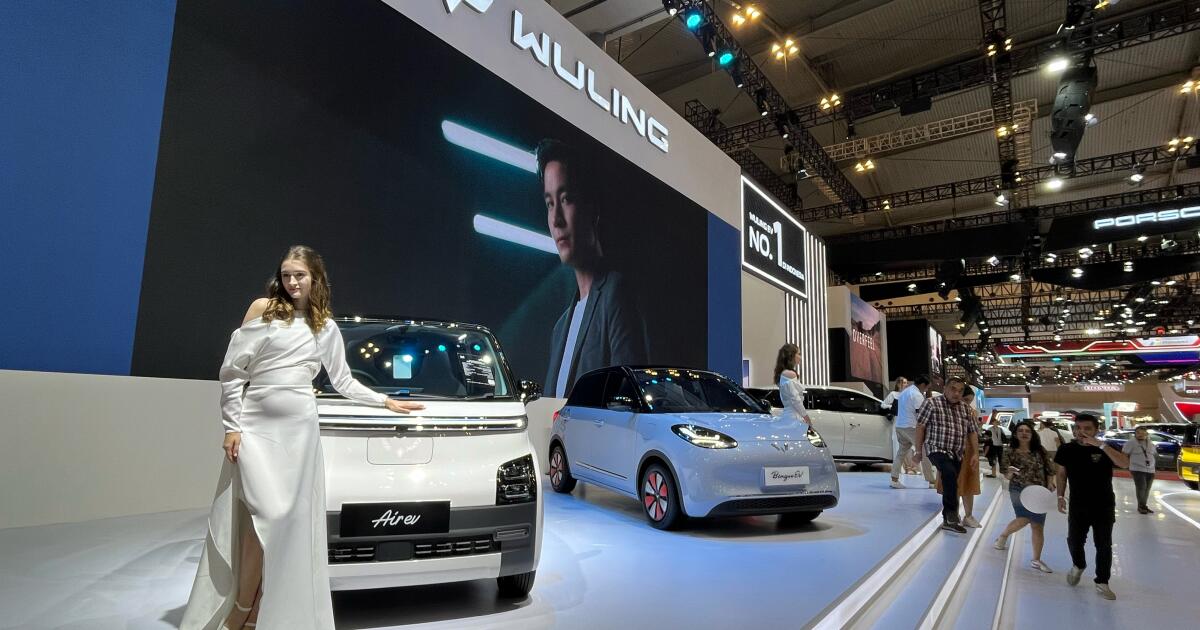
Late last year Chinese automaker BYD surpassed Tesla as the world’s biggest seller of electric vehicles.
But you won’t find its cars in the United States anytime soon. With the Chinese auto industry facing tariffs in the U.S. and the European Union, one of its most important markets is Southeast Asia.
Of the 31 passenger car brands represented last month at the sprawling Indonesia International Auto Show outside Jakarta, about a third were from China. The vast majority of those were electric vehicles.
Striding past fashion models and huge video displays, Safik Bahsein made his way to the BYD display, where he honed in on a BYD Dolphin, which promises 300 miles on a single charge and sells for the equivalent of $26,000.
Visitors look at a BYD car during an auto show last month. Chinese car companies have been gaining ground in Indonesia, particularly in EVs.
(Tatan Syuflana / Associated Press)
It’s one of three EV models that BYD now sells in Indonesia, the world’s fourth most populous country — with more than 275 million people — and the largest car market in Southeast Asia. The company’s first shipment of 1,000 EVs arrived last month.
“It’s quite beautiful,” said Bahsein, 49, who works in shipping. “Compared with European cars, I think BYD has good prospects in the future.”
In his view, the quality of Chinese cars now matches those from Europe and Japan. He said he was considering buying one for his wife, though he still prefers his Tesla Model 3, which he had to have specially imported two years ago because there are no dealers in Indonesia.
The country’s car market has long been dominated by the Japanese brands Toyota, Daihatsu and Honda. But Chinese companies have been gaining ground, particularly in EVs, where Japanese automakers have lagged.
Chinese brands accounted for 43% of EV sales in the first half of 2024, according to the Assn. of Indonesia Automotive Industries.
But getting people to buy EVs has been especially challenging in Indonesia, where there are many cheaper alternatives and a dearth of charging stations. Only 17,121 EVs were sold last year — just 2% of all auto sales.
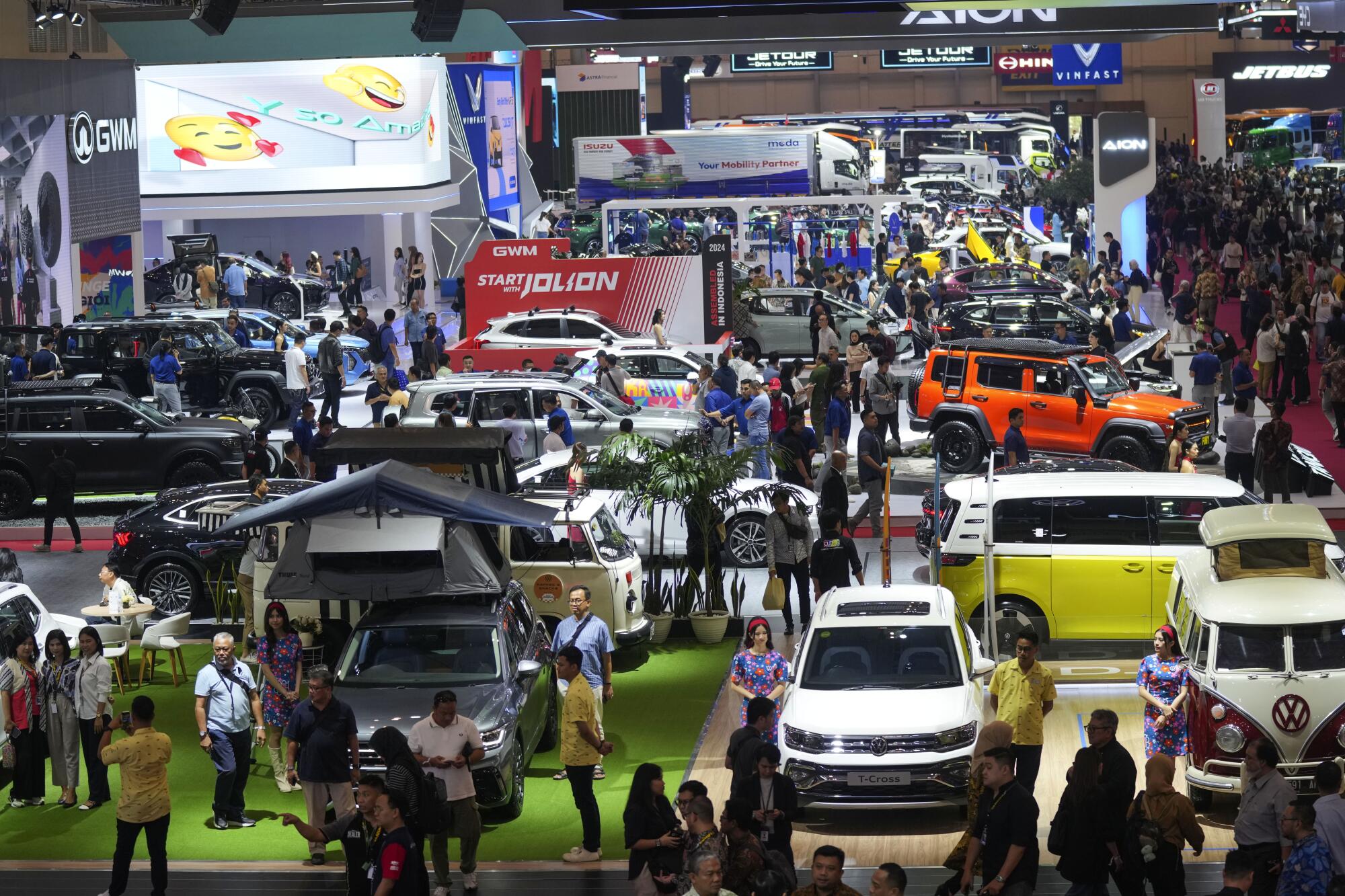
“Southeast Asia, specifically Thailand and Indonesia, is the beachhead, both as a market and a production base,” said Lei Xing, former chief editor of the China Automotive Review.
(Tatan Syuflana / Associated Press)
The Indonesian government has created incentives for EV buyers and set a goal of 400,000 EV sales next year. But the international data analytics firm Fitch Solutions has suggested that a more realistic expectation is 56,000 by 2028.
For Goldie Liem, 24, who recently bought a Binguo EV from the Chinese carmaker Wuling, the biggest incentive was the license plate, which exempts Jakarta drivers from road restrictions meant to cut down on traffic.
That saves her time on her daily office commute, which can take up to two hours. She said she also saves on gas, and pays about $60 a year in taxes compared with $430 for her old Mazda.
“It gets me from A to B, that’s it,” she said. “I haven’t tried to take it out of town yet, because I’m not that brave, in terms of charging stations and all that.”
It would take much more to make her husband an EV convert. They couple had come to the auto show so he could check out gas-powered BMWs.
In China, the EV industry has flourished thanks to clean energy subsidies and access to comprehensive supply chains for battery technology and vehicle manufacturing. But intense domestic competition has prompted price cuts and led automakers to look overseas for growth.
Brazil, Belgium, the United Kingdom, Thailand and the Philippines are the biggest export markets this year, according to the China Passenger Car Assn. Indonesia is among the fastest growing.
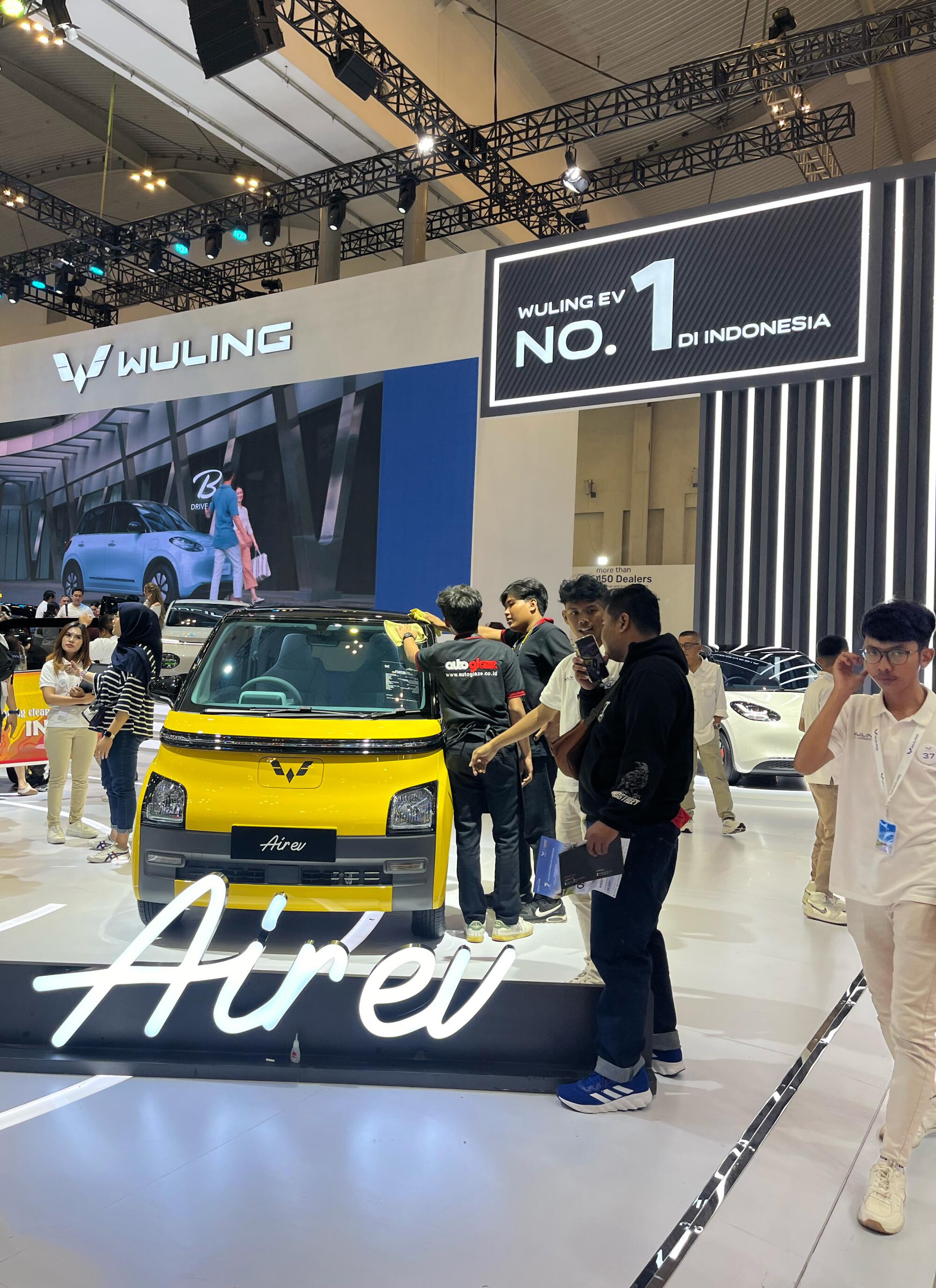
Wuling, a Chinese EV brand, accounts for about 40% of EV sales in Indonesia. But electric cars still only make up about 2% of total car sales, hampered by insufficient charging infrastructure.
(Stephanie Yang / Los Angeles Times)
“Southeast Asia, specifically Thailand and Indonesia, is the beachhead, both as a market and a production base,” said Lei Xing, an independent auto analyst and former chief editor of the China Automotive Review. “It’s not like you’re going into Europe and competing against the Volkswagens and the BMWs. Now with the EV opportunity, Chinese brands are jumping on that.”
BYD recently announced plans to build a $1.3-billion EV plant two hours from Jakarta that will begin operations in 2026, joining other Chinese brands Neta and Wuling to build electric cars in Indonesia.
It’s no coincidence that Indonesia also happens to be one of the world’s leading producers of nickel and other minerals needed in EV batteries.
China has already invested billions of dollars in Indonesian nickel mines in order to procure the strategic metal. Now Indonesia is trying to attract more Chinese funding to process its natural resources and build cars at home.
In an op-ed this year for China Daily, a state-run newspaper, a senior Indonesian transportation official declared his country’s EV industry “open for business.”
The official, Rachmat Kaimuddin, the deputy coordinating minister of transportation and infrastructure, also encouraged Chinese carmakers to take advantage of the “golden opportunity” of recently announced tax incentives for international car brands producing in Indonesia.
For brands like BYD, building more facilities in other countries is a critical part of global expansion, particularly as the U.S. and EU have threatened to implement harsher policies to keep cheap Chinese models from pushing out their own domestic manufacturers.
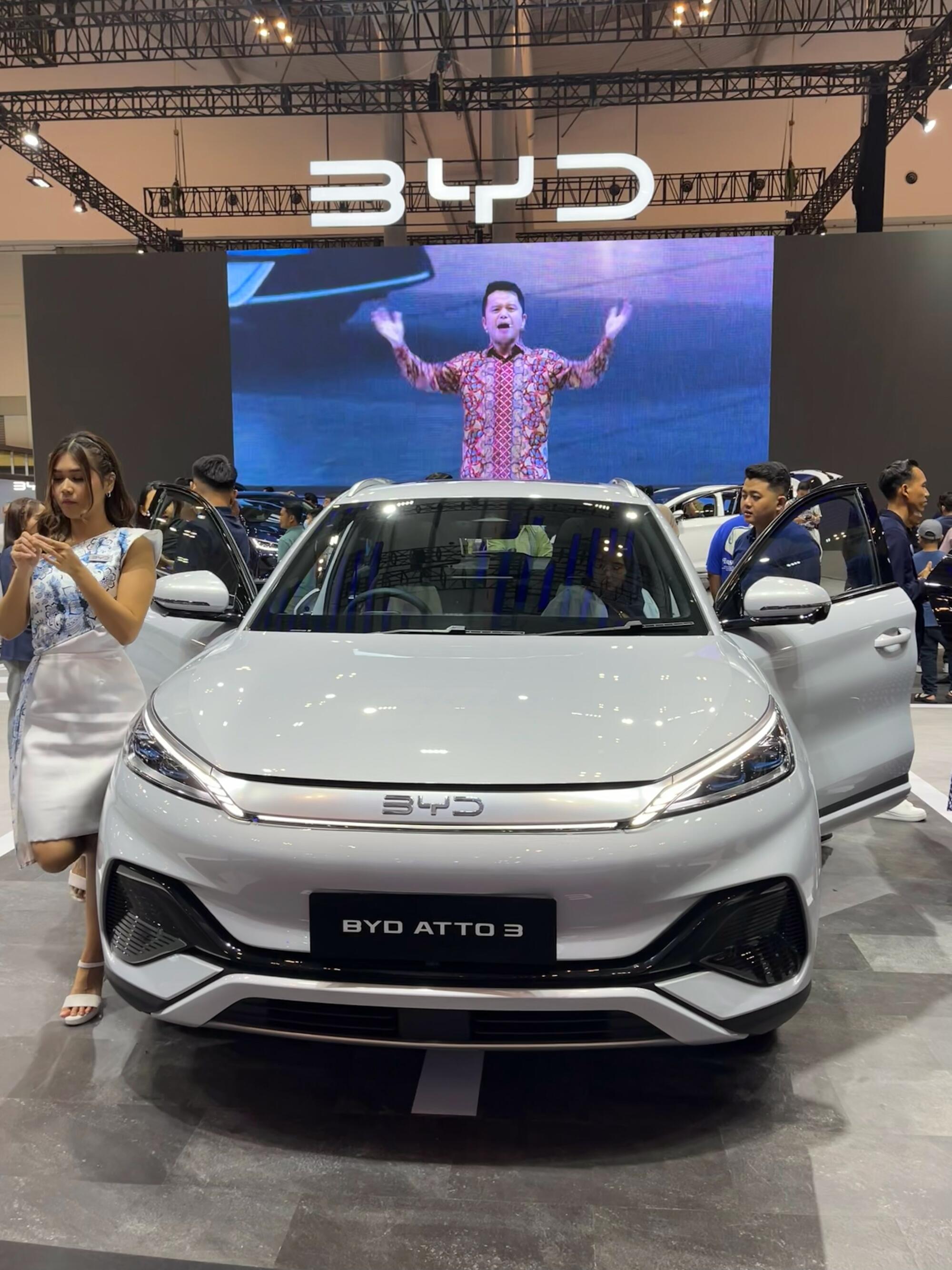
Leading Chinese automaker BYD delivered its first 1,000 EVs to Indonesian consumers this year, as it expands its manufacturing and sales in one of Southeast Asia’s biggest auto markets.
(Stephanie Yang / Los Angeles Times)
Last month, the EU announced tariffs of up to 37.6% on Chinese EVs. In the U.S., President Biden raised the existing 25% tariff on Chinese EVs to 100%.
BYD has also opened a plant in Thailand, and has announced investment plans for Turkey, Hungary and Mexico, which could help the automaker sidestep foreign import taxes in the U.S. and Europe on Chinese goods.
“These are very strategic locations,” said Xing, the auto analyst. “In order to be global, I think the U.S. and Europe are the last two frontiers.”
In the meantime, there is Southeast Asia. At the auto show, Ricky Aristin, 23, spent two hours browsing cars that could potentially replace his Honda Accord. The highlight was climbing into the driver’s seat of a BYD Seal, an electric sedan that sells for about $44,000.
“It feels like an expensive car,” Aristin said. “It’s a good experience from the car with the lowest price.”
Nonetheless, he decided he wouldn’t buy an EV until Jakarta has more charging stations.



The Los Angeles City Council on Tuesday unanimously advanced an ordinance to halt new oil and gas drilling and phase out all existing production over the next 20 years. L.A. is home to more than 2,000 active oil wells.
The measure revives a similar ban passed in 2022, which was struck down by a judge following legal challenges from the oil and gas industry.
It must pass a second vote before final adoption later this summer, and would make L.A. the largest city in the United States to phase out existing oil wells.
“Today, Los Angeles is making a decision that aligns with our need to turn the page on urban oil drilling,” Councilmember Katy Yaroslavsky said during Tuesday’s council meeting. “The absence of an enforceable oil ordinance has had real consequences for our communities.”
The ban in 2022 was seen as a historic move for a region built on the petroleum industry.
But in 2024, a Los Angeles County Superior Court judge invalidated the law, ruling that the state, not the city, has jurisdiction over petroleum production. The legal challenge was brought by oil companies including Warren Resources, which operates a large oil field in Wilmington. Much of the field is beneath the city of Long Beach, but it also extends under Los Angeles.
Shortly after that, state legislators advanced Assembly Bill 3233, which reaffirmed city and county authority to regulate oil and gas activity. It was largely seen as the missing piece that made the original ordinance vulnerable.
“It’s now unequivocal that cities have the authority to regulate, limit and prohibit oil and gas operations within our jurisdiction,” Yaroslavsky said.
The new ordinance, written by the Department of City Planning, prohibits new oil and gas extraction, including drilling, redrilling or deepening existing oil wells for the purposes of production. It also designates all existing and active idle wells as “nonconforming uses,” meaning they may only operate during the phaseout period and are no longer compliant with current zoning.
Warren Resources, which led the lawsuit against the previous ban, did not immediately respond to a request for comment. The company previously argued that the 2022 ban was rushed and would lead to more oil imports to the area, causing increased emissions from tankers and trucks and other environmental consequences.
Many wells in the city operate near schools, homes and parks. Most are concentrated in low-income areas and communities of color, such as Wilmington and the harbor district, West L.A. and South L.A., where residents have long reported respiratory issues, headaches, throat irritation and other health problems. Studies have found oil wells can emit carcinogens and are linked to adverse health effects.
“This ordinance is such an important step toward giving every frontline community in Los Angeles access to clean air,” Silvia Esparza, a South L.A. resident and member of environmental justice group Stand-L.A., said in a news conference ahead of Tuesday’s vote.
Ashley Hernandez, a Wilmington resident and organizer with the nonprofit Communities for a Better Environment, said bloody noses and noxious fumes were a regular part of life in the neighborhood growing up.
She noted that in addition to oil drilling, L.A. residents continue to face other environmental hazards, such as the recent oil pipeline rupture that sent crude into the L.A. River or the ongoing cold storage warehouse fire in Boyle Heights that is spewing toxic smoke.
“I’m here to remind L.A. city and these toxic neighbors that Wilmington residents are more important than any ‘black gold’ under their homes,” Hernandez said. “We need our city to protect our families now and to stop the oil industry’s reign of power in our city. A passage of the oil phaseout ordinance today gives the city a chance to correct this wrong.”
Times staff writer Dakota Smith contributed to this report.

Shares in Elon Musk’s rocket company SpaceX halted their three-day slide that had erased roughly $600 billion off its market value.
SpaceX shares closed at $156.11 with a nearly 1% gain on Tuesday, a slight recovery from a 16% fall on Monday.
That loss dropped the stock below $160.95, where it ended the day June 12 after a 19% surge during its record initial public offering. The IPO gave it a market cap of $2.2 trillion, making SpaceX one of the world’s most valuable public companies.
It also turned Musk into the world’s first trillionaire, a status he retains despite the sell-off.
The downturn probably reflects investor unease over the company’s spending plans and potential debt load, analysts say.
SpaceX raised a total of $86 billion after underwriters exercised their right to sell additional shares, on top of the $75 billion initially raised. It was the largest IPO in history.
A little more than half a billion shares were distributed to institutional and retail investors at a price of $135, with the stock opening at $150 as some holders immediately flipped shares for a profit.
Shares rose as high as $176.52 during the IPO before settling at the $160.95 price. In the weeks since, shares reached a high of $225.64, meaning that some investors lost money or are underwater with paper losses.
Since the IPO, SpaceX has dropped some big bucks.
It announced last week that it was acquiring AI coding startup Cursor for $60 billion in a deal expected to close in the third quarter. The San Francisco company, founded in 2022, enables engineers to instruct software in English to run coding tasks autonomously.
It also sold $25 billion in bonds on Tuesday , unusual for a company that just went public, much less for one that just raised a record sum.
The IPO surpassed the 2019 offering by Saudi Aramco, Saudi Arabia’s state-owned oil giant, which raised $29.4 billion, the prior record holder.
S&P Global issued a report last week that assigned SpaceX a “BBB” credit rating, the lowest possible rating to qualify as an investment grade credit risk. It noted the company will have “elevated capital expenditure” through 2029.
SpaceX rivals OpenAi and Anthropic filed this month for initial public offerings that, while not expected to be as large as Musk’s company, will be large in their own right.
Wedbush analyst Dan Ives, who has been bullish on SpaceX stock, said the market is digesting “massive debt and equity raises from Big Tech players” in the coming years.
“This is part of an industry wave of debt offerings on Wall Street, like Alphabet and SpaceX among others,” he wrote in an email.
With the stock already giving up gains since the IPO, it will be further tested when tranches of locked-up shares held by current and former employees are released.
At least 20% of the shares will be released after second-quarter results are disclosed sometime in the coming months, with all the lockups expiring in December.
SpaceX, based in Texas, is the leading launch services company in the world, with its Falcon 9 rocket accounting last year for the vast majority of satellites sent into space.
It is also the leading satellite-based broadband provider with its Starlink service. But the extraordinary interest in the IPO was driven by Musk’s plans to make the company an AI leader — including plans to launch orbiting satellite data centers powered by the sun that crunch AI data.
He merged his xAI artificial intelligence company into SpaceX this year, with the combined entity recently announcing it was leasing computer power to rivals Anthropic and Google at two terrestrial data centers it has constructed.
Musk moved the company’s headquarters from Hawthorne to Texas in 2024, but it retains large operations in the South Bay city and blasts off regularly from Vandenberg Space Force Base in Santa Barbara County.
Investment research firm Morningstar placed a $780-billion valuation on SpaceX, focusing on its core rocket and Starlink broadband satellite businesses. It suggested investors wait a few months for the stock to settle before buying in.
“I think the day-to-day stock price movements are usually based on market sentiment,” said report co-author Nicolas Owens, an equity analyst at Morningstar. “So I was not surprised when it went way up right after the IPO — and I’m not surprised it [came down]. Not much has really changed in the fundamentals.”
Mike Alves, founder of Pasadena’s Vida Vision Fund, has a stake in SpaceX that accounts for 46% of his AI and robotics fund.
He said he was not perturbed by the stock drop, noting that Facebook fell under $18 a share just months after its May 2012 IPO closed at $38 a share. It has since risen more than 1,000% above its offering price.
“The volatility doesn’t really matter because you’re going to multiply your best investment many times, so I’m not so worried about it,” he said, adding that investors seeking shares could now “scoop them up at a good deal.”

The nation is awash in data center hate and California is no exception.
Temporary bans have cropped up across the state as residents from Imperial County to San José fight proposals in their communities. Monterey Park became the first city in the country earlier this month to permanently ban data centers by a popular vote. And a recent poll sponsored by the environmental group Net-Zero California showed 70% of state residents don’t want data centers in their communities.
But unlike in Virginia, Texas, Ohio and other states where residents are fighting 400-plus megawatt hyperscaler facilities in their backyards, California has some major barriers keeping data centers at bay.
Sky high industrial electricity prices are more than double the national average. Long wait times to connect to the grid have some new data centers sitting empty in Silicon Valley. And the state regulates the size of the backup generators that keep the centers running when the grid goes down. That has limited most facilities to a fraction of the size that artificial intelligence increasingly demands.
That all means that California is seeing less of a boom — fewer proposed data centers, and smaller in size — than in the country’s hot spots.
“California isn’t even on the map today,” said Mehdi Paryavi, chairman of the International Data Center Authority. “Taxes are high, land is expensive, water is scarce, energy is difficult to find, communities are pushing back. There are all kinds of problems.”
Northern California and Southern California were hubs for an earlier generation of data centers. “But over time, as the sector has grown, the overwhelming majority has been developed elsewhere,” said Andrew Batson, head of data center research at real estate intelligence firm JLL.
“Almost all the data center demand being generated from California is being serviced by adjacent states,” from places such as Phoenix and Las Vegas, Batson said, “where power is much cheaper, land is more affordable, and regulations are quite less.”
Still, “California can’t outsource all it’s data center capacity,” and the state expects to see growth over the coming years.
Fifty-one facilities are currently planned in the state, according to a recent study from the Pew Research Center, an 18% increase over the 277 operating today. According to a study from UC Riverside, data center electricity use in the state doubled between 2019 and 2023.
But some grid operators elsewhere are already seeing overwhelming loads, such as the Pennsylvania-New Jersey-Maryland Interconnection that expects about 40% to be added to its total demand, largely from data centers, by 2035. Compare that to the California Energy Commission which expects data centers to drive an increase of about 2 gigawatts by 2030, and 5 GW by 2040. That’s about 4 and 9% of its 52 GW peak load respectively.
“It’s a significant amount of demand growth, but it’s not dwarfing all the other factors,” said Mark Specht, a senior energy manager at the Union of Concerned Scientists who put out a report on California data center growth last month. “Some of the projections we’re seeing for increased electricity demand from electric vehicles in 2045 is actually higher than the demand from data centers.”
California regulations are part of what’s keeping data centers relatively small: A state rule requires any backup generator bigger than 100 megawatts to be certified as a power plant.
Specht’s report found none of the current data centers in California and almost none of the proposed ones require that certification because they fall under the 100 MW cap. (Exceptions include a 417 MW planned facility in Santa Clara and a 330 MW one in Imperial County blocked Tuesday by a moratorium vote.)
One hundred MW could power a small city’s peak demand, yet the average U.S. data center is expected to demand over 600 MW by 2030, according to the energy intelligence company Cleanview.
A San Francisco Chronicle analysis showed that California facilities currently make up about 5% of national data center power demand, but that share is expected to fall to 1% if building proceeds as planned across the country.
Still, the growth that does exist is raising concerns among utility ratepayer advocates and environmentalists, not to mention the general public.
“There are real costs at stake,” said Mark Toney executive director at The Utility Reform Network, a ratepayer advocacy group.
He noted Pacific Gas & Electric anticipates a massive amount of new demand from data centers — about 10 GW worth — or enough to power 7.5 million homes. That would require grid upgrades he estimates at about $10 billion, partly borne by ratepayers. Interest has been high in PG&E territory because it serves the San Francisco Bay area, where California’s projected data center buildout is concentrated around San Jose, now that Santa Clara has reached capacity.
Data center electricity projections come with uncertainty, and PG&E says its confirmed large load in the pipeline — mostly data centers — is closer to 5.3 GW.
Whatever demand materializes, TURN and others are fighting to shield ratepayers from the costs of PG&E’s buildout, a battle playing out at the Public Utilities Commission.
PG&E spokesperson Rob Stillwell said data centers help reduce rates by spreading the costs of grid maintenance over more customers. He noted data centers already have to pay the up front costs of connecting to the grid, under a temporary rule.
But TURN says those don’t include all of the infrastructure and broader grid updates that PG&E will have to invest in to support data centers.
And the rule only applies for PG&E territory and doesn’t require data centers to bring their own clean power.
TURN is now backing a bill from State Sen. Steve Padilla (D-Chula Vista) that would require all data centers to pay for 100% of the costs of new transmission upgrades as well as new clean energy to cover at least half their required electricity. The industry is opposing the effort.
Another Padilla bill would approve data centers faster if they use more clean energy. One from Assemblymember Rebecca Bauer-Kahan (D-Orinda), would require data centers to disclose their energy use to the state. And bills by Assemblymember Diane Papan (D-San Mateo) would require them to project and report their water use as part of permitting and licensing.
Yet politicians have been hesitant to regulate. Last year, similar bills were either watered down, didn’t make it through the legislature or were vetoed by Gov. Gavin Newsom.
At a panel in January, gubernatorial candidates were asked how they would balance environmental concerns about data centers with their potential to drive economic activity.
“We have to make sure that those data centers are paying their fair share,” said Xavier Becerra, adding that businesses need to move away from diesel backup generators.
Former candidate Tom Steyer of San Francisco answered with a dodge or a dose of realism, depending on your view.
“What data centers are looking for is cost to compute and speed to compute, and the good news is that California’s energy is so expensive on a cost basis, they’ll never come here,” Steyer said. “We may talk all we want about data centers, but they’re not coming.”
-
News11 minutes ago
Federal judge bars Trump from implementing proof of citizenship requirement to vote
-

 Los Angeles, Ca2 hours ago
Clue may identify SUV in Long Beach hit-and-run that left woman injured
-

 Detroit, MI2 hours ago
Ilitch Companies creates gaming platform, expands beyond Detroit
-

 San Francisco, CA2 hours ago
First of its kind queer museum in San Francisco Chinatown amplifies Chinese LGBTQ artists
-

 Dallas, TX2 hours ago
These children were sold for sex. Then the system failed them again
-

 Miami, FL2 hours ago
Hard Rock Cafe lets Downtown Miami lease lapse after 30-plus years
-

 Boston, MA2 hours ago
Federal judge in Boston bars Trump from implementing proof of citizenship requirement to vote – The Boston Globe
-

 Denver, CO2 hours ago
Denver Broncos Foundation launches extension of ‘ALL IN. ALL COVERED.’ emphasizing youth football participation

