Ohio
How JD Vance's Ohio hometown defied his expectations

By Nicholas P. Brown
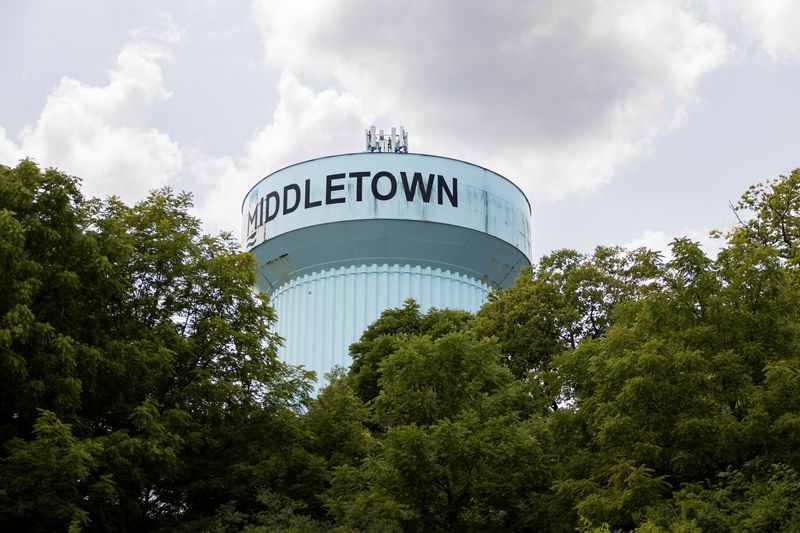
MIDDLETOWN, Ohio (Reuters) – In his bestselling 2016 memoir, Republican vice presidential hopeful JD Vance questioned whether rural, white Americans, like those in his native Middletown, Ohio, had the drive to reverse their economic decline. But as Vance was writing, his hometown was in the thick of the grassroots revitalization he envisioned.
Vance’s “Hillbilly Elegy: A Memoir of a Family and Culture in Crisis” tried to explain the mindset of white Appalachian voters at a time when many Americans were baffled by the popularity of Donald Trump, who would win the presidential election later that year.
The Yale-educated Ohio senator, who was tapped earlier this month to be Trump’s running mate in the Nov. 5 election, urged this struggling cohort to take more responsibility for its problems, stop looking to government or big companies for solutions, and work harder to improve its lot.
Chunks of Middletown still encapsulate the hackneyed images of the disenfranchised industrial hubs Vance wrote about: shabby strip malls sit along sprawling, potholed thoroughfares in a city where Trump flags fly from pickup trucks.
But there’s a different vibe in the southwestern Ohio city’s downtown. A brewery, wine bar, art collective, and even an opera house surround intersections bridged by sleek brick crosswalks and walls brightened by murals. Rainbow flags, left over from last month’s LGBTQ Pride celebrations, hang in several windows.
It’s part of a revitalization that, while far from complete, conflicts with the 2016 book’s portrayal of a community that is a “hub of misery,” and whose people react “to bad circumstances in the worst way possible,” according to some 20 locals interviewed by Reuters.
“We’ve been through this before, where we’ve had to reinvent ourselves. That’s what I think people lose sight of,” said Sam Ashworth, trustee and former executive director of the city’s historical society.
Ashworth noted that the city’s population, which is about 78% white, experienced industrial shifts throughout the 20th century that saw the loss of jobs in the tobacco and paper industries. “JD’s time in Middletown was very short,” said Ashworth, 83.
The Middletown of Vance’s youth was reeling from contraction and labor disputes at its AK Steel plant, which in 2003 – the year Vance graduated from high school – employed around 4,000 people, sharply down from its heyday in the 1970s.
The 2007-2009 recession compounded the strain, triggering a decline in city property tax revenue. AK Steel continued to downsize, employing about 2,300 people in 2012, municipal financial records show. The plant is owned today by Cleveland-Cliffs Inc.
Vance’s memoir referred to disenfranchised white communities as “a pessimistic bunch,” asking rhetorically if they were “tough enough” to hold themselves accountable for their plight and reverse their fortunes. “We created the (problems), and only we can fix them,” the future U.S. senator wrote.
Middletown, part of a staunchly conservative congressional district that voted overwhelmingly for Trump in the 2016 and 2020 presidential elections, is trying to do just that.
Between 2012 and 2022, the city’s income tax revenue spiked from $19.7 million to $33.6 million, according to official records. Optimism has been further fueled by Cleveland-Cliffs’ announcement this year of a $2 billion investment in its Middletown Works steel plant, and the city has approved a new, $200 million commercial development on 50 acres of municipal land.
The city, with a population of about 51,000, still grapples with high poverty and low median income, and the 75-bed Hope House Mission, a local homeless shelter, remains consistently full, said Tim Williams, the shelter’s vice president of homeless services.
But the situation is improving, and locals credit that to the kind of bootstraps-style initiative whose prospects Vance had questioned. “He makes it sound like this place sucks you in and that you’re destined to fail,” said Rochelle Zecher, a 42-year-old shop owner. “But this community builds itself up.”
Vance’s press secretary had no immediate comment on Reuters’ reporting.
FEDERAL FUNDS
In 2011, the city government and the Middletown Community Foundation created Downtown Middletown Inc, a nonprofit organization that helps market the city’s commercial district. With capital limited after the recession, city leaders got creative in finding money, including by using funds left over from a previous redevelopment loan.
That same year the city persuaded Cincinnati entrepreneur Jim Verdin to refurbish a building that now houses the Pendleton Art Center, creating space for 30 art vendors at little cost to Middletown.
Triple Moon Coffee Company, across the street from the art center, was launched in 2015 by lifelong Middletown resident Heather Gibson, who opened it with funds from her partner’s long-forgotten AK Steel retirement account.
The cafe is one of at least five LGBTQ-owned businesses in Middletown, said Duane Gordon, spokesman for the Middletown Pride Committee, who added that the city’s outreach to a wider array of communities helped spur its economic revitalization.
Middletown navigated the coronavirus pandemic with help from the federal government, receiving $19 million from Democratic President Joe Biden’s American Rescue Plan of 2021. City businesses got a combined $75 million from the Paycheck Protection Program – a business loan initiative signed by Trump and later extended by Biden – according to the federal government’s pandemic spending database.
The Republican Party’s 2024 platform promises to “rein in wasteful federal spending” as a way of “promoting economic growth,” and Vance has voiced skepticism about how much federal policymakers can do for local communities.
But Gibson, who used her PPP loan to open a drive-through behind her cafe, said federal money saved her business.
“It was a sink-or-swim moment,” she said.
(Reporting by Nicholas P. Brown; Editing by Paul Simao)



Why artists are dropping out of the Great American State Fair
Musicians cancel appearances at the Great American State Fair after questions over Freedom 250 and claims the July Fourth event is nonpartisan.
As several states pull out of the Great American State Fair in Washington, D.C., questions are coming up closer to home — Is Ohio still participating?
Massachusetts and North Carolina won’t participate in the fair, according to USA TODAY. Reports also indicate that Connecticut, Illinois, Maine and Oregon are also expected to skip the event, with some states citing a combination of financial and political concerns as reasons for opting out.
Here’s what we know about Ohio’s role in the event so far.
Is Ohio skipping the 2026 Great American State Fair?
Ohio has confirmed its participation with a booth titled “Ohio: The Heart of it All,” which showcases state parks and childhood development. The governor’s office began the planning process for the booth in February, shortly after the Great American State Fair was announced, said Lisa Peterson director of communications in the governor’s office.
The Great American State Fair, organized by Freedom 250, is a 16-day exposition that will be displayed on the National Mall from June 25 to July 10.
Additionally, Ohio will host a stop from the “Freedom Truck,” a traveling exhibit tied to Freedom 250. The exhibit will appear at the Ohio State Fair in Columbus. Organizers describe the Freedom Truck as a mobile museum that visits existing fairs and community events, not a version of the Great American State Fair itself.
When does the ‘Freedom Truck’ stop in Ohio?
The Freedom Truck is scheduled to be at the Ohio State Fair from July 27 through Aug. 10, 2026 at the Ohio Expo Center in Columbus.
The exhibit includes interactive and historical exhibits about the founding of the United States, according to organizers.
The mobile museum will be open from 10 a.m. to 9 p.m. Monday through Friday, and from 9 a.m. to 9 p.m. on weekends, with the final day closing at 6 p.m.
What is the Great American State Fair?
The Great American State Fair is a 16-day event planned for June 25 through July 10 on the National Mall in Washington, D.C. Organized by Freedom 250, the fair is part of a broader effort to mark the nation’s 250th anniversary with state exhibits, food, entertainment and cultural programming, according to USA TODAY.
President Donald Trump announced he will headline the Freedom 250‑organized Great American State Fair and hold an “America Is Back” rally, the publication reports.
America250 vs. Freedom 250: What’s the difference?
The Great American State Fair is part of Freedom 250, a Trump-backed initiative to celebrate the country’s 250th anniversary.
That effort is different from America250, the official, congressionally-authorized program coordinating nationwide commemorations. Meanwhile, America 250‑Ohio, the Ohio Commission for the U.S. Semiquincentennial, is the official state-level partner to the national America250 effort.
The Ohio Lottery offers multiple draw games for those aiming to win big.
Here’s a look at June 23, 2026, results for each game:
Mega Millions
Mega Millions drawings take place every week on Tuesday and Friday at 11 p.m.
48-51-60-63-66, Mega Ball: 20
Check Mega Millions payouts and previous drawings here.
Pick 3
Drawings are held daily, seven days a week, at 12:29 p.m. and 7:29 p.m., except Saturday evening.
Midday: 8-8-0
Evening: 2-0-5
Check Pick 3 payouts and previous drawings here.
Pick 4
Drawings are held daily, seven days a week, at 12:29 p.m. and 7:29 p.m., except Saturday evening.
Midday: 7-2-9-0
Evening: 1-6-9-3
Check Pick 4 payouts and previous drawings here.
Pick 5
Drawings are held daily, seven days a week, at 12:29 p.m. and 7:29 p.m., except Saturday evening.
Midday: 2-9-2-5-7
Evening: 2-8-6-4-9
Check Pick 5 payouts and previous drawings here.
Rolling Cash 5
Drawings are held daily, seven days a week, at approximately 7:05 p.m.
03-09-22-37-39
Check Rolling Cash 5 payouts and previous drawings here.
Feeling lucky? Explore the latest lottery news & results
This results page was generated automatically using information from TinBu and a template written and reviewed by an Enquirer digital news director. You can send feedback using this form.

TEMPE, AZ – JANUARY 02: Head coach Jim Tressel of the Ohio State Buckeyes holds the football from the trophy after the Buckeyes defeated the Notre Dame Fighting Irish in the Tostito’s Fiesta Bowl at Sun Devil Stadium on January 2, 2006 in Tempe, Arizona. The Buckeyes defeated the Fighting Irish 34-20. (Photo by Jeff Gross/Getty Images)
-

 New Mexico3 minutes ago
Feds allowed millions of fentanyl pills to ‘walk’ on New Mexico streets: DEA Whistleblower
-

 North Dakota11 minutes ago
Finding a hero: Efforts to identify North Dakota soldier Irvin C. Ellingson’s remains took years
-

 Ohio18 minutes ago
Is Ohio at the Great American State Fair? Latest as some states opt out
-

 Oklahoma21 minutes ago
Woman hospitalized after house fire in northeast Oklahoma City
-
Oregon26 minutes ago
Puffins return to the Oregon Coast: where and when to see them
-

 Pennsylvania33 minutes ago
Pennsylvania coroners refuse to release autopsy reports – and that hinders research on deaths in custody
-

 Rhode Island36 minutes ago
‘Condom Hut’ Movie Adds Another Big Name
-
 South-Carolina41 minutes ago
Star Fox Review: Can’t quite teach an old Fox new tricks


