Ohio
How JD Vance's Ohio hometown defied his expectations

By Nicholas P. Brown
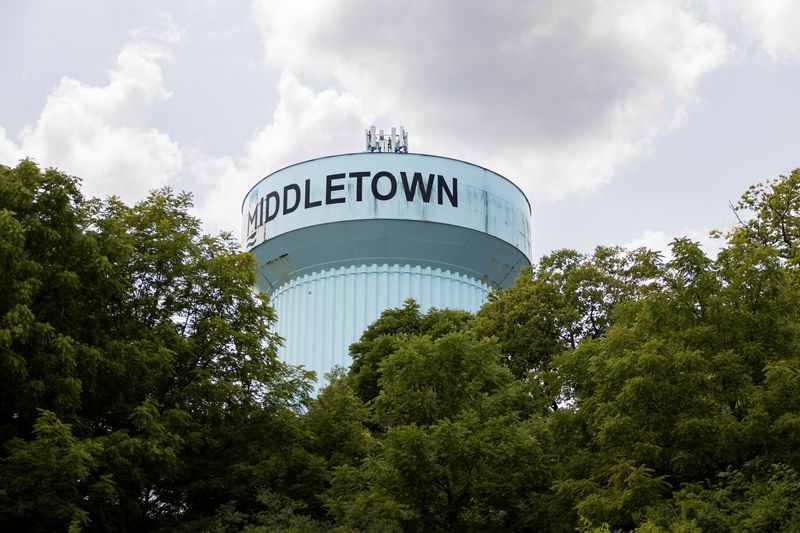
MIDDLETOWN, Ohio (Reuters) – In his bestselling 2016 memoir, Republican vice presidential hopeful JD Vance questioned whether rural, white Americans, like those in his native Middletown, Ohio, had the drive to reverse their economic decline. But as Vance was writing, his hometown was in the thick of the grassroots revitalization he envisioned.
Vance’s “Hillbilly Elegy: A Memoir of a Family and Culture in Crisis” tried to explain the mindset of white Appalachian voters at a time when many Americans were baffled by the popularity of Donald Trump, who would win the presidential election later that year.
The Yale-educated Ohio senator, who was tapped earlier this month to be Trump’s running mate in the Nov. 5 election, urged this struggling cohort to take more responsibility for its problems, stop looking to government or big companies for solutions, and work harder to improve its lot.
Chunks of Middletown still encapsulate the hackneyed images of the disenfranchised industrial hubs Vance wrote about: shabby strip malls sit along sprawling, potholed thoroughfares in a city where Trump flags fly from pickup trucks.
But there’s a different vibe in the southwestern Ohio city’s downtown. A brewery, wine bar, art collective, and even an opera house surround intersections bridged by sleek brick crosswalks and walls brightened by murals. Rainbow flags, left over from last month’s LGBTQ Pride celebrations, hang in several windows.
It’s part of a revitalization that, while far from complete, conflicts with the 2016 book’s portrayal of a community that is a “hub of misery,” and whose people react “to bad circumstances in the worst way possible,” according to some 20 locals interviewed by Reuters.
“We’ve been through this before, where we’ve had to reinvent ourselves. That’s what I think people lose sight of,” said Sam Ashworth, trustee and former executive director of the city’s historical society.
Ashworth noted that the city’s population, which is about 78% white, experienced industrial shifts throughout the 20th century that saw the loss of jobs in the tobacco and paper industries. “JD’s time in Middletown was very short,” said Ashworth, 83.
The Middletown of Vance’s youth was reeling from contraction and labor disputes at its AK Steel plant, which in 2003 – the year Vance graduated from high school – employed around 4,000 people, sharply down from its heyday in the 1970s.
The 2007-2009 recession compounded the strain, triggering a decline in city property tax revenue. AK Steel continued to downsize, employing about 2,300 people in 2012, municipal financial records show. The plant is owned today by Cleveland-Cliffs Inc.
Vance’s memoir referred to disenfranchised white communities as “a pessimistic bunch,” asking rhetorically if they were “tough enough” to hold themselves accountable for their plight and reverse their fortunes. “We created the (problems), and only we can fix them,” the future U.S. senator wrote.
Middletown, part of a staunchly conservative congressional district that voted overwhelmingly for Trump in the 2016 and 2020 presidential elections, is trying to do just that.
Between 2012 and 2022, the city’s income tax revenue spiked from $19.7 million to $33.6 million, according to official records. Optimism has been further fueled by Cleveland-Cliffs’ announcement this year of a $2 billion investment in its Middletown Works steel plant, and the city has approved a new, $200 million commercial development on 50 acres of municipal land.
The city, with a population of about 51,000, still grapples with high poverty and low median income, and the 75-bed Hope House Mission, a local homeless shelter, remains consistently full, said Tim Williams, the shelter’s vice president of homeless services.
But the situation is improving, and locals credit that to the kind of bootstraps-style initiative whose prospects Vance had questioned. “He makes it sound like this place sucks you in and that you’re destined to fail,” said Rochelle Zecher, a 42-year-old shop owner. “But this community builds itself up.”
Vance’s press secretary had no immediate comment on Reuters’ reporting.
FEDERAL FUNDS
In 2011, the city government and the Middletown Community Foundation created Downtown Middletown Inc, a nonprofit organization that helps market the city’s commercial district. With capital limited after the recession, city leaders got creative in finding money, including by using funds left over from a previous redevelopment loan.
That same year the city persuaded Cincinnati entrepreneur Jim Verdin to refurbish a building that now houses the Pendleton Art Center, creating space for 30 art vendors at little cost to Middletown.
Triple Moon Coffee Company, across the street from the art center, was launched in 2015 by lifelong Middletown resident Heather Gibson, who opened it with funds from her partner’s long-forgotten AK Steel retirement account.
The cafe is one of at least five LGBTQ-owned businesses in Middletown, said Duane Gordon, spokesman for the Middletown Pride Committee, who added that the city’s outreach to a wider array of communities helped spur its economic revitalization.
Middletown navigated the coronavirus pandemic with help from the federal government, receiving $19 million from Democratic President Joe Biden’s American Rescue Plan of 2021. City businesses got a combined $75 million from the Paycheck Protection Program – a business loan initiative signed by Trump and later extended by Biden – according to the federal government’s pandemic spending database.
The Republican Party’s 2024 platform promises to “rein in wasteful federal spending” as a way of “promoting economic growth,” and Vance has voiced skepticism about how much federal policymakers can do for local communities.
But Gibson, who used her PPP loan to open a drive-through behind her cafe, said federal money saved her business.
“It was a sink-or-swim moment,” she said.
(Reporting by Nicholas P. Brown; Editing by Paul Simao)



Ohio
NECIC to host community visioning session for Mansfield’s north end in partnership with Heritage Ohio

MANSFIELD — The North End Community Improvement Collaborative, Inc. (NECIC) will host a Community Visioning Session in partnership with Heritage Ohio, Inc. on Tuesday, July 28 at 6 p.m. at the United Steelworkers Hall, located at 376 West Longview Avenue in Mansfield.
The public is invited to attend and share input on the future of Mansfield’s North End, with a focus on strengthening neighborhood revitalization efforts and identifying opportunities for continued growth and investment.
The session is part of an upcoming visit from Heritage Ohio’s Downtown Assessment Resource Team, also known as D.A.R.T. The visit is designed to help communities explore next steps for revitalization and introduce the key building blocks of a successful long term revitalization effort: organization, promotion, design, and economic vitality.
NECIC reached out to Heritage Ohio as part of its ongoing work to support revitalization in the North End, especially near the corner of Springmill Street and Bowman Street, where NECIC has been focusing recent revitalization efforts.
Since joining the organization in early 2025, NECIC President & CEO Matthew Benko- Scruggs has placed a strong focus on revitalization near the corner of Springmill Street and Bowman Street.
This work has included the organization’s move back into the neighborhood, continued investment in the area, and community centered efforts such as the Springmill Spring Cleanup event.
During the Community Visioning Session, residents, business owners, stakeholders, and other community members will have the opportunity to learn more about Heritage Ohio, the revitalization process, and ways they can help shape the future of the North End.
“We want this process to be rooted in the voices of the people who live, work, and invest in the North End,” said Benko-Scruggs. “This session is an opportunity for the community to share ideas and help guide what revitalization can look like in our neighborhood.”
Heritage Ohio, Inc. is a statewide nonprofit organization that supports the development, redevelopment, and improvement of downtowns and neighborhood districts throughout Ohio through technical assistance, training, networking, and advocacy.
Community members are encouraged to attend and take part in the conversation.
For more information, contact Director of Community Organizing Emily Schwan at 419-
522-1611, ext. 109 or Emily@necic-ohio.org.

A grand jury in Franklin County, Ohio, indicted nine people suspected of being involved in a human trafficking ring, officials said.
Ohio Attorney General Andy Wilson said in a news release on Monday that the nine people were indicted on a combined 42 felony charges in connection with the human trafficking investigation. Marcus Gant, Magon Smith, Raymond Valentine, Aimee Fabin, John W. Gibson II, Malik Jackson, Kayla Wheeler, Jeremy Lindsey, and Mackenzie Fitzpatrick face a variety of charges, including engaging in a pattern of corrupt activity. All nine are in custody.
The news release said they are accused of using narcotics to coerce women into commercial sex work at the Econo Lodge on North Wilson Road. The suspects then laundered money through Valentine Floral on Eakin Road, officials said. The alleged crimes took place between April 2025 and January 2026.
Some of those charged face trafficking in persons, compelling prostitution and promoting prostitution charges. Of the nine, Gant faces the most charges. The 37-year-old from Columbus faces 11 different counts related to the human trafficking investigation.
The Central Ohio Human Trafficking Task Force led that investigation, the news release added.
According to Monday’s news release, the Franklin County Prosecutor’s Office has taken previous legal action against the Econo Lodge. Officials said a lawsuit was filed earlier this year against the owner of a hotel, who was accused of “neglecting to address repeated drug and violent activity on the property.” A settlement was reached.
People can report human trafficking in Ohio by calling 844-END-OHHT, texting “ENDOHHT” to 847411, downloading the END OHHT app or submitting information online.

-

 Florida47 seconds ago
Man, 74, becomes oldest inmate executed in Florida in state’s 10th lethal injection this year
-

 Georgia7 minutes ago
Athlon Sports tabs Florida-Georgia among SEC’s best games in 2026
-

 Hawaii13 minutes ago
4,000 troops lose air conditioning in Hawaii
-

 Idaho19 minutes ago
Idaho is home to the nation's first DarkSky Reserve. Now it's home to the nations first DarkSky Certified Resort
-

 Illinois25 minutes ago
2 teens hospitalized after being rescued by bystanders from Lake Michigan at Illinois Beach State Park near Zion
-

 Indiana31 minutes ago
‘Big Boy’ locomotive returns for overnight stay in northeast Indiana
-

 Iowa37 minutes ago
Meet the 3 Best New Food at the Iowa State Fair finalists for 2026
-

 Kansas43 minutes ago
‘Explosive diarrhea’ outbreak includes 5 cases in Sedgwick County, 22 in Kansas

