Business
This California city lost its daily newspapers — and is living what comes next

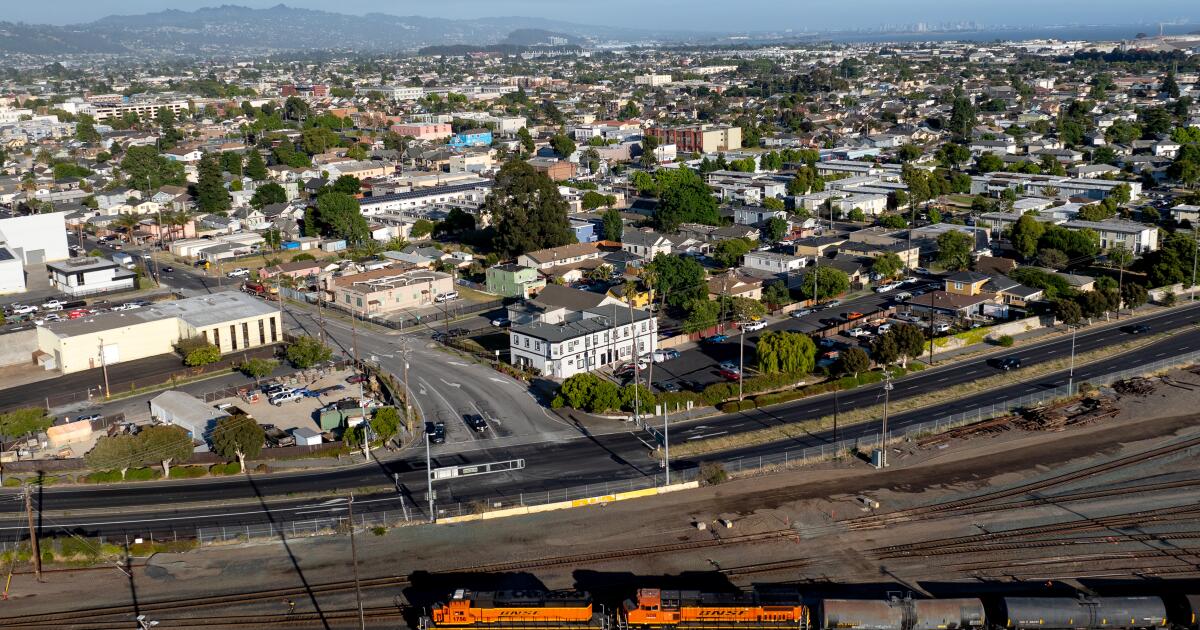
For years Richmond City Councilmember Cesar Zepeda has been on an unsuccessful crusade to persuade the grocery store chains of America — or at least one of them — to bring a supermarket back to his industrial city on the edge of the San Francisco Bay.
He’s persistent. He’s called corporate headquarters. He’s emailed customer relations. Occasionally, he’s gotten executives on the phone, and listened to them stammer on about why Richmond isn’t the right place for them to locate a store, despite its population of 117,000 in the heart of the Bay Area.
After years of disappointing conversations, Zepeda has concluded something basic about his city: It is paying a big price by not being able to tell its own story.
Richmond has not had its own daily newspaper for years. The loss came during a period of profound struggles for the town, which has dealt with fluctuating crime, economic problems and environmental challenges. Zepeda and others say there is a lot of good and bad going on in Richmond, but the dearth of local news coverage offers a skewed view of the city — oversimplified and years out of date — as an impoverished and violent community.
“The lack of coverage puts us into deserts of everything. We have a hospital desert. We have a grocery store desert,” Zepeda said. “Just the lack of any coverage, it affects the perception.”
In this news desert, the main information source has been the Richmond Standard, a news website funded by Chevron, Richmond’s largest employer. It offers reports on youth sports, crime logs and things to do in town. Recent articles have highlighted a mural project, a car caravan supporting racial justice and upcoming closures to Interstate 80.
But the Standard is conspicuously silent when it comes to hard-hitting reporting on the Chevron refinery, which activists blame for the city’s high rates of hospitalization for childhood asthma. On June 19, the City Council voted to put a measure on the November ballot asking local voters to levy a tax on the refinery that would generate tens of millions of dollars a year to be used as the city sees fit. The lead-up and follow-up to this hugely consequential development were nowhere on the Standard’s homepage.
Richmond is one in a swelling number of California communities that in recent years have had to navigate civic life without a traditional newspaper. The city — a onetime shipbuilding hub that fell on hard times and is now in the midst of a rebound — was once served by multiple papers, but the grim economics took them out one by one.
All the while, in-depth daily coverage of Richmond, a city with 23 distinct neighborhoods and cutthroat politics, with a refinery of vital importance to the state’s energy economy, shrank and shrank.
“The lack of coverage puts us into deserts of everything. We have a hospital desert. We have a grocery store desert.”
— Zepeda Richmond City Councilmember Cesar Zepeda
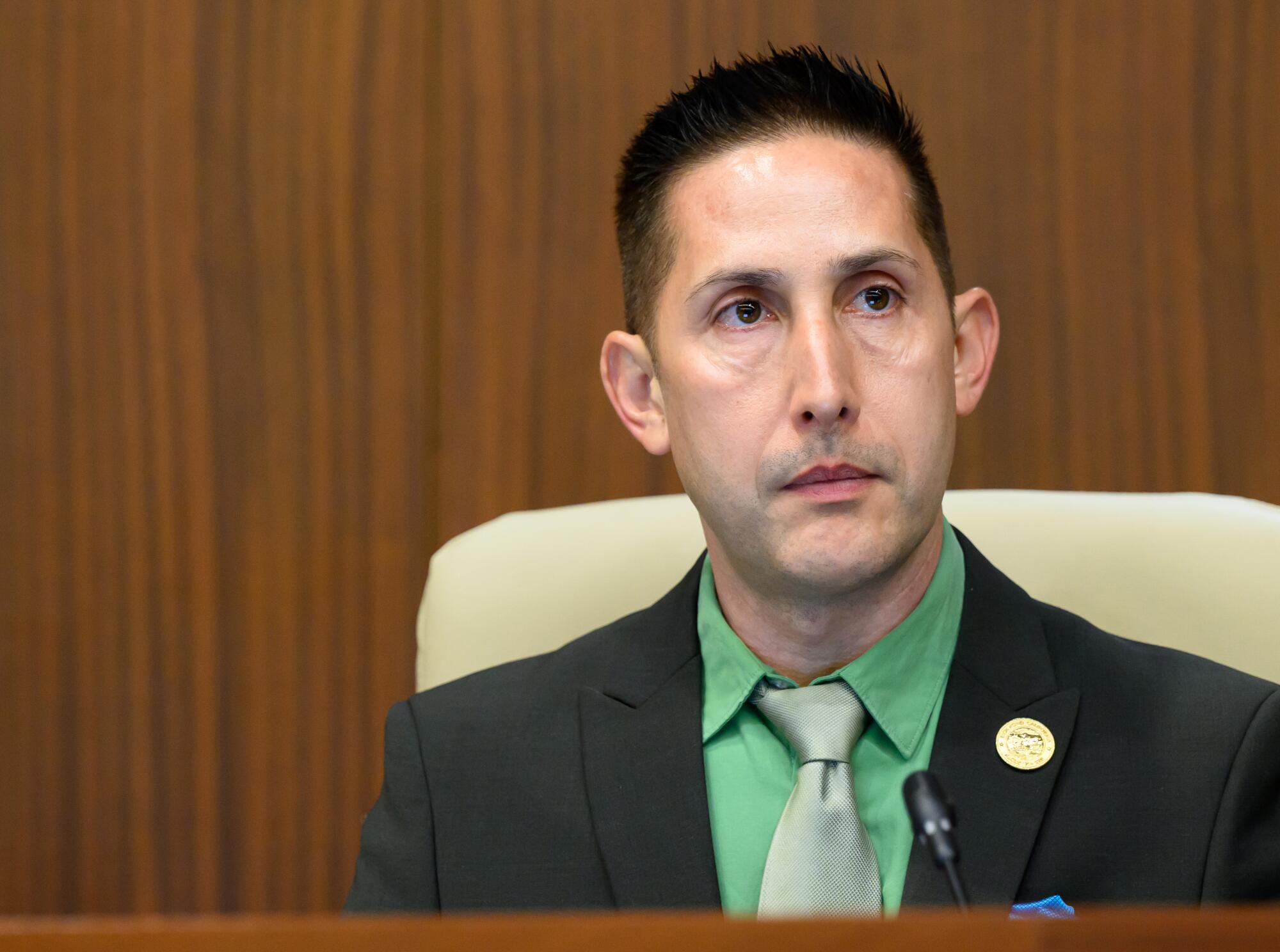
Councilmember Cesar Zepeda says the dearth of local news coverage in Richmond has resulted in a skewed portrayal of his city, making it harder to draw retailers.
(Josh Edelson / For The Times)
The issue of California’s growing news deserts — and the fallout on civic engagement — has become a heated topic in the state Legislature, where Assemblymember Buffy Wicks (D-Oakland) is pushing a measure, Assembly Bill 886, that would require leading social media platforms and search engines to pay news outlets for accessing their articles, either through a predetermined fee or through an amount set by arbitration. Publishers would have to use 70% of those funds to pay journalists in California. Lawmakers are also considering state Senate Bill 1327, which would tax large tech platforms for the data they collect from users and pump the money into news organizations by giving them a tax credit for employing full-time journalists.
AB 886 is sponsored by the California News Publishers Assn., whose members have argued for years that online search engines and social media platforms are gutting the newspaper business by gobbling up advertising revenue while publishing content they don’t pay for. (The Los Angeles Times is a CNPA member, and its business leaders have publicly supported the measure.)
The legislation has drawn staunch opposition from Google and other tech companies, which contend it would upend their business model.
The rise of the search engine is one of many factors pushing California newspapers out of business. Richmond’s news decline began well before eyeballs and advertising migrated online.
But Richmond’s story is not just about the loss of news. It also shows how a community gets information in a post-newspaper world.
Richmond is now a laboratory for online journalism startups, including the one owned by Chevron, whose massive refinery looms over the city and has been the focus of ongoing concerns over toxic emissions.
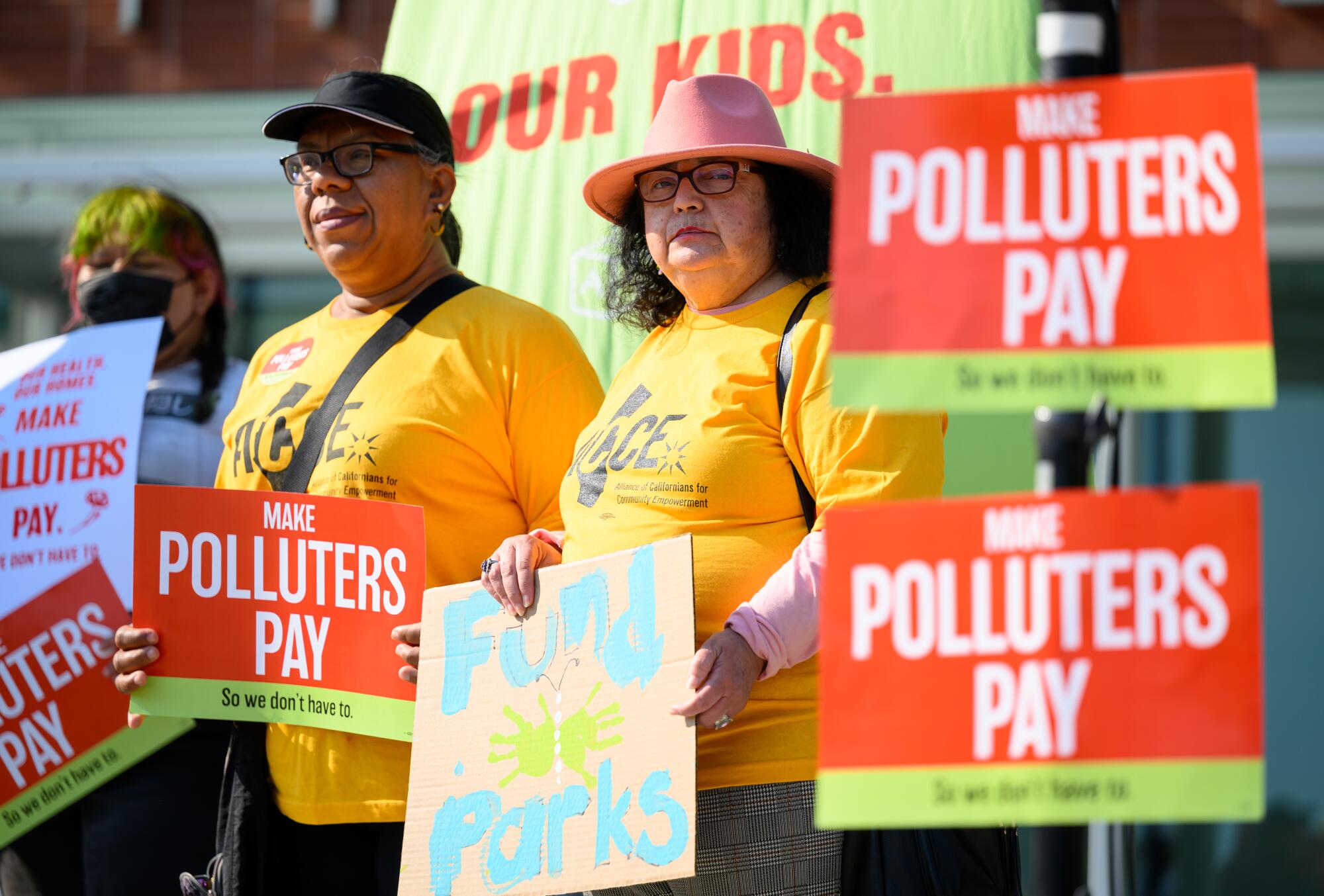
Protesters rally in support of putting a measure on the November ballot that would levy a new tax on Chevron’s refinery, generating millions of dollars annually for city coffers.
(Josh Edelson / For The Times)
The region’s independent online publications are sometimes hard-hitting and admirably hardworking, but they are limited in size and reach. The students at UC Berkeley’s journalism school operate Richmond Confidential, a news lab for student reporters that is funded by a grant from the Ford Foundation. Since late 2020, the husband-and-wife team of Linda and Soren Hemmila have put out the Grandview Independent, whose website proclaims: “For us, there is no story too small.”
There is also a youth-focused site, the Pulse, and a publication that focuses on the area’s Black community. In late June, the team behind the well-regarded local news websites Berkeleyside and Oaklandside launched a sister publication called Richmondside.
Still, said City Councilmember Doria Robinson, “the unfortunate best source” for much of the day-to-day goings on in recent years has been the Richmond Standard.

Councilmember Doria Robinson finds it troubling that Richmond residents get their daily news from a site funded by Chevron, the town’s biggest employer and a source of controversy.
(Josh Edelson / For The Times)
Robinson is a third-generation Richmond resident who was elected to the council in 2022 and for years before that ran a nonprofit farm in North Richmond. She said she is grateful for the work of all the reporters laboring on a shoestring to bring news to her city. But it doesn’t replace the weight and influence of the local paper she remembers from her youth.
And as for the Chevron paper, she said: “It is just unfortunate to have to depend on a project that is openly and proudly funded by our local petroleum [company].”
In 2011, the news group that owned the West County Times made an announcement that had become all too familiar to Richmond readers: More layoffs and cuts were coming to the chain that published the West County Times along with several other outlets in the East Bay. There would be less news out of Richmond.
Former Councilmember Tom Butt, who sends out an email about Richmond that doubles as an informal newsletter, lamented the decision and urged citizens to complain, writing: “What will this mean for Richmond? Undoubtedly, it will mean reduced coverage of local news.”
Five years later, in 2016, the ax swung again, and the West County Times was merged, along with a number of other newspapers, into two. Another chunk of the reporting staff was cut.
“The level of connection we were able to maintain with people in the community really evaporated in a significant way,” said Craig Lazzeretti, a journalist who covered the region for 30 years, much of it in Richmond. Over time, Richmond lost its education and public safety reporters, he said, and while City Hall remained a priority, coverage of sports and entertainment also declined.
In its heyday, the coverage was rigorous, and “it did play a significant role” in civic life, Lazzeretti said. “You had a lot of strong political personalities in Richmond.”
He admits the local newspapers of that era were not perfect: “We were covering an ethnically diverse city, and there wasn’t a lot of ethnic diversity in our newsroom.” But reporters did try to reflect what was going on in the city.

The Richmond-San Rafael Bridge spans San Francisco Bay, connecting Contra Costa and Marin counties.
(Josh Edelson / For The Times)
As the 21st century dawned, the West County Times, the lone paper still covering Richmond vigorously, was facing a menacing economic shift: the rise of the internet. Advertising dollars — long the financial mainstay of traditional newspapers — moved online, budgets dwindled, and soon there were almost no reporters left to cover Richmond on a daily basis.
Meanwhile, life in Richmond was entering a dark period. The city’s better-paying manufacturing and industrial jobs were evaporating because of economic shifts, spawning an exodus of middle-class earners to the suburbs.
Chevron, which had long been one of the biggest influences on local politics, stayed. But as concerns mounted about the effects of its refinery on air quality, progressive candidates began organizing to counter the weight of the oil company.

The Richmond Standard, funded by Chevron, has been conspicuously silent when it comes to hard-hitting reporting on the company’s refinery.
(Josh Edelson / For The Times)
By 2010, candidates backed by the Richmond Progressive Alliance had pressed the company to contribute more fees to the city to compensate for environmental damage. And then came the disaster of August 2012, when a corroded pipe at the refinery sprung a leak, igniting a series of fiery explosions that shrouded the East Bay in choking black smoke. More than 100,000 people were ordered to shelter in place, with windows and doors sealed shut, and thousands sought medical treatment after inhaling toxic air.
The episode set off a wave of activism that included investigations into Chevron’s operating practices. In August 2013, Chevron agreed to plead no contest to criminal charges stemming from the fire and pay $2 million in fines.
Five months later, on Jan. 23, 2014, Chevron launched the Standard.
“We think it’s good for us to have a conversation with Richmond on important issues, and we also think there are a lot of good stories in this city that don’t get told every day,” the company wrote to readers in announcing the news site.
Progressives were alarmed: The entity that in their eyes most needed watchdogging was now a leading source of local coverage.
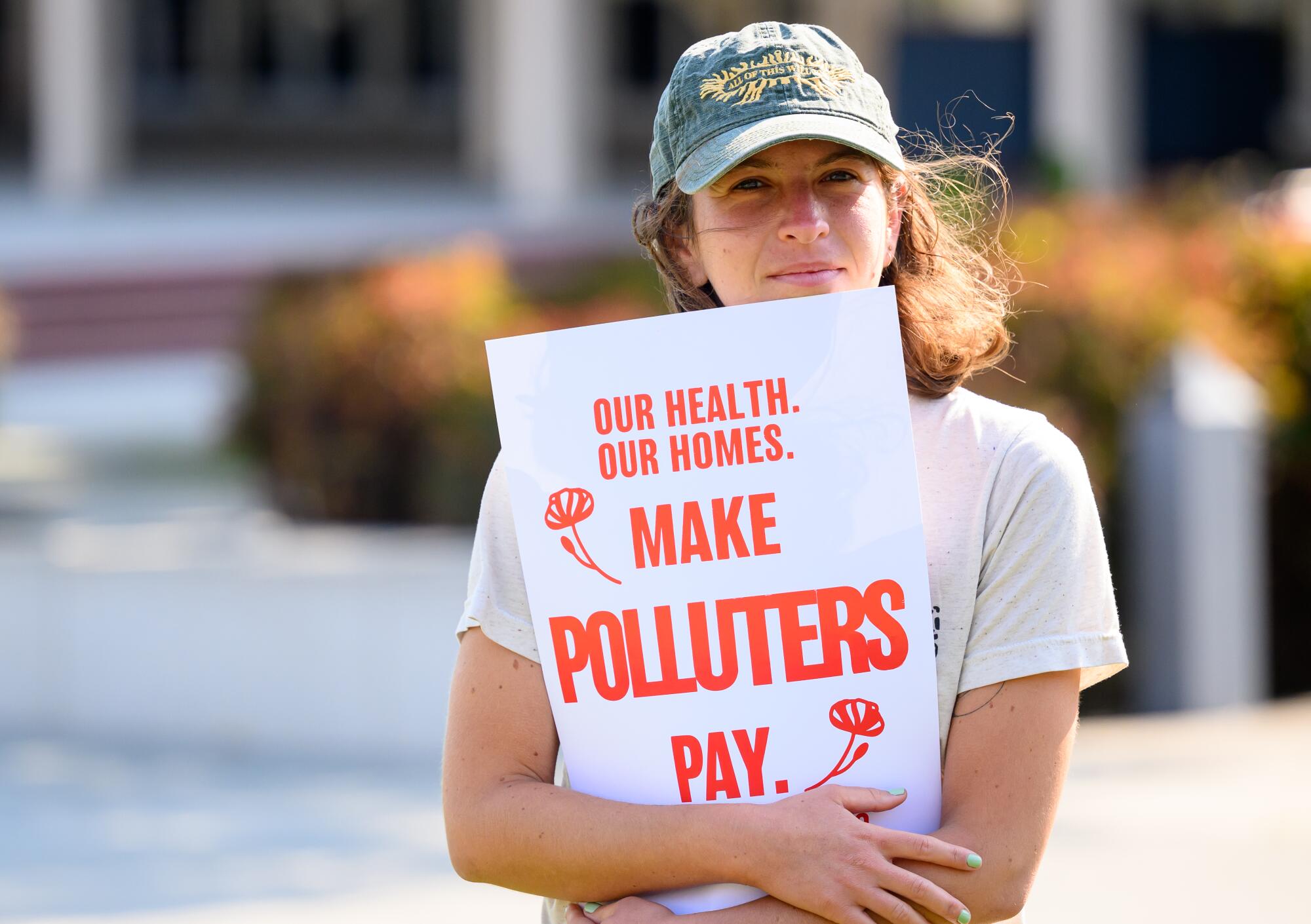
Tina Szpicek rallies in support of a November ballot measure that would levy a new tax on Richmond’s Chevron refinery.
(Josh Edelson / For The Times)
Still there was now a reporter roaming the neighborhoods, reporting on a new baseball field, a burglary, local businesses and even some local politics.
In June, while the Standard ignored the City Council’s vote on taxing the refinery, it did cover a Little League triumph, a shooting that left two people dead and the schedule of movies to be screened this summer at “Movies in the Park.”
Ross Allen, a spokesperson for Chevron, said the community didn’t need the Standard to cover the council’s vote — it was a big enough event that it received ample coverage in mainstream California publications.
He added, however, that Chevron opposes the proposed tax, and that “we will have coverage on the reasons why that is a terrible idea for Richmond in the Standard. We’ll have it everywhere.”
The Times interviewed Richmond residents in June to gauge whether the long absence of a local newspaper mattered in their lives. Many said they were unaware of Richmond’s news media history, but in interview after interview stressed their hunger for news about their city.
Juan Alfredo, 27, recently moved to Richmond from Guatemala after a stopover in Los Angeles. He paused to chat while walking his little white poodle in the city’s Miller/Knox Regional Shoreline Park. Across the sparkling waters of the bay, the San Francisco skyline and misty green hills of Marin County rose in the distance.
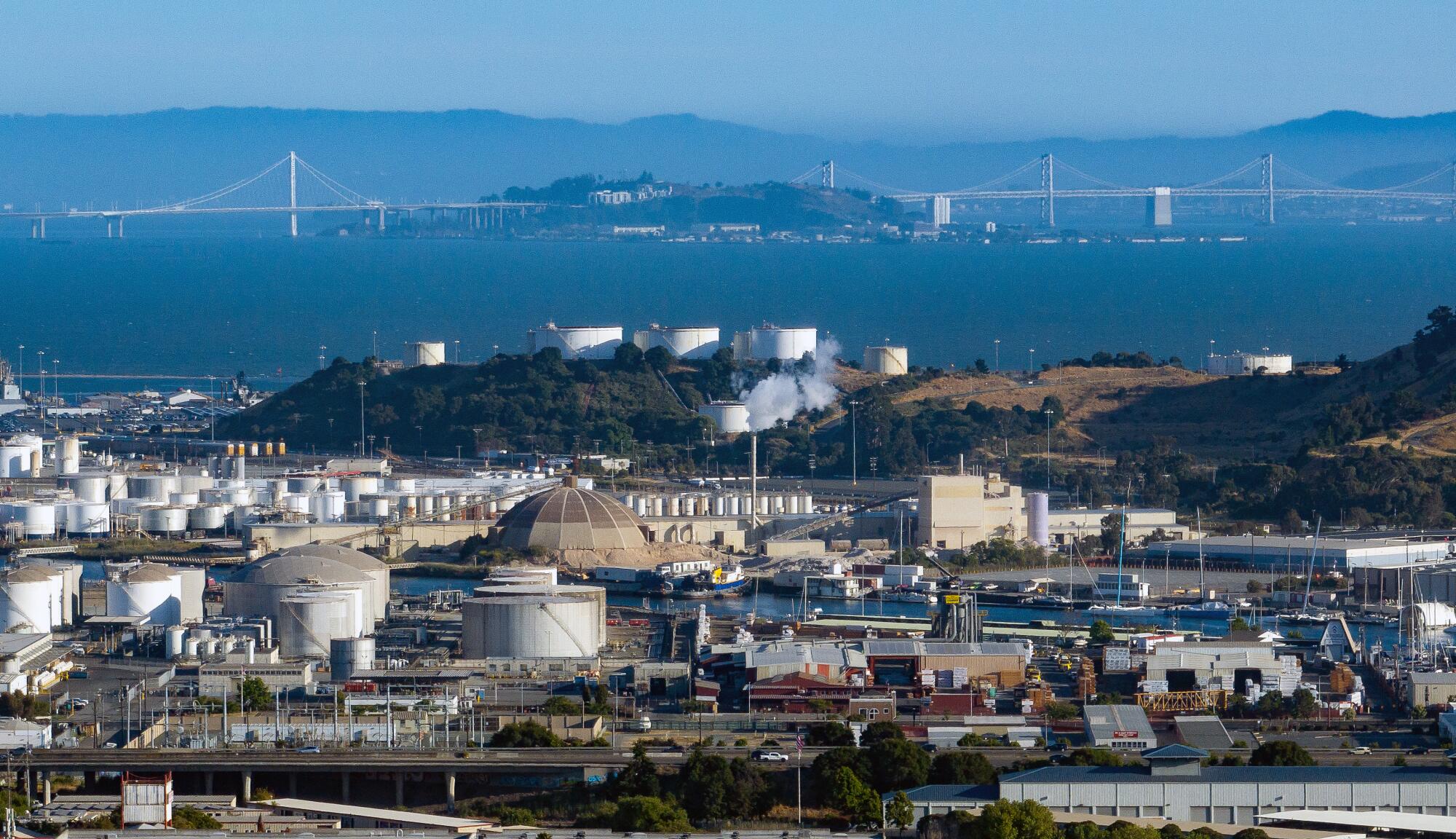
Richmond is one of many smaller working-class cities that saw its local newspapers buckle as print advertising revenue and paid circulation dropped.
(Josh Edelson / For The Times)
Alfredo said that he loves Richmond’s physical beauty, but that his new home struggles with some quality-of-life issues, including trash and messed-up streets. And he has no idea where to turn for information about what is going on in the city.
A few miles away, Elaina Jones, who moved from nearby Orinda last year, said she enjoys the community in the Marina Bay neighborhood. But she said she has little sense of what’s happening in the rest of the city. What she does know, she learns not from local media but from talking to her older neighbors.
Still, she plans to vote in the local elections in November — and said to do so she needs to figure out what’s going on.
One of her would-be representatives, City Council candidate Sue Wilson, said the lack of a local newspaper means candidates often work to reach voters one-on-one, by going to their doors.
Lots of residents are in the dark about who’s running for office and their positions on issues. That may be one reason, some officials said, that voter turnout in local elections is abysmal.
Wilson said Richmond’s tumultuous politics often make her think, “This seems like the sort of thing that would be in the newspaper.”
She paused. “But then there is no newspaper.”
The journalists at Richmondside hope to do their part to change that. On June 25, the site went live with what they hope will be dynamic coverage.
Richmondside is the latest offshoot of the Cityside Journalism Initiative, a nonprofit online news platform launched by journalists looking to reinvigorate local news coverage in the Bay Area. The effort is funded through grants and reader donations.

Surveys done by Richmondside, a new online news venture, found residents want “the rest of the world to know there are many positive stories” in their city.
(Josh Edelson / For The Times)
Richmondside’s new editor, Kari Hulac, said the publication would have two full-time staffers and two interns, as well as editorial support from across the organization and contributions from freelancers. She said readers can look forward to air quality coverage, as well as stories on neighborhood issues, small businesses and public safety.
For Hulac, a veteran Bay Area journalist, the launch represents a welcome second chance to be involved in local news.
“I’ve locked the door on a newsroom,” she recalled of shutting a news bureau in Tracy. “I put the handwritten note on the door: ‘This office is closed permanently.’”
“If you had told me, I don’t know, a year ago, that I would be back in the Bay Area working in a local newsroom again, I never in a million years would have believed it,” she said.



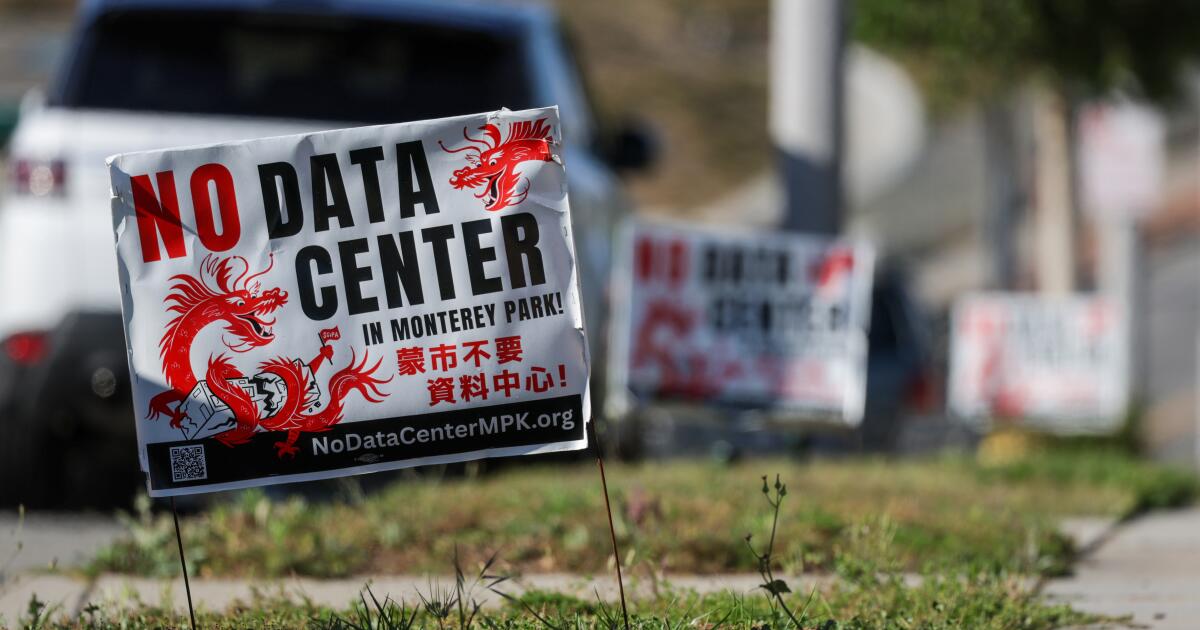
Residents of Monterey Park voted overwhelmingly to ban data centers on election day, making the San Gabriel Valley city the first in the nation to do so by public vote.
As of Wednesday, 86% of votes were in favor of Measure NDC, the city ban, according to the Los Angeles County registrar-recorder/county clerk.
Other cities and towns have passed moratoriums on data centers, as a wave of opposition sweeps the country. But the Monterey Park vote can only be overturned by another ballot measure, making it the most permanent data center ban in a jurisdiction.
Monterey Park’s City Council had already banned data centers by ordinance, after a proposed 247,000-square-foot data center met an outpouring of public anger and concern. The developer withdrew that plan.
That facility would have been less than 500 feet away from the nearest home, and would have used three times the electricity of the entire 60,000-person city. Residents said it would have caused noise and air pollution and driven up electricity rates.
“This ensures long-lasting protections for current and future generations,” Amy Wong, co-founder of the group San Gabriel Valley Progressive Action, said of the vote. “It means that future city councils cannot overturn a data center ban, even if data center developers wanted to spend money to fund pro-data center candidates.”
The measure had no formal opposition. The developer of the proposed facility, investment firm HMC StratCap, said it wouldn’t engage in the ballot fight when it withdrew in March.
The Data Center Coalition, an industry trade group, expressed disappointment in the vote.
“It sends a signal that the area is closed for business, both for data centers and for other significant economic development projects,” state policy director Khara Boender said.
“It deprives local residents of the opportunity to compete for jobs and investment, while also causing the area to relinquish substantial long-term economic investment, high-wage jobs, and critical tax revenue to neighboring areas or other states.”
SGV Progressive Action worked with hyperlocal groups including No Data Center Monterey Park to rally support for the measure.
The group is now focused on stopping data center proposals in the City of Industry and fighting a move by City of Industry, Santa Fe Springs, Vernon and City of Commerce to welcome data centers and other industry with fast-tracked permitting and tax incentives.
City of Industry, in the San Gabriel Valley, and Vernon, south of downtown L.A., are primarily industrial areas, each with around 300 permanent residents. They are employment centers, and tens of thousands of workers commute in daily.
There has been little vocal opposition to data centers among the few residents of these cities. Wong said the protest is primarily coming from the surrounding neighborhoods.
“If a data center gets built in City of Industry, residents across the region would bear the brunt of pollution and increased utility costs,” Wong said, noting that it is surrounded by 16 other cities and unincorporated communities.
Data center proposals have been limited in California compared to Virginia, Texas, Georgia, Illinois and Arizona, which sit at the center of a recent boom in hyperscaler facilities to power artificial intelligence.
California has the third-most data centers in the country, with 300, but high electricity rates, expensive land and regulatory hurdles mean that fewer, and smaller, facilities are currently planned than in other hotspots.
That doesn’t mean opposition hasn’t been fierce. In Coachella and Imperial County, residents are showing up in droves to protest local proposals.
In the San Gabriel Valley, Montebello, El Monte and Baldwin Park have all enacted temporary moratoriums, and Alhambra recently banned data centers as part of a zoning code update.
Wong said she hoped the ballot measure vote would galvanize the opposition. “The vote is a testament to the people power of our region,” she said. “Our region is worth protecting, and we won’t let data centers determine our future.”

A rule intended to prevent rent gouging in the wake of the Eaton and Palisades fires has lapsed in Los Angeles County, possibly exposing some renters to hikes.
The executive order that blocked rent increases was issued by Gov. Gavin Newsom amid the devastating wildfires last year. Under the order, landlords couldn’t increase rents by more than 10% above their prefire levels.
The rule, which was supposed to be temporary and was repeatedly extended, ended Friday after a vote to extend it again failed to garner enough votes. Supervisor Lindsey Horvath, whose district includes Pacific Palisades, sounded the alarm in a motion to extend price protections that failed to pass at the Board of Supervisors’ May 19 meeting.
“These price gouging protections continue to be necessary as construction and rebuilding continue, and as thousands of people remain displaced,” the motion said. “Families which signed short-term leases could face drastic price increases of 50% or more without further price gouging protection.”
Los Angeles County is home to more than 1 million rental properties, though not all of them needed protection from the new rule. There are already stricter rent increase caps for many residences, depending on the location, type and age of the building. Despite the rent control in the region, the people of Los Angeles pay among the highest rents in the country.
It is uncertain whether renters will face rapidly rising rents now that the protection has lapsed. But some real estate experts and policymakers said there was no need for the temporary rule that was part of the governor’s state of emergency.
Supervisors Kathryn Barger, Janice Hahn and Holly Mitchell abstained from voting on the motion to extend the protection, while Supervisors Hilda Solis and Horvath supported it.
“I abstained because I did not see sufficient evidence to justify extending this emergency ordinance, nor did I see evidence to eliminate it entirely,” Hahn said.
Barger’s office said she supported allowing the protections to sunset while waiting to see whether new information emerged.
“Market data already shows countywide rents are only about 2% above pre-emergency levels and rental inventory has grown,” Barger representative Helen E. Chavez Garcia said. “The Supervisor is also mindful of the burden these ongoing protections place on small property owners throughout the county.”
Mitchell did not immediately respond to a request for comment.
There haven’t been steep rent hikes in neighborhoods within three miles of the Palisades fire, according to a Times analysis of data from Zillow, the property listing company.
In ZIP Codes within three miles of the Palisades fire, rent increased 4.8% from December 2024 to April 2025. In areas around the Eaton fire, which destroyed swaths of Altadena, rent jumped 5.2% in the same period.
In L.A. County, ZIP Codes farther from the fires saw only about a 2% increase.
A landlords representative, Jesus Rojas of the Apartment Owners Assn. of Greater Los Angeles, told the supervisors during public comment at the meeting that the county’s rent-gouging rules have “long outlived the emergency they were intended to address” and are now being “wrongfully used to harm thousands of rental housing providers throughout the county.”
“There is no proof that multifamily rental housing providers are hugely increasing rents for impacted homeowners,” Rojas said.
Indeed, there are strong signs that the property market in the Los Angeles area has at last begun to cool.
L.A. metro-area rent prices recently fell to a four-year low, with the median rent slipping to $2,167 in December.
Meanwhile, condominium sales had their slowest start of the year in decades. Condo sales in Los Angeles have plummeted to a 20-year low, with fewer than 2,000 units sold in January and February — the worst start to the year since 2005.
Newsom defended the price-gouging protections shortly after they went into effect.
“In the days following the Los Angeles firestorms, we worked quickly to protect Los Angeles survivors from any form of exploitation,” he said in February 2025. “The state has the tools in place to not only block price gouging during this emergency, but also to prosecute bad actors.”
The Los Angeles County Department of Consumer and Business Affairs said it received more than 2,000 complaints after the fires, alleging that retailers and landlords were taking advantage of people put in hardship by their losses, and sent out more than 2,000 cease-and-desist letters to businesses and landlords for alleged price gouging, said Morine Merritt, who oversees department investigations into consumer and real estate fraud.
“Close to 90% of the complaints that we received involved allegations of rent increases,” Merritt said in an interview. Now that the fire-related protections have expired, existing laws and “regular market conditions determine price increases for goods and services, including rents,” she said.
Crackdowns on fire-related rent gouging have been rare, said Chelsea Kirk of the activist organization the Rent Brigade, which analyzed L.A. County’s rental market in the year after the fires. It reported 18,360 potential examples of price gouging in listings but said that few lawsuits had been filed by authorities so far.
Last week, Rent Brigade announced what it said was the first private civil lawsuit brought by a family that claimed to be rent-gouged in the aftermath of the wildfires. Plaintiffs Randall and Candy Renick, whose Altadena home was damaged, said they were charged nearly three times the maximum permitted rate for nearly 10 months. They seek restitution of $96,000 plus civil penalties and attorneys’ fees.
The rental market has probably stabilized since the fires, Kirk said, but other families may still be “locked into illegal rents” that they agreed to pay when they were in a rush to find housing after they were displaced.


Dear Mr. Pelley:
I meant what I said in my letter last week to the 60 Minutes team: joining 60 Minutes is the honor of my career and I am grateful to be working alongside the people who have contributed to the most important television journalism brand this country has ever produced. While I’m new to 60 Minutes, I’ve devoted my career to investigative journalism and storytelling. I started this job excited to collaborate and to benefit from the wisdom and experience of the 60 Minutes veterans, with you among them. For that reason, one of the first things I did in my new role was call you to talk and invite you to dinner. It is a profound disappointment that you rejected that overture and chose ambush instead. Yesterday, you hijacked my first meeting with staff to disparage me, my qualifications, and my intentions with remarkable incivility and contempt. I welcome a diversity of viewpoints and respectful debate among the team, but this was nothing of the sort. Yesterday’s performative display of hostility enacted in front of the staff instead of in a civil, private conversation-demonstrated that you have no interest in contributing to the future success of the show, or approaching my new tenure with a mind open to collaboration and progress. I am here to deliver first-in-class news programming, not to make headlines about newsroom drama. I am eager to work alongside those who share this goal.
Despite yesterday’s misconduct, I had hoped that in sitting down with you today we could find a path forward together. You made clear that you are not interested in such a path.
Your antipathy to the future of the show has come through loud and clear. And I have heard you. I therefore write on behalf of CBS News, Inc. (“CBS”) to inform you that your employment with CBS is terminated for cause effective immediately. Enclosed is your formal termination letter.
Sincerely,
Nick Bilton
Executive Producer, 60 Minutes
-
New Hampshire2 seconds ago
New Hampshire Pummels Altoona with 14 Runs on 18 Hits
-

 New Jersey5 minutes ago
‘This Cruelty is Intentional’: The New Jersey Lawmakers Fighting to Shut Down Delaney Hall
-
North Carolina10 minutes ago
Former staffer claims sexual harassment in ethics complaint against NC insurance commissioner
-

 New Mexico12 minutes ago
New Mexico Highlands University president sues school
-

 North Dakota20 minutes ago
North Dakota voters to decide single-subject requirement for future constitutional amendments on June 9
-

 Ohio27 minutes ago
Ohio State reaches $100 million settlement with nearly 300 sex abuse survivors | CNN
-

 Oklahoma30 minutes ago
RECAP: Democrat State Superintendent Candidates Address Oklahoma Education Issues in Primary Debate
-

 Oregon35 minutes ago
Oregon man charged with the murders of four women is now accused of killing a fifth

