Lifestyle
Ted Danson has embraced the light, but he's still grateful for the dark : Wild Card with Rachel Martin


Ted Danson speaks onstage on June 5, 2024.
Jesse Grant/Getty Images for the Environment
hide caption
toggle caption
Jesse Grant/Getty Images for the Environment

Ted Danson speaks onstage on June 5, 2024.
Jesse Grant/Getty Images for the Environment
A note from Wild Card host Rachel Martin:
I started watching The Good Place with my kids. It was sort of born out of guilt that I didn’t take them to church, honestly. I decided that the very least – and I mean the very least – I could do to prevent complete moral decay, was to watch a show that sandwiched real ethical questions between jokes about frozen yogurt and the infinite nature of the universe.
What really captivated my kids was the idea throughout the show that people are both good and bad. We are both things all the time. Some of us are a little more of one than the other, but you get the point. Ted Danson is one of the best representations of this. He plays Michael, who’s a bad guy, playing a good guy, who actually becomes a good guy, who’s still a little bit bad.
Ted Danson’s character, Michael, introduces The Good Place and its scoring system.
YouTube
In that lies the real joy of a Ted Danson performance, because you can see this duality in so many of his roles. He’s a happy-go-lucky guy with a quick wit and a quicker smile, and then you start to see the cracks in that sunny demeanor. There’s a darkness underneath all that goodness that gives his characters depth.
You see this duality with Sam Malone on Cheers, Hank Larsson in Fargo and even when he played a version of himself in Curb Your Enthusiasm. He’s all light and fun, and then you see that little twinkle in his eye, that unforgettable smirk, how he literally skips into scenes and you have to wonder if everything is as it appears. So I invited him on Wild Card to find out.
Danson has a new podcast with his former Cheers co-star, Woody Harrelson, called Where Everybody Knows Your Name with Ted Danson and Woody Harrelson (sometimes).
This Wild Card interview has been edited for length and clarity. Host Rachel Martin asks guests randomly-selected questions from a deck of cards. Tap play above to listen to the full podcast, or read an excerpt below.
Question 1: What was your form of rebelling as a teenager?
Ted Danson: I’m not 100 percent sure I ever rebelled as a teenager. I brought my parents to their knees when I was 45. But, as a teenager, I smoked cigarettes.
Rachel Martin: That’s rebellious.
Danson: Yeah, my father’s museum in Arizona had this huge Hopi bowl full of sand right outside the door with a sign that said, “No smoking.” People would get out of their car, light a cigarette, walk five feet and have to stick it out. We’d watch them from our hiding place and we’d scamper up, grab the cigarette before it was put out and run back into the canyon and smoke.
I guess that’s rebellion. I’m milquetoast, I’m telling you, but it came later.
Martin: So now I have to go there. When you were 45, you brought your parents to their knees?
Danson: Well, I won’t be too specific, but I didn’t really grow up emotionally until I was in my 40s, and I was a bit of a liar in my relationship. I’ll leave it at that. And I started to work on myself very seriously around that time. I went to clinics and a psychologist and a mentor. I worked very hard to not be that person who hid his emotions and left out the back door.
So that was all kind of messily in the press, and my poor parents were going, “What?” And I finally called them and they were very sweet and they came to support me and everything. The press sounded horrible. But the work underneath the press was invaluable. I’m very glad for that time, even though it was messy – very messy.

Question 2: If you got a do-over for one decision in your life, what would it be?
Danson: I wouldn’t.
Martin: You wouldn’t?
Danson: I wouldn’t choose a do-over. You know, if I did something differently and I took a different path, I wouldn’t be with my wife, Mary Steenburgen. I am horribly embarrassed about many things in my past, things that are cringeworthy, but that’s my life.
Martin: Were you always so accepting of that, or has that been an evolution for you to look back at your life and those mistakes and embarrassments and errors and say, “It’s okay?”
Danson: Well, I wish I hadn’t become a liar and walked out the back door early in life. I wish that hadn’t been me, but even your wounds, you kind of have fondness for if you’ve gone through them and live through it and acknowledged it and made amends and all that stuff.

Martin: Did your wife, Mary, have a hard time accepting those wounds?
Danson: No. First of all, I’m one of those people that obnoxiously vomits their life out on people.
Martin: Like, on your first date?
Danson: Literally the day I met her.
Martin: She accepted you for all the things?
Danson: Yeah, from day one. I was like a convert to truth. And our life together is so empty of secrets. If there’s even a moment when I didn’t exactly tell the truth, it’s so devastating to me that I immediately grind to a halt and say, “I got to talk to you.” Being truthful, it greases the skids of life. But our life together is very full of laughter and joy. We’re very blessed.
Question 3: How often do you think about death?
Danson: Ooh, a lot. I don’t like living in fear, and I have tons of it, you know, it comes up. I just finished filming A Classic Spy and I was having so much fun doing it that halfway through I was going, “Oh, don’t die. Let me finish this.”
But then I went, “Wait a minute, what you’re really saying is that you are so happy to be doing what you’re doing, you’re so joyful, having so much fun, don’t take it away from me, life,” you know?
So instead of being fearful, just say thank you. Thank you for this blessing that I have. Thank you for this job. Thank you for whatever, because then I can live in gratitude, which is more joyful and I don’t have to live in fear.


On a 75-mile cliff-hugging stretch of highway in California, traffic is way up, despite soaring gas prices. And locals expect the busiest summer in years.
The road is Highway 1 in Big Sur, which reopened in January after three years of repair and reconstruction following a pair of landslides. Drivers can once again embark on the state’s most famous road trip, covering the 100 miles between Cambria to the south and Carmel to the north without leaving the two-lane coastal highway. And they’re heading out in big numbers.
Caltrans estimates that as of May, Big Sur restaurant and retailer guest counts are up 40% from last year, and that northbound traffic at Ragged Point, the southern gateway to Big Sur, has risen 900% year-over-year.
People pose for photos near Bixby Bridge. Monterey County’s Board of Supervisors voted to explore a 12-month ban on parking around the bridge.

Safety cones prevent parking along Coast Road near the Bixby Bridge.
“Take your time,” said Kirk Gafill, co-owner of the popular Nepenthe restaurant and president of the Big Sur Chamber of Commerce, offering advice to travelers. “You’re going to be sharing the road with a number of people.”
As travelers rediscover the road, the cost of driving has been shooting skyward. California’s average gas price ($6.11 per gallon as of May 26) is up 26% from the year before. In early April, rates hit $9.99 at the isolated gas station in the Big Sur community of Gorda.
For spring and summer travelers, these numbers would seem to pose a stark question: Stay home and save money, or head for the coast because the road is finally open and it’s still cheaper than flying?
So far, the latter answer is winning big.

Fog lingers off the coast of Highway 1.
“We are definitely seeing a huge uptick in our reservations,” said Megan Handy, assistant general manager at the upscale Treebones resort. She estimated that bookings are 30% or more ahead of last year, and rates are unchanged since then. But “it’s still not feeling super crowded, which is nice. Everything still feels kind of calm.”
But added traffic has raised some anxiety. On May 19, Monterey County’s Board of Supervisors voted to explore a 12-month ban on parking at Bixby Bridge, one of the region’s top photo spots.
Over the years, the number of cars parking near the bridge — often illegally, sometimes impeding emergency vehicles — has risen. The proposed parking moratorium won’t take effect until the supervisors discuss it further.

-
Share via
Busy as things are, several business owners pointed out that many international travelers have not yet returned — perhaps because most make their plans more than six months ahead, perhaps because of global politics, perhaps a little of each.
The biggest challenge for businesses during this resurgence? “Restaffing and retaining,” said Handy at Treetops.
At Nepenthe, Gafill said his business has seen a 45% boost in guest volume since the road’s reopening. Gafill said he would have expected a 35% pickup, “simply by virtue of reopening the highway.” The additional 10%, he said, might be “all that pent-up demand,” aided by “a very beautiful and very dry winter,” followed by a mild spring.

A lunch crowd dines at popular restaurant Nepenthe.
Another possible factor: Nobody can be sure how long the road will remain open.
To cope with the influx of people, Gafill said, “everybody is trying to recruit and retain their existing staff.”
At the Ragged Point Inn, where rates dropped as low as $149 nightly last fall, rates are back over $200 and staffers are suggesting that customers book at least six months ahead. The inn has reopened its snack bar for the first time since early 2023, and management is investing in capital upgrades and staging live music on weekends throughout the summer.
Business “is up over 100%,” said Diane Ramey, whose family owns the inn. “I know not all of our neighbors are having the same lift, but everybody is doing better.”
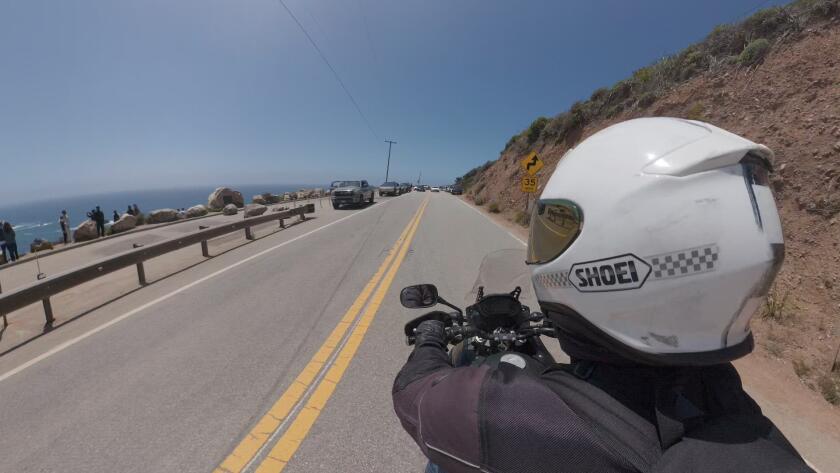
Traffic approaching Bixby Bridge.

A visitor poses in an oversized chair at Big Sur River Inn.
Even at the New Camaldoli Hermitage, a Benedictine monastery above Lucia, the road’s reopening and coming summer season have made a difference. Bookings are up an estimated 30% at the hermitage, which rent rooms and cottages (for two nights or more) to visitors who agree to its requirement of silence.
Big Sur business owners advise visitors to travel on weekdays for less traffic and the best hotel rates, and to get on the road as early as possible.
Since its opening in 1937, the highway has been vulnerable to landslides and shifting ground, operating on a longstanding cycle of landslide, closure, repair, reopening and then another landslide, or sometimes a fire. The U.S. Geological Survey has identified the Big Sur coastline as one of the most landslide-prone areas in the western United States. The 2023-2026 closure was the longest in the highway’s history.
Over time, road crews have used increasingly sophisticated strategies. In the most recent efforts, Caltrans said, it used drones to help survey the slopes and remotely operated bulldozers and excavators to reduce risks to workers.
During the closure, no traffic was allowed on 6.8-mile span from just north of Lucia until about a mile south of the Esalen Institute. Drivers detoured inland by way of U.S. 101.

Correspondents of CBS’ 60 Minutes pose for a portrait in 2023. From left to right, they are Sharyn Alfonsi, L. Jon Wertheim, Bill Whitaker, Lesley Stahl, Scott Pelley, Cecilia Vega, and Anderson Cooper. Former Executive Producer Bill Owens sits on the far right. Only Wertheim, Whitaker and Stahl remain at the program.
CBS Photo Archive/CBS via Getty Images/CBS
hide caption
toggle caption
CBS Photo Archive/CBS via Getty Images/CBS
Stay up to date with our Up First newsletter sent every weekday morning.
When CBS fired Scott Pelley on Tuesday night, the new 60 Minutes executive producer, Nick Bilton, told Pelley it was for insubordination at a staff meeting the day before.
The veteran correspondent argues he was defending the DNA of 60 Minutes and the integrity of its journalism.
The battle royale over the network’s most prestigious and profitable news program is part of a broader fight over the direction of CBS News.
And given CBS’s acquisition by a billionaire family whose business interests have become intertwined with the political interests of President Trump, it reflects a larger war over control of the media in the current moment.

That father and son, Larry and David Ellison, bought CBS’ parent company, Paramount, last summer. In January, they became co-owners of TikTok’s U.S. operations. Now they’re seeking approval from Trump’s regulators to buy Warner Bros. Discovery, the parent company of CNN.
A glamorous show shorn, for now, of most its stars

CBS fired Cecilia Vega, a correspondent, and Tanya Simon, the executive producer, from 60 Minutes last week. They are shown in this photo at the 2026 White House Correspondents’ Association Dinner on April 25, 2026 in Washington, D.C.
Kristina Bumphrey/Variety via Getty Images/Variety
hide caption
toggle caption
Kristina Bumphrey/Variety via Getty Images/Variety
But the specifics of this individual episode matter — for 60 Minutes, CBS, its audience of millions, and even the news business itself.
The program has been the most glamorous post in broadcast news. The correspondents are the stars of the show. And now, there are just three of them.
Anderson Cooper left last month, concerned over the direction of the network’s coverage. Last week was a virtual bloodbath: correspondents Cecilia Vega and Sharyn Alfonsi were fired. So were a producer and two show executives — including Tanya Simon, a longtime staffer who had stepped up as executive producer when her predecessor resigned in protest before the Ellisons’ takeover.

With Pelley’s ouster, only correspondents Lesley Stahl, Bill Whitaker, and Jon Wertheim remain. Now they are considering whether to resign, according to two associates with knowledge.
Their brand-new boss, Bilton, was previously a tech reporter for The New York Times and an investigative reporter for Vanity Fair. He executive-produced a documentary for Netflix about a couple accused of laundering Bitcoin and has been a producer on several other films.
Notably, he has no experience in television news.
Neither does Bari Weiss, whom David Ellison installed as the network’s editor in chief last October. The Ellisons also bought her center-right views-and-news site, The Free Press.
She has maintained that the network of Walter Cronkite needs a makeover for the digital moment. She has also contended for years that CBS, along with the rest of mainstream media, is too reflexively anti-Trump, anti-Israel, and too woke.
A rejection of CBS News executives’ overtures

The new executive producer of 60 Minutes, Nick Bilton, has been a tech journalist and documentary filmmaker, but lacks experience in broadcast news.
Matt Winkelmeyer/Getty Images/Getty Images North America
hide caption
toggle caption
Matt Winkelmeyer/Getty Images/Getty Images North America
Bilton attempted to set a conciliatory tone at Monday’s meeting — his first with the show. Pelley, a formidable veteran correspondent and former CBS Evening News anchor, wasn’t having it.
Pelley called Bilton unwelcome and unqualified. And Pelley said that Weiss was attempting to “murder” the program.
In firing Pelley on Tuesday, Bilton said the journalist had hijacked the meeting and rejected overtures to work constructively through their differences. (NPR obtained a copy of the firing notice.) Bilton wrote that Pelley’s “antipathy to the future of the show came through loud and clear.”
In his own statement late Tuesday evening, shared with NPR, Pelley accused CBS’s new news leadership of killing 60 Minutes‘ DNA and pushing him “to inject falsehoods and bias into a politically sensitive story” and “to include assertions that are unverified.”
The accusations, to which CBS has not yet responded, echo those made by Alfonsi and Vega, the two correspondents fired last week.
Earlier this year, Alfonsi publicly complained after Weiss held one of her stories at the last minute, and kept it frozen for weeks, demanding an on-camera interview with a Trump White House official that never played out. It ran, unchanged from the intended version, with additional statements from the administration tacked on to the end.
After being fired, Vega said in a statement obtained by NPR that her team had “experienced efforts to insert political bias into our stories.”
“Let’s call this what it is: censorship, both censorship and self-driven” Vega continued. “It is dangerous for the show and dangerous for democracy.”
Weiss previously rejected Alfonsi’s and Vega’s allegations. (CBS said Vega’s claims, for example, were “not based in reality” while expressing appreciation for her work.)
Weiss and Bilton say digital threat requires a 60 Minutes overhaul now
In a meeting this morning, Weiss said that Pelley chose his own path — that is, to be fired rather than to find a way to work through his concerns, according to attendees. The network and Weiss have not yet publicly addressed Pelley’s accusations of interference.
Bilton and Weiss say they respect the show’s traditions, its accomplishments and its legacy of enterprise reporting, extended interviews and visual storytelling. It rose in the ratings 9% over the past season under Simon.
The two news leaders say, however, 60 Minutes needs to be overhauled before it becomes increasingly irrelevant in the era of streamers and other sources of news, information and entertainment in the digital age.
Interviews with 12 current and former CBS News staffers, from producers to executives, suggest great reservations and suspicions remain about Weiss’ judgment and her ability to handle the prominent and even famous journalists on whom her division relies.
Weiss had initially sought to reinvent the CBS Evening News, dropping a two-anchor format that had sagged in the ratings. Cooper turned down Weiss’ overtures to anchor it and left the network altogether, concerned about her approach, according to associates. (They spoke on condition of anonymity because Cooper has not chosen to speak publicly on the matter.)

David Ellison became chairman and CEO of CBS’ parent company, Paramount, after buying it last year.
Noam Galai/Getty Images for Paramount/Getty Images North America
hide caption
toggle caption
Noam Galai/Getty Images for Paramount/Getty Images North America
The ratings have continued to sag under new anchor Tony Dokoupil. And some CBS journalists, including producers who have left the Evening News, have publicly accused Weiss of making editorial decisions driven by politics. She has rejected those claims.
The decision to take on overhauling two key shows — one listing, one highly profitable, both high profile — carries significant risks for Weiss and the network, even apart from other considerations.
But the Ellisons’ presence cannot be ignored.

When Shari Redstone was negotiating the sale of CBS’s parent company, Paramount, to the Ellisons’ Skydance Media last year, the network announced the end of Stephen Colbert’s late night show. He had been one of the president’s most biting and acerbic critics.
David Ellison also made a series of concessions directly to Trump’s chief broadcast regulator, Federal Communications Commission Chair Brendan Carr, gutting CBS’s diversity, equity and inclusion initiatives and appointing a conservative ombudsman to field complaints of bias against its news reporting.
Carr and other regulators approved the Paramount deal last summer.
The accommodations echo those made by other media titans.
Amazon and Blue Origin founder Jeff Bezos remade the editorial pages of the Washington Post, which he owns, into a far more hospitable zone for Trump at the outset of his second term. So did Los Angeles Times owner Dr. Patrick Soon-Shiong, a noted medical device inventor. Amazon and Blue Origin have multi-billion dollar contracts with the federal government. Soon-Shiong’s medical research firm routinely has patent applications up for review with federal regulators. One was approved Tuesday.
The Ellisons are hoping to win approval from federal regulators next month for their purchase of Warner Bros. Discovery in a deal valued at more than $110 billion. It would include Warner Bros. Studio, HBO and CNN, among other properties.
As Weiss routs CBS News’ old guard, the question of what role she might play at CNN — and what changes that portends at CBS — hangs over journalists at the two networks. The fate of 60 Minutes serves as a high-stakes case study for both.

-
Lifestyle2 seconds ago
With Highway 1 open, Big Sur braces for its busiest summer in years
-
 Politics7 minutes ago
Commentary: Bass clears first hurdle, but if Pratt holds off Raman, the mayoral race could be a holy war
-
 Sports15 minutes ago
The Ball brothers’ head coach at Chino Hills, Steve Baik, is the new coach at Calabasas
-
World25 minutes ago
Social media operation linked to Iran manipulated public through fake Irish and Scottish profiles
-
 News52 minutes ago
National Guard has done little to reduce violent crime in D.C., a new study finds
-

 Los Angeles, Ca2 hours ago
Man claiming to be armed robs Culver City bank, gets away with $10,000
-

 Detroit, MI3 hours ago
Fired Detroit TV anchor Taryn Asher files sex discrimination lawsuit against old station, claims new GM protected men
-

 San Francisco, CA3 hours ago
San Francisco family devastated as they face nearly 90% rent increase

