Sports
If anyone knows what Caitlin Clark is experiencing, it's Diana Taurasi … to an extent


PHOENIX — Caitlin Clark was on the bench, for once, clapping as the final seconds ticked here Sunday. The Indiana Fever rookie celebrated an 88-82 win over the Phoenix Mercury with teammates, and then she was surrounded by television cameras and photographers. As she spoke to an ESPN reporter, Diana Taurasi walked past 20 feet away, headed for the home locker room.
This contest was big for the Fever, its first victory over a winning team in 20 tries, but it also presented a before-and-after picture that was impossible to ignore. Clark, 22, is the hotshot rookie, the future of the WNBA. Phoenix’s Taurasi, 42, is the league’s career scoring leader, someone who has a street named after her outside the arena.
In front of a sold-out crowd at Footprint Center, Clark was steady over 39 minutes. Although she shot 4 of 14, she finished just shy of her first professional triple-double with 15 points, 9 rebounds and 12 assists. “My gosh … she’s just an incredible passer,” Indiana coach Christie Sides said. “She just finds the plays that need to happen.”
Taurasi posted 19 points, 3 assists and 3 rebounds in 32 minutes. Two nights earlier, in a home win over the Los Angeles Sparks, Taurasi had buried five 3-pointers. Against the Fever, she shot 2 of 10 from deep, never finding an offensive rhythm.
a near triple-double from Caitlin Clark in today’s win over Phoenix 😈 pic.twitter.com/KSJriLAb3l
— Indiana Fever (@IndianaFever) June 30, 2024
Aside from the courtside interview, during which she praised her team’s resilience, Clark didn’t talk to reporters after the game. Sides said the guard did not feel well and needed to meet with the trainer. It’s also a fair bet Clark didn’t want to be put into position to answer questions about beating Taurasi, the rising star toppling a legend. In some ways, this has been a challenge for the entire Indiana franchise.
This weekend Sides twice was asked to assess Clark’s performance. Twice she focused her answer more on the Fever’s youth and their collective growth. After Indiana’s loss to the Seattle Storm on Thursday, Clark met with reporters alongside teammate Aliyah Boston. After reporters directed a fifth straight question to Clark, Clark waved her hand and said, “Ask Aliyah a question.”
If anyone can relate, it’s probably Taurasi, but this comes with an asterisk. Twenty years ago, she was in a similar situation. Like Clark at Iowa, Taurasi had finished her college career at Connecticut as the best player in the sport. She was the No. 1 pick of the WNBA Draft and was expected to elevate the league. The difference was media attention. Since joining the league, Clark has been the focus of countless debates — some on basketball, others on race. She has learned that anything she says can become a national headline or conversation.
Perhaps that explains her reaction Saturday when asked about the WNBA All-Star Game, which takes place July 20 in Phoenix. Even though Clark ranked second in recent fan voting, she didn’t want any part of the conversation. “I don’t know if I’ll be there,’’ she said after practice at Arizona State University. “I’m not going to talk in hypotheticals. My focus is on playing basketball. All that takes care of itself.”
In the same media session, Clark was asked for her first memory of Taurasi, a difficult task considering she was only 2 when Taurasi first joined the WNBA. But after thinking a second, Clark said Taurasi was always someone she associated with women’s professional basketball. She appreciated the intensity and fire in which Taurasi played, and called Sunday’s game a chance to compete against the best, “a dream come true.”
“That’s somebody I grew up idolizing and looking up to and wanting to be like one day,’’ Clark said. “I don’t know if there’s going to be many people to be able to do it like her.”
As a Phoenix rookie in 2004, Taurasi instantly became the face of the franchise. Her first home game drew 10,493 fans, the most for an opener in three years. Before many road games that season, Taurasi met pregame and talked with a select group of 50 fans. Former Phoenix general manager Seth Sulka told reporters at the time that the attention was unlike anything he had seen in the WNBA.
“I loved it,” Taurasi said when asked about this Sunday. “I just loved to play basketball. I didn’t care too much about outside noise or what people thought of me. I enjoyed every minute. Being a rookie was cool, man. It was fun. You could do whatever you want, you didn’t know any better. Being in Sports Illustrated, Slam … ESPN the Magazine.”
Taurasi glanced at a young reporter in the room.
“You’re too young. You don’t know what I’m talking about,” she said.
Like Clark, Taurasi still had to deal with physical play, with veterans trying to put her in her place. Opponents respected her talent, but they made her earn their respect. On April 5, while providing TV commentary during the women’s Final Four, Taurasi recalled a “Welcome to the WNBA” moment and how an intimidating defender named DeLisha Milton-Jones twice elbowed her in the face. It set up a rivalry of sorts.
During a recent phone conversation, Milton-Jones, the coach of the women’s program at Old Dominion, laughed. She had seen Taurasi’s comments on social media. “I’m like, ‘Invite me on your show so I can tell them the other side,”’ she said.
Milton-Jones was aware of Taurasi’s skill. In the WNBA, she saw it up close. How Taurasi manipulated the game with her vision. How she understood spacing and timing. How she applied a point guard’s touch to multiple positions. But what impressed Milton-Jones most was how Taurasi arrived with tricks that took most rookies a season or two to learn.
Milton-Jones said that when she elevated for a jump shot, Taurasi would poke her in the stomach, just hard enough to make her flinch and throw off her shot. On offense, Taurasi would come off a pindown and try to jam Milton-Jones to try to create space.
“She would literally punch me in the stomach,’’ Milton-Jones said. “Then she would blast off wide open. My coach is yelling at me like, ‘You need to be guarding her!’ And I’m like, ‘She just punched me in the stomach!’ She was feisty and crafty and she had this vet savvy-esque play to her game.”
(Responded Taurasi outside the media room Sunday: “I think it was my upbringing. Italian Argentines, we’re sneaky. We’re always trying to find an advantage somehow. In the game of basketball, there’s games within the game. And when you’re not physically gifted as much as other people, you have to find little ways to get that edge.”)
Carrie Graf, who coached Taurasi her first two pro seasons, said Taurasi’s biggest flaw was with the referees. She was too harsh. Instead of yelling in their faces, she told Taurasi to use her charisma. To remember that officials are people. But there was no questioning her readiness.
“I can picture this shot like it’s a photograph,’’ Graf said on the phone from Australia. “She’d get in the lane and she’d be up against the tall timbers. She’s on the right side and she extended her right arm out like it was an elevated hook shot. And then with her left hand, the shot blocker is coming in, and while she’s in the air, she goes up and grabs the shot blocker’s arm to clear some space so she could put the ball on the rim. Women just weren’t doing that stuff back then.”
Diana Taurasi drives against Caitlin Clark in Sunday’s game. (Chris Coduto / Getty Images)
Clark has this quality as well, but instead of hanging in the air, it’s pulling up from the logo, a trademark move that has made her famous within the sport. She did this twice Sunday, igniting the crowd. Even in Phoenix, the “Clark” jerseys outnumbered Phoenix players’ in many sections of the arena.
Caitlin Clark showing off her deep range with another logo three 🎯 pic.twitter.com/IX8wnVb3g4
— Indiana Fever (@IndianaFever) June 30, 2024
Clark is still navigating this transition. Like she has all season, she forced too many passes Sunday, resulting in 6 turnovers. She tried a behind-the-back pass that had little chance. She misfired on a lead pass in transition. She lost the ball and fell to the court.
Before the game (Clark meets with reporters before every contest), she had said her biggest adjustment had simply been the pace of everything. After losing to South Carolina in the NCAA national championship, Clark returned to Iowa City for a day and “then my life kind of changed,” she said.
After the draft, Clark moved to Indianapolis. May 3, she played her first preseason game. She hasn’t slowed since, playing 20 games for the 8-12 Fever. The exciting part is she knows she has room to grow, mastering details that can elevate her game. The frustrating part is she hasn’t had much practice time to do so.
“I had to learn game to game,” Clark said. “That’s kind of been the biggest adjustment.”
Taurasi predicted as much. She didn’t mean it as a shot at Clark and the league’s talented rookies. Only that this transition often takes time. In a Phoenix radio interview, Taurasi compared it to a college quarterback adjusting to the NFL. After Sunday’s loss, she expressed how much she respects how Clark has handled it.
“It’s amazing what Caitlin has been able to do,” Taurasi said. “Her short career so far has been nothing short of remarkable. The one thing that I really love about her is she loves the game. You can tell she’s put the work in. And even throughout her short WNBA career, it’s been a lot of pressure, a lot of things thrown at her, she keeps showing up and keeps getting better every single game. Her future is super bright.”
(Top photo: Kate Frese / NBAE via Getty Images)



NEWYou can now listen to Fox News articles!
The best Indianapolis 500 finish could be subjective, depending on which driver a fan was rooting for to win.
It certainly is in the eye of the beholder.
So take this list for what it’s worth. One view of the 10 best finishes in Indianapolis 500 history. Of course, it skews to more recent decades when the runs have come a little faster and the finishes have had a tendency to be a little closer.
We’ll add one each day to this list of fantastic finishes ahead of the 110th running of the Indy 500 on May 24 (12:30 p.m. ET on FOX).
10. Ericsson outduels O’Ward (2022)
After a red flag, Marcus Ericsson held off Pato O’Ward in a two-lap shootout. The shootout didn’t last two laps, though, as there was a crash on the final lap behind them. Ericsson had a comfortable lead when the red flag came out for a crash with four laps to go, a situation where in past Indianapolis 500 races, they likely would have ended the race under caution with Ericsson as the winner.
9. Foyt survives chaos (1967)
How does a driver who wins by two laps end up on this list? It’s because the win nearly didn’t happen on the last lap. A big crash with cars and debris littering the frontstretch just ahead of Foyt as he came to the checkered flag forced him to navigate through the wreckage for the win.
8. Sato can’t catch Franchitti (2012)
This was one of those finishes where the leader holds on for the win, but boy did the leader have to hold on. Takuma Sato tried to pass Dario Franchitti early on the final lap but to no avail and Franchitti sped off for the victory. This was one of those Indy 500s that made you hold your breath all the way to the checkered flag.
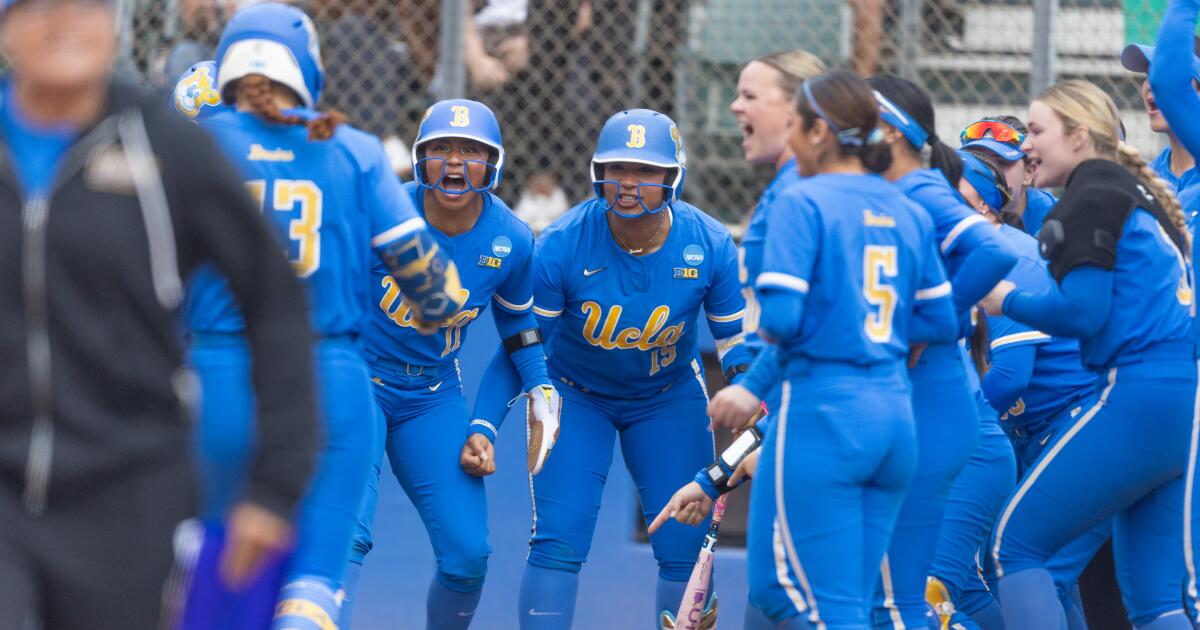
No. 8 UCLA stuck with right-hander Taylor Tinsley throughout the Los Angeles Regional and that faith in the senior paid off.
During the Bruins’ NCAA tournament opener at Easton Stadium, Tinsley gave up 10 runs before her teammates rallied for a walk-off win. She returned less than 24 hours to pitch against South Carolina, giving up two earned runs in a victory. Tinsley was back in the circle Sunday afternoon, yielding one run in UCLA’s 15-1 victory over the Gamecocks to advance to the super regionals.
“I am proud of Taylor’s resiliency, the ability to do whatever she can to help this team,” UCLA coach Kelly Inouye-Perez said. “She got stronger through the weekend. I am proud of that.”
Tinsley and her teammates will host Central Florida in a super regional that begins Friday.
“I feel good,” Tinsley said after pitching three key games in three days. “I could have gone more innings if needed.”
South Carolina right-hander Jori Heard gave up only one hit through two innings, keeping UCLA’s potent bats relatively quiet. The Gamecocks had runners on first and second with two outs in the second, but Tinsley escaped the inning with a pop-up to left field.
The Bruins got on the board first with a two-run home run from left fielder Rylee Slimp in the third inning. The Bruins followed it up by loading the bases with no outs in the fifth for right fielder Megan Grant.
Grant cooked up a grand slam to make it 6-0. She has 40 home runs, extending her hold on the NCAA single-season home run record. Oklahoma freshman Kendall Wells trails Grant with 37 homers.
“Its just incredible because I am blessed to be able to say the number 40,” Grant said.
South Carolina broke through on an RBI single from left fielder Quincee Lilio to cut UCLA’s lead to 6-1 in the fifth inning after being held to just one hit since the first inning. The Gamecocks couldn’t cash in the rest of the way.
The Bruins resumed scoring in the sixth inning, with the bases loaded and Grant at bat again. Fans at Easton Stadium anticipated another grand slam, holding up their cellphones hoping to catch some magic. Grant served up a two-run RBI single to expand the lead 8-1.
Jordan Woolery added to the scoring with a two-run RBI double down the left-field line, and Kaniya Bragg hit a home run to left-center field. Soo-jin Berry put a bow on the win with one more home run.
Sports
Pro wrestling star learns what ‘land of opportunity’ means in US as he details journey from Italy to America

NEWYou can now listen to Fox News articles!
Cristiano Argento has been tearing up opponents in the ring for the National Wrestling Alliance (NWA) as he worked his way up the ladder to get a few shots at some gold.
But the path to get to one of the most prestigious pro wrestling companies in the U.S. was long and a path that not many wrestlers have taken.
Argento was born and raised in Osimo, Italy – a town of about 35,000 people located on the east side of the country closer to the Adriatic Sea. He told Fox News Digital he started training in a ring at a boxing gym before he got started on the independent scene in Italy. He wrestled in Germany, Sweden, France and Denmark before he came to the realization that, to become a professional wrestler, he needed to make his way to the United States.
ZERO BS. JUST DAKICH. TAKE THE DON’T @ ME PODCAST ON THE ROAD. DOWNLOAD NOW!
Cristiano Argento performs in the National Wrestling Alliance (Instagram)
He first worked his way to Canada to get trained by pro wrestling legend Lance Storm. He moved to Canada, leaving most of his friends and family behind and without a firm grasp on the English language.
“At the time, my English was horrible. I didn’t speak any English at all,” he said. “But I was with my friend, Stefano, he came with me and he translated everything for me. I probably missed 50% of the knowledge that Lance Storm was giving to us because I was unable to understand. I was only given a recap and everything I was able to see. I’m sure if I was doing it now with a proper knowledge of English, it would have been a different scenario.
“Eventually, I moved back to Italy after the training and I said, OK, now, I want to go to the U.S. So, I studied English more properly, and eventually I got my first work visa that was in Texas. I was in Houston for a short period of time. I trained with Booker T at Reality of Wrestling. I got on his show, which was my debut in the U.S. That was awesome. I eventually got a new work visa in Pittsburgh, Pennsylvania, where I currently live since 2017. Since then, my wrestling career, thankfully, kept growing, growing, growing and growing until now wrestling for the NWA. One of the bigger promotions in the U.S.”
Argento said that his family thought he was “nuts” for chasing his pro wrestling dream.
He said they were more concerned about his well-being given that he was half-way around the world without anyone he knew by his side in case something went sideways.
“My family, friends, everybody was like why do you want to move to the opposite side of the world not knowing the language, not knowing anybody, by yourself, to try to become a professional wrestler? And I was like, well, we have one life, I love, and that’s what I’m gonna do,” he told Fox News Digital. “Eventually, my family was really supportive. But when I first said, ‘Hey, mom and dad, I want to do that.’ They looked at me like, ‘Are you nuts? Are you drunk or something? What are you talking about?’ And I said, no that’s what I want to do. And they knew I loved this sport because in Italy I was traveling around Europe, spending time in Canada training, so they started to understand slowly that’s what I want to do with my life. They were proud of me.
Cristiano Argento works out in the gym. (Instagram)
“They’re still proud of me. I think more like the fact that you’re gonna try that, that it’s hard than more like you’re gonna leave us. The fact like, oh, my son is gonna go on the opposite side of the world for a six-hour time difference and we’re gonna see him maybe, when, like, I don’t know. Not often. I think it was more that. And for me too, it was really hard. It was heartbreaking not being able to see my family every day or every month. Like once a year if I’m lucky. I think that was the biggest part for them because of concern or that I was here by myself and if I have any issue or any problem, I didn’t have nobody. So they were scared. Like, you get sick, if you have a problem, anything, and they’re not being able to be here next to me. But they were really supportive since day one.”
Argento is living out his dream in the U.S. He suggested that the moniker of the U.S. being the “land of opportunity” wasn’t far from what is preached in movies and literature – it was the real thing.
“I was inspired by people who came to the U.S. and made it big,” Argento told Fox News Digital. “The U.S. was always like the land of opportunity. That’s how they sell it to us and this is what it is. I feel like, in myself, that was true because anything I tried to do so far I was able to reach a lot more than if I wasn’t here. I’m not yet where I’d like to be but I see like there’s so many opportunities in this country. Not just in wrestling but like in any business to reach the goal. I’m really happy of the choices I did here.
National Wrestling Alliance star Cristiano Argento poses in Times Square in New York. (Instagram)
CLICK HERE TO DOWNLOAD THE FOX NEWS APP
“But my big inspirations were big-time actors who moved to the country, who didn’t know English, with no money, no support system. I had one dream, I have to go right there to make it happen and I’m gonna go and do it and I’m gonna make it happen. So those people were always the biggest inspiration even if it wasn’t in wrestling, just how they handled their passion, how they pursued their dream without being scared of anything, how far you are, how alone by yourself … You don’t know the language, you’re like, let’s go, let’s do it.”
Outside of the NWA, Argento has performed for the International Wrestling Cartel, Enjoy Wrestling and Exodus Pro Wrestling this year.
-

 Finance3 minutes ago
Banks must respond strategically to these six shifts – I by IMD
-

 Movie Reviews21 minutes ago
Review | Paper Tiger: Adam Driver and Scarlett Johansson lead dark gangster movie
-
World33 minutes ago
Stocks fall and oil prices gain after Trump warns the Iran ‘clock is ticking’
-
 Lifestyle1 hour ago
How Tamara Rojo is remaking ballet
-

 Technology2 hours ago
Microsoft is retiring Teams’ Together Mode
-

 World2 hours ago
Canada confirms hantavirus case linked to cruise ship outbreak that has killed three passengers
-

 Politics2 hours ago
Trump reads Bible as thousands pack National Mall for America 250 prayer rally
-

 Health2 hours ago
Frequent museum visits tied to reduced cellular aging, research finds


