Sports
Rory McIlroy and the U.S. Open he will never escape — even though he tried


PINEHURST, N.C. — Within seven minutes of Bryson DeChambeau’s ball landing in the cup, the ripping sound of tires skirting on pavement whipped through Pinehurst Resort as Rory McIlroy’s courtesy Lexus SUV pulled out of his 2011 U.S. Open champion parking place and drove away from the day he’ll never escape. He stared into the distance as his agents and caddie spoke around him. No interviews. The 35-year-old Northern Irishman simply tossed his clubs and workout bag into the trunk, slipped into the driver’s seat and threw it into reverse. The U.S. Open ended at 6:38 p.m. At 7:29 p.m., McIlroy’s Gulfstream 5 took off, leaving the Sandhills of North Carolina without his fifth major championship but with the collapse that will define him forever.
Just 90 minutes earlier, McIlroy strutted down the 14th fairway prepared to redefine his career. Ten years without a major. Ten years of pain and close calls, a man who won four majors by the time he was 25 then fell short again and again. And here he was, with five holes remaining at the U.S. Open, leading Bryson DeChambeau and the field by two strokes.
But Rory McIlroy did not win the 2024 U.S. Open.
Three bogeys and a pair of missed three-foot putts later, McIlroy lost it to DeChambeau. It will be remembered far more than any of his four wins.
Chewing a nutrition bar walking off the 14th tee, McIlroy leaned over to peek at the 13th green to his right. McIlroy had a two-shot lead because he had just birdied 13 as DeChambeau — playing in the final group as the 54-hole leader — had bogeyed No. 12. But DeChambeau put his drive safely on the par-4 13th with a putt for eagle, and McIlroy wanted to get a look. DeChambeau ultimately birdied to get back within one.
McIlroy entered Sunday at Pinehurst three shots back of DeChambeau. He was not supposed to win this, but he seemingly went and grabbed it. For 13 holes, we saw the version of McIlroy many pleaded for during the past decade. He looked like a killer, or some version of it. He opened with a birdie on the first hole and birdied Nos. 9, 10, 12 and 13 with lengthy putts. He was winning this major.
But golf is not a sport kind to the premature formation of narratives.
😱 😱 😱 😱
RORY MISSES ON 18.
Bryson can win the U.S. Open with a par on 18. pic.twitter.com/lSk0ZzzZK2
— U.S. Open (@usopengolf) June 16, 2024
He parred No. 14. Then, he bogeyed the par-3 15th after overshooting the green, but that was acceptable. It was one of the hardest holes of the day, and DeChambeau bogeyed it too.
It was on 16 that the fear kicked in. McIlroy had a simple-seeming par putt from two feet, six inches. And he missed. It wasn’t really close, rounding the left edge. Yet McIlroy remained on a mission to stay calm. The instant it missed, he flattened both his palms to give the “calm down” signal. Yet throughout the Pinehurst No. 2 a familiar sentiment was whispered. Not again.
And no matter how hard he tried to steel himself, McIlroy sent his tee shot on the par-3 17th into the left-side bunker. Credit to him, he hit a beautiful, soft pitch out from the sand and saved par.
But what happened next signaled it might be over far before it truly was.
McIlroy put his putter back into his bag, leaned over to grab his driver and his eyes bulged into a fearful grimace. The game plan was out the window. The thoughts that got him here were gone. He was flying blind.
See, McIlroy had a plan this week. He talked about it nearly every day from Tuesday through Saturday. Boring golf. Disciplined golf. Bogeys will happen, so never get flustered. “Just trying to be super stoic,” McIlroy said Tuesday. “Just trying to be as even-keeled as I possibly can be.” And he was for 71 holes, through it all. His tournament could be defined by how impressive that demeanor was, making the kind of ugly, tough par saves he historically missed.
GO DEEPER
U.S. Open analysis: 10 things to know on Bryson DeChambeau’s win
But somewhere between 16 and 18, McIlroy stared into the headlights and wasn’t prepared to look away. He was now a different golfer. His eyes looked like they were playing through each heartbreaking scenario, in turn putting them into fruition. Maybe then, we should have known.
So, for some inexplicable reason, McIlroy pulled out driver. Why, oh why, did he want his driver? The day before, he hit a 3 wood and left himself only a 133-yard wedge shot in. There was no need for extra length on the 449-yard hole. Maybe McIlroy, likely the best driver of the golf ball in recent memory, thought this would be his signature moment. Maybe he was chasing even though he was tied. Either way, McIlroy launched a drive too far left — into Pinehurst’s infamous native area, just in front of a patch of wiregrass. He had no play. He punched out an awkward little roller up to the front of the green. And again, his short game came to play with a nice little chip to three feet, nine inches from the 18th pin.
He missed. Again.
It was as if Bill Buckner let a second ball go through his legs. There is no explanation nor any defense. McIlroy’s short, softly hit putt broke right immediately and rode the right edge of the hole. Rory McIlroy had just bogeyed three of the final four holes to hand away the 2024 U.S. Open, giving Bryson DeChambeau room to earn it with an incredible up and down out of the 18th bunker to par and take the title. If McIlroy made both three-foot putts, he wins the U.S. Open. If he makes one, he goes to a playoff. But he made neither.
McIlroy signed his scorecard in the scoring tent and watched the finish on TV with the slightest, faintest sense of hope. He ate another nutrition bar during DeChambeau’s bunker shot. His hat sat loosely crooked on top of his head for the final putt with hands on his hips. He took one last nervous, sick-to-his-stomach gulp down his throat before the putt fell in. When it did, he turned, looked down, swallowed once more and exited out the door behind him. He gathered his belongings and made his way to the Lexus.
The golfer known for his ability to speak eloquently on all subjects declined to speak to media. There was nothing left to say.
McIlroy’s career began with a collapse. He was just 23 and entered Sunday at the 2011 Masters with a four-shot lead but shot a disastrous 80 to fade away. People will always remember that day, but he won the U.S. Open two months later. It was the first of four majors in as many years. He seemed on pace to chase the greats.
He’s never won a major again.

Rory McIlroy had a two-shot lead with five holes to play Sunday. (Jared C. Tilton / Getty Images)
But unlike so many other sports figures who burned bright early only to fade out, McIlroy’s game didn’t dissipate. He’s remained one of the three or four best players in the world for most of these last 10 years. He’s won 26 PGA Tour events. He’s finished top 10 at 21 of the 37 majors since. By most metrics, the past three years have been his best. He just couldn’t win. Most wouldn’t have even called him a choker. First, he just got off to a bad starts and finished hot. Then, the last three years, somebody else grabbed it from him. At the 2022 Open Championship, he shot a perfectly fine Sunday 70. He just couldn’t hit the 50-50 birdies, and Cameron Smith did to shoot a 64 and steal it. At the 2023 U.S. Open, he entered one back of Wyndham Clark. They shot the same Sunday score. He didn’t hand these away.
The 2024 U.S. Open at Pinehurst? Rory McIlroy choked.
McIlroy has made some enemies in his time, and two of the people he’s bumped heads with most are Greg Norman and Phil Mickelson, two players as synonymous for their epic collapses as they are for their eight combined majors. Norman is most famous for his six-shot 1996 Masters disaster. Mickelson famously double-bogeyed the 18th hole at the 2006 U.S. Open at Winged Foot to give it to Geoff Ogilvy. Now, McIlroy will live forever with those two men.
There aren’t many comparisons in sports to the path of McIlroy. There aren’t other athletes or team dynasties that won multiple titles immediately, stayed at the top of the sport but became known as chokers at the end of their run. The Patriots won three more titles after the Super Bowl losses to the Giants. The core of the 2004 Yankees was aging, and they won again five years later. Jordan Spieth didn’t give majors away after his third major before the age of 24 — his play declined.
The hardest part with McIlroy is always thinking he might get the next one. He is still that good. He still has a runner-up finish at a major each of the past three years. And there’s this idea that if he keeps putting himself in contention, the cards will eventually fall his way.
But on Sunday, something changed. McIlroy is 35 now, and maybe the muscle memory has faded over the last decade. How to put your entire dreams into something and have it work out. How to prove a narrative wrong or hit the perfect shot with thousands of fans living and dying with every swing.
Rory McIlroy sped off out of the Pinehurst Resort parking lot early Sunday evening not just a man in heartbreak. He drove off as forever the man who missed those two putts.
(Top photo: Jared C. Tilton / Getty Images)



NEWYou can now listen to Fox News articles!
With the largest World Cup field in the history of the tournament, 32 of the 48 teams will be fighting for a spot in the knockout stage.
66.6% of nations will advance out of the group stage this summer, which is a massive upgrade from 50% in past World Cups. Because of this, sportsbooks have adjusted with less favorable odds.
Prior to the start of the tournament, Spain, Argentina, Brazil, England, and Germany entered with the strongest odds to advance from the group stage, supported by recent major-tournament success and talent-rich rosters.
All five nations are heavily favored at -10000 to advance to the knockout round.
The Spaniards are the defending European Champions while the Argentinians are looking to win back-to-back titles. Germany has not made it out of the group stage in the last two World Cups, but has always been a perennial contender— having won four titles in its history. And then of course there’s Brazil, which has more titles than any country with five.
Now, after the conclusion of the first day of the World Cup, Mexico has joined the group at the top. El Tri has surged to -10000 to advance to the knockout stage after initially being just -1400. Mexico’s huge leap up the oddsboard is a direct result of its dominating 2-0 win over South Africa.
With that in mind, let’s dive into the odds for each team to advance to the knockout stage of the 2026 FIFA World Cup as of June 12.
This page may contain affiliate links to legal sports betting partners. If you sign up or place a wager, FOX Sports may be compensated. Read more about Sports Betting on FOX Sports.
Odds to Advance to Knockout Stage
Spain: -10000 (bet $10 to win $10.10 total)
Argentina: -10000 (bet $10 to win $10.10 total)
Brazil: -10000 (bet $10 to win $10.10 total)
England: -10000 (bet $10 to win $10.10 total)
Mexico: -10000 (bet $10 to win $10.10 total)
Germany: -10000 (bet $10 to win $10.10 total)
Portugal: -5000 (bet $10 to win $10.20 total)
France: -5000 (bet $10 to win $10.20 total)
Belgium:-3500 (bet $10 to win $10.29 total)
South Korea: -2500 (bet $10 to win $10.40 total)
Switzerland: -1800 (bet $10 to win $10.56 total)
Netherlands: -1400 (bet $10 to win $10.71 total)
Morocco: -1000 (bet $10 to win $11 total)
Colombia: -1000 (bet $10 to win $11 total)
Uruguay: -1000 (bet $10 to win $11 total)
Canada: -1000 (bet $10 to win $11 total)
Ecuador: -900 (bet $10 to win $11.11 total)
Norway: -900 (bet $10 to win $11.11 total)
United States: -750 (bet $10 to win $11.33 total)
The U.S. men’s national team is currently -750 to advance from Group D (Photo by Omar Vega/USSF/Getty Images).
Croatia: -500 (bet $10 to win $12 total)
Austria: -500 (bet $10 to win $12 total)
Türkiye: -500 (bet $10 to win $12 total)
Ivory Coast: -500 (bet $10 to win $12 total)
Japan: -500 (bet $10 to win $12 total)
Egypt: -340 (bet $10 to win $12.94 total)
Algeria: -310 (bet $10 to win $13.23 total)
Scotland: -310 (bet $10 to win $13.23 total)
Senegal: -230 (bet $10 to win $14.35 total)
Sweden: -230 (bet $10 to win $1435 total)
Bosnia and Herzegovina: -220 (bet $10 to win $14.55 total)
Paraguay: -205 (bet $10 to win $14.88 total)
Iran: -200 (bet $10 to win $15 total)
Czechia: -165 (bet $10 to win $16.06 total)
Ghana: -140 (bet $10 to win $17.14 total)
Australia: -110 (bet $10 to win $19.09 total)
DR Congo: +100 (bet $10 to win $20 total)
Raúl Jiménez helped propel Mexico to a 2-0 win over South Africa in the opening match of the 2026 FIFA World Cup (Photo by Yair Gonzalez/Jam Media/Getty Images).
Saudi Arabia: +105 (bet $10 to win $20.50 total)
Tunisia: +140 (bet $10 to win $24 total)
New Zealand: +150 (bet $10 to win $25 total)
Uzbekistan: +180 (bet $10 to win $28 total)
Cape Verde: +200 (bet $10 to win $30 total)
Panama: +200 (bet $10 to win $30 total)
Qatar: +275 (bet $10 to win $37.50 total)
South Africa: +320 (bet $10 to win $42 total)
Jordan +350 (bet $10 to win $45 total)
Iraq: +450 (bet $10 to win $55 total)
Haiti: +800 (bet $10 to win $90 total)
Curaçao: +1000 (bet $10 to win $110 total)
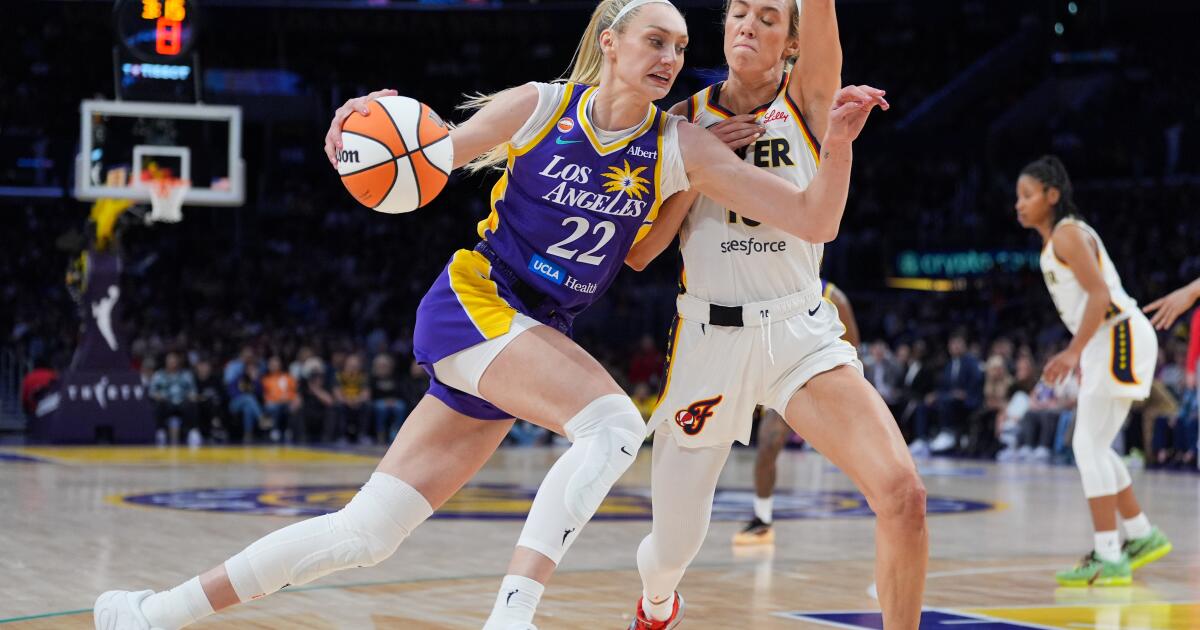
Cameron Brink said she’d appreciate some grace. She really would.
Sparks fans should give her some, because where else is she going to get it?
Certainly not from WNBA refs. Not from opponents with more to play for than ever. Certainly not from the game itself; basketball moves fast, and a bummer can become a bust in a blink.
But Brink, 24, is not on the brink of bust territory, no. Block that thought. Technically, it’s Year 3, but after a torn ACL derailed her as a rookie two summers ago, it’s practically like Year 2 for the former Stanford star. And by design, the WNBA is testing her confidence, her decision-making and her patience as she tries to reestablish herself as one of the WNBA’s best young players.
So, grace.
The recognizable 6-foot-4 forward — she’s the long-blond-haired hooper in the New Balance ads — was the No. 2 overall pick in 2024.
Now she’s her team’s No. 3 option in the post. She’s coming off the bench behind Nneka Ogwumike and Dearica Hamby for the Sparks, who are a modest 6-6 after wins this week over the expansion Portland Fire and the struggling Seattle Storm.
Against the Fire, Brink scored two points and picked up four fouls in nine minutes. Then she went to Seattle and had 15 points in 18 minutes but was pulled with more than five minutes left in the fourth quarter after getting her third, fourth and fifth fouls in 86 seconds. (WNBA players get six fouls before being disqualified.)
For the season, Brink has been called for 49 fouls in 208 minutes. A foul about every four minutes!
They’re silly fouls and they’re phantom calls. Egregious and ticky-tack. Costly and common. A real fouled-up buffet. She sets screens that get scrutinized as if by the most vigilant TSA agent. And sometimes, yes, she’s doing the accidental tripping. Other times, the officials are.
Her reputation precedes her, so everyone gets a superstar’s whistle when being defended by Brink. Opponents bake it into their game plans.
That can’t continue.
All that fouling is hindering Brink’s development because it’s robbing her of important in-game reps — which she needs, foremost, to figure out how to stop fouling.
Sparks forward Cameron Brink, left, blocks the shot of the Tempo’s Laura Juskaite during a game last month.
(Jeff Lewis / Associated Press)
“At the pro level,” said Tara VanDerveer, Brink’s coach at Stanford, “every young player always has a lot of work to do. And I saw her make a three. I see her block shots. She rebounds, she can handle the ball, she’s unselfish, she’s a terrific talent. But there’s always things players need to work on.”
We know what Brink’s thing is.
“She has to be disciplined,” VanDerveer said. “And if you want something so badly, if you want to be an All-Star someday or make the Olympic team, you’ve got to be dependable … and I think anyone can change, if it’s behavior they recognize is not in their best interests or not in their team’s best interests. It’s hard, but it’s something I think people can do.
“That’s what Cam is working on.”
And, VanDerveer added, “I’m really so excited that Nneka is there, because she will give her such great guidance and mentorship.”
And grace. Brink is getting that from Ogwumike — also a former Stanford star, the Sparks legend returned to L.A. this season after two seasons in Seattle — and her other teammates.
“I just do my best to lead by example,” Ogwumike, 35, said. “But then also let [Brink] know that she’s very capable, that she’s more than capable, which is exactly why she’s here with us and it’s exactly why we need her on this team.”

Sparks forward Cameron Brink, wearing a facemask, controls the ball while defended by Sun forward Raegan Beers.
(Joe Buglewicz / Getty Images)
But how long will Brink get grace from the Sparks in the what-have-you-done-for-me-lately business of basketball?
The foul trouble tells us why a win-now team wouldn’t trust her, why the Sparks would give meaningful minutes to two veteran post players ahead of her. Why they wouldn’t prioritize Brink’s development alongside winning as they strive to snap a previously unthinkable five-year playoff drought.
And what about fans? How patient will you all be with a player who was drafted immediately after Caitlin Clark and five spots in front of Angel Reese?
These days, that might depend on what the parlay calls for.
Or, preferably, whether you remember Brink’s first 15 WNBA games. All starts, all signs pointing to stardom. She showed up in 2024 throwing lavish block parties. Her 2.3 blocks per game were message-sending spikes, like what Lisa Leslie used to enthrall Sparks crowds with.
From the jump, she had guys coming to games at Crypto.com Arena wearing her No. 22 jersey and little girls arriving in groups with No. 22 painted on their cheeks and “I love Cam Brink” signs in hand.
And then the torn ACL cost her 25 games of her rookie season and another 25 last season, plus her spot on the United States’ Olympic 3×3 women’s basketball team in Paris in 2024.
She had to start over. Lost a lot of ground. But you see that masked woman stuck on the Sparks’ bench for all but 17 minutes per game?
You can’t miss her. She’s looking uncomfortable in protective facial gear that either hinders her breathing or her peripheral vision, her only options to protect the torn septum she suffered in a victory over the Las Vegas Aces last month.
She’s the one with the 6-8 wingspan who’s averaging 9.2 points, 4.3 rebounds and 1.5 blocks while shooting 52.1% from the field in her limited minutes.
She’s still Cameron Brink. Between fouls, she’s fluid and fast and covers more of the court than almost anyone in the WNBA, able to leap from defending guards to centers in a single bound.
“It’s just looking at every day as a new opportunity to learn and grow and not getting too bogged down when things don’t go exactly as you planned,” Brink told me. “Because more times than not, things are not going to go how you want them to. And that’s life. So I just want to be able to put my best effort out there every single night.
She knows what the Sparks need from her: “To perform, just come on the floor and compete.”
To prove she can stay on the floor to compete.

NEWYou can now listen to Fox News articles!
When will Team USA lose in the 2026 FIFA World Cup? Or, will it not lose at all?
Let’s check out the odds for the Americans’ stage of elimination at FanDuel Sportsbook, as of June 11.
Team USA — Stage of elimination odds
Last 32: +170 (bet $10 to win $27 total)
Last 16: +220 (bet $10 to win $32 total)
Group stage: +500 (bet $10 to win $60 total)
Quarterfinals: +500 (bet $10 to win $60 total)
Semifinals: +1200 (bet $10 to win $130 total)
Runner-up: +2800 (bet $10 to win $290 total)
Outright winner: +6000 (bet $10 to win $610 total)
This page may contain affiliate links to legal sports betting partners. If you sign up or place a wager, FOX Sports may be compensated. Read more about Sports Betting on FOX Sports.
The outlook appears to be … ho-hum?
If the odds ring true, the Americans are expected to make it out of the group stage but fall in the first knockout stage game.
How would that result stack up against previous results? Well, at the 2022 World Cup, Team USA made it to the Round of 16, which was viewed as a stellar accomplishment.
The U.S. men’s national team currently has 60-1 odds to lift the 2026 FIFA World Cup trophy this summer (Photo by Omar Vega/USSF/Getty Images).
In 2018, the USA did not qualify for the World Cup, and in 2014 and 2010, the Americans also made it to the Round of 16. Their best result this century occurred in 2002, when the Americans made it all the way to the quarterfinals before being eliminated.
In 1998, Team USA lost in the group stage, in 1994, it fell in the Round of 16, and in 1990, it also fell in the group stage.
With the expanded World Cup format, 32 teams will advance to the knockout stage (out of 48), giving teams a much better chance of getting out of the group stage than in previous tournaments. In past years, only 50% of the field advanced to the knockout round, but now 66.6% of teams will move on.
With that being said, anything less than a knockout round appearance on home soil would be viewed as a major failure this summer for Team USA.
The second result on the oddsboard is the “Last 16,” meaning the USA would make it out of the group stage and win one knockout stage game, before falling in the second knockout stage game. The third result is that the Americans failed to make it out of the group stage, and the fourth is that they made it to the quarterfinals, meaning they won two knockout stage games.
Making the semis, losing in the championship game and winning the championship are the three results with the longest odds.
The U.S. begins its World Cup journey on Friday as the Stars and Stripes face Paraguay at Los Angeles Stadium. Getting off to a fast start in the group is crucial for the team’s World Cup dreams of making a deep run this summer.
-

 Los Angeles, Ca12 minutes ago
MLB to screen Hollywood classic at drive-ins nationwide
-

 Detroit, MI32 minutes ago
Detroit at Le Mans: Cadillac favorite, Ford poised for 2027
-

 San Francisco, CA42 minutes ago
Hudson Pacific lands SF’s biggest office lease in nearly a decade
-

 Dallas, TX47 minutes ago
NFL Brazil tickets are available: Shop Cowboys vs. Ravens NFL Brazil tickets now
-

 Miami, FL54 minutes ago
North Miami man accused of stabbing victim 7 times
-

 Boston, MA57 minutes ago
Everything you need to know about Sail Boston 2026
-
Denver, CO1 hour ago
Broncos’ Jonathon Cooper arrested again on four charges, including harassment, violation of protection order
-

 Seattle, WA1 hour ago
Ribbon-cutting marks completion of mixed-income condos in Seattle’s Phinney Ridge


