Politics
As California water agency investigates top manager, some worry progress could be stymied

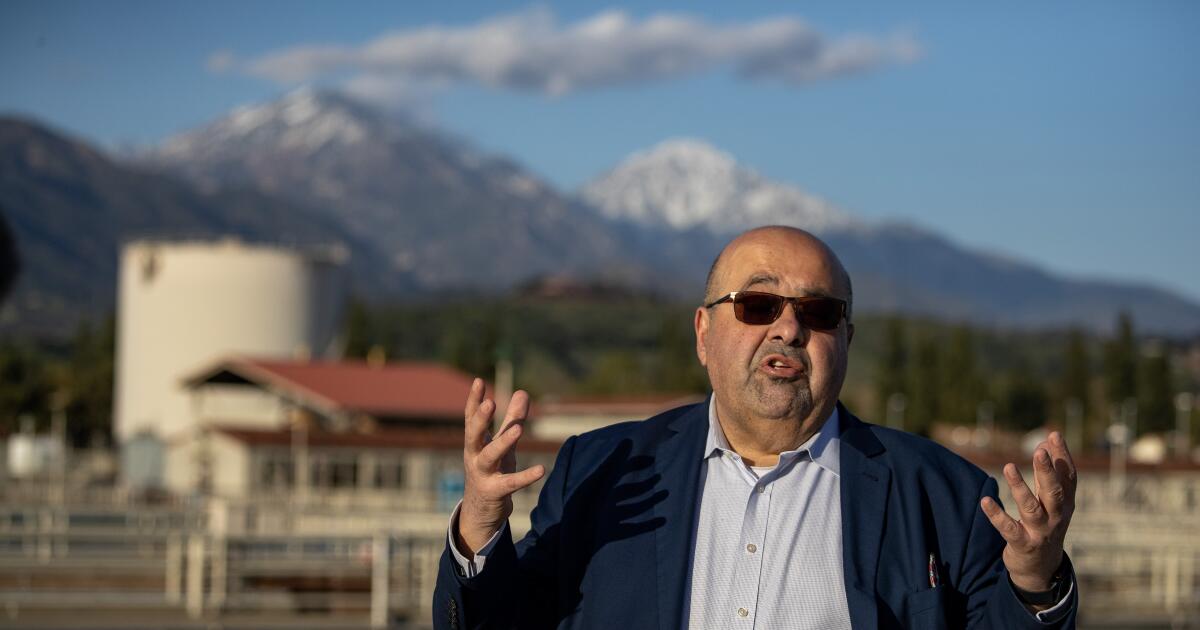
In the three years that Adel Hagekhalil has led California’s largest urban water supplier, the general manager has sought to focus on adaptation to climate change — in part by reducing reliance on water supplies from distant sources and investing in local water supplies.
His efforts to help shift priorities at the Metropolitan Water District of Southern California, which has traditionally focused largely on delivering imported water to the region, have won praise among environmental advocates who hope to reduce dependence on supplies from the Colorado River and Northern California.
However, now that Hagekhalil is under investigation for harassment allegations and has been placed on leave by the MWD board, some of his supporters say they’re concerned that his sidelining might interfere with the policies he has helped advance.
“I would hope this doesn’t mean that we undo the progress that’s been made since Adel came in,” said Conner Everts, executive director of the Southern California Watershed Alliance, who has supported Hagekhalil’s policies.
Aggressive and impactful reporting on climate change, the environment, health and science.
The accusations against Hagekhalil surfaced Thursday while he was traveling in Singapore for a water conference.
Chief Financial Officer Katano Kasaine made the allegations in a confidential letter to the board, which was leaked to the media. She said Hagekhalil has harassed, demeaned and sidelined her and created a hostile work environment.
Hagekhalil denied the accusations, saying he has always treated the staff with respect and professionalism, and that the claims amount to “disagreements on management decisions.”
The MWD board voted to place Hagekhalil on administrative leave for 90 days while Kasaine’s complaint and other allegations are investigated. In his place, the board temporarily appointed assistant general manager Deven Upadhyay, who has been at the agency for 29 years, as interim general manager.
Everts has for more than three decades been advocating for Southern California to reduce reliance on imported water supplies by boosting local supplies. He said he has been pleased to see Hagekhalil and MWD moving forward with plans for the country’s largest wastewater recycling facility in Carson, and working to develop a plan for adapting to climate change.
Everts said he hopes that whatever results emerge from the investigations, the agency doesn’t revert to an outmoded focus on imported water that he believes some “old guard” leaders of MWD still favor.
Everts, like many others who spoke at Thursday’s board meeting, said the accusations demand a fair and impartial investigation.
“Hopefully, Adel comes back and continues to lead in this direction. And if not, whoever would step in would do that,” Everts said. “Does the culture change of the agency continue to progress? That’s my question.”
MWD is the nation’s largest wholesale supplier of drinking water, serving cities and agencies that supply 19 million people across Southern California.
MWD Board Chair Adán Ortega Jr. said that while the board made “difficult decisions” regarding the allegations against Hagekhalil, “we maintain our commitment to the policies and direction of this organization.”
Ortega said he doesn’t expect any change in the district’s “current policy course.”
“Our task at hand is tackling climate change,” Ortega said in an interview with The Times. “Anybody that would challenge that is up against a pretty embedded policy framework for tackling climate change.”
Ortega was involved in selecting Hagekhalil, who previously worked for the city of Los Angeles and who was hired after a bitter struggle among board members in 2021. Ortega said his priorities as board chair have been the same priorities that Hagkhalil has been pursuing.
As for the accusations against Hagekhalil, Ortega said he was upset that someone leaked the confidential letter.
“I believe that whoever leaked it was trying to box in the board. But we’re not going to let them, and I don’t think it worked,” Ortega said.
He said all the initiatives that Hagekhalil was working on will continue under Upadhyay while the matters are investigated.
“The board drives the agenda,” he said. “I think the board has been united on things that Adel and I have both shared.”
Hagekhalil has led the agency at a time of major initiatives, including negotiations aimed at addressing water shortages on the Colorado River, plans for building the water recycling plant in Carson, and the MWD board’s consideration of Gov. Gavin Newsom’s plan to build a $20-billion water tunnel in the Sacramento-San Joaquin River Delta.
Some of Hagekhalil’s supporters questioned why the matter was brought to the board while he was traveling, and suggested the public airing of grievances appeared to be aimed at pushing aside a leading advocate for transforming the district’s focus.
But Ortega said any speculation that placing Hagekhalil on leave might derail the MWD’s current policy agenda is unfounded.
“The board is fully organized in support of that agenda,” Ortega said. “So I don’t feel any nervousness or doubt about our continued policy direction.”
“It’s a mistake to think that the fate of our policy agenda rests on one person,” he added. “Nothing is changing in terms of the board’s organization or the items that we’re considering in future months, or the composition of the committees. All of that is intact. And so nothing changes.”
Still, some environmental advocates have said they’re concerned about a potential link between the surfacing of allegations against Hagekhalil and efforts by some within the agency to push for the proposed Delta Conveyance Project, a 45-mile tunnel that would create a second route to draw water from the Sacramento River into the aqueducts of the State Water Project. They pointed out that Kasaine currently serves as treasurer of the Delta Conveyance Design and Construction Authority, the entity that was created to finance the tunnel project.
“I think it is a calculated ambush that is designed to get the tunnel approved, over the objections of other members of the Metropolitan board,” said Patricia Schifferle, director of Pacific Advocates, an environmental consulting firm.
During an MWD committee meeting on Monday, supporters and opponents of the proposed tunnel debated the costs and benefits of the project.
Karla Nemeth, director of the State Department of Water Resources, told board members that the project is essential to improving the reliability of water supplies in the face of climate change, sea-level rise and a major earthquake.
Other supporters made similar arguments, while opponents argued that building the tunnel would harm the delta’s deteriorating ecosystem and would be more expensive than other water-supply alternatives.
The costs would be paid for by urban and agricultural water districts that decide to participate. The state recently released a cost-benefit analysis that is intended to provide information for local water agencies to consider.
The MWD would receive a large share of the water, and the board’s eventual decision on whether to participate is expected to be pivotal in determining whether the state’s plan goes forward.
The MWD board in 2020 agreed to contribute $160.8 million toward planning and pre-construction costs. District officials say the board could consider whether to provide additional funding for planning and pre-construction costs at the end of this year, and it will likely be several years before there is a decision on long-term financial participation.
When the state’s cost-benefit analysis was released last month, Hagekhalil said: “The questions are, how can this project be implemented, what kind of assurances can we have in the resilience it provides to the Delta and our water supply future, and at what price?”
Leaders of several environmental groups said they were disappointed to see Hagekhalil placed on administrative leave before the accusations against him have been investigated.
“It is critically important and appropriate for MWD to take these allegations seriously and we applaud the agency’s decision to investigate the claims made, so that the board can have an accurate understanding of what has been happening among the organization’s senior leadership,” said Bruce Reznik, executive director of the group LA Waterkeeper. “That said, the public needs more information to ensure the complete independence of this review.”
He said any action against Hagekhalil should have come after an independent investigation.
Reznik called Hagekhalil a “visionary, inclusive and transparent leader” who is helping the agency reform its approach to adapt to the effects of climate change.
“He has been vocal about his vision and plans to transform the agency,” Reznik said. “That focus must continue at MWD.”


Walt Disney Co. is rallying public support for ABC as it faces an early Federal Communications Commission review of its TV station licenses and the guest booking policy of its daytime talk show “The View.”
ABC began running spots Monday asking viewers to comment on the FCC’s recent actions that Disney sees as an effort to stifle speech seen as critical of President Trump. The president has repeatedly threatened to pull broadcast licenses of TV outlets that feature journalists and hosts he dislikes.
In April, the FCC called for an early review of the licenses for Disney’s eight broadcast TV stations, a day after Trump demanded that ABC fire late-night host Jimmy Kimmel over a joke about First Lady Melania Trump. FCC Chair Brendan Carr has repeatedly threatened to use the levers of power he has to punish TV and radio stations that irritate Trump.
The licenses for the TV stations, including KABC in Los Angeles, were originally scheduled for renewal between 2028 and 2031. Calling for an early review is highly unusual, but the agency said it’s related to an inquiry into Disney’s diversity, equity and inclusion policies and whether they violated federal anti-discrimination rules.
The FCC has not declined to renew a TV license since the early 1980s. With court challenges, such a process can take years to enact.
Carr also has taken aim at ABC’s daytime talk show “The View.” He publicly questioned whether the program should have the status of news programs, which are exempt from having to give equal time to the opponents of political candidates who appear as guests.
“The View” was granted an exemption from the rarely enforced rule in 2002. ABC’s Houston station KTRK filed a petition with the FCC in May asking for a declaration that the program can maintain that status.
“The Commission’s actions threaten to upend decades of settled law and practice and chill critical protected speech, both with respect to The View and more broadly,” KTRK-TV said in the filing.
ABC has maintained that “The View” books politicians based on newsworthiness and not partisanship. The program featured Vice President JD Vance last week, where he received a cordial welcome.
ABC’s message asking consumers to support “The View” amid an FCC investigation.
(ABC)
ABC is airing spots warning viewers that the FCC wants to control what viewers see on “The View.” The message opens with the voice of legendary broadcaster Barbara Walters giving her introduction to the program she founded — “I had this idea for a show — different women, with different points of view.”
Walters is followed by an announcer who says, “‘The View’ has welcomed your favorite guests and covered the issues you care about for nearly 30 years. Now the FCC wants to control who is allowed to appear on the show.”
The spot says “the FCC is questioning our support to the community.” A QR code shows up on the screen that takes viewers directly to the FCC’s electronic comment filing system where they can submit their comments, which is regularly part of the agency’s review process.
Disney also is airing spots calling for support of its local TV stations, including L.A.’s KABC. The spots are customized for each ABC station market, emphasizing a commitment to local news coverage.
Disney did not comment on the campaign. But a network insider not authorized to speak publicly about it said “ABC believes it is important for the public to know what is happening, what’s at stake, and how to engage directly in the process if they want to make their voices heard.”
Disney’s aggressive defense of its stations and “The View” is a stark contrast to its decision to settle a lawsuit filed by Trump over inaccurate statements ABC News anchor George Stephanopoulos made about a sexual assault civil suit that the president lost in court.
ABC agreed to pay Trump $15 million in December 2024 to end the legal fight — sparking an outcry among free speech advocates, who believed the network would have won the case.
ABC also caved in September, when Kimmel’s program was briefly pulled from the air after two major TV station groups refused to air it following the host’s comments about the killing of right-wing activist Charlie Kirk.
Disney received major blowback from the Hollywood community, where Kimmel is extremely popular. Data also show that the company experienced cancellations of its Hulu and Disney+ streaming services in protest of the move.
Politics
Cops could be forced into race-based guessing game after Supreme Court move, Thomas joins dissent

NEWYou can now listen to Fox News articles!
Justices Samuel Alito and Clarence Thomas on Monday dissented from the Supreme Court’s refusal to take up a case that they said forces police officers to create a separate set of rules for racial minorities.
“It is dangerous to allow an individual to be treated differently based on statistics, studies, or expert testimony that purports to show that members of the racial or ethnic group to which he belongs are more likely to act in a certain way than are members of other groups,” Alito wrote on behalf of himself and Thomas. “Here, the special treatment helped the individual; in other situations it will not.”
The case, U.S. v. Donte J. Carter, involved a Black man whose firearm and theft convictions were vacated after the D.C. Court of Appeals held that police seized him before they had reasonable suspicion. Officers later recovered a .40-caliber pistol from Carter’s pants and the government said the gun had been stolen from an FBI agent’s vehicle.
According to the D.C. court, “black Americans like [Carter] are ‘especially distrustful of law enforcement’” and therefore “‘less likely’ than other people ‘to terminate a police encounter’ due to skepticism that any attempt to exercise their constitutional rights will be respected.”
SUPREME COURT REJECTS BOSTON PARENTS’ APPEAL CLAIMING RACIAL BIAS IN AN ADMISSIONS POLICY
Supreme Court Justices Clarence Thomas and Samuel Alito are pictured together. (Getty Images)
The D.C. court reasoned that Carter’s race was relevant to whether a reasonable person in his position would have felt free to end the police encounter. It ruled that the encounter effectively became a seizure, and that such an action was unlawful because police officers hadn’t established reasonable suspicion before subjecting him to it.
Alito and Thomas argued that the D.C. ruling effectively forces law enforcement to treat people differently based on their race, something precedent established by the Supreme Court prohibits.
“Under the test, officers will need to quickly assess a person’s race, and if officers and courts must craft special rules for black persons, what about dark-skinned Latinos, other Latinos, and members of other minority groups?” Alito continued. “We have said that our ’Constitution is color-blind.’ It ‘almost never’ allows government actors to treat persons differently based on their race.”
SUPREME COURT RULES ON KEY VOTING RIGHTS ACT RULE AS REPUBLICANS AND DEMOCRATS WAGE REDISTRICTING WAR
U.S. Supreme Court Justice Clarence Thomas appears before swearing in Pam Bondi as U.S. Attorney General in the Oval Office at the White House in Washington, D.C., on Feb. 5, 2025. (Andrew Harnik/Getty Images)
To support his claims, Alito cited Students for Fair Admissions v. Harvard and Louisiana v. Callais and Shaw v. Reno.
“And we have rejected the proposition that the Constitution permits an individual to be treated differently based on a ‘perception that members of the same racial group — regardless of their age, education, economic status, or the community in which they live — think alike,’” Alito wrote, citing Shaw v. Reno.
This appears to be a direct challenge to the D.C. Court of Appeals, which lawyers representing the United States argued forced police officers to assume that all black people have the same attitudes toward police officers and would therefore feel uncomfortable exercising constitutional rights in their presence.
TRUMP’S FIRING POWER FACES TWIN SUPREME COURT TESTS, BUT ONE AGENCY MAY GET SPECIAL TREATMENT
Supreme Court Justice Clarence Thomas and Justice Samuel Alito are seen inside the Supreme Court building in Washington, D.C., in December 2023. (Jacquelyn Martin-Pool/Getty Images)
CLICK HERE TO DOWNLOAD THE FOX NEWS APP
Carter, the individual Alito noted was helped by the case, initially lied to officers by answering in the negative when approached and asked if he was carrying a weapon.
The police then asked Carter to pull his pants up, at which point they noticed an L-shaped bulge which was later identified as a .40-caliber pistol that had been stolen from a federal agent’s vehicle.

WASHINGTON — The Supreme Court refused Monday to block an excessive force lawsuit against a former Los Angeles Police Department officer who shot and killed a knife-wielding man whose speeding truck had slammed into several cars near downtown Los Angeles.
The court turned down an appeal petition from the Los Angeles city attorney’s office, over the objections of Justices Clarence Thomas and Samuel A. Alito Jr.
Litigation over the six-second shooting incident has extended over six years.
Federal judges in California agreed that Officer Toni McBride had reason to fire four shots at the suspect in April 2020 but not the two final shots that killed him.
Daniel Hernandez was alleged to be under the influence of methamphetamine when he got out of his truck and walked toward the officer. She repeatedly ordered him, “Drop the knife,” as he approached.
But the 9th Circuit Court of Appeals, by a 6-5 vote, ruled last year that a jury could decide the officer went too far when she fired two final shots after the suspect had fallen to the ground.
The majority reasoned that in the one-second pause between shots four and five, McBride “could have and should first reassessed the situation” and possibly concluded the suspect no longer posed a danger.
That ruling would have sent the case to a trial.
But the Los Angeles city’s attorney’s office appealed to the Supreme Court in October and urged the justices to review and reverse the 9th Circuit’s decision.
The city’s attorneys said the appeals court failed to consider the “totality of circumstances from the perspective of a reasonable officer on the scene” and its decision refused “to allow for reasonable mistakes in fast-moving, life-threatening encounters.”
UC Berkeley law dean Erwin Chemerinsky filed a response for the Hernandez family. He urged the court to stand aside and let a jury decide whether the officer’s actions were reasonable.
“The 9th Circuit simply held that it should be for the jury to resolve the factual dispute over what happened,” he said.
The justices had considered the appeal since late February before finally turning it down without comment on Monday.
The Supreme Court has repeatedly ruled police officers may be sued for unreasonable searches and seizures only if they are shown to have knowingly violated clearly established law.
However, this doctrine of “qualified immunity” has divided judges over whether a particular rule or limit has been clearly established.
The 9th Circuit majority said shooting a fallen suspect crosses the line.
“It has been clearly established for more than a decade that when an officer shoots and wounds a suspect, and he falls to the ground, the officer cannot continue to shoot him, absent some indication that he presents a continuing threat,” wrote Judge Jacqueline H. Nguyen.
“A fallen and injured suspect armed only with a bladed instrument does not present a continuing threat merely because he makes nonthreatening movements on the ground. … Under such circumstances, a jury could reasonably find that she employed constitutionally excessive force. If so, she is not entitled to qualified immunity,” she said.
The five dissenters said the officer made a reasonable split-second decision.
Judge Ryan Nelson said McBride “was justified in shooting Daniel Hernandez to alleviate the risk that he posed when he advanced toward her while armed and ignoring commands to stop. … She cannot be reasonably expected or required to reassess her shooting in a tight six second period during an intense and dangerous situation throughout which Hernandez was rising and never stopped moving.”
Judge Patrick Bumatay echoed this concern.
“Judges review police shootings only in hindsight. We review police tapes years after the fact. We get to rewind, pause, fast forward — analyzing the situation frame-by-frame. While the advent of police bodycam videos has been a welcome change, we can’t ignore that real life isn’t in slow motion,” he said.
-

 Lifestyle2 minutes ago
Frame: From Scandal to $300 Million in Sales
-
Politics9 minutes ago
Facing FCC pressure, ABC launches campaign to support ‘The View’ and its TV stations
-
 Sports17 minutes ago
Dodgers defeat Twins, but lose Kyle Tucker and catcher Dalton Rushing
-

 World27 minutes ago
Belgium issues visas to Taliban delegation for EU migration talks
-

 News57 minutes ago
Trump says proof of his allegations that vandals cut Reflecting Pool paint will be provided in court
-

 New York2 hours ago
Video: Historic Brooklyn Church Destroyed in Fire
-

 Los Angeles, Ca2 hours ago
2 killed in high-speed crash on Mulholland Highway
-

 Detroit, MI3 hours ago
Man armed with gun shot by police in downtown Detroit ahead of fireworks show, police say

